Thursday, March 30, 2006

Aquinum 2

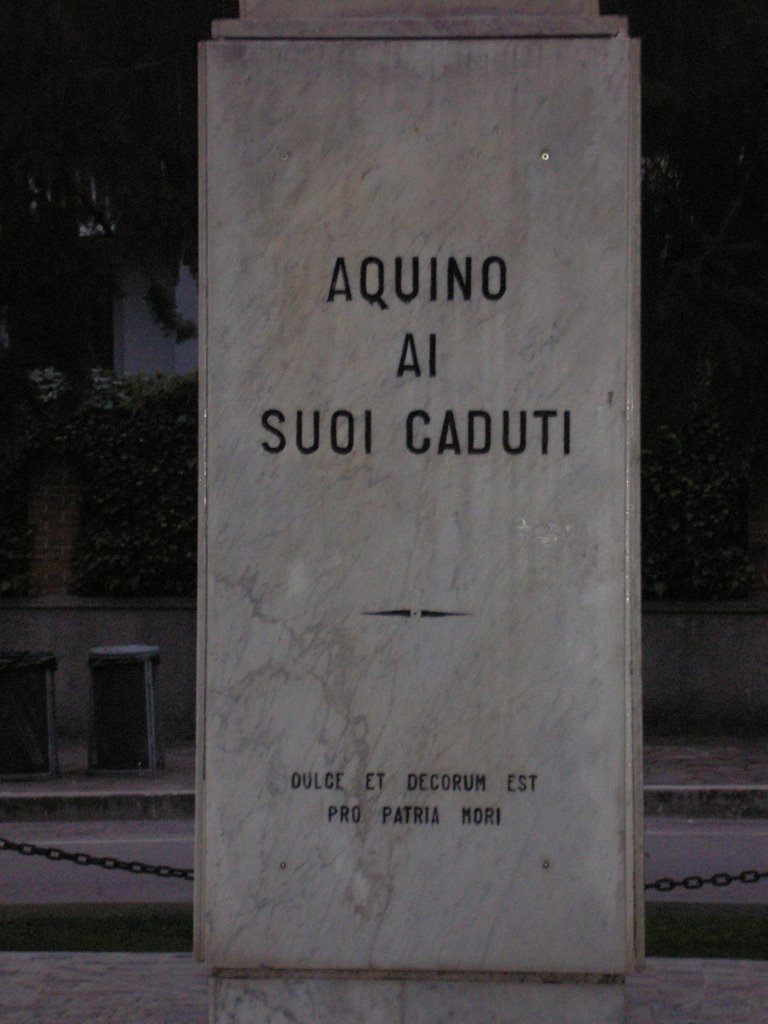
In the recent post on Aquinum, I forgot to mention that I also saw a nice classical reference in modern-day Aquino in the large piazza in front of the main church in town. On a monument to soldiers fallen in battle one finds the following:

Dulce et decorum est pro patria mori is from Horace Odes 3.2. Here is the text of the whole ode:

Angustam amice pauperiem pati
robustus acri militia puer
condiscat et Parthos ferocis
uexet eques metuendus hasta

uitamque sub diuo et trepidis agat 5
in rebus. Illum ex moenibus hosticis
matrona bellantis tyranni
prospiciens et adulta uirgo

suspiret, eheu, ne rudis agminum
sponsus lacessat regius asperum 10
tactu leonem, quem cruenta
per medias rapit ira caedes.

Dulce et decorum est pro patria mori:
mors et fugacem persequitur uirum
nec parcit inbellis iuuentae
poplitibus timidoue tergo. 15

Virtus, repulsae nescia sordidae,
intaminatis fulget honoribus
nec sumit aut ponit securis
arbitrio popularis aurae. 20

Virtus, recludens inmeritis mori
caelum, negata temptat iter uia
coetusque uolgaris et udam
spernit humum fugiente pinna.

Est et fideli tuta silentio 25
merces: uetabo, qui Cereris sacrum
uolgarit arcanae, sub isdem
sit trabibus fragilemque mecum

soluat phaselon; saepe Diespiter
neglectus incesto addidit integrum, 30
raro antecedentem scelestum
deseruit pede Poena claudo.

Wednesday, March 29, 2006

More on Fifth-Foot Spondees (Updated)

I was surprised to find not just one, but two fifth-foot spondees in Ausonius' Versus Paschales, found under heading IV in Green's edition--a poem of only 31 lines. Moreover, the two lines come in quick succession, only separated by one line. Here are lines 21-5:

trina fides auctore uno, spes certa salutis
hunc numerum iunctis virtutibus amplectenti.
tale et terrenis specimen spectatur in oris
Augustus genitor, geminum sator Augustorum...

Update: Upon looking through Green's commentary, I realized I missed a third spondeiazon, which comes only three lines after the last one mentioned:
...omnia solus habens atque omnia dilargitus. (28)

This really is remarkable--three spondeizontes within six lines?

For readers interested in the interpretation of this poem (and it is, to my mind, a very interesting poem), Green points us to the treatment of J.-L. Charlet entitled 'Theologie, politique et rhetorique: la celebration poetique de Paques a la cour de Valentinien et d'Honorius, d'apres Ausone (Versus Paschales) et Claudien (de Salvatore)', found on pp. 259-87 in La Poesia tardo-antica: tra retorica, teologia e politica (Messina 1984).

Tuesday, March 28, 2006

Where's the ACL?

The American Classical League's web server can not currently be found. Does anyone know why?

How are folks like me supposed to find a job?

In other news, I'm reading the Apology with my ninth grade student, a budding linguist who is further along in Greek than the students at the college who started at the same time.

After April 1st I'll be reading book 2 of Plato's Republic with J, AKA 'the Hawk' (no foolin'). We read book 1 with Eric while taking Greek Rose Comp with Gil Prose.

As my thesis winds down I'll find plenty more classical stuff to blog about. Right now hazy chronology and the technical nature of metrical analysis have been stealing my time, and don't seem very blogworthy.

I will say, though, that Byzantine scholarship has really grabbed my attention. I'd like to continue with that once this work is done, though I'd first like to make up for all the ancient classics I've never had much of a chance to read. Can you imagine tragedy and comedy never even being offered during my graduate career?

Friday, March 24, 2006

I have chosen to tell the truth about virtue

I was walking through Pembroke Arch on Bryn Mawr's campus the other day and by the time I'd crossed Merion Ave. something odd occurred to me.

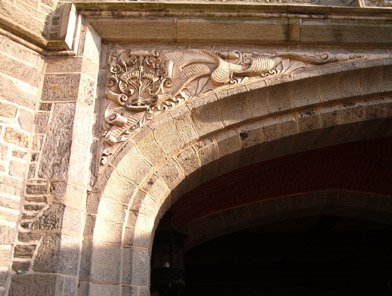
Just above the arch on the left side as you're exiting there's an inscription that reads VIRTVTEM DILEXI, "I have loved virtue."

I thought I must have misread it because the college's motto is VERITATEM DILEXI (supposed to mean 'I have chosen truth'). This page at Bryn Mawr actually claims that the motto is inscribed on Pem Arch.

Later in the day I passed through and took another look. Sure enough it says VIRTVTEM.

As far back as 1908 M. Carey Thomas, the famed president of Bryn Mawr College, had instructed that the motto be placed upon the library's book plates. She quoted the motto in its conventional form, "VERITATEM DILEXI."

It has made its way onto the official seal (seen here), but is it correct? Is it possible that inscription was misread a century ago and that the misreading stuck?

As proof I've taken photos of the inscription:


You'll probably want to have a closer look:


I suspect the phrase to be adapted from a sentiment in Cicero (whose periodic style does not lend itself to epigrams and that we should expect to be condensed):

Nihil est enim virtute amabilius, nihil quod magis adliciat ad diligendum, quippe cum propter virtutem et probitatem etiam eos, quos numquam vidimus, quodam modo diligamus.

(De amicitia 28)

That's just a guess of course.

I've found several references to 'VERITATEM DILEXI' as the epitaph chosen by the 19th century scholar Ernest Renan (1823-1892) (cf. Discours & Conférences, 39). It was the title of a poem written in his honor the year after his death by Mary Darmesteter. Darmesteter (alias Madame James Darmesteter, alias A. Mary F. Robinson, alias Mary Duclaux, alias Madame Duclaus) wrote a biography of Renan in 1895. Perhaps interest in Renan and his ideas (chiefly his philosophical ideas on what constitutes a nation) kept his chosen epitaph at the fore of people's minds and caused them to confuse it with the similar-sounding though quite different VIRTVTEM DILEXI.

Is it time to resort to the epigraphic evidence and to emend the text of the motto? This seems to me like a clear case of corruption, though I'm not sure many will be happy to let 'virtue' replace the accepted 'truth.'

Thursday, March 23, 2006

Causal Clauses

What say we do a quick review of Latin causal clauses? The following notes are taken from Allen & Greenough sec. 321, examples (mostly) omitted.

NOTE.--Causal clauses take either the Indicative or the Subjunctive, according to their construction; the idea of Cause being contained, not in the mood itself, but in the form of the argument, or in the connecting particles.

321. The Causal Particles quod, quia, and quoniam take the Indicative, when the reason is given on the authority of the writer or speaker; the Subjunctive, when the reason is given on the authority of another.

NOTE 2.--[W]hat the speaker himself thought under other circumstances may have the Subjunctive....So with quod even a verb of saying may be in the Subjunctive: as,--

rediit quod se oblitum nescio quid diceret (Off. i. 13), he returned because he said he had forgotten something.

NOTE 3.--The Subjunctive with quia is rare. The causal particle quando takes the Indicative.

REMARK.--Non quod, non quia, non quoniam, introducing a reason expressly to deny it, take the Subjunctive. Non quo and non quin introduce a Result clause, but with nearly the same meaning.

a. Causal Clauses introduced by quod, etc., take the Subjunctive in Indirect Discourse, like any other dependent clause.

b. A Relative, when used to express cause, regularly takes the Subjunctive.

c. Cum causal takes the Subjunctive.

NOTE.--In early Latin cum causal takes the Indicative.

Wednesday, March 22, 2006

Concessive Clauses

Ok, time for a quick review of Latin concessive clauses. The following is taken from section 313 of Allen and Greenough with the examples omitted.

The particles of Concession (meaning although, granting that) are the following: quamquam, quamlibet, quamvis, quantum vis, ut, net, cum, licet, etsi, tametsi, etiamsi.

Some of these take the Subjunctive, others the Indicative. Thus,--

a. Quamvis, ut, and ne take the Subjunctive.
NOTE.--Quamvis means literally, as much as you will....The subjunctive with quamvis and ne is hortatory; that with ut is of uncertain origin.

b. Licet (properly a verb) takes a Substantive clause in the Subjunctive.
NOTW.--The subjunctive with licet is by the sequence of tenses necessarily limited to the Present and Perfect tenses.

c. Etsi, etiamsi, tametsi, even if, take the same constructions as si.

d. Cum concessive takes the Subjunctive.
NOTE.--In early Latin cum (quom) concessive usually takes the Indicative.

e. Quamquam introduces an admitted fact and takes the Indicative.

f. Quamquam more commonly means and yet, introducing a new proposition in the indicative.

g. The poets and later writers frequently use quamvis and quamquam like etsi, connecting them with the Indicative or the Subjunctive, according to the nature of the condition.
NOTE.--Even Cicero occasionally uses quamquam with the Subjunctive.

h. The Relative pronoun qui is often used with the Subjunctive to express concession.

i. Concession is often expressed by the Hortatory Subjunctive without a particle.

Christian Tomb Discovered Underneath Mussonlini's Secret Bunkers

Mussolini lived at Villa Torlonia in 1925-1943 with his wife and children, delighting in tennis games and horseback rides on the grounds that surround the house, built by one of Rome's aristocratic families.

"When the winds of war started blowing, he ordered the construction of the bunker," said Eugenio La Rocca, superintendent for Rome's monuments.

Two underground structures, built in great secrecy, cover more than 2,000 square feet and include an anti-gas chamber with air ducts and showers for decontamination, all protected by a double set of airtight doors.

Mussolini dug the bunker 23 feet deep, burying a 10-foot thick concrete box with bare cylindrical corridors and multiple escape routes.

While restoring the chamber, archeologists discovered it was built over a second-century Christian tomb, where they found three bodies. The area was a common burial ground in Roman times, housing mainly the sprawling underground corridors of one of six Jewish catacombs in the city.

Tuesday, March 21, 2006

The relative value of ancient coinage

Here's one of the things I did last night instead of working on my thesis: I took the values in 1891 British Pounds assigned by James Gow (Companion to School Classics, 3rd ed.) to Athenian and Roman coinage and converted the value to 2005 U.S. dollars.

Rome, 49 BC (when Caesar introduced the Aureus):

Aureus (gold) (= 100 sesterces) = $127.53
Denarius (silver) (= 4 sesterces) = $5.10
Sestertius (brass) (= 2 dupondii)= $1.28
As (copper) (= ¼ sesterce) = $0.32


Attic money (age undefined):

1 talent = $30,067.15
1 mina = $500.63
1 drachma = $4.79
1 obol = $0.79

The copper chalchous, 1/8 an obol, would be worth about a dime.

I have no idea how accurate this is, but it does account for inflation from the 1891 values. Gow apparently based his calculations upon the quantity of silver used in certain coins and then the relative value of these coins to others.

If it's accurate, it puts things into perspective, for example when Gow says that an artisan in the age of Pericles earned 1 drachma a day (= $4.79 US), and that a juryman made 2 obols (= $1.58).

Of course it's impossible to say what the values were in different times and places, but a ballpark is better than a desert.

Monday, March 20, 2006

Aquinum

My wife and I recently had some friends in town, one of whose maiden name is Aquino. Her predecessors, after coming to the U.S., are thought to have taken this surname from the name of their hometown in Italy (reminiscent of the naming of the Corleone family in Godfather). So while they were here, we decided to take a daytrip to find the old family stomping grounds, which are located south of Rome about halfway to Naples, sitting on a level plain near the mountains, within view of Monte Cassino. No train stops in somewhat small village of Aquino; rather, Aquino shares a station with a couple of other small towns nearby. We were told at the station that there are no buses and no taxis that go from the station to Aquino, so we walked a few kilometers to get to the actual town. There were a couple of interesting things I thought might be worth noting. First, Aquino is the birthplace of Thomas Aquinas. Here is the house he is said to have been born in:

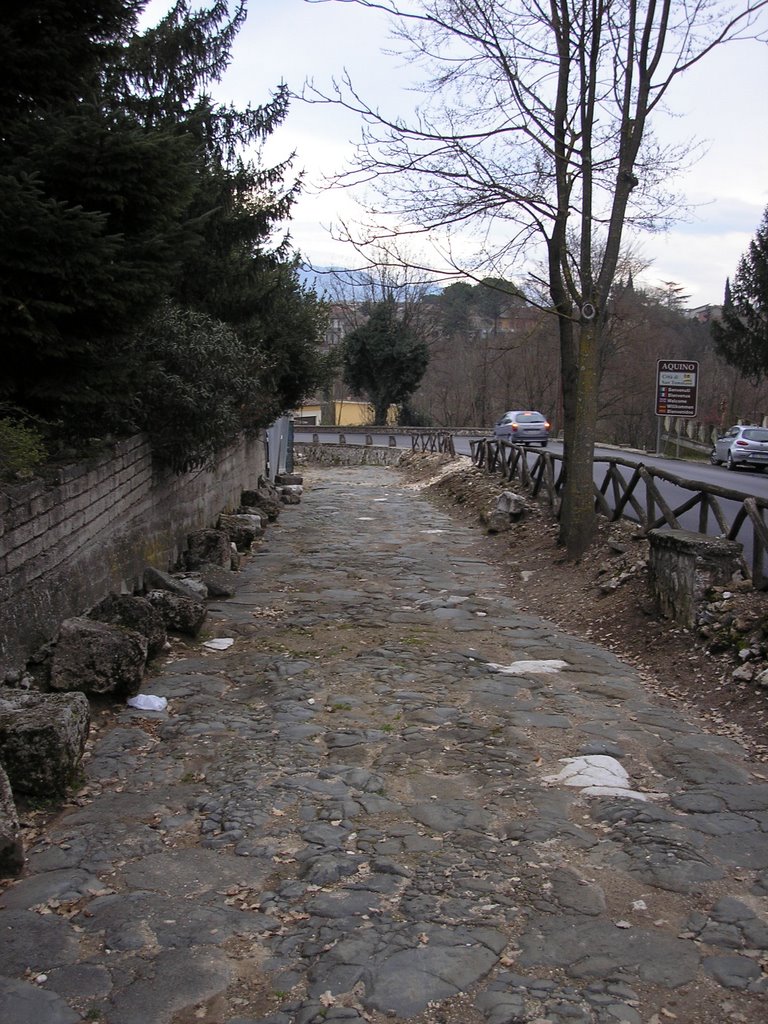
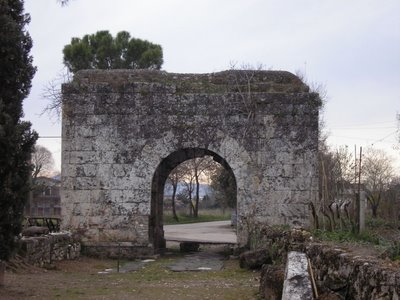
Second, medieval and modern-day Aquino are built hard by the ancient Roman colony of Aquinum, thought by some to be the birthplace of Juvenal. The town in located on the Via Latina:
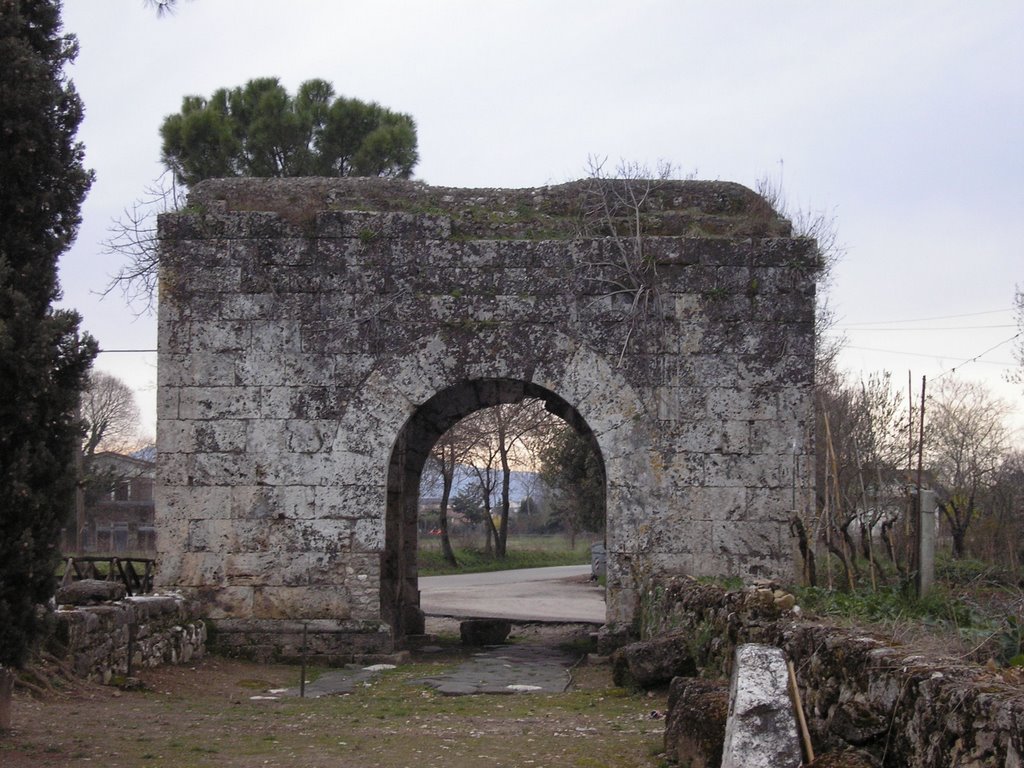
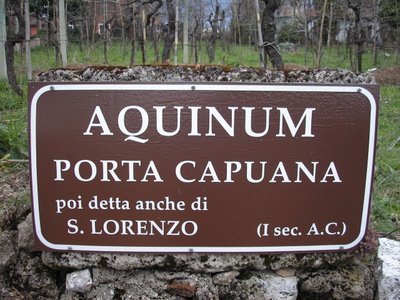
Here is the town gate and a modern sign placed there to label it:
The identification of Aquinum with Juvenal's birthplace is not, however, undisputed. The 1949 edition of the Oxford Classical Dictionary affirms that Juvenal was born there, citing Satire 3.319 as evidence. Here is the passage in context (the text is from The Latin Library):

'...his alias poteram et pluris subnectere causas, 315
sed iumenta uocant et sol inclinat. eundum est;
nam mihi commota iamdudum mulio uirga
adnuit. ergo uale nostri memor, et quotiens te
Roma tuo refici properantem reddet Aquino,
me quoque ad Heluinam Cererem uestramque Dianam 320
conuerte a Cumis. saturarum ego, ni pudet illas,
auditor gelidos ueniam caligatus in agros.'

It may be problematic, though, to take the line in the poem strictly biographically. Susanna Morton Braund, in Satires: Book I (Cambridge 1996), has the following comment on line 319:
'adj. tuo may mean 'your favourite' (cf. OLD 2b, cr. Suet. Galb. I Liviae...Veientanum suum revisenti) or 'your native' (perhaps supported by reddet: OLD 2). It is usually taken to indicate J.'s birthplace; however, this involves identifying Umbricius' interlocutor with the poet Juvenal: see Introduction sec. 2. Aquinum was a town in Latium on the via Latina c. 75 miles from Rome. This lover of Rome, who does not leave with Umbricius, may have a country seat in Aquinum.'

Turning to section 2 of the introduction, this is what we find:
'The second fundamental idea is one which rescues us from trying to read the satires as self-revelation. Roman verse satire uses the autobiographical monologue as the chief mode of presentation. This does not mean that the satirists are (necessarily) using their satires to convey their personal feelings to the world. Far from it. Authors in all genres of Roman literature, including Roman verse satire, were accustomed to creating characters....[I]n the personal genres of poetry--love elegy, lyric poetry, epigram and satire--the character (or persona, 'mask') is frequently presented as a first-person voice.

'Authors and their audiences were accustomed to this convention thanks to their experience of the education in rhetoric enjoyed by members of the Roman elite....The analogy between rhetoric and poetry is reinforced by the fact that most Greek and Latin literature, including poetry, was written for oral delivery by the author or another voice to a live audience. In the light of this, the identification of the views of the characters in satire with those of the authors becomes unnecessary and crude. To read the poems as autobiographical self-revelations from which 'facts' about the poet's life may be deduced (the 'biographical fallacy' propounded by, notably, Highet (1954)) is to neglect other, more rewarding, questions.' (pp. 2-3)

In addition to the line in the poem, an inscription from Aquinum is often used to justify the belief that Juvenal hailed from there. In the introduction to C.H. Pearson's and Herbert A. Strong's introduction to Thirteen Satires of Juvenal (2nd ed., Oxford 1892) we read the following:
'Decimus Junius Juvenalis is said in a life of uncertain authenticity to have born at Aquinum. This statement is to some extent corroborated by a line in the third Satire, where the speaker suggests that his friend, who is presumably Juvenal, may some day or other be visiting his own Aquinum. It is made more probable still by the fact that a tablet has been dug up at Aquinum, in which D. Junius Juvenalis, of the cohort of the Dalmatians, duumvir quinquennalis, and flamen to the deified Vespasian, dedicates a shrine to Ceres. Helvina Ceres is alluded to in the third Satire as a deity reverenced at Aquinum. Further, there is no reason for referring to Juvenal to any other place but Aquinum, though a single scholiast says that some persons took him to have been a Gaul on account of his great size.' (p. 9)

More attestation comes from biographies, but these are often taken to be unreliable. Pearson writes:
'The biographies prefixed to his Satires in the MSS. are as numerous as they are satisfactory. Of these there are nine, seven of which are printed by Otto Jahn in his edition of 1851....Juvenal is said by all his biographers to have been the son or the adopted son of a wealthy freedman. His mother was named Septimuleia and was a townswoman of Aquinum. He had a sister, also Septimuleia, who married Fuscinus. He seems to have been brought up at a good school. His chief instructor, when he began to study rhetoric, was Protus of Berytus, a teacher who was noted for his provincial and antiquarian tastes, and whose practice it was to restrict the number of his pupils to three or four, and to converse with these in the Socratic fashion, rarely lecturing to them....The inscription at Aquinum shows that he served the most important magistracy in his native town, and held the honourable position of titular chaplain, so to speak, to Vespasian.' (pp. 9-11)

Braund, however, calls both the biographies and the inscription into question:
'Virtually nothing is known of the life and circumstances of Juvenal. It is not even certain that the name we give him, Decimus Iunius Iuuenalis, is correct. The ancient biographies seem worthless and even the best of these, attributed by Valla in his 1486 edition to 'Probus', offers the same kind of reconstruction from details in the Satires as presented by some recent scholars, a method which fails to take account of the generic convention of using first-person presentation....Nor is the inscription from Aquinum which was believe to depict Juvenal as commander of a Dalmation cohort reliable evidence, leaving aside the fact that it disappeared long ago; moreover, the date it suggested is earlier than other indicators. As Syme says, there is a 'scarcity of facts' in this field, although that has not prevented its being 'infested with credulity and romance'. His own assesment of the little evidence afforded by Juvenal's name and the poems leads him to suggest, tentatively, an African origin.' (pp. 15-16)

Sunday, March 19, 2006

Some Classical References in Deus Caritas Est

In reading through Pope Benedict XVI's recent encyclical Deus Caritas Est, I came across the following references to classical writers. All citations are from the English translation published by Libreria Editrice Vaticana (February 2006).

'The Greeks--not unlike other cultures--considered eros principally as a kind of intoxication, the overpowering or reason by "divine madness" which tears man away from his finite existence and enables him, in the very process of being overwhelmed by divine power, to experience supreme happiness. All other powers in heaven and on earth thus appear secondary: "Omnia vincit amor" says Virgil in the Bucolics--love conquers all--and he adds: et nos cedamus amori"--let us, too, yield to love.' (p. 12) [I found it interesting that he turned to a Latin example while discussing Greek ideas of eros.]

'Consequently, [God's] creation is dear to him, for it was willed by him and "made" by him. The second important element now emerges: this God loves man. The divine power that Aristotle at the height of Greek philosophy sought to grasp through reflection, is indeed for every being an object of desire and love--and as the object of love this divinity moves the world [the footnote reference is to Metaphysics XII.7]--but in itself it lacks nothing and does not love: it is solely the object of love. The one God in which Israel believes, on the other hand, loves with a personal love. His love, moreover, is an elective love: among all the nations he chooses Israel and loves her--but he does so precisely with a view to healing the whole human race. God loves, and his love may certainly be called eros, yet it is also totally agape.' (pp. 23-4)

'So [speaking of the creation of Adam and Eve] God forms woman from the rib of man. Now Adam finds the helper that he needed: "This at last is bone of my bones and flesh of my flesh" (Gen. 2:23). Here one might detect hints of ideas that are also found, for example, in the myth mentioned by Plato, according to which man was originally spherical, because he was complete in himself and self-sufficient. But as a punishment for pride, he was split into two by Zeus, so that now he longs for his other half, striving with all his being to possess it and thus regain his integrity [the footnote reference is to Symposium XIV-XV.189c-192d]. While the biblical narrative does not speak of punishment, the idea is certainly present that man is somehow incomplete, driven by nature to seek in another the part that can make him whole, the idea that only in communion with the opposite sex can he become "complete". The biblical account thus concludes with a prophecy about Adam: "Therefore a man leaves his father and his mother and cleaves to his wife and they become one flesh" (Gen. 2:24).' (p. 28)

'Acknowledgment of the living God is one path towards love, and the "yes" of our will to his will unites our intellect, will and sentiments in the all-embracing act of love. But this process is always open-ended; love is never "finished" and complete; throughout life, it changes and matures, and thus remains faithful to itself. Idem velle atque idem nolle [the footnote reference is to Sallust, De coniuratione Catilinae XX.4]--to want the same thing, and to reject the same thing--was recognized by antiquity as the authentic content of love: the one becomes similar to the other, and this leads to a community of will and thought.' (pp. 38-9)

Friday, March 17, 2006

Elisions in [Lactanti] Carmen De Passione Domini (Updated)

Although the De Passione Domini is a fairly short hexameter poem (80 lines), it contains a rather high frequency of elisions. Out of the poem's 80 lines, 42 of them (by my count) contain at least one elision. There are 6 lines with 2 elisions (6, 11, 36, 37, 40, 48), and 3 lines with 3 elisions (21, 35, 57), for a grand total of 53 in the poem. Here are the 3 lines with 3 elisions:

21: Pauperiem extremam et rerum inferiora secutus
35: Fige animo et testes et caeci infanda Pilati
57: Disce adversa pati et propriae invigilare saluti

For a slightly different configuration, see Manitius, Geschichte der Christlich-Lateinischen Poesie p. 49 n. 4. A couple of these differences are due to our using different texts to calculate. For example, one of his 3 lines with 3 elisions is 56, which is line 57 in the CSEL version of the text. Again, he lists line 3 as having two elisions, whereas I have it as having one. The CSEL text reads
Respice me, me conde animo, me pectore serva.

The app. crit., on the other hand, shows a variant of in pectore instead of pectore, which would generate another elision.

One difference, though, that I can't figure out based on the app. crit. is line 48. I have this as a two-elision line, whereas Manitius does not list it among his two-elision lines:
Atque ingens lateris vulnus, cerne inde fluorem.
The only variant listed by the CSEL's app. crit. is lateri for lateris, but this doesn't effect the elisions.

Wednesday, March 08, 2006

The Cento Revisited

It is well-known to students of Late Antique poetry that Vergil's lines were could be dismembered, reassembled, and turned into something completely different by Christian and non-Christian Latin poets. I was unaware that the same happened to Prudentius in a subsequent age. That, however, is what Pauly-Wissowa's Realencyclopaedie tells me in the section on the Hamartigenia in the Prudentius article. Apparently the close of the poem (by which I assume is meant Prudentius' closing prayer, ll. 931-66) was made into a cento by a Spanish bishop named Ascaricus. Here is the sentence from the article along with the references given:

Aus dem Schluss des Gedichtes machte der spanische Bischof Ascaricus einen Cento (Fr. Buecheler Carmina lat. epigr. nr. 927. C. Weyman Rh. Mus. L 1895, 154).

Tuesday, March 07, 2006

Hexameter Verse/Prudentius (Updated)

Prudentius, in his Hamartigenia, is not afraid to use a fifth-foot spondee from time to time. Here are the examples I've come across so far, all with a quadrisyllabic word spanning the fifth and sixth feet:

76: una eademque tamen rota sideris indiscretis
266: ac velut artificis domini manus inperfectum
422: Postremum cuneum rex promovet Euuaeorum
713: imperio. Hoc mulier rea criminis exprobanti
859: ditibus et longo fumantibus intervallo

Monday, March 06, 2006

New books

The folks at Edgar Kent, a Canadian publishing house (apparently partnered with the University of Toronto Press), have asked me to forward the following to scholars who might be interested. The first, on Greek warfare, was written by a Marine who became a classicist, which intrigues me as a classicist whose father was a Marine. The second is by Frank Frost on Athenian historiography, which was lauded in the BMCR.

I guess there's no harm in giving them a little free publicity:

please find below details of our latest titles in Classics. We would appreciate if you would take the time to review these titles and forward this email to any scholars who may be interested in our books.


THE ATHLETES OF WAR

AN EVALUATION OF THE AGONISTIC ELEMENTS IN GREEK

WARFARE

by John C. Dayton


In this dramatically revisionist account of Greek warfare, John Dayton challenges the modern views that Greek warfare was more an aspect of the Greek spirit of competition than a desire to inflict drastic harm on an enemy. He examines all the ancient evidence bearing on the actual conduct of war and combat among the Greeks themselves and in struggles of Greeks with barbarians from the archaic period to the fourth century, and draws on Polybius for the evidence Roman warfare bears on the conduct of battles. A thorough analysis of casualty statistics shows that Greeks suffered heavily from warfare, and that there was no “tournament-like” limitation on the harm that one party might inflict on another. He places the scholarly analyses of Greek warfare in the context of the ideologies prevalent at the time modern historians study the question, and he uses the evidence of casualty figures suffered in modern conflicts to show that the damage Greek armies inflicted on one another is comparable to the losses suffered in modern “total war.”


The conception that Greek warfare was more an aspect of the Greek spirit of competition than a desire to inflict drastic harm on an enemy is a modern myth. The notion still exerts great cultural influence, and persists precisely because it is a myth, a durable belief in principled and ceremonial wars between Greeks that shares some elements with the belief in the peaceable savage who fights only for his own honor or in his own defense. Examining all the ancient sources that provide information on the nature and ideology of combat in the Greek world, John Dayton shows that this modern conception is thoroughly disprovable by any objective criteria. His presentation of the data also provides a basic source of information about Greek warfare and history for all studies in the future. This is a study essential to any understanding of Greek history, of which war was a constant feature.


Contents


Introduction • 1: The History of Agonism • 2: The Archaic Evidence •

3: The Fifth Century • 4: The Casualties • 5: The Fourth Century •

6: Polybius and the Roman Connection • Conclusion • Bibliography • Index


John Dayton combines military experience with classical training to provide an understanding of Greek attitudes towards war. Born in Michigan in 1966, he served with the U.S. Marine Corps from 1987 to 1991. He studied classics at Princeton and the University of Kansas, and received his doctorate from Brown University in 2003. He was the Heinrich Schliemann Fellow at the American School of Classical Studies in Athens in 2000-01, and subsequently has taught at the College of the Holy Cross in Worchester, Massachusetts and the University of Indiana. He is currently a member of the classics faculty of the University of Calgary.


Hardcover Edition

ISBN 0-88866-651-9 • $82.50 • 200 Pages


Order From:

University of Toronto Press

Phone: (416) 667-7791 or toll-free 1-800-565-9523 in North America.
Fax: (416) 667-7832 or toll-free 1-800-221-9985 in North America.
E-mail: publishing@utpress.utoronto.ca

Mail U.S.
2250 Military Road
Tonawanda, New York 14150

Mail Canada
5201 Dufferin Street
Toronto, On M3H 5T6

United Kingdom and Continental Europe
NBN International,
Phone 44 (0) 1752 202301,
Fax 44 (0) 1752 202333
E-mail: orders@nbninternational.com


--------------------------------------------------------------------------------


POLITICS AND THE ATHENIANS

ESSAYS ON ATHENIAN HISTORY AND HISTORIOGRAPHY


by Frank J. Frost


From the Foreword by Erich Gruen, Gladys Rehard Wood Professor of History and Classics, University of California, Berkeley


“Frank Frost has been among the leading historians of archaic and classical Greece for the past four decades and more.… The articles assembled here…put on exhibit the coherence and continuity of his writing over the years on the political history of Athens in its most dramatic and productive time, the sixth and fifth centuries B.C., on the tangled historiography treating that era, and on the severe limitations as well as the exciting challenge of reconstructing it.…. One thinks particularly of ‘Pericles,’… a compelling deconstruction of Plutarch’s simplistic dichotomy of aristocrats vs. democrats which had misled more than a generation of scholars. [and] his “Themistocles’ Place in Athenian Politics.” These seminal articles exhibit Frank’s great strength in the dissection of historiographical traditions and the extraction of reliable evidence to rebuild the picture.… He argues for the circumstances in which stories were concocted, traces the tortuous paths that they followed, and exposes plausible reasons for their alteration and manipulation that shed as much light on the motives of the tellers as on the meaning of the tales.


“One finds this form of scrupulous scrutiny again and again in his essays… alive to the vast lacunae in our testimony but also to the potential of discovery and the value of weaving together the diverse strands that survive.… He both sobers and stimulates his readers.


Contents


Foreword • Author’s Preface • Attic Literacy and the Solonian Seisachtheia • Aspects of Early Athenian Citizenship • The Rural Demes of Attica • Solon Pornoboskos and Aphrodite Pandemos • Solon and Salamis, Peisistratos and Nisaia • Plutarch and Theseus • Toward a History of Peisistratid Athens • The “Ominous” Birth of Peisistratos • Peisistratos, the Cults, and the Unification of Attica • Faith, Authority, and History in Early Athens • Politics in Early Athens • Tribal Politics and the Civic State • The Athenian Military before Cleisthenes • The Dubious Origins of the “Marathon” • Themistocles’ Place in Athenian Politics • Themistocles and Mnesiphilus • Troizen and the Persian War • A Note on Xerxes at Salamis • Thucydides I. 137.2 • Some Documents in Plutarch’s Lives • Aristodemos • Phylarchus, Fragment 76 • Pericles and Dracontides • Pericles, Thucydides, Son of Melesias, and Athenian Politics before the War • A Frank Frost Bibliography


“Frank Frost has been one of the most penetrating researchers into the social and political structure of archaic Athens.…His work has always been marked by a careful evaluation of the sources and an awareness of the contemporary context… This is a valuable book. It not only brings together a group of papers important for the study of Athenian history, but it also allows us to appreciate the achievement of an important American historian of ancient Greece. Let us hope for more in the future..” J.A.S. Evans in Bryn Mawr Classical Review


Hardcover Edition

ISBN 0-88866-650-0 • $82.50 • 299 Pages


Order From:

University of Toronto Press

Phone: (416) 667-7791 or toll-free 1-800-565-9523 in North America.
Fax: (416) 667-7832 or toll-free 1-800-221-9985 in North America.
E-mail: publishing@utpress.utoronto.ca

Mail U.S.
2250 Military Road
Tonawanda, New York 14150

Mail Canada
5201 Dufferin Street
Toronto, On M3H 5T6

United Kingdom and Continental Europe
NBN International,
Phone 44 (0) 1752 202301,
Fax 44 (0) 1752 202333
E-mail: orders@nbninternational.com


*Please quote the title and ISBN when ordering your books.

The Cameleopard

As a great fan of the 'liger' dialogue in Napoleon Dynamite, I had to post this section on the 'cameleopard' which I just came across in Pliny the Elder while looking for something else. Both texts are copied from Perseus (Latin ed. K.F.T. Mayhoff), and I've included the notes from Perseus' English translation (ed. John Bostock and H.T. Riley).

XXXI.

harum aliqua similitudo in duo transfertur animalia. nabun aethiopes vocant collo similem equo, pedibus et cruribus bovi, camelo capite, albis maculis rutilum colorem distinguentibus, unde appellata camelopardalis, dictatoris caesaris circensibus ludis primum visa romae. ex eo subinde cernitur, aspectu magis quam feritate conspicua, quare etiam ovis ferae nomen invenit.

CHAP. 27.--THE CAMELEOPARD; WHEN IT WAS FIRST SEEN AT ROME.
There are two others[1] animals, which have some resemblance to the camel. One of these is called, by the Æthiopians, the nabun.[2] It has a neck like that of the horse, feet and legs like those of the ox, a head like that of the camel, and is covered with white spots upon a red ground; from which peculiarities it has been called the cameleopard.[3] It was first seen at Rome in the Circensian games held by Cæsar, the Dictator.[4] Since that time too, it has been occasionally seen. It is more remarkable for the singularity of its appearance than for its fierceness; for which reason it has obtained the name of the wild sheep.[5]

1 He speaks here of only one of the animals which resemble the camel; the giraffe, namely. The other, which he for the present omits, is the ostrich.

2 The description of the giraffe, here given, is sufficiently correct, but we have a more minute account of it by Dion Cassius, B. xliii. In the time of the Emperor Gordian, ten of these animals were exhibited at Rome at once; a remarkable fact, when we bear in mind that so few have been imported into Europe for many centuries past. The giraffe is figured in the mosaic at Præneste, and under it is inscribed its name, nabi.--B. It has been found that it is unable to bear the winters of Europe.

3 Its form being like that of the camel, while its spots resemble those of the leopard. Horace refers to it, when speaking of an object calculated to excite the vulgar gaze; "Diversum confusa genus panthera camelo"-- "The race of the panther mingled with the camel," Ep. B. ii.; Ep. i. 1. 195.

4 According to Dion Cassius, B. xliii., these games were celebrated A.U.C. 708.--B.

5 This comparison can only be employed to indicate the mild nature of the giraffe.--B.

"hoc opus, hic labor est"

'I conclude, therefore, that he excelleth history, not only in furnishing the mind with knowledge, but in setting it forward to that which deserves to be called and accounted good: which setting forward, and moving to well-doing, indeed, setteth the laurel crown upon the poets as victorious; not only of the historian, but over the philosopher, howsoever, in teaching, it may be questionable. For suppose it be granted, that which I suppose, with great reason, may be denied, that the philosopher, in respect of his methodical proceeding, teach more perfectly than the poet, yet do I think, that no man is so much philophilosophos, as to compare the philosopher in moving with the poet. And that moving is of a higher degree than teaching, it may by this appear, that it is well nigh both the cause and effect of teaching; for who will be taught, if he be not moved with desire to be taught? And what so much good doth that teaching bring forth (I speak still of moral doctrine) as that it moveth one to do that which it doth teach. For, as Aristotle saith, it is not gnwsis but praxis must be the fruit: and how praxis can be, without being moved to practise, it is no hard matter to consider. The philosopher showeth you the way, he informeth you of the particularities, as well of the tediousness of the way and of the pleasant lodging you shall have when your journey is ended, as of the many by-turnings that may divert you from your way; but this is to no man, but to him that will read him, and read him with attentive, studious painfulness; which constant desire whosoever hath in him, hath already passed half the hardness of the way, and therefore is beholden to the philosopher but for the other half. Nay, truly, learned men have learnedly thought, that where once reason hath so much overmastered passion, as that the mind hath a free desire to do well, the inward light each mind hath in itself is as good as a philosopher's book: since in nature we know it is well to do well, and what is well and what is evil, although not in the words of art which philosophers bestow upon us; for out of natural conceit the philosophers drew it; but to be moved to do that which we know, or to be moved with desire to know, "hoc opus, hic labor est."'

--Sir Philip Sydney, from The Defence of Poesy

Sunday, March 05, 2006

Question

Does anyone know how I can convert digital pictures of the pages of a book into PDFs?

Friday, March 03, 2006

The Epic Successors of Virgil

'This is a short book on some very long poems written in the first 130 years of the Roman empire: Ovid's Metamorphoses, Lucan's Bellum Civile, Statius' Thebaid, Valerius Flaccus' Argonautica, and Silius Italicus' Punica. My aim above all is to throw light on the dynamics of a tradition. Tradition is often felt negatively as a dead weight; I shall have succeeded if I encourage in my reader a sense that these monstrous poems are possessed of a restless and fertile energy and that close to the surface of their hides there is stretched an intricately sensitive nerve-system.

'In literary terms the source of this dynamism is Virgil's Aeneid. One of the greatnesses of this apparently definitive Roman epic is its ability to spawn a vigorous progeny. The successors to Virgil, at once respectful and rebellious, constructed a space for themselves through a 'creative imitation' that exploited the energies and tensions called up but not finally expended or resolved in the Aeneid.'

--Philip Hardie, The Epic Successors of Virgil (Cambridge University Press 1993), p. 1

Thursday, March 02, 2006

Michael Choniates, a reader of Nicander

Michael Choniates was Metropolitan of Athens in the early 13th century, a learned man who loved the ancient world and wrote with sadness about the barbarous conditions to which Athens had fallen in his time. I found him through a letter he'd written which in part praised the work another man had done in making Nicander accessible to others. In the following poem (number 6) the opening is unmistakably--though metaphorically--Nicandrean:

Δράκοντι δηχθεὶς καὶ νοητοῖς σκορπίοις,
θνήσκων τε μικροῦ καὶ τὰ λοίσθια πνέων
ἀναθεωρῶ τὸν κρεμασθέντα ξύλῳ,
ὡς καὶ θανών πως ἀναβιῴην πάλιν.
'Having been bitten by a dragon and by mental scorpions, close to death and breathing my last, I reconsider the one hanging on the wood, how even having died I might somehow return to life.'

The poem continues (with two more Nicandrean images), but I'll leave it for now since I really should be getting ready for the German exam. There are a few things I have questions about (ζωὴ μόνος?), but for the most part it's clear: a prayer for everlasting life.

Ἀνάστασις γάρ ἐστι καὶ ζωὴ μόνος, (5)
ὡς ἀμνὸς αἴρων κοσμικὴν ἁμαρτίαν.
Εἰ χάλκεος γὰρ καὶ τυπικός τις ὄφις
ἑρπυστικῶν δήγμασι θανατουμένους
ἐζωοποίει προςδεδορκότας μόνον,
πῶς οὐκ ἂν αὐτὸς ἐξαναστήσεις, ἄναξ, (10)
κέντρῳ πεπληγότα με τῆς ἁμαρτίας
καὶ κείμενον δείλαιον ὡς τεθνηκότα
καὶ βλέμμ’ ἀνατείνοντα πρὸς σὲ καὶ μόνον;
Ἀλλ’, ὦ πρὸς ὕψος ἀναβὰς θεοῦ λόγε,
ὡς πάντας ἄρδην πρὸς σεαυτὸν ἑλκύσαις, (15)
ὡς αἰχμαλωτεύσειας αἰχμαλωσίαν,
ὡς αὐτὸς εἶπας καὶ Δαυὶδ ψάλλων ᾄδει,
ἕλκυσον, ἀπάλλαξον αἰχμαλωσίας
καὶ προςλαβοῦ με τὸν κακοῖς ἀπωσμένον
χερσὶ ταθείσαις σταυρικῇ διατάσει, (20)
καὶ ζωοποιῷ σῷ τριταίῳ θανάτῳ
ἔμπνευσον ἐμπνεύσαντι παλινζωίαν
ὡς πνεύματι ζῶ σήν τε νέκρωσιν φέρω
καὶ συμμετάσχω, σῶτερ, ἀειζωίας.

Naked Philosophers

I just came across the following in a section of Prudentius' Hamartigenia in which he is expounding on the wickedness of fallen man. I'm fairly certain I've never seen the italicized word before or, if I have, I don't recall it.

Inde canina foro latrat facundia toto;
hinc gerit Herculeam vilis sapientia clavam
ostentatque suos vicatim gymnosofistas,
incerat lapides fumosos idololatrix
religio et surdis pallens advolvuitur aris. (401-5)


Guess I may have to go to Pliny 7.2.2 to check it out.