
Showing posts with label Latin Poetry. Show all posts

Wednesday, June 25, 2008

'Silver Age' Again

Chris comments in the post below:

If I recall, some "silver age" authors actually first designated Cicero, Vergil, and company as authors of the "Golden Age". So naturally taken up from that Silver Age would be a complement. My OED is packed before the move, so I cannot check it at the moment.

I would be interested in any references in which 'silver' writers refer to the Augustan writers (or even to late Republican literature if we want to extend back to Cicero, as we probably should) as having written in a 'Golden Age'. To be sure, 'silver' writers sometimes made a trope of their secondariness; for example, Statius Thebaid 10.445-6 (Hinds discusses this and other passages relating to 'secondariness'):
vos quoque sacrati, quamvis mea carmina surgant
inferiore lyra, memores superabitis annos.

Also of interest is the pseudo-Ovidian Argumenta Aeneidis, praefatio 1-4 (text from Ziolkowski and Putnam's The Virgilian Tradition):
Vergilius magno quantum concessit Homero,
tantum ego Vergilio, Naso poeta, meo.
Nec me praelatum cupio tibi ferre, poeta;
ingenio si te subsequor, hoc satis est.

Vergil refers to the return of a golden age in general terms in Eclogue 4, which he specifically relates to Saturnian myth (e.g., redeunt Saturnia regna, 6): ac toto surget gens aurea mundo (9); but a quick glance through Ziolkowski and Putnam's index s.v. 'golden age' didn't yield anything relating to literary designations (but I was skimming pretty quickly and don't have time at the moment for a really thorough search).

In English, the term 'golden age' to refer to Augustan literature seems to have come into play earlier than 'silver age'. The OED's earliest reference is from Dryden in 1700: 'With Ovid ended the golden age of the Roman tongue.' Interestingly, Dryden uses the term mythically 15 years previous to this: 'Those first times, which Poets call the Golden Age.'

'Silver Age' Literature

I was intrigued by a footnote in Stephen Hinds' Allusion and Intertext regarding the post-antique designation of early imperial literature as 'silver'--namely, how long this designation has been around, which according to the OED goes back at least to 1736 (p. 83 n. 66).

So I went to the OED entry for 'silver age'. The first meaning is the mythical one: 'The second age of the world, according to the Greek and Roman poets, inferior in simplicity and happiness to the first or golden age.'

Definition 1.b is the literary meaning: 'The period of Latin literature from the death of Augustus to that of Hadrian.' And indeed, the first use is from 1736, where Ainsworth writes: 'Tacitus, Pliny the historian, Suetonius, and some other prose writers, flourished in the silver age.' The next use comes in Charles Butler's Life of Hugo Grotius:'The language of the Pandects is of the silver age.'

What I find most interesting is the way in which a term used to describe a mythical period in ancient literature (cf. subiit argentea proles, Ovid Met.1.114) has made its way into English as a literary-historical term to describe the actual poetry (and prose) of certain ancient writers. Huh.

Friday, June 20, 2008

On the Virtues of Keeping Your Mouth Shut

Inspired by Dennis, I was looking through the Disticha Catonis and found a few good ones on holding your tongue, and thought I'd post them here.

3. Virtutem primam esse puto compescere linguam:
Proximus ille deo est, qui scit ratione tacere.

10. Contra verbosos noli contendere verbis:
Sermo datur cunctis, animi sapientia paucis.

12. Rumores fuge, ne incipias novus auctor haberi,
Nam nulli tacuisse nocet, nocet esse locutum.

Sunday, May 18, 2008

Wise man say ...

multa legas facito, tum lectis neglege multa;
nam miranda canunt, sed non credenda poetae.
"See to it that you do much reading, and then overlook much of what you've read; for poets sing things to be admired, but not to be believed."

This comes from the famous Distichs of Cato. At least they were famous in past ages. Since it's been established that they were not written by Cato the Elder, they've lost their luster.

They were famous enough even in Byzantine that the great scholar Maximus Planudes wrote a Greek translation (I'm sure I've mentioned it before). It was for centuries a textbook, and was apparently used by Benjamin Franklin as a schoolboy, and later quoted frequently and published by him in translation (though not his own).

I should like to bring selections into the classroom early. The benefits are many: they offer authentic Latin with a long history of readership; they present the meter of epic in self-contained, digestible couplets; they offer a small, manageable context from which one might easily introduce new vocabulary or grammatical concepts; they are generally of intrinsic interest.

Few things are more memorable than maxims, and this collection has the additional merit of having influenced centuries of students, influencing the the makers of the middle ages and beyond. Is there any disadvantage in allowing students to share in this tradition, perhaps to understand the spirit of past ages? They need not agree, or take it as moral council, yet they may still feel connected to the past. And tis collection more points for discussion than "canis latrat" or "Quintus ad terram cadit".

Looking back where we began, I think some of my students could benefit from this advice today, as could many scholars who want to mine poetry for biographical or social data, or to apply theories and produce results.

Saturday, July 21, 2007

Prudentius

Recently noted in a list of research grants to faculty of Dickinson College:

Marc Mastrangelo, professor of classical studies, received a $30,000 Loeb Classical Library Foundation Research Grant to support the completion of a literary and philological commentary on the Psychomachia Prudentius. This volume is expected to help establish Prudentius as one of the most significant intellectuals and artists of Late Antiquity.

As an admirer of Prudentius, I look forward to getting a look at this once it's published.

Tuesday, April 24, 2007

On the Sublime (In Two Odes of Horace)

In the opening poems of Books 1 and 3 of Horace's Odes, we find a use of the adjective sublimis near the end. The two usages highlight two different types of achievement with a lofty result.

In 1.1, to Maecenas, Horace constructs a long priamel, and caps it by noting that poetry distinguishes him from the masses:

me doctarum hederae praemia frontium
dis miscent superis, me gelidum nemus
Nympharumque leves cum Satyris chori
secernunt populo, si neque tibias
Euterpe cohibet nec Polyhymnia
Lesboum refugit tendere barbiton. (29-34)
He then tells Maecenas that, if he will include Horace in the canon of lyric poets, he will strike the stars with his exalted head:
quodsi me lyricis vatibus inseres,
sublimi feriam sidera vertice. (35-6)

In 3.1, on the other hand, Horace contrasts the peace experienced by the simple rustic with the problems attendant upon the successful and materially rich. Since 'fear and threats' (37) follow where the master goes, why should Horace trouble himself to build a lofty, cutting-edge new house and give up his modest Sabine farm?
...cur invidendis postibus et novo
sublime ritu moliar atrium?
Cur valle permutem Sabina
divitias operosiores? (45-8)

Horace brings this imagery of rising aloft via poetry vs. via material construction full circle in the last ode of Book 3, 3.30, where he claims (in the first ode in this meter, which Garrison labels the 'first Asclepiadean', since 1.1) to have built a 'monument' out of his poetry that excels all material construction and even endures through the ravages of storm and time:
exegi monumentum aere perennius
regalique situ pyramidum altius,
quod non imber edax, non Aquilo impotens
possit diruere aut innumerabilis
annorum series et fuga tempora. (1-5)

Monday, April 23, 2007

Vengeance in Horace Odes 1.2

Words related to the verb ulciscor (pf. ppl. ultus) appear three times in Odes 1.2, the poem in which Horace makes the interesting transition, during the 'kletic' part of the ode, from Mercury to Augustus in what West calls (I believe, but I'll have to doublecheck) a syntactical sleight-of-hand.

The first instance comes in l. 17, referring to the personified Tiber: ...Iliae dum se nimium querenti/ iactat ultorem ('...while he vaunts himself as the avenger for Ilia, lamenting vehemently'). On what account would Ilia seek vengeance? It seems that there could be a few things in view: 1) her execution for becoming pregnant while a Vestal Virgin; 2) the murder of one of her sons, Remus, by her other son (this seems to me the least likely to be in view here, though Tiber does attempt to flood the monumenta regis (15). The Regia, of course, is properly connected with Numa, but one cannot forget Romulus' position as the first rex of Rome); 3) the assassination of Julias Caesar, her descendant.

The second use connect with 3) mentioned above. In invoking Mercury imitating a youth (=Augustus), Horace describes him this way: ...patiens vocari/ Caesaris ultor ('...allowing [yourself] to be called the avenger of Caesar') (43-4). We have moved from the divine (but personified) Tiber as avenger to the blurred human/divine of Mercury/Augustus as avenger.

The final use comes in the second-to-last line of the poem and is addressed to Caesar: ...neu sinas Medos equitare inultos ('...nor may you allow the Medes to ride unavenged') (51). Now in the purely human realm, we learn that the Parthians are unavenged. The focus has changed from vengeance for civil strife to a wish for vengeance turned to the world outside of Rome, reprising a point Horace had made in lines 21-2. This makes perfect sense in the larger context of the poem, as it is a plea to end civil wars and to turn that energy elsewhere.

Saturday, April 14, 2007

Diffugere nives, redeunt iam gramina campis arboribusque comae...

Color me excited. I just leard that the topic of our special seminar with Michael Putnam next Saturday (part of the annual Michels lecture events) is Horace Odes 1.4 and 4.7, two poems that we read in class this semester. Housman said that 4.7 was the most beautiful poem in the Latin language. Dennis has an even better Housman anecdote about the poem, if he would be so kind to share it with us and tell us where he learned of it :).

Tuesday, April 03, 2007

Aurea Mediocritas and Horace Odes 2.10.1-8

Horace Odes 2.10 is appropriately given the English title 'The Golden Mean' in Garrison's edition of the Epodes and Odes. The famous Latin phrase aurea mediocritas occurs in line 5, with the phrase's two words perfectly balanced around quisquis and with mediocritatem filling all six syllables of the second half of the Sapphic line after the diaeresis, or pause.

In addition, the phrase itself is bracketed and reinforced by nicely balanced syntax and anaphora in the first two stanzas:

Rectius vives, Licini, neque altum
semper urgendo neque, dum procellas
cautus horrescis, nimium premendo
litus iniquum.

Auream quisquis mediocritatem
diligit, tutus caret obsoleti
sordibus tecti, caret invidenda
sobrius aula.

In the first stanza, neque is repeated in a 'neither...nor' construction, followed each time by a gerund. Garrison points out that the gerunds are nearly synonymous in meaning, but one warns against going too far out to sea while the other warns against staying too close to the shore.

In the second stanza, anaphora is used again with caret, this time with two nominative adjectives similar in sense (tutus and sobrius) referring to the man who wisely avoids two dissimilar extremes: poverty and excessive wealth. In this instance, moreover, the word order is also chiastic: tutus caret...caret...sobrius.

The phrases using the anaphora are balanced in construction, but refer to opposite extremes in sense; Licinius is to live in between both, and hence keep to the 'golden mean'.

Wednesday, March 14, 2007

Why Doesn't My OCT Look Like This? (2)


Berkeley, University of California, The Bancroft Library, UCB 066
Part I 1. ff. 1-72 Italy s. XV
Folios: ff. 1-58 — Horace (Quintus Horatius Flaccus), Carmina

Tuesday, March 13, 2007

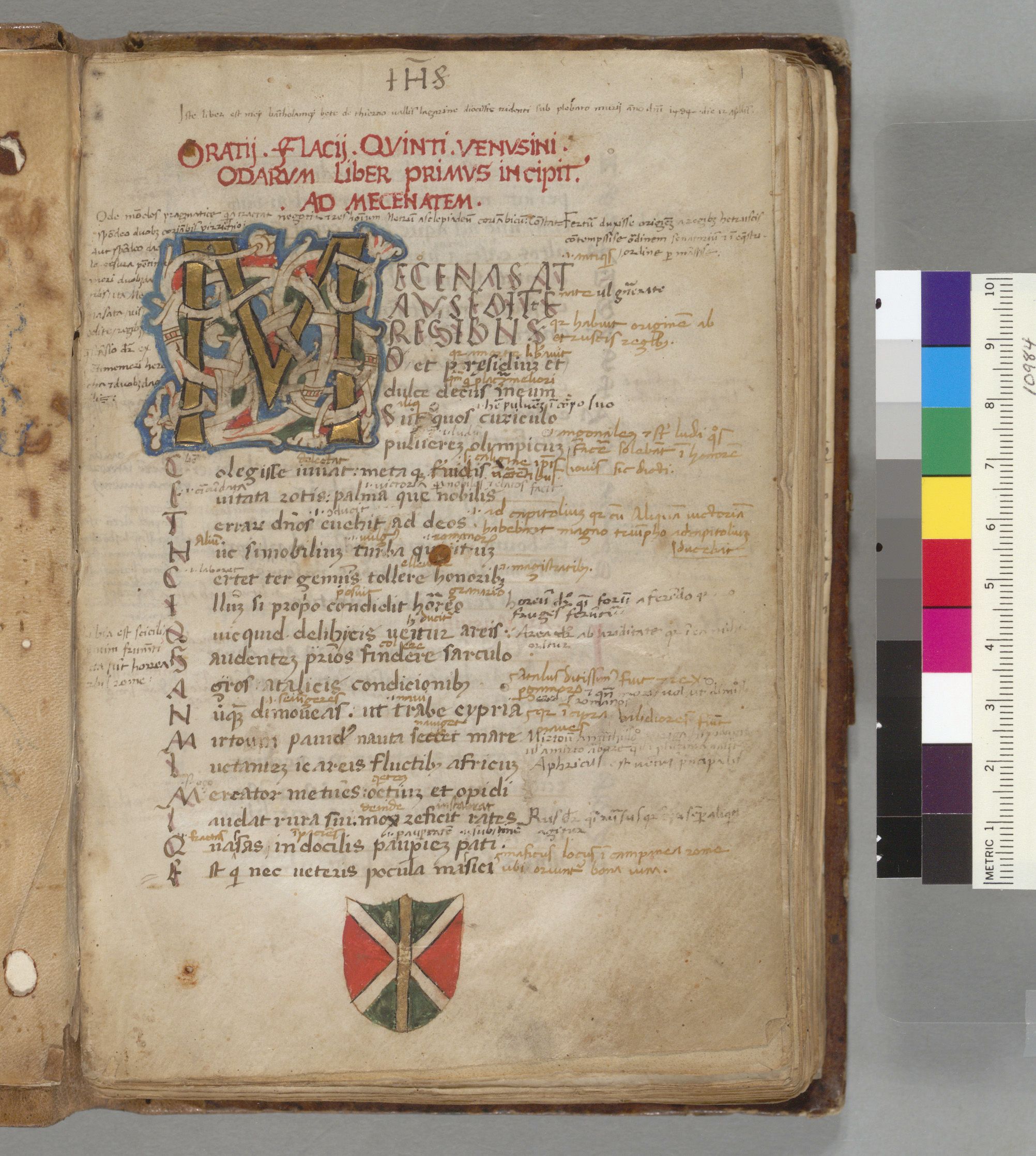
Why Doesn't My OCT Look Like This?

Actually, I don't even own an OCT of Horace at the moment, but I'm certain that, even if I did, this is not what I would be seeing.

Horace, Odes, Epodes, and Carmen saeculare, Italy, 1st quarter of the 16th century, 165 x 105 mm, Decorated initial
Burney 181, f. 90

Monday, March 12, 2007

A Brief Outline of Horace, Odes 2

2.1: For Pollio; civil wars; Horace ['H.' hereafter] prefers to sing of lighter subjects.

2.2: For Crispus Sallustius; moral poem; vanity of riches and supremacy of virtue.

2.3: For Delius; Golden Mean; enjoy life; death the great equalizer.

2.4: For Xanthus, in love with a slave girl; no need to be ashamed; mythological exempla; don't worry--H. not interested in the girl.

2.5: No addressee named, but the addressee interested in girl still too young for love; be patient; give it time.

2.6: For Septimius; bury me at Tibur; if that is not possible, then at Tarentum; praise of country/rural life.

2.7: For Pompeius; homecoming poem; had fought against Octavian; H. saved by Mercury at Battle of Phillipi.

2.8: For Barine, deceitful temptress of men.

2.9: For Volgius; it is not always winter; give up desiring your lost lover Mystes; sing instead of the victories of Augustus.

2.10: For Licinius; praise of the Golden Mean.

2.11:For Quinctius; time is short; enjoy the pleasures of leisure and wine while you can.

2.12: For Maecenas; war-themes not fit for lyre; they are better for prose histories; H. will sing love songs of Licymnia, who is better than all riches.

2.13: Addressed to tree that almost killed him; music in the Underworld.

2.14: For Postumus; death comes for everyone; your heir will get your possessions.

2.15: No addressee; private wealth is taking over everything against ancient custom instead of making things for public enjoyment.

2.16: For Pompeius Grosphus; peace of mind can't be found in war or bought with riches; Grosphus is rich, but H. has received a modest farm.

2.17: For Maecenas; we're best friends; we've both been saved from death; it will come eventually, but for now we should be grateful we've survived.

2.18: No addressee; H. is satisfied with his modest estate; on the other hand, the rich are greedy; but death will come for rich and poor alike.

2.19: Hymn to Bacchus; it is right to sing to him; he is powerful over many things, and was even able to go to the Underworld and escape unharmed.

2.20: For Maecenas; H. will not die, but his poetry will give him immortality; already he is turning into a swan; so, though he dies, he will not die, and his funeral will be corpseless, for 'the swan has flown' (West).

Thursday, February 22, 2007

No Snow/Horace

The other day I posted a snippet of Horace that was appropriate to our snowy conditions. Since it's warmed up and everything has started to melt, I thought I'd post another snippet, even though it's not quite spring yet. These are the first four lines of Odes 1.4.

Solvitur acris hiems grata vice veris et Favoni
trahuntque siccas machinae carinas,
ac neque iam stabulis gaudet pecus aut arator igni
nec prata canis albicant pruinis.

Tuesday, February 13, 2007

Snow/Horace

We've been getting some snow here in the Philadelphia area today, so I thought I would post the wintry opening stanzas of Horace Odes 1.9, followed by David West's translation:

Vides ut alta stet niue candidum
Soracte nec iam sustineant onus
siluae laborantes geluque
flumina constiterint acuto?

Dissolue frigus ligna super foco 5
large reponens atque benignius
deprome quadrimum Sabina,
o Thaliarche, merum diota.


You see Soracte standing white and deep
with snow, the woods in trouble, hardly able
to carry their burden, and the rivers
halted by sharp ice.

Thaw out the cold. Pile up the logs
on the hearth and be more generous, Thaliarchus,
as you draw the four-year-old Sabine
from its two-eared cask.

Any readers out there have any other favorites for 'wintry' passages in classical literature?

Monday, January 15, 2007

Poetry and Livy's Preface

It is interesting to me that Livy's preface begins with the first four feet of a dactylic hexameter:

Facturusne operae pretium sim...

In other words, he inaugurates his prose history with the trappings of epic. This is only the first indication in the preface that Livy has poets on his mind.

He refers again to poetry when commenting on his refusal either to attempt to substantiate or refute the accounts of Rome's earliest days:
Quae ante conditam condendamve urbem poeticis magis decora fabulis quam incorruptis rerum gestarum monumentis traduntur, ea nec adfirmare nec refellere in animo est.

And, in a nice bit of ring-composition-cum-variatio, he ends the preface with a reference to 'the poets':
Cum bonis potius omnibus votisque et precationibus deorum dearumque, si, ut poetis, nobis quoque mos esset, libentius inciperemus, ut orsis tantum operis successus prosperos darent.

This is a present contrary-to-fact condition: 'If I were a poet, I would begin...'; in other words, he's not a poet, so he won't begin in such a way.

Or will he? By raising the issue in the first place, in a sort of praeteritio, he's already put such an invocation in the minds of his readers, his denials notwithstanding. And it's not as though he hasn't been thinking about the gods in the course of this preface:
Datur haec venia antiquitati, ut miscendo humana divinis primordia urbium augustiora faciat, et si cui populo licere oportet consecrare origines suas et ad deos referre auctores, ea belli gloria est populo Romano ut, cum suum conditorisque sui parentem Martem potissimum ferat, tam et hoc gentes humanae patiantur aequo animo quam imperium patiuntur.


Some questions to ponder: what, exactly, is the relationship of Livy's history to epic poetry? Was he attempting to write 'epic in prose'? How close are the parallels we can draw between his treatment and use of foundation myths and the treatment and use of them made by Vergil?

I realize that these are questions that have probably been addressed at length in the scholarship. Nevertheless, they're some questions that came up as I was reading the preface, and it's always good to try to take a fresh look. And it's better, perhaps, to try to come up with some ideas and theories before rushing to the answers that have already been given.

As always, any comments or feedback is welcome.

Friday, December 29, 2006

Martial's Drinking Game

David Meadows, the rogue classicist, is wondering about an epigram of Martial that is bandied about here and there to support the claim that 'the Romans' (always a loaded phrase) would toast their ladies with a drink for every letter of their names. Unable to find the epigram due to the old-fashioned habit among old-fashioned writers of forgoing citations (as though everyone with a proper education should recognize every classical reference, as when Tully ruefully remarked ... you get the picture), David has asked for help in locating a verse translated in part as 'Six cups to Naevia's health go quickly round!'

That would be Martial 1. 71:

Laevia sex cyathis, septem Iustina bibatur,
Quinque Lycas, Lyde quattuor, Ida tribus.
Omnis ab infuso numeretur amica Falerno,
Et quia nulla venit, tu mihi, Somne, veni.
The custom, via this epigram, has even found its way into the Oxford Latin Dictionary under bibo 1 d, 'to toast (a name, by drinking once for each letter).'
Let Laevia be drunk with six glasses, Justina seven,
Lycas five, Lyde four, Ida three.
Let all my loves be recounted from the Falernian (wine) consumed,
and since none comes, you, Sleep, come to me.
David was right, I think, in suspecting the claim to be spurious in that the context makes it clear that this wasn't a custom, but simply a sad and lonely night for poor old Martial, drinking himself to sleep over thoughts of girls gone by.

That's why I've translated bibatur as 'let her be drunk' rather than 'let her be toasted.' The idea of a toast is misleading. Martial is not 'drinking to the health' of all the girls he knew before; rather, the alcohol acts as a surrogate for each.

It's heart-breaking, really.

Friday, October 13, 2006

Did Lucan Understand Condensation and Evaporation?

We report. You decide. Here is Housman's text, followed by Braund's traslation.

iamque polo pressae largos densantur in imbres
spissataeque fluunt; nec seruant fulmina flammas
quamuis crebra micent: extinguunt fulgura nimbi.
hinc inperfecto conplectitur aera gyro
arcus uix ulla uariatus luce colorem
Oceanumque bibit raptosque ad nubila fluctus
pertulit et caelo defusum reddidit aequor. (Bellum Civile 4.76-82)

And now, they [i.e., the clouds] are squeezed and thickened by the sky into abundant rains
and pour down condensed; thunderbolts cannot preserve their flames;
although they flash incessantly, the rain-clouds quench the lightning-flashes.
Then the rainbow embraces the air with its hoop
incomplete, its colour hardly varied by light,
and drank the Ocean and swiftly carried up the waves
to the clouds and restored the water which had flooded from the sky.