Showing posts with label Classical Tradition. Show all posts

Wednesday, March 12, 2008

An Allusion to Keats?

Another of Mifflin's classically-themed sonnets is called 'An Elegy'. I was reminded of Keats due to the following bolded rhyme.

Immortal laurel of no growth terrene,
Gather, ye Muses, in Olympian air;
'T is for a shepherd, loved of Pan, to wear;
Behold him lying on the headland green
That juts above the sea in this demesne,
As still as sculptured marble, and as fair.
Ye will not wake him if ye crown him there;
Wreathe him the while he seems to sleep serene.
The syrinx now lies useless by his head...
Was that a sigh within the cypress near?
Oh, soft, ye Muses!--softly round him tread,
Bring all your late reluctant garlands here;
Relax your haughty mien; ye need not fear
To crown this Dorian now--for he is dead!

The rhyme of 'demesne' and 'serene' occurs here in lines 5 and 8. Keats' poem 'On First Looking into Chapman's Homer' is also in sonnet form. In addition, the rhyme-scheme is the same in the two poems except for the last two lines (Mifflin: abbaabbacdcddc; Keats: abbaabbacdcdcd). But Mifflin's 'a' line-ending ('-ene') is Keats' 'b' line-ending. Thus, though the 'demesne-serene' rhyme occurs in the same four-line segment of Keats' poem, it is in lines 6 and 7 instead of 5 and 8.
Much have I travell'd in the realms of gold,
And many goodly states and kingdoms seen;
Round many western islands have I been
Which bards in fealty to Apollo hold.
Oft of one wide expanse had I been told
That deep-brow'd Homer ruled as his demesne;
Yet did I never breathe its pure serene
Till I heard Chapman speak out loud and bold:
Then felt I like some watcher of the skies
When a new planet swims into his ken;
Or like stout Cortez when with eagle eyes
He star'd at the Pacific--and all his men
Look'd at each other with a wild surmise--
Silent, upon a peak in Darien.

(Text here.)

It seems probable to me that this particular rhyme (especially with the rather uncommon 'demesne') was borrowed from Keats, but of course I may well be wrong about that. Has anyone come across it elsewhere before?

Tuesday, March 11, 2008

Lloyd Mifflin

I confess I'd never heard of the Pennsylvanian sonneteer Lloyd Mifflin until recently. He has a goodly number of poems on classical subjects. The following, called 'The Ship', is a nice little reflection on the effects that the reading of Homer can bring to bear on the imagination. You can find it at Google books here.

I LAY at Delos of the Cyclades,
At evening, on a cape of golden land;
The blind Bard's book was open in my hand,
There where the Cyclops makes the Odyssey's
Calm pages tremble as Odysseus flees.
Then, stately, like a vision o'er the sand,
A phantom ship across the sunset strand
Rose out of dreams and clave the purple seas;
Straight on that city's bastions did she run—
Whose toppling turrets on their donjons hold
Bells that to mortal ears have never tolled—
Then drifted down the gateway of the sun
With fading pennon and with gonfalon,
And dropped her anchor in the pools of gold.

Friday, July 13, 2007

Ars Poetica

Archibald MacLeish's short Ars Poetica ends with the rather famous following two lines:

A poem should not mean
But be.

These lines are quoted fairly frequently. For example, they were the basis for an answer on Jeopardy last night. I confess that I don't understand what they mean. Based on the lines themselves, I suppose that's a silly question, since I suppose they just 'are'. Perhaps the point is to make interpretation seem ridiculous, but leaving that aside--what, really, does it mean (gasp) for a poem not to 'mean/ But be'?

The text can be found here or here. More interesting is an image of the original manuscript here.

UPDATE: To put it a little more clearly: a believer in MacLeish's axiom couldn't answer my question on grounds of principle, for to do so would be a violation of the axiom. It seems to be intended as a metapoetic comment on poetry as such, but, given that it comes in a poem, as soon as one extracts the comment--the 'meaning' of part of the poem--to apply it to how we read poems in general, he does violence to the principle that a poem does not 'mean/ But [is]'. Dennis' idea of paradox is a good way of looking at it. For the more cynical, 'nonsense' is another.

Saturday, July 07, 2007

Bakhtin Again

In the first part of his review, Eagleton gives a sketch of Bakhtin's difficult life under the Stalinists. At one point, he writes:

Here [in St. Petersburg], as always, he was surrounded by a close group of anarchically minded writers and eccentric polymaths. Indeed, the story of his life is the tale of one such coterie after another; they seemed to form spontaneously around him in whatever godforsaken backwater he happened to wash up. He was a man who practised dialogism as well as preached it. By the late 1920s, however, the kind of religiosity which his circle promoted [a form of Russian Orthodoxy] was in increasing disfavour with the state; and in 1929 Bakhtin was arrested for membership of a religious circle, anti-Communist proclivities and corrupting the young by his teaching.

If you think this sounds suspiciously like an ancient gadfly featured in Bill and Ted's Excellent Adventure, you'd be right, for that is the connection Eagleton goes on to make explicit:
The thinker whose notions of dialogism, subversive irony and indirect speech ran back to Socrates now seemed about to suffer his predecessor’s fate.

But he didn't. To find out why, you can read the rest here.

Friday, January 26, 2007

Images from Livy (9)


'Landscape with She-Wolf Suckling Romulus and Remus', by Annibale Carracci (1560-1609), c. 1590. Pen, brown ink and brown wash, retouched in black ink, on white paper. Paris, Louvre.

Thursday, January 25, 2007

Images from Livy (8)


'Romulus and Remus Given Shelter by Faustulus', by Pietro Berrettini, called Pierre de Cortone (1597-1669), around 1643 (Paris, Louvre)

Wednesday, January 24, 2007

Images from Livy (7)


'Les Sabines', by Jacques-Louis David (1748-1825), 1799 (Paris, Louvre)

Tuesday, January 23, 2007

Images from Livy (6)


'The Introduction of the Cult of Cybele at Rome', by Andrea Mantegna (about 1430/1-1506), 1505-6. Glue on Linen. Housed in National Gallery (London).

The National Gallery's page on this picture says the following:

Inscribed in the centre: S HOSPES NUMINIS IDAEI C [By decree of the Senate host to the Idaean deity]. Various other inscriptions on the tombs.

In 204 BC the Romans brought the cult of Cybele, the eastern goddess of victory, from Pessina, Asia Minor, to Rome. Mantegna has combined the accounts of Ovid, Livy and Appian. Cybele is represented by her sacred stone - 'she fell to earth as a meteor' - and as a bust with a mural crown (associating her with a city state). According to Juvenal, Cornelius Scipio (probably in profile gesturing with his right hand) was the most worthy Roman citizen to receive Cybele.

This is one of four pictures commissioned in 1505 by Francesco Cornaro a Venetian nobleman, who claimed descent from the ancient Cornelii family (prominent in the picture). Mantegna only completed one before his death and Bellini supplied another (Washington, National Gallery).

Monday, January 22, 2007

Images from Livy (5)


'Marcus Curtius', attributed to Bacchiacca (1495-1557), probably about 1520-30. Oil on wood. Housed in National Gallery (London).

Friday, January 19, 2007

Images from Livy (4)


'The Death of Camilla', by Jacques-Louis David (1748-1825), black chalk with brush and gray wash on cream-colored laid paper (New York, Metropolitan Museum of Art)

Thursday, January 18, 2007

Images from Livy (3)


'The Oath of the Horatii', by Jacques-Louis David (1748-1825), 1786 (Toledo, Toledo Museum of Art)

Wednesday, January 17, 2007

Images from Livy (2)


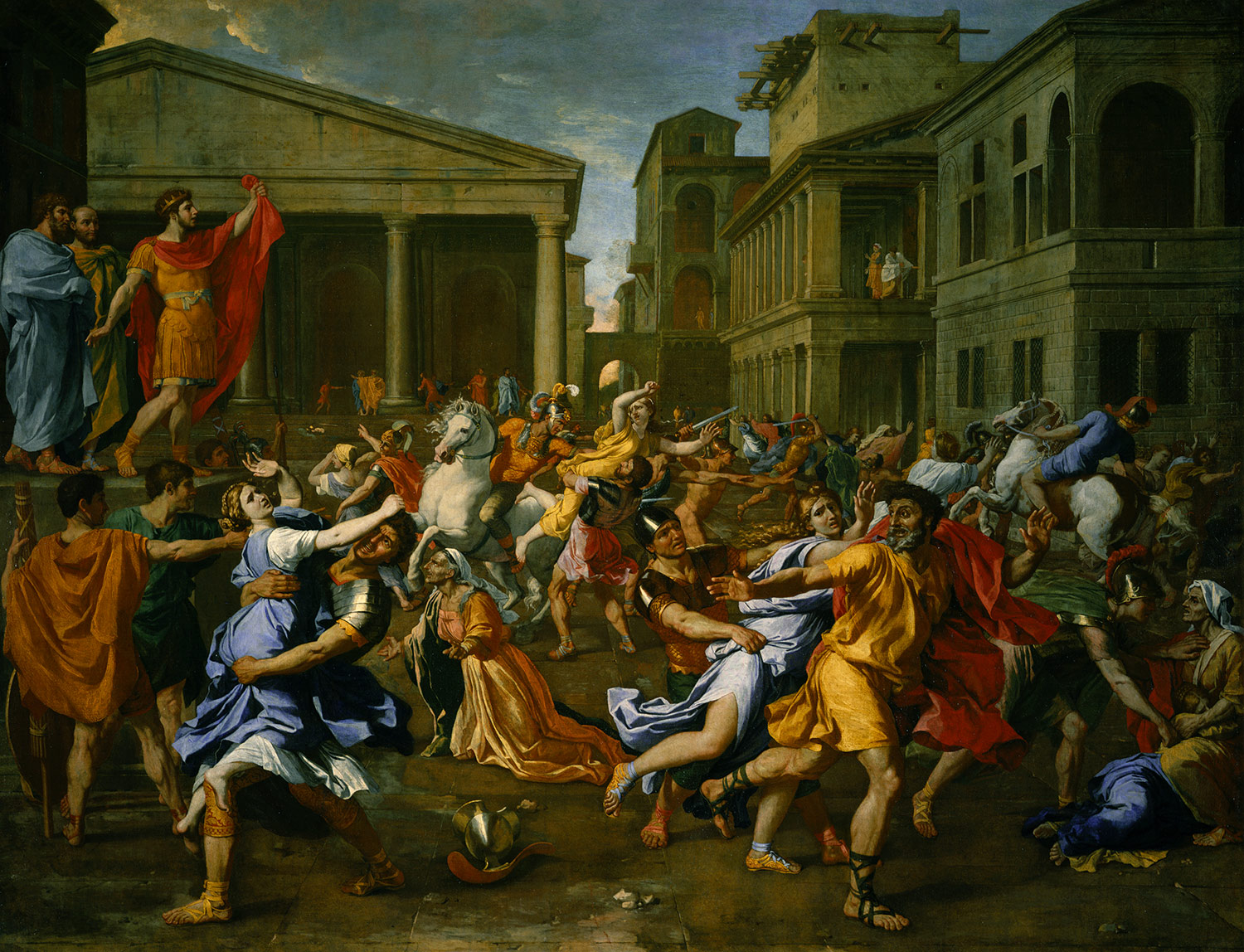
'The Rape of the Sabines', by Nicolas Poussin (1594-1665), ca. 1637-8 (Paris, Louvre)

Tuesday, January 16, 2007

Images from Livy (1)


'The Oath of the Horatii', by Armand Caraffe (1762-1822) (Moscow, Pushkin Museum)

Wednesday, November 01, 2006

John Calvin, Near-Classicist

Unlike Luther, Calvin was not a university-trained theologian. He had, of course, been sent by his father to the University of Paris in order to study for the priesthood. But the original plans for John's ordination were scuttled when his father, a notary for the bishop of Noyon in Picardy, quarrelled with the cathedral chapter. In the aftermath of the quarrel Calvin was sent instead to Orleans and later to Bourges to study law. By inclination Calvin preferred to be neither a lawyer nor a priest, though he did obey his father by earning a doctorate in civil law. In the preface to his commentary on the Psalms, written many years after the events, Calvin claimed that his chief ambition as a young man had been to lead a quiet life as a reclusive scholar, one who edited and interpreted classical texts. He might very well have lived such a quiet life, had he not experienced what he later described as a rapid, if somewhat reluctant, conversion to the Protestant movement. This unexpected conversion propelled him within a remarkably short time to prominence withing Protestant circles of reform.

(From David C. Steinmetz, 'The Theology of John Calvin' (in The Cambridge Companion to Reformation Theology, edited by David Bagchi and David C. Steinmetz [2004], pp. 113-29), pp. 113-14.)

Tuesday, October 31, 2006

Auden's Thoughts on Catullus (et al.)

From 'New Year Letter', Part One:

There DRYDEN sits with modest smile,
The master of the middle style,
Conscious CATULLUS who made all
His gutter-language musical,
Black TENNYSON whose talents were
For an articulate despair,
Trim, dualistic BAUDELAIRE,
Poet of cities, harbours, whores,
Acedia, gaslight and remorse,
HARDY whose Dorset gave much joy
To one unsocial English boy,
And RILKE whom die Dinge bless,
The Santa Claus of loneliness.

Thursday, October 12, 2006

A Reference to Ovid in Calvin's Commentaries

2 Thess. 1:5 reads:

...Ostensionem iusti iudicii Dei: ut digni habeamini regno Dei, pro quo et patimini.

...Which is a manifest token of the righteous judgment of God, that ye may be counted worthy of the kingdom of God, for which ye also suffer...

In commenting on the phrase 'a demonstration of the righteousness of God', Calvin refers to a remark of Ovid in the Amores:
Without mentioning the exposition given by others, I am of opinion that the true meaning is this — that the injuries and persecutions which innocent and pious persons endure from the wicked and abandoned, shew clearly, as in a mirror, that God will one day be the judge of the world. And this statement is quite at antipodes with that profane notion, which we are accustomed to entertain, whenever it goes well with the good and ill with the wicked. For we think that the world is under the regulation of mere chance, and we leave God no control. Hence it is that impiety and contempt take possession of men’s hearts, as Solomon speaks, (Ecclesiastes 9:3) for those that suffer anything undeservedly either throw the blame upon God, or do not think that he concerns himself as to the affairs of men. We hear what Ovid says, — “I am tempted to think that there are no gods.”

The footnote gives the reference:
“ Solicitor nullos esse putare deos .” — Ovid in. Am. 9:36. In order to see the appropriateness of the quotation, it is necessary to notice the connection of the words “ Cum rapiant mala fata bonos.... Solicitor ,” etc. ; — “When misfortunes overtake the good, I am tempted,” etc. — Ed

In addition, Calvin makes another 'classics reference' immediately after the passage
just cited:
Nay more, David confesses (Psalm 73:1-12) that, because he saw things in so confused a state in the world, he had well-nigh lost his footing, as in a slippery place. On the other hand, the wicked become more insolent through occasion of prosperity, as if no punishment of their crimes awaited them; just as Dionysius, when making a prosperous voyage, boasted that the gods favored the sacrilegious. [The note explains thus: "Our author alludes to a saying of Dionysius the younger, tyrant of Sicily, on occasion of his plundering the temple of Proserpine."] In fine, when we see that the cruelty of the wicked against the innocent walks abroad with impunity, carnal sense concludes that there is no judgment of God, that there are no punishments of the wicked, that there is no reward of righteousness.