Showing posts with label Geschichte der Philologie. Show all posts

Tuesday, February 20, 2007

Wilamowitz-Moellendorff/Homer's Iliad

BMCR has a new review of a book that looks very interesting, which is centered around 'the publication of a nearly word for word transcript of Wilamowitz's lectures on Homer's Iliad in 1887/1888'. The reviewer, Edith Foster, goes on to say:

Paul Draeger and a team of sub-editors surround these lectures with a very copious and responsible supporting apparatus. However, the book reaches far beyond the editing and publication of transcripts, since in addition to the lectures it offers a portrait and defense of Wilamowitz himself.

This many layered volume begins with a short essay in praise of Wilamowitz by Walter Burkert (who is simultaneously the dedicatee of the volume), after which Paul Draeger provides an essay on Wilamowitz's character as a lecturer. He describes Wilamowitz's broad activities both as a university and a public lecturer, citing many vivid eye-witness accounts. Student accounts emphasize the appeal of Wilamowitz's deep knowledge and rhetorical power.

This introduction to Wilamowitz as lecturer is followed by introductions to the lectures themselves. First, Draeger offers information on the student copyists and on the character and history of their transcripts of the Homer lectures. Second, he provides an outline of the lectures and detailed remarks on Wilamowitz's personality as it emerges from the lectures. For instance, he compares how Wilamowitz characterized scholars with whom he agreed or disagreed (62-64), and discusses how and how often Wilamowitz mentioned himself (65-66). Draeger also lists and evaluates Wilamowitz's terms of praise and blame (56-57). Other questions have a more practical orientation. Draeger argues about whether or not Wilamowitz used a blackboard and maps (probably, 54) or brought any books other than the Iliad with him to the lectures (probably not, 55-59). Without neglecting to mention Wilamowitz's errors, Draeger provides detailed demonstrations of his astonishing memory (56, 66-70). The description of the lectures is laudatory; 21st Century practices are seen in negative contrast (53, 55).

The third and penultimate element of the introduction is a description of the close connections between these lectures and Wilamowitz's book Die Ilias und Homer (1916). Draeger argues that Wilamowitz's Homer lectures of 1887/88 are still useful even though Wilamowitz's main hypotheses about book 11 of the Iliad are nearly universally rejected (77). He points out that the lectures offer a very comprehensive discussion of the material from book 11 and that this discussion is not available in Wilamowitz's later publications (77-78). He also provides a sequence of examples to show that the lecture notes contain readings which have not yet been considered for critical editions (79-81), as well as a list of passages about which Wilamowitz changed his mind by 1916 (82-83). He might have been better off to let Wilamowitz speak for himself by this point and to place such arguments after the lectures, or even in an appendix. They give the impression that the lectures will be interesting mainly to an audience studying Wilamowitz, whereas in fact, both readers studying Homer, as well as readers studying their own received practices in historical context will find them useful.

You can read the rest here.

Saturday, January 28, 2006

Gow's Housman

Before Saranike and I head out to do a little book hunting I thought I'd recommend A.S.F. Gow's A.E. Housman: a sketch together with a list of his writing and indexes to his classical papers.

Why that long and odd subtitle? Because one condition of Housman's will was that no one ever collect his published papers into a single volume. He evidently didn't want his early work to stand beside what he considered his life's achievments (Manilius, for one).

Gow's sketch is brief (57 pages with the remainder taken by the bibliography and indexes), charming, and allows Housman to speak humbly about himself often. That would appear to some to be a paradox of his character, but it is perfectly reasonable that someone so well-known for his attacks on the intellectual failings and dishonesty of others would appraise himself as a pedant who counted only as one fourth a Bentley or roughly a Porson.

The harshest critic of other was his own harshest critic.

Next on my list is, appropriately, C.O. Brink's English Classical Scholarship: historical reflections on Bentley, Porson, and Housman. Stay tuned.

Tuesday, December 27, 2005

Sandys's History of Classical Scholarship


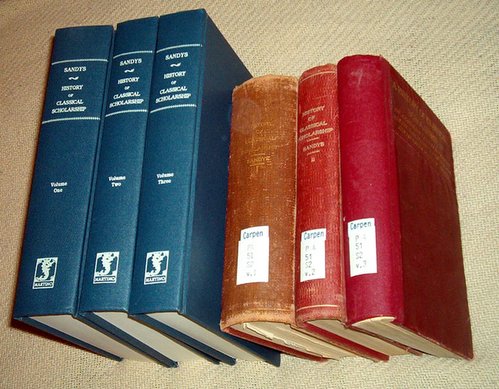
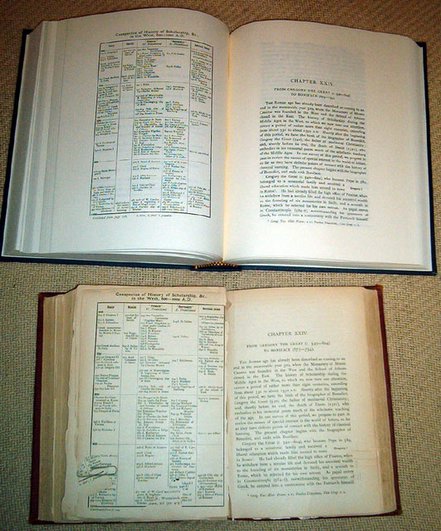
LEFT: My brand spanking new copy. RIGHT: the library's old copy, which is yellowed and falling apart.

This is what I asked of my parents for Christmas this year: a facsimile edition of John Edwin Sandys's A History of Classical Scholarship. I opted for the facsimile because it's printed on better paper and is more durably bound. This set was done by Martino Publishing in partnership with Krown and Spellman, booksellers. Krown & Spellman sell it for $165 + $5 per book shipping USPS. The edition which Martino offers on their site, apparently not in connection with Krown & Spellman, is listed at $195.

The only weakness of the facsimile is the quality of the illustrations, mostly portraits of classical scholars. The differences from the original did not photograph well, but it's something like a very good photocopy: no gray tones, some loss of detail, but nothing to cry about. Posted by Picasa

Here are some more comparisons:
 
 Posted by Picasa

 
 Posted by Picasa

Wednesday, September 21, 2005

Old Timey Scholars

I am thoroughly enjoying (very occasionally) browsing through Briggs and Calder's Classical Scholarship: A Biographical Encyclopedia (and I do take Rusten's caution to heart, especially since I noted a few glaring omissions myself).

You can read about former Bryn Mawr professors Paul Shorey, Tenney Frank, and Lily Ross Taylor. I see via the department's site that Briggs's Biographical Dictionary of North American Classicists contains entries on Paul Shorey, Herbert Weir Smyth, Gonzalez Lodge, Arthur Leslie Wheeler, Tenney Frank, Lily Ross Taylor, Louise Adams Holland, and T. Robert S. Broughton.

But the reason I started this post was simply to say that I envy the old-timers who knew these languages better than many of us ever will. I've just gotten my hands on J.G. Schneider's edition of the Theriaca of Nicander (1816) which has been highly praised by those in the know (one modern scholar once called it the only useful edition, a direct slap to Otto Schneider's edition of 1856 and an acknowledgment of the limitations of Gow-Scholfield). I haven't time to do much with it yet, but the most promising thing is J.G. Schneider's prose: his Latin is the clearest academic Latin prose I've come across.

That's high praise.

Tuesday, March 01, 2005

Nietzsche on Classics and Classicists

first of all, it's nice to see dennis back again! i was beginning to wonder whether he'd abandoned us for fairer campi. if anyone else is glad to see his return, they are warmly invited to express their delight in the comments.

and now on to our citation for the day--

Classical scholarship as knowledge of the ancient world cannot, of course, last forever; its material is exhaustible. What cannot be exhausted is the perpetually new adjustment of our own age to the classical world, of measuring ourselves against it. If we assign the classicist the task of understanding his own age better by means of the classical world, then his task is a permanent one.--This is the antinomy of classical scholarship. Men have always, in fact, understood the ancient world exclusively in terms of the present--and shall the present now be understood in terms of the ancient world? More precisely: men have explained the classical world to themselves in terms of their own experience; and from what they have acquired of the classical world in this way, they have assessed, evaluated their own experience. Hence experience is clearly an absolute prerequisite for a classicist. Which means: the classicist must first be a man in order to become creative as a classicist...

Sunday, February 20, 2005

Nietzsche on Classics and Classicists

the following is (in)appropriate, since we just talked a little about the history of classical scholarship.

Ah, it's a miserable history, the history of classical scholarship! The most nauseating erudition; the sluggish, passive indifference; timid acquiescence.--Who has ever possessed any freedom?

Stephanme, Stephanyou, Stephanus

ever wonder why texts of plato have that funny page-numbering system? you know, 'stephanus pages'? well, i wondered, too.

they are due to the edition of scholar and printer henricus stephanus (henri estienne) (1528-31--1598), son of scholar and printer robertus stephanus (robert estienne). henricus has a number of notables to his credit, including discovering ten new books of diodorus while on a trip to italy, which were printed in 1559, the same year in which he took over his father's business in geneva.

moreover, he was responsible for the printing of editions of myriad ancient works: 58 in latin and 74 in greek, of which 18 were editiones principes. his aeschylus, edited by victorius (1557), was the first to include the complete Agamemnon.

he is perhaps best-known for his Thesaurus Linguae Graecae, which, as of 1908, was still unsurpassed as a Greek lexicon on a large scale, and for his edition of Plato, issued in 1578, which held its ground for two centuries until the bipontine edition of 1781-87.

(the foregoing information is taken from sandys, A History of Classical Scholarship, vol.II.)

Sunday, February 13, 2005

Nietzsche on Classics and Classicists

When classicists discuss their discipline, they don't get down to the root of the matter: they don't adduce classical scholarship itself as a problem. Bad conscience? Or simple inadvertance?

Wednesday, February 09, 2005

An American Hero of the Mind

my dad pointed me to this fascinating story in the toledo blade:

Scarborough: An American hero of the mind

DETROIT - This is the story of one of black history's amazing unknown pioneers, a slave who, against all odds, rose to become the foremost black classical scholar, a major voice in the debate over the future of black America and, finally, president of Wilberforce University.

And it is the story of a young white woman, born long after he died, who found his fascinating autobiography tucked away and forgotten, and who has just given William Sanders Scarborough's incredible life back to the nation after it was somehow tragically lost for decades.

"He was an American hero of the mind," Michelle Valerie Ronnick said. "His story remains living proof that if you work hard, aim high, and dream big dreams, you can overcome tremendous obstacles."

Thanks to her own hard work, Wayne State University Press has just published his book. The Autobiography of William Sanders Scarborough: An American Journey From Slavery to Scholarship (425 pages; $29.95).

Her achievement, like that of her subject, has been hailed as nothing short of brilliant by Henry Louis Gates, the famous scholar and critic.

Though they are separated by race, gender, and more than a century, the black pioneer and the young scholar have something in common. No one would have expected either to become experts in ancient tongues.

Growing up in Florida in the 1970s, Michele Ronnick took Latin as a senior in high school mainly because her brother liked the teacher. It started her on a lifelong passion for the classics.

Nobody would ever have expected Scarborough to become a scholar - let alone a leading expert on Greek and Latin. When he was growing up, it was illegal to teach blacks to read or write. U.S. Sen. John C. Calhoun, the famous fire-eating defender of slavery, once said that if he "could find a Negro who knew the Greek syntax, he would then believe the Negro was a human being."

Scarborough, who surreptitiously was taught to read, ended up not just knowing that ancient language fluently, he became the author of a Greek college textbook widely used in the late 19th century.

He rose to become an amazing example who fought hardship all his life; never took no for an answer, and who wasn't content to be a trailblazer in merely academic circles.

He dabbled in Ohio politics and fought Booker T. Washington's idea that African-Americans should be content to learn industrial arts and not worry about cultivating the life of the mind.

And William Scarborough was witness to some of the greatest moments of his time. He was a 12-year-old boy in Atlanta when the city was sacked by William Tecumseh Sherman. (When blacks were allowed to do some looting, he tellingly went after, he says, "pencils, envelopes, and paper.")

He saw Jefferson Davis dragged away as a prisoner of war; met Richard Wright and Frederick Douglass; knew Warren G. Harding, and attended Booker T. Washington's funeral.

He fell in love with a white divorcee when that was social suicide; they married in 1881, and lived happily ever after for 45 years.

Then, in the fall of 1926, he died, after struggling into his library for one last look at his beloved books. Shortly before he had finished writing an autobiography, to which his heartbroken wife added a few pages. But it was never published, and it and he were finally forgotten.

Meanwhile, Michelle Ronnick had gone on to become an expert on Roman literature, and ended up as part of the tiny classics department at this sprawling urban school.

Eight years ago, doing research, she came across a reference to one William Scarborough. It said he was African-American, a former slave, and was the author of a textbook of ancient Greek.

What amazed her was that she had never heard of him. Her interest was piqued. Then, after a lot of digging, she discovered a treasure trove: A copy of his autobiography, forgotten, in the Ohio Historical Society archives. For some reason, it had never been published. As she began to read, she was hooked.

Wayne State University Press has just published the manuscript. It reveals a black man who was a straight-laced Victorian; who was always proper, but whose remarkable life puts most of us to shame.

"I have never been ashamed of my birth conditions," he says succinctly. "I have left that to the slaveholders."

Shortly before he died nearly a century ago, Professor William Sanders Scarborough finished his memoir, writing, "I look ahead into years to come, when the melting pot - America - will have melted away racial lines, hates, and prejudices … a thing this country owes to its honor."

We can only guess what he would have thought today. But I think it might be something like what I heard a minister say once during a service in the African Methodist Episcopal Church to which the old professor belonged.

"Lord, we're not what we should be. We're not what we could be and we're not what we are going to be. But at least we're not what we were."
--------------------------------------------------------------------------------
Jack Lessenberry, a member of the journalism faculty at Wayne State University in Detroit and The Blade’s ombudsman, writes on issues and people in Michigan.
» E-mail him at OMBLADE@aol.com or call 1-888-746-8610.
» Read more Jack Lessenberry columns at www.toledoblade.com/lessenberry

Tuesday, February 08, 2005

Nietzsche on Classics and Classicists

Other than the great number of incompetent classicists, there is at present a number of men who are born classicists, but who are prevented for various reasons from realizing themselves. But the crucial obstacle in the way of these born classicists is the misrepresentation of classical scholarship by unqualified classicists.

Leopardi is the modern ideal of a classicist, the German classicists are quite impotent (the case of Voss is worth considering!).

Thursday, September 02, 2004

i'll see your philology, and raise you a philosophy

as dennis will remember, several days ago i lamented to him regarding the following comment from allan bloom's essay 'the study of texts', which can be found in his book giants and dwarfs:

Almost all modern scholarship, beginning with classical philology, started from the assumption that its fundamental ideas were superior to those of the authors it studied and placed these authors in a context alien to them. Even such as idealist and realist, liberal and conservative are profoundly misleading although they seem to us as natural as night and day.


i was chagrined by the assertion that classical philologists, from the very inception of the discipline, saw themselves as prima facie superior to the ancients, for that, it seems, would make those scholars rather uncharitable and condescending toward their predecessors. while i am still not ready to accept this diagnosis in any holistic sense (though i am trying to keep my eyes much more open for evidence thereof), i cannot think it was mere coincidence that, almost immediately after reading bloom's words, i came across this statement in m.i. finley's book the ancient greeks (which, by clicking on the link, you may purchase for as little as $0.47) in his discussion on the dark age and the homeric poems:

Nothing can make up for the nonexistence of contemporary Greek writing, whether narrative or religious or administrative. And so we, like the Greeks, must fall back on the Iliad and the Odyssey. Here again, surprising as it may seem, we know far more than the Greeks, for not only has modern philology made its contribution....


i realize the parallel to bloom's words is not necessarily a close one --there is no use here of labels for the ancients such as 'liberal', 'conservative', or anything else, and he goes on in the same paragraph to rehabilitate the poems as more than 'merely poetic fiction'. but in spirit, perhaps there is a similarity in finley's statement to the very thing which bloom criticizes, viz., that it seems strange to say that we are more knowledgeable about the greeks' own poetry than the greeks were themselves.