Favorite Google Search Directing Someone to the Campus Today?
'i'm look the Angola basketball'.

Male Graduate Students:
un-serious in terms of studies since 1931.
Our largely reticent co-blogger mentioned in the title to this post is a great enthusiast of Plato and his caprine leading man Socrates. In Symposium 215a and following, we find Alcibiades comparing Socrates to Marsyas:
“The way I shall take, gentlemen, in my praise of Socrates, is by similitudes. Probably he will think I do this for derision; but I choose my similitude for the sake of truth, not of ridicule. For I say [215b] he is likest to the Silenus-figures that sit in the statuaries' shops; those, I mean, which our craftsmen make with pipes or flutes in their hands: when their two halves are pulled open, they are found to contain images of gods. And I further suggest that he resembles the satyr Marsyas. Now, as to your likeness, Socrates, to these in figure, I do not suppose even you yourself will dispute it; but I have next to tell you that you are like them in every other respect. You are a fleering fellow, eh? If you will not confess it, I have witnesses at hand. Are you not a piper? [215c] Why, yes, and a far more marvellous one than the satyr. His lips indeed had power to entrance mankind by means of instruments; a thing still possible today for anyone who can pipe his tunes: for the music of Olympus' flute belonged, I may tell you, to Marsyas his teacher. So that if anyone, whether a fine flute-player or paltry flute-girl, can but flute his tunes, they have no equal for exciting a ravishment, and will indicate by the divinity that is in them who are apt recipients of the deities and their sanctifications. You differ from him in one point only--that you produce the same effect with simple prose unaided by instruments. For example, when we hear any other person--[215d] quite an excellent orator, perhaps--pronouncing one of the usual discourses, no one, I venture to say, cares a jot; but so soon as we hear you, or your discourses in the mouth of another,--though such person be ever so poor a speaker, and whether the hearer be a woman or a man or a youngster--we are all astounded and entranced. As for myself, gentlemen, were it not that I might appear to be absolutely tipsy, I would have affirmed on oath all the strange effects I personally have felt from his words, and still feel even now. For when I hear him [215e] I am worse than any wild fanatic; I find my heart leaping and my tears gushing forth at the sound of his speech, and I see great numbers of other people having the same experience. When I listened to Pericles and other skilled orators I thought them eloquent, but I never felt anything like this; my spirit was not left in a tumult and had not to complain of my being in the condition of a common slave: whereas the influence of our Marsyas here has often thrown me into such a state [216a] that I thought my life not worth living on these terms. In all this, Socrates, there is nothing that you can call untrue. Even now I am still conscious that if I consented to lend him my ear, I could not resist him, but would have the same feeling again. For he compels me to admit that, sorely deficient as I am, I neglect myself while I attend to the affairs of Athens. So I withhold my ears perforce as from the Sirens, and make off as fast as I can, for fear I should go on sitting beside him till old age was upon me."
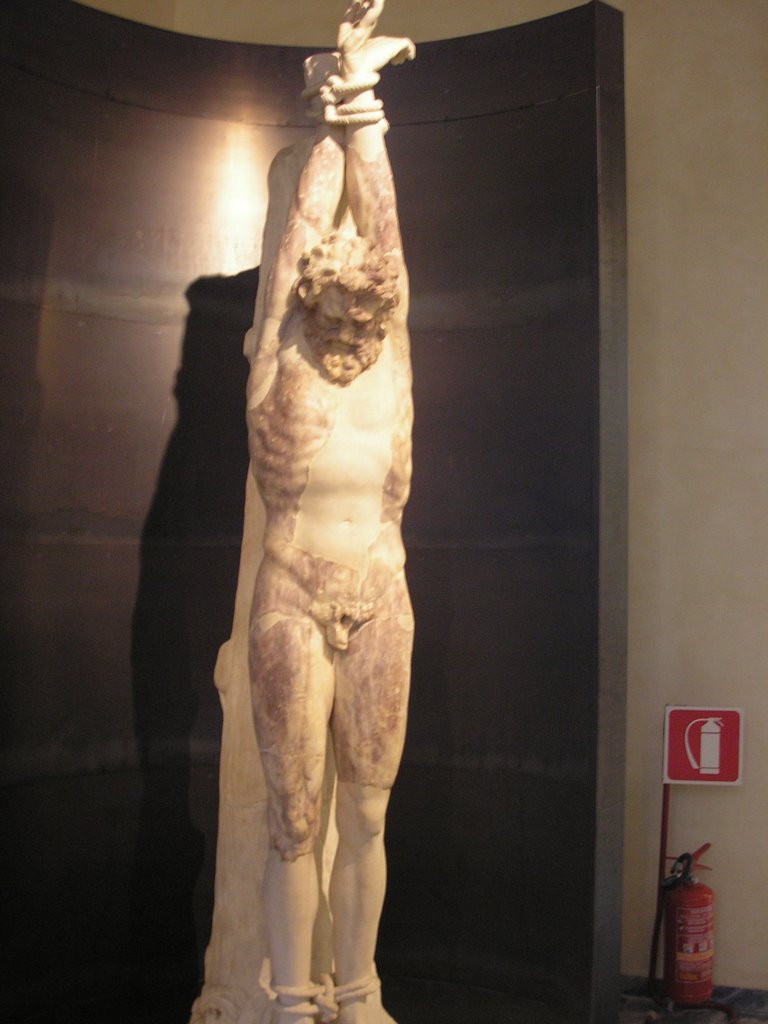
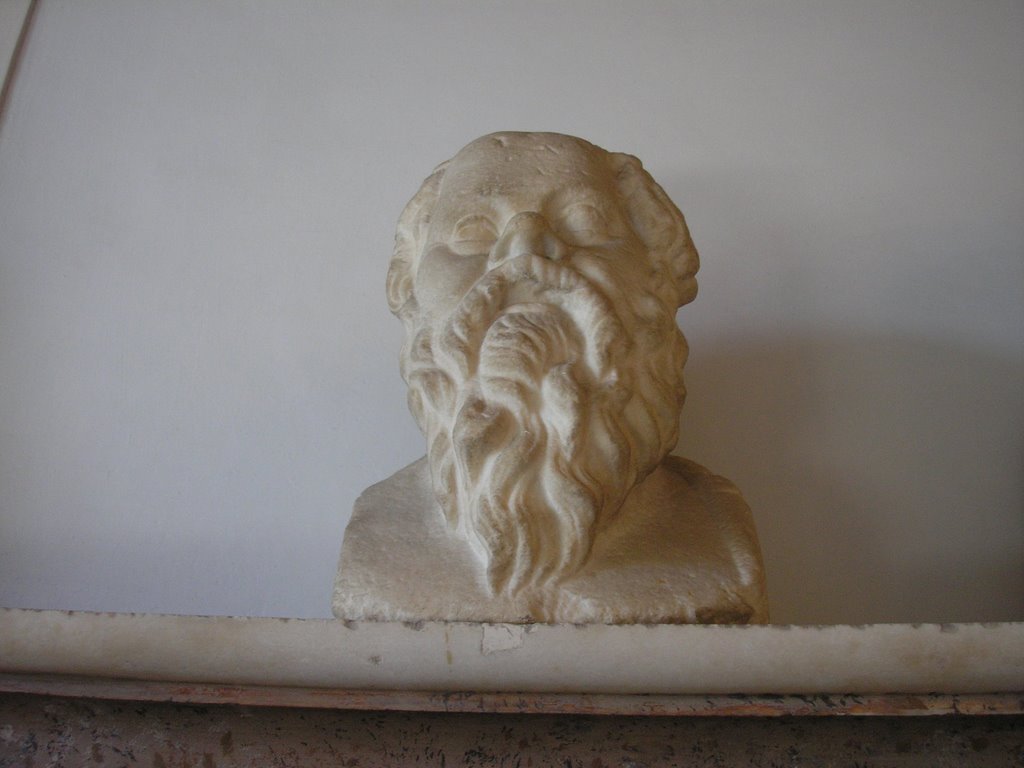
Two recent (and blunt) answers to that question are, via Google search pages:
'cambridge latin course unit four cheat sheets' (triggered by remarks on the 'Cambridge Greek and Latin Classics Series' and the 'Grad School Cheat Sheet')
'catullus dirty poems' (triggered by Dennis' remarks on Catullus 50).
Last week was 'culture week' in Italy, so a lot of museums and sites were free. I tried to take advantage and save some euros and grabbed a bunch of photos along the way, and thought I'd post some that ancient enthusiasts might enjoy. Since Dennis remarked on the apparent popularity of Constantine, I decided to post a couple colossals of the big C from the Capitoline Museums. First, the head from the giant statue originally in the apse of the Basilica Nova: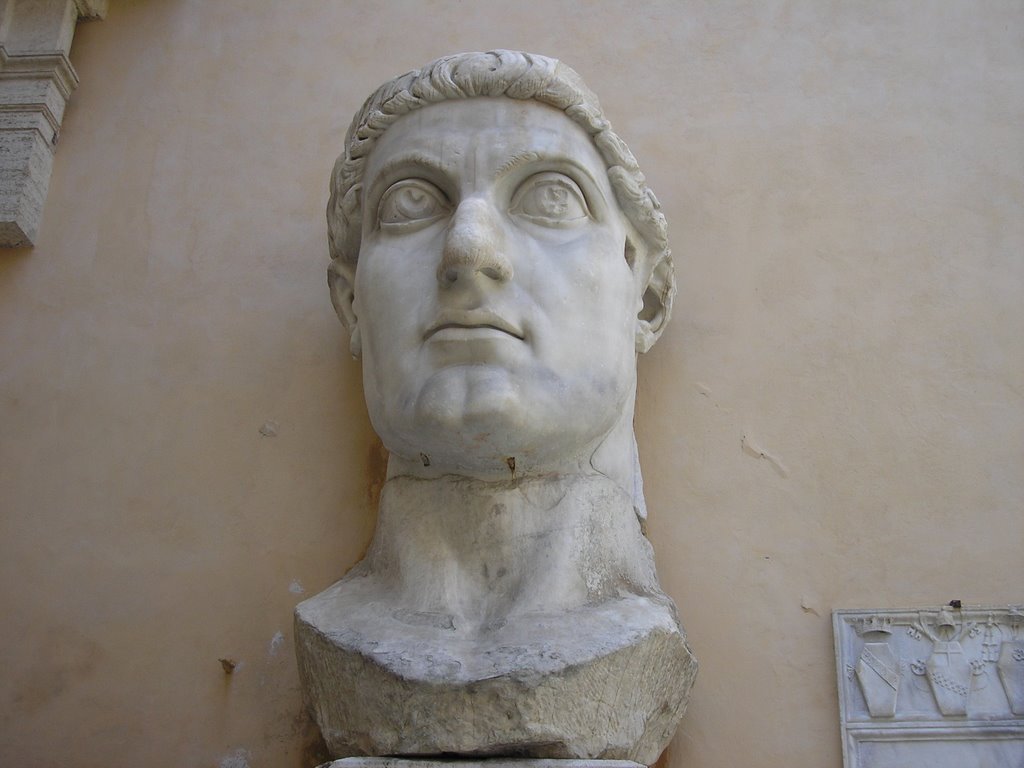
Next, possibly my favorite piece of ancient sculpture: the 'We're Number 1!' hand from the same statue.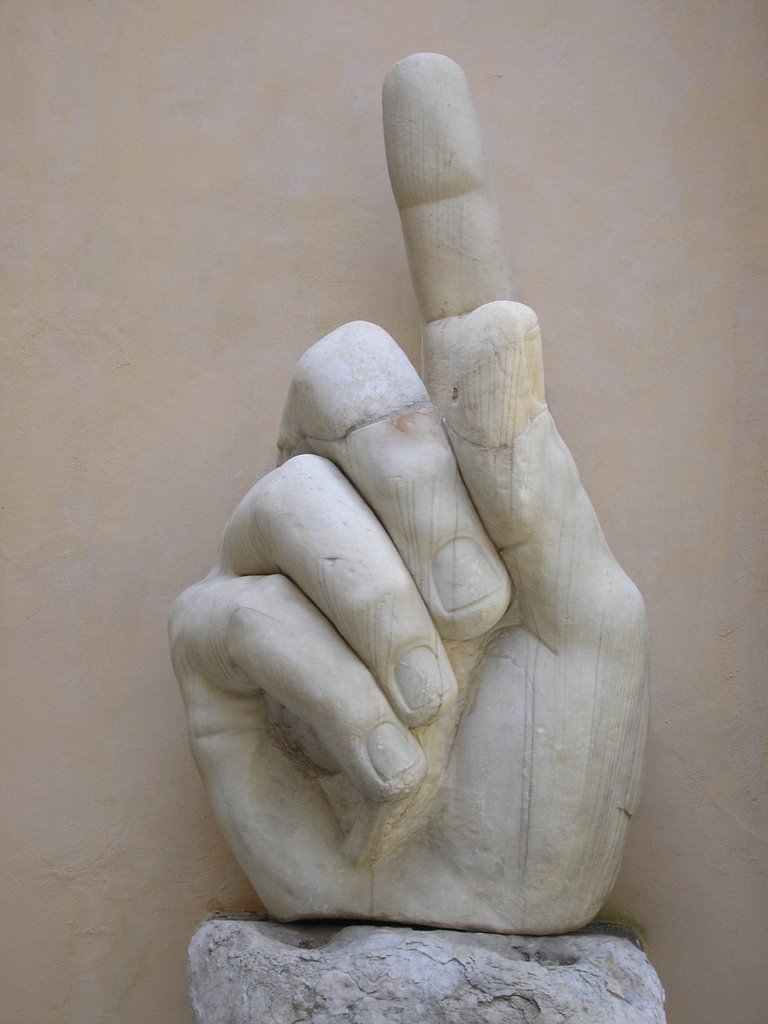
Finally, an incredible bronze head, hand, and globe of Constantine. My museum guide says the following about it: 'Beginning in the mediaeval period, the precious remains of the sculpture depicting the first Christian emperor--the head, hand, and globe--were part of the patrimony of the patriarch's Lateran residence. In 1471, they went to the Capitoline Hill, as part of Sixtus IV's donation to the People of Rome. The large head, a masterpiece of antique bronze statuary, impressive both in the colossal scale and the intensity of the features, has been associated with portraits of Constantine during the last period of his life. The hand, intended to hold up a globe, symbol of the power over the world, is securely attributable to the statue.'
'Boeckh's use of the term "encyclopaedia" also requires a gloss. He would have the student learn by careful study one or preferably several areas of learning before he is introduced to the survey of learning. He would, for example, introduce one to literature through intensive study of an author's work until he has attained to thorough knowledge of that body of writing. Only after repeated experiences of such a sort would he expose the student to the survey. Careful study in several fields provides a number of points from which the entire circle may be constructed. He who starts from a survey of the whole, which can be presented only in outlines, stands at the mercy of the surveyor and cannot attain to exact knowledge for himself. And yet the student cannot rest in minute knowledge of the several areas he has mastered. Such a one becomes arrogantly biased in his knowledge; and since no part of study is an island, study of single areas remains incomplete without their being fitted into the total ciruict of knowledge. By "encyclopaedia," Boeckh means the comprehensive view of all that is known. Obviously we have here another idea unattainable since probably the time of Dante. Boeckh envisages a scholar well acquainted with several areas whose experience in them enables him to fill out the less nearly complete areas presented in the encyclopaedic survey. He can thus contemplate competently the whole circle of knowledge much more inclusively than if he had not looked at the whole with a mind trained by previous intensive study.
'Methodology is not in Boeckh's view an actual part of philology itself, but is consideration of the means and tools for philological study. Its value for philology lies largely in the fact that it enables the instructed scholar to enter with equal detail as far as he may need to go into whatever area of knowledge the encyclopaedic study has presented to him.'
--John Paul Pritchard, from the preface to his abridged translation of August Boeckh's Encyclopaedie und Methodologie der philologischen Wissenschaften. The title of the translation is On Interpretation and Criticism (University of Oklahoma Press, 1968)
Apologies for my lack of posts 'round here lately. I hope to start getting a few things up of perhaps at least marginal interest.
I thought Merriam-Webster's word-of-the-day for yesterday was intriguing. Here it is:
catchpole \KATCH-poal\ noun
: a sheriff's deputy; especially : one who makes arrests for failure to pay a debt
Example sentence:
David knew that it must be the catchpole knocking at his door, so he quickly threw on his shoes and coat and snuck out the back.
Did you know?
Imagine chasing a chicken around the barnyard. Catching it would be no mean feat. And chasing down someone who owes you money is pretty challenging too. It's no surprise then that these two taxing tasks come together in "catchpole," which derives from a word that literally means "chicken chaser" — Anglo-French "cachepole." Before it referred to the debt police, "catchpole" was used more generally for any tax collector. That's the sense demonstrated in a 12th-century homily about the apostle Matthew: "Matheus thet wes cachepol thene he iwende to god-spellere" ("Matthew who was a catchpole until he turned into a writer of the Gospel").
*Indicates the sense illustrated in the example sentence.
'Philology and philosophy are treated as reciprocal. They exist on equal footing, and neither functions satisfactorily without the other. Their methods, as Boeckh views them, are opposite; philology attains to knowledge through induction, whereas philosophy starts from a concept. To formulate his concepts soundly, the philosopher needs an adequate fund of knowledge or data; too many philosophers, Boeckh charges, lack a basis in knowledge or tradition. The insights or intuitions of the well-based philosopher are more trustworthy than are those of the man not thus firmly based. On the other hand, the philologist who attempts to work without some order concept in his view gathers a mere aggregate of facts, cannot digest his data into a system. Philosophy is, as the etymology of the word indicates, the love of wisdom; philology, seeking Newman's "twofold logos," is the love of expression in words and of what that expression conveys. The followers of each strive after an unattainable idea. Boeckh would undoubtedly be exceedingly wary of the tendency apparent in some recent literary interpreters to treat philology as almost subservient to philosophy. In the study of literature, philology must be master and philosophy the servant.'
--John Paul Pritchard, from the preface to his abridged translation of August Boeckh's Encyclopaedie und Methodologie der philologischen Wissenschaften. The title of the translation is On Interpretation and Criticism (University of Oklahoma Press, 1968)
Or should that be beeroglyphics?
Maybe this is the wrong place for this, but I'm stumped. Lionshead beer, a cheap but eminently drinkable Pennsylvania pilsner, has puzzles under the bottle cap. Maybe I'm just dense, but I can't solve this one:
I'm hoping that some of our vast and learned readership can help restore this bit of lost knowledge, exercising some of the skills they've acquired in the pursuit of Altertumswissenschaft.
UPDATE: I think the good professor solved the problem (see comment below): Count to 10.
And while I'm grateful, I feel a little like Ralphie in A Christmas Story, whose high hopes were dashed by the crass commercialism of the secret message he'd deciphered with the aid of his long-awaited and hard won Little Orphan Annie decoder ring: "Drink more Ovaltine."
Here the commercialism has been replaced by banality.
No, this will not do. We shall adopt the lectio difficilior, viz. bull ain't whistlin', evidently a colloquialism whose precise meaning is unrecoverable.
That's more like it.
I'm always interested to know how people find the campus, so I check the site meter pretty regularly. Our (mostly) silent partner, Magister Coke, brings in a lot of his students, but the big one has got to be Constantine's Vision.
Must be a hot topic these days.
I'm most puzzled, however, by this: it seems the IRS is auditing some very old books.
Someone found the Campus by googling Nicander's Alexipharmaca.
This isn't the first time someone's found us by searching for this most misunderstood and disliked Hellenistic poet. I should do him the honor of posting something more substantial than the post everyone stumbles upon.
In the meantime, go easy on the lad. His books don't sell well, and I doubt he's holding out on the feds.
Then again, maybe the IRS is concerned with incurring the wrath of those whom they audit. Antidotes might come in handy.
I've never been much of a Latinist -- don't get me wrong. It's just that Greek poetry has always interested me more, even when it seems so straight forward and, by modern standards, jingoistic. Consequently I haven't read much Horace beyond the Sermones. I'm familiar with the famous 'dulce et decorum est,' but Eric's post which referred to it reminded of Tyrtaeus (7th c. BC). I would imagine that everyone who's written on either poem has noted the connection, but I thought it'd be nice to post the text for comparison:
τεθνάμεναι γὰρ καλὸν ἐνὶ προμάχοισι πεσόντα
ἄνδρ’ ἀγαθὸν περὶ ἧι πατρίδι μαρνάμενον·
τὴν δ’ αὐτοῦ προλιπόντα πόλιν καὶ πίονας ἀγροὺς
πτωχεύειν πάντων ἔστ’ ἀνιηρότατον,
πλαζόμενον σὺν μητρὶ φίληι καὶ πατρὶ γέροντι (5)
παισί τε σὺν μικροῖς κουριδίηι τ’ ἀλόχωι.
ἐχθρὸς μὲν γὰρ τοῖσι μετέσσεται οὕς κεν ἵκηται,
χρησμοσύνηι τ’ εἴκων καὶ στυγερῆι πενίηι,
αἰσχύνει τε γένος, κατὰ δ’ ἀγλαὸν εἶδος ἐλέγχει,
πᾶσα δ’ ἀτιμίη καὶ κακότης ἕπεται. (10)
†εἶθ’ οὕτως ἀνδρός τοι ἀλωμένου οὐδεμί’ ὤρη
γίνεται οὔτ’ αἰδὼς οὔτ’ ὀπίσω γένεος.
θυμῶι γῆς πέρι τῆσδε μαχώμεθα καὶ περὶ παίδων
θνήσκωμεν ψυχ<4έω>4ν μηκέτι φειδόμενοι.
ὦ νέοι, ἀλλὰ μάχεσθε παρ’ ἀλλήλοισι μένοντες, (15)
μηδὲ φυγῆς αἰσχρῆς ἄρχετε μηδὲ φόβου,
ἀλλὰ μέγαν ποιεῖτε καὶ ἄλκιμον ἐν φρεσὶ θυμόν,
μηδὲ φιλοψυχεῖτ’ ἀνδράσι μαρνάμενοι·
τοὺς δὲ παλαιοτέρους, ὧν οὐκέτι γούνατ’ ἐλαφρά,
μὴ καταλείποντες φεύγετε, τοὺς γεραιούς. (20)
αἰσχρὸν γὰρ δὴ τοῦτο, μετὰ προμάχοισι πεσόντα
κεῖσθαι πρόσθε νέων ἄνδρα παλαιότερον,
ἤδη λευκὸν ἔχοντα κάρη πολιόν τε γένειον,
θυμὸν ἀποπνείοντ’ ἄλκιμον ἐν κονίηι,
αἱματόεντ’ αἰδοῖα φίλαις ἐν χερσὶν ἔχοντα— (25)
αἰσχρὰ τά γ’ ὀφθαλμοῖς καὶ νεμεσητὸν ἰδεῖν,
καὶ χρόα γυμνωθέντα· νέοισι δὲ πάντ’ ἐπέοικεν,
ὄφρ’ ἐρατῆς ἥβης ἀγλαὸν ἄνθος ἔχηι,
ἀνδράσι μὲν θηητὸς ἰδεῖν, ἐρατὸς δὲ γυναιξὶ
ζωὸς ἐών, καλὸς δ’ ἐν προμάχοισι πεσών. (30)
ἀλλά τις εὖ διαβὰς μενέτω ποσὶν ἀμφοτέροισι
στηριχθεὶς ἐπὶ γῆς, χεῖλος ὀδοῦσι δακών.
In the recent post on Aquinum, I forgot to mention that I also saw a nice classical reference in modern-day Aquino in the large piazza in front of the main church in town. On a monument to soldiers fallen in battle one finds the following: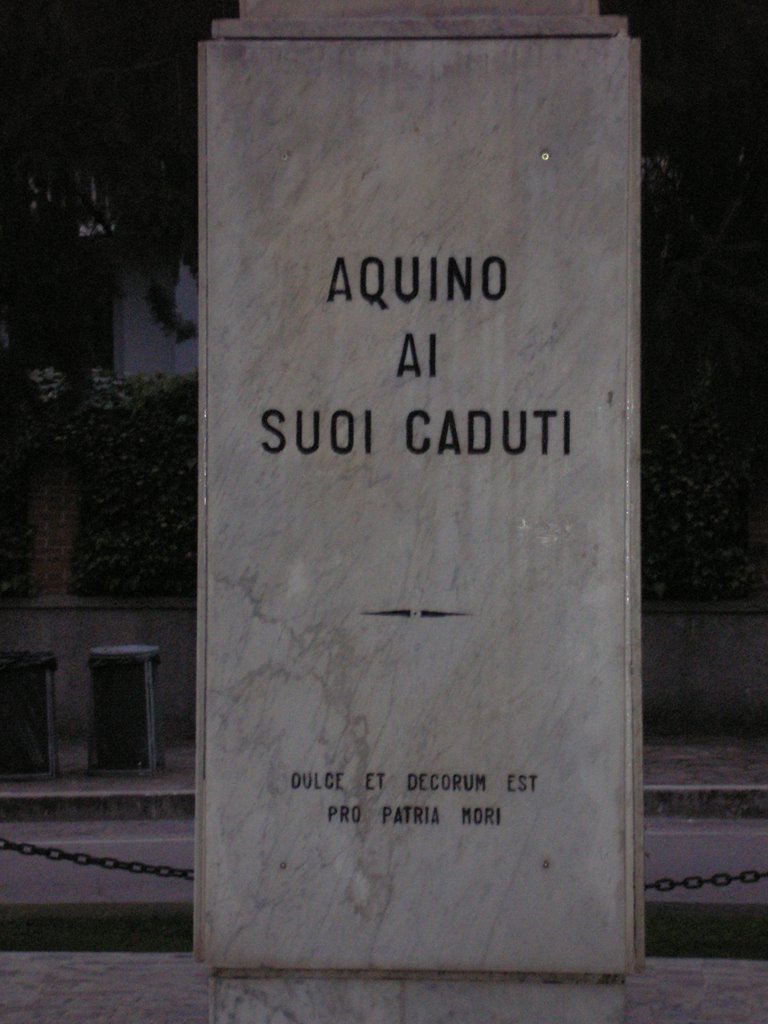
Dulce et decorum est pro patria mori is from Horace Odes 3.2. Here is the text of the whole ode:
Angustam amice pauperiem pati
robustus acri militia puer
condiscat et Parthos ferocis
uexet eques metuendus hasta
uitamque sub diuo et trepidis agat 5
in rebus. Illum ex moenibus hosticis
matrona bellantis tyranni
prospiciens et adulta uirgo
suspiret, eheu, ne rudis agminum
sponsus lacessat regius asperum 10
tactu leonem, quem cruenta
per medias rapit ira caedes.
Dulce et decorum est pro patria mori:
mors et fugacem persequitur uirum
nec parcit inbellis iuuentae
poplitibus timidoue tergo. 15
Virtus, repulsae nescia sordidae,
intaminatis fulget honoribus
nec sumit aut ponit securis
arbitrio popularis aurae. 20
Virtus, recludens inmeritis mori
caelum, negata temptat iter uia
coetusque uolgaris et udam
spernit humum fugiente pinna.
Est et fideli tuta silentio 25
merces: uetabo, qui Cereris sacrum
uolgarit arcanae, sub isdem
sit trabibus fragilemque mecum
soluat phaselon; saepe Diespiter
neglectus incesto addidit integrum, 30
raro antecedentem scelestum
deseruit pede Poena claudo.
I was surprised to find not just one, but two fifth-foot spondees in Ausonius' Versus Paschales, found under heading IV in Green's edition--a poem of only 31 lines. Moreover, the two lines come in quick succession, only separated by one line. Here are lines 21-5:
trina fides auctore uno, spes certa salutis
hunc numerum iunctis virtutibus amplectenti.
tale et terrenis specimen spectatur in oris
Augustus genitor, geminum sator Augustorum...
...omnia solus habens atque omnia dilargitus. (28)
The American Classical League's web server can not currently be found. Does anyone know why?
How are folks like me supposed to find a job?
In other news, I'm reading the Apology with my ninth grade student, a budding linguist who is further along in Greek than the students at the college who started at the same time.
After April 1st I'll be reading book 2 of Plato's Republic with J, AKA 'the Hawk' (no foolin'). We read book 1 with Eric while taking Greek Rose Comp with Gil Prose.
As my thesis winds down I'll find plenty more classical stuff to blog about. Right now hazy chronology and the technical nature of metrical analysis have been stealing my time, and don't seem very blogworthy.
I will say, though, that Byzantine scholarship has really grabbed my attention. I'd like to continue with that once this work is done, though I'd first like to make up for all the ancient classics I've never had much of a chance to read. Can you imagine tragedy and comedy never even being offered during my graduate career?
I was walking through Pembroke Arch on Bryn Mawr's campus the other day and by the time I'd crossed Merion Ave. something odd occurred to me.
Just above the arch on the left side as you're exiting there's an inscription that reads VIRTVTEM DILEXI, "I have loved virtue."
I thought I must have misread it because the college's motto is VERITATEM DILEXI (supposed to mean 'I have chosen truth'). This page at Bryn Mawr actually claims that the motto is inscribed on Pem Arch.
Later in the day I passed through and took another look. Sure enough it says VIRTVTEM.
As far back as 1908 M. Carey Thomas, the famed president of Bryn Mawr College, had instructed that the motto be placed upon the library's book plates. She quoted the motto in its conventional form, "VERITATEM DILEXI."
It has made its way onto the official seal (seen here), but is it correct? Is it possible that inscription was misread a century ago and that the misreading stuck?
As proof I've taken photos of the inscription: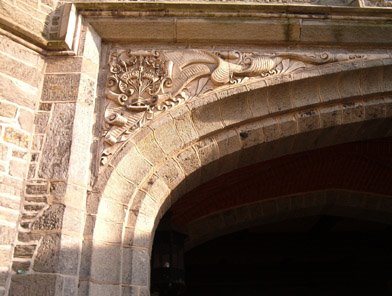
You'll probably want to have a closer look:
I suspect the phrase to be adapted from a sentiment in Cicero (whose periodic style does not lend itself to epigrams and that we should expect to be condensed):
Nihil est enim virtute amabilius, nihil quod magis adliciat ad diligendum, quippe cum propter virtutem et probitatem etiam eos, quos numquam vidimus, quodam modo diligamus.
What say we do a quick review of Latin causal clauses? The following notes are taken from Allen & Greenough sec. 321, examples (mostly) omitted.
NOTE.--Causal clauses take either the Indicative or the Subjunctive, according to their construction; the idea of Cause being contained, not in the mood itself, but in the form of the argument, or in the connecting particles.
321. The Causal Particles quod, quia, and quoniam take the Indicative, when the reason is given on the authority of the writer or speaker; the Subjunctive, when the reason is given on the authority of another.
NOTE 2.--[W]hat the speaker himself thought under other circumstances may have the Subjunctive....So with quod even a verb of saying may be in the Subjunctive: as,--
rediit quod se oblitum nescio quid diceret (Off. i. 13), he returned because he said he had forgotten something.
NOTE 3.--The Subjunctive with quia is rare. The causal particle quando takes the Indicative.
REMARK.--Non quod, non quia, non quoniam, introducing a reason expressly to deny it, take the Subjunctive. Non quo and non quin introduce a Result clause, but with nearly the same meaning.
a. Causal Clauses introduced by quod, etc., take the Subjunctive in Indirect Discourse, like any other dependent clause.
b. A Relative, when used to express cause, regularly takes the Subjunctive.
c. Cum causal takes the Subjunctive.
NOTE.--In early Latin cum causal takes the Indicative.
Ok, time for a quick review of Latin concessive clauses. The following is taken from section 313 of Allen and Greenough with the examples omitted.
The particles of Concession (meaning although, granting that) are the following: quamquam, quamlibet, quamvis, quantum vis, ut, net, cum, licet, etsi, tametsi, etiamsi.
Some of these take the Subjunctive, others the Indicative. Thus,--
a. Quamvis, ut, and ne take the Subjunctive.
NOTE.--Quamvis means literally, as much as you will....The subjunctive with quamvis and ne is hortatory; that with ut is of uncertain origin.
b. Licet (properly a verb) takes a Substantive clause in the Subjunctive.
NOTW.--The subjunctive with licet is by the sequence of tenses necessarily limited to the Present and Perfect tenses.
c. Etsi, etiamsi, tametsi, even if, take the same constructions as si.
d. Cum concessive takes the Subjunctive.
NOTE.--In early Latin cum (quom) concessive usually takes the Indicative.
e. Quamquam introduces an admitted fact and takes the Indicative.
f. Quamquam more commonly means and yet, introducing a new proposition in the indicative.
g. The poets and later writers frequently use quamvis and quamquam like etsi, connecting them with the Indicative or the Subjunctive, according to the nature of the condition.
NOTE.--Even Cicero occasionally uses quamquam with the Subjunctive.
h. The Relative pronoun qui is often used with the Subjunctive to express concession.
i. Concession is often expressed by the Hortatory Subjunctive without a particle.
Mussolini lived at Villa Torlonia in 1925-1943 with his wife and children, delighting in tennis games and horseback rides on the grounds that surround the house, built by one of Rome's aristocratic families.
"When the winds of war started blowing, he ordered the construction of the bunker," said Eugenio La Rocca, superintendent for Rome's monuments.
Two underground structures, built in great secrecy, cover more than 2,000 square feet and include an anti-gas chamber with air ducts and showers for decontamination, all protected by a double set of airtight doors.
Mussolini dug the bunker 23 feet deep, burying a 10-foot thick concrete box with bare cylindrical corridors and multiple escape routes.
While restoring the chamber, archeologists discovered it was built over a second-century Christian tomb, where they found three bodies. The area was a common burial ground in Roman times, housing mainly the sprawling underground corridors of one of six Jewish catacombs in the city.
Here's one of the things I did last night instead of working on my thesis: I took the values in 1891 British Pounds assigned by James Gow (Companion to School Classics, 3rd ed.) to Athenian and Roman coinage and converted the value to 2005 U.S. dollars.
Rome, 49 BC (when Caesar introduced the Aureus):
Aureus (gold) (= 100 sesterces) = $127.53
Denarius (silver) (= 4 sesterces) = $5.10
Sestertius (brass) (= 2 dupondii)= $1.28
As (copper) (= ¼ sesterce) = $0.32
Attic money (age undefined):
1 talent = $30,067.15
1 mina = $500.63
1 drachma = $4.79
1 obol = $0.79
The copper chalchous, 1/8 an obol, would be worth about a dime.
I have no idea how accurate this is, but it does account for inflation from the 1891 values. Gow apparently based his calculations upon the quantity of silver used in certain coins and then the relative value of these coins to others.
If it's accurate, it puts things into perspective, for example when Gow says that an artisan in the age of Pericles earned 1 drachma a day (= $4.79 US), and that a juryman made 2 obols (= $1.58).
Of course it's impossible to say what the values were in different times and places, but a ballpark is better than a desert.
My wife and I recently had some friends in town, one of whose maiden name is Aquino. Her predecessors, after coming to the U.S., are thought to have taken this surname from the name of their hometown in Italy (reminiscent of the naming of the Corleone family in Godfather). So while they were here, we decided to take a daytrip to find the old family stomping grounds, which are located south of Rome about halfway to Naples, sitting on a level plain near the mountains, within view of Monte Cassino. No train stops in somewhat small village of Aquino; rather, Aquino shares a station with a couple of other small towns nearby. We were told at the station that there are no buses and no taxis that go from the station to Aquino, so we walked a few kilometers to get to the actual town. There were a couple of interesting things I thought might be worth noting. First, Aquino is the birthplace of Thomas Aquinas. Here is the house he is said to have been born in:
Second, medieval and modern-day Aquino are built hard by the ancient Roman colony of Aquinum, thought by some to be the birthplace of Juvenal. The town in located on the Via Latina: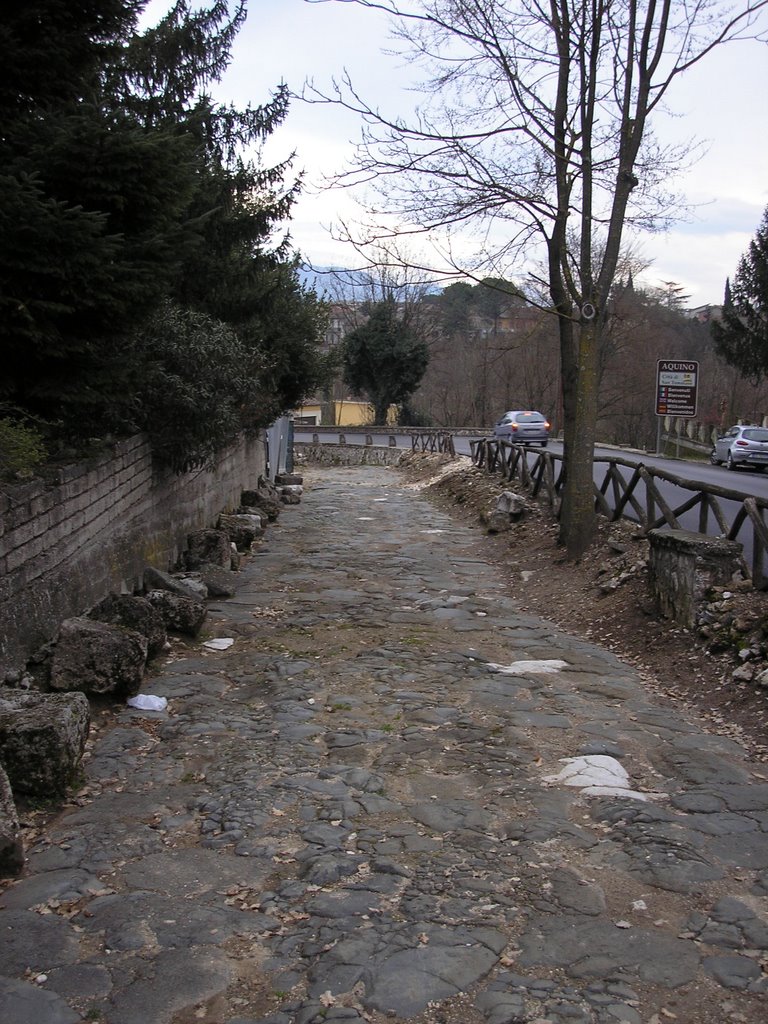
Here is the town gate and a modern sign placed there to label it: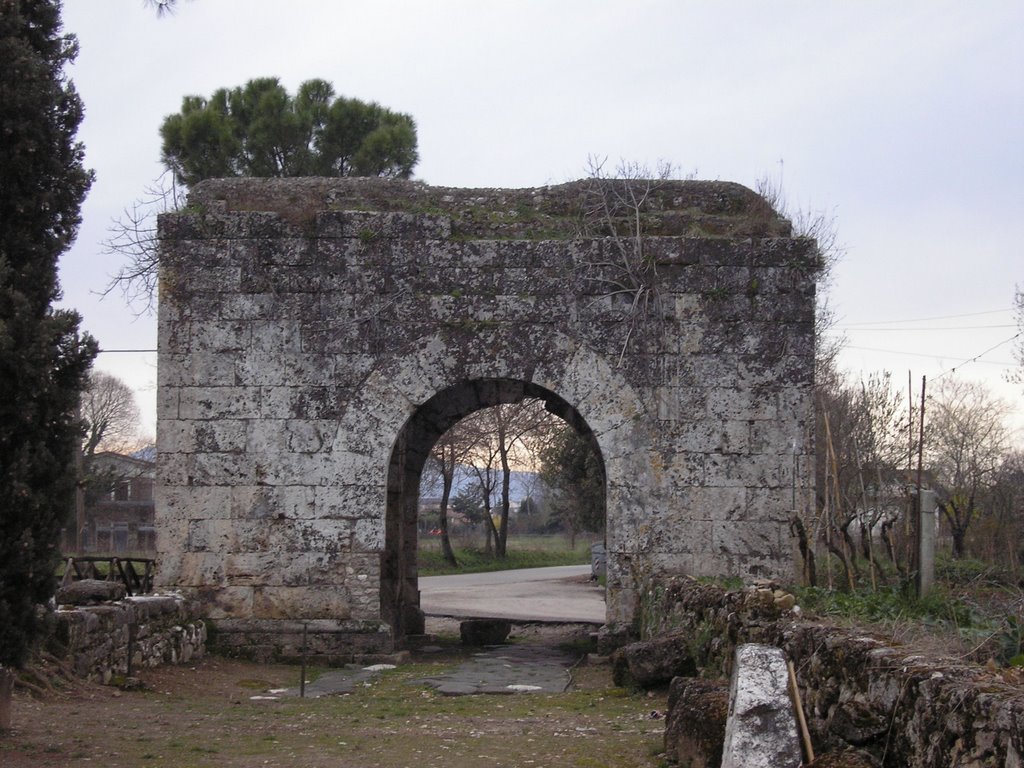

The identification of Aquinum with Juvenal's birthplace is not, however, undisputed. The 1949 edition of the Oxford Classical Dictionary affirms that Juvenal was born there, citing Satire 3.319 as evidence. Here is the passage in context (the text is from The Latin Library):
'...his alias poteram et pluris subnectere causas, 315
sed iumenta uocant et sol inclinat. eundum est;
nam mihi commota iamdudum mulio uirga
adnuit. ergo uale nostri memor, et quotiens te
Roma tuo refici properantem reddet Aquino,
me quoque ad Heluinam Cererem uestramque Dianam 320
conuerte a Cumis. saturarum ego, ni pudet illas,
auditor gelidos ueniam caligatus in agros.'
'adj. tuo may mean 'your favourite' (cf. OLD 2b, cr. Suet. Galb. I Liviae...Veientanum suum revisenti) or 'your native' (perhaps supported by reddet: OLD 2). It is usually taken to indicate J.'s birthplace; however, this involves identifying Umbricius' interlocutor with the poet Juvenal: see Introduction sec. 2. Aquinum was a town in Latium on the via Latina c. 75 miles from Rome. This lover of Rome, who does not leave with Umbricius, may have a country seat in Aquinum.'
'The second fundamental idea is one which rescues us from trying to read the satires as self-revelation. Roman verse satire uses the autobiographical monologue as the chief mode of presentation. This does not mean that the satirists are (necessarily) using their satires to convey their personal feelings to the world. Far from it. Authors in all genres of Roman literature, including Roman verse satire, were accustomed to creating characters....[I]n the personal genres of poetry--love elegy, lyric poetry, epigram and satire--the character (or persona, 'mask') is frequently presented as a first-person voice.
'Authors and their audiences were accustomed to this convention thanks to their experience of the education in rhetoric enjoyed by members of the Roman elite....The analogy between rhetoric and poetry is reinforced by the fact that most Greek and Latin literature, including poetry, was written for oral delivery by the author or another voice to a live audience. In the light of this, the identification of the views of the characters in satire with those of the authors becomes unnecessary and crude. To read the poems as autobiographical self-revelations from which 'facts' about the poet's life may be deduced (the 'biographical fallacy' propounded by, notably, Highet (1954)) is to neglect other, more rewarding, questions.' (pp. 2-3)
'Decimus Junius Juvenalis is said in a life of uncertain authenticity to have born at Aquinum. This statement is to some extent corroborated by a line in the third Satire, where the speaker suggests that his friend, who is presumably Juvenal, may some day or other be visiting his own Aquinum. It is made more probable still by the fact that a tablet has been dug up at Aquinum, in which D. Junius Juvenalis, of the cohort of the Dalmatians, duumvir quinquennalis, and flamen to the deified Vespasian, dedicates a shrine to Ceres. Helvina Ceres is alluded to in the third Satire as a deity reverenced at Aquinum. Further, there is no reason for referring to Juvenal to any other place but Aquinum, though a single scholiast says that some persons took him to have been a Gaul on account of his great size.' (p. 9)
'The biographies prefixed to his Satires in the MSS. are as numerous as they are satisfactory. Of these there are nine, seven of which are printed by Otto Jahn in his edition of 1851....Juvenal is said by all his biographers to have been the son or the adopted son of a wealthy freedman. His mother was named Septimuleia and was a townswoman of Aquinum. He had a sister, also Septimuleia, who married Fuscinus. He seems to have been brought up at a good school. His chief instructor, when he began to study rhetoric, was Protus of Berytus, a teacher who was noted for his provincial and antiquarian tastes, and whose practice it was to restrict the number of his pupils to three or four, and to converse with these in the Socratic fashion, rarely lecturing to them....The inscription at Aquinum shows that he served the most important magistracy in his native town, and held the honourable position of titular chaplain, so to speak, to Vespasian.' (pp. 9-11)
'Virtually nothing is known of the life and circumstances of Juvenal. It is not even certain that the name we give him, Decimus Iunius Iuuenalis, is correct. The ancient biographies seem worthless and even the best of these, attributed by Valla in his 1486 edition to 'Probus', offers the same kind of reconstruction from details in the Satires as presented by some recent scholars, a method which fails to take account of the generic convention of using first-person presentation....Nor is the inscription from Aquinum which was believe to depict Juvenal as commander of a Dalmation cohort reliable evidence, leaving aside the fact that it disappeared long ago; moreover, the date it suggested is earlier than other indicators. As Syme says, there is a 'scarcity of facts' in this field, although that has not prevented its being 'infested with credulity and romance'. His own assesment of the little evidence afforded by Juvenal's name and the poems leads him to suggest, tentatively, an African origin.' (pp. 15-16)
In reading through Pope Benedict XVI's recent encyclical Deus Caritas Est, I came across the following references to classical writers. All citations are from the English translation published by Libreria Editrice Vaticana (February 2006).
'The Greeks--not unlike other cultures--considered eros principally as a kind of intoxication, the overpowering or reason by "divine madness" which tears man away from his finite existence and enables him, in the very process of being overwhelmed by divine power, to experience supreme happiness. All other powers in heaven and on earth thus appear secondary: "Omnia vincit amor" says Virgil in the Bucolics--love conquers all--and he adds: et nos cedamus amori"--let us, too, yield to love.' (p. 12) [I found it interesting that he turned to a Latin example while discussing Greek ideas of eros.]
'Consequently, [God's] creation is dear to him, for it was willed by him and "made" by him. The second important element now emerges: this God loves man. The divine power that Aristotle at the height of Greek philosophy sought to grasp through reflection, is indeed for every being an object of desire and love--and as the object of love this divinity moves the world [the footnote reference is to Metaphysics XII.7]--but in itself it lacks nothing and does not love: it is solely the object of love. The one God in which Israel believes, on the other hand, loves with a personal love. His love, moreover, is an elective love: among all the nations he chooses Israel and loves her--but he does so precisely with a view to healing the whole human race. God loves, and his love may certainly be called eros, yet it is also totally agape.' (pp. 23-4)
'So [speaking of the creation of Adam and Eve] God forms woman from the rib of man. Now Adam finds the helper that he needed: "This at last is bone of my bones and flesh of my flesh" (Gen. 2:23). Here one might detect hints of ideas that are also found, for example, in the myth mentioned by Plato, according to which man was originally spherical, because he was complete in himself and self-sufficient. But as a punishment for pride, he was split into two by Zeus, so that now he longs for his other half, striving with all his being to possess it and thus regain his integrity [the footnote reference is to Symposium XIV-XV.189c-192d]. While the biblical narrative does not speak of punishment, the idea is certainly present that man is somehow incomplete, driven by nature to seek in another the part that can make him whole, the idea that only in communion with the opposite sex can he become "complete". The biblical account thus concludes with a prophecy about Adam: "Therefore a man leaves his father and his mother and cleaves to his wife and they become one flesh" (Gen. 2:24).' (p. 28)
'Acknowledgment of the living God is one path towards love, and the "yes" of our will to his will unites our intellect, will and sentiments in the all-embracing act of love. But this process is always open-ended; love is never "finished" and complete; throughout life, it changes and matures, and thus remains faithful to itself. Idem velle atque idem nolle [the footnote reference is to Sallust, De coniuratione Catilinae XX.4]--to want the same thing, and to reject the same thing--was recognized by antiquity as the authentic content of love: the one becomes similar to the other, and this leads to a community of will and thought.' (pp. 38-9)


