Thursday, June 28, 2007

A complete translation of Livy

I know I'm not the only one to hunt through Google Books to find useful editions and out of print classics.

But one thing I've had great difficulty locating is a complete text of Livy. Out of print editions on the used book market are few and expensive, and plain e-texts are unattractive. I'm not averse to printing PDFs (2-up, double-sided) and keeping them on the shelf in three ring binders.

So if you're like me and you're looking for Livy, then look no farther:


  1. Books 1 to 8
  2. Books 9 to 26
  3. Books 27 to 36
  4. Book 37 to the end

Wednesday, June 27, 2007

QOTD

I can't remember if I've posted this here before, but don't feel like checking and came across it again today. It comes from Kathleen Jamieson's article 'Jerome, Augustine and the Stesichoran Palinode' (Rhetorica 5 [1987] 353-67). On the verbal war between Rufinus and Jerome, she writes:

Reading the apologiae of Rufinus and Jerome leaves one with the sense of having helplessly witnessed the bludgeoning of a child. (p. 359)

Review: Letters of A.E. Housman

Frank Kermode in the London Review of Books reviews Archie Burnett's expensive new edition of Housman's letters. It's worth reading for many reason, including entertaining bits like this:

He declined all academic and national honours because to accept them would be to admit comparability with other classical scholars who had received them, admiring the attitude of the 17th-century Greek scholar Thomas Gataker who refused a Cambridge doctorate because ‘like Cato the censor he would rather have people ask why he had no statue than why he had one.’ When he came across some self-critical words of T.E. Lawrence in Seven Pillars of Wisdom – ‘there was a craving to be famous; and a horror of being known to like being known’ – he wrote in the margin: ‘This is me.’ So in the course of his life he turned down everything from the OM to the poet laureateship, not to speak of many honorary doctorates. And he refused all invitations to give lectures except for the ones that he conceived to be part of his job.
That's my guy. I'll leave it to you to find the bit about Wittgenstein and the bathroom.

Well, he's not quite Lesbia, but ...

A 57 year old Scotsman spent ten long years watching the man of his dreams from afar before getting up the nerve to confess his feelings in a letter, complete with a classical reference:

Aberdeen Sheriff Court heard the letter Leverett gave Mr Davidson contained references to the Roman poet Catullus and referred to Mr Davidson as the "loveliest guy" and the "cuddliest teddy bear".

It claimed the victim had shown Leverett "affection over many years" and said there was "a beautiful poem about a young man" who wanted 300,000 kisses.
He must mean Catullus 5, which by my calculation adds up precisely to ... 'many thousands.' And not only that, they're to be confounded so that not even the lovers know how many there were. But perhaps Mr. Leverett is just a very talented reader of verse. We should ask for further insights into poetic mysteries.

Before we go, the relevant (ubiquitous) poem for our readers:
Vivamus mea Lesbia, atque amemus,
rumoresque senum severiorum
omnes unius aestimemus assis!
soles occidere et redire possunt:
nobis cum semel occidit brevis lux,
nox est perpetua una dormienda.
da mi basia mille, deinde centum,
dein mille altera, dein secunda centum,
deinde usque altera mille, deinde centum.
dein, cum milia multa fecerimus,
conturbabimus illa, ne sciamus,
aut ne quis malus inuidere possit,
cum tantum sciat esse basiorum.

Lively Up Your Latin (with earthquakes)

That title doesn't make much sense, but then again I just woke up and am about the celebrate the one week anniversary of the school year's end. What better way to celebrate, however, then to write about some new information that might supplement well the dreadful (and dreadfully trendy) Cambridge Latin Course?

Here's something to add to the CLC's exceedingly dull treatment of Boudicca (even if it is questionable that the Romans wouldn't have known an earthquake when they felt one):

Up until now, a series of bizarre events that allegedly took place at the time have been played down as exaggeration and allegory rather than taken at face value.

But British classicist Raphael Isserlin has re-examined the ancient texts and concluded that they are not simply classical literary devices, but descriptions of a serious earthquake that hit the heart of the religious and political capital of Roman Britain - Colchester.

BBC History magazine, which has published Mr Isserlin's findings, explains that the texts recall how the “statue of the goddess Victory in Colchester partly rotated and toppled over, how strange sounds were heard and how the sea turned blood red”.

Along with Dr Roger Musson, the British Geological Survey's most senior seismologist, Mr Isserlin believes these three events are likely to occur during a strong earthquake.

“The noise, a deep, dull sound could conceivably have been described as a strange moan or prolonged groan - often accompanies earthquakes,” Dr Musson told BBC History.

“The seawater change could result from seismic waves causing cliff collapses or destabilising sloping mud deposits which can muddy the water and transform the colouring of the sea.

. . . . .

The full version of 'Boudica's Earthquake' in the July issue of BBC History Magazine, is on sale June 27, priced £3.60.
I'm thinking of having the kids perform a big musical number with the Britons singing "Boudic-CAN!" and the Romans "Boudic-CAN'T!" back and forth, building to a crescendo when the suddenly the earthquake hits and the Britons have the confidence to go at their oppressors West Side Story style. That will get the kids interested. ("When you're a Brit you're a Brit all the way ...".) Or maybe I'll just have some coffee now.

Friday, June 22, 2007

Homer Manuscript Coming

Apparently, a digitalized version of a 10th century manuscript of the Iliad (which is, of course, *not* one of the poems at issue in that 'centuries-old debate among scholars' known as the 'Homeric Question') is coming soon to a travel center near you on the internet superhighway. The about.com notice sends us here and here, as well.

Thursday, June 21, 2007

The 'Euripidean Question'?

When Dennis emailed me about this, I thought it had to be a joke, but apparently not. Notice anything odd in the following?

A University of Iowa graduate student won $8,000 on Tuesday's episode of "Who Wants To Be a Millionaire."

Kecia Lynn decided to walk away with $8,000 rather than answer the $16,000 question: "The Homeric Question" is a centuries-old debate among scholars over the authorship and origins of what two works? If Lynn had guessed incorrectly she would have fallen back to $1,000. The correct answer was Electra and Medea.

Friday, April 27, 2007

OCT titles

I was just entering my copy of Denys Page's Aeschylus OCT into Librarything when I noticed that one library gave the title as 'Aeschyli Septem Quae Supersunt Tragoedias [SIC].'

The jacket, the title page, and the OUP website use the accusative 'Tragoedias,' but why? The spine reads simply Aeschyli Tragoediae.

In full 'Aeschyli Septem Quae Supersunt Tragoedias edidit Denys Page' sounds like an excited statement:

'Denys Page has published the seven surviving tragedies of Aeschylus!' Oh my god! I can't even believe it!

I'm inclined to think this is actually what was intended (though I exaggerate). One could make the argument that those editions which display 'Fabulae' or 'Tragoediae' on their title pages are mistaken. What, then, would 'edidit,' 'recensuit,' or 'adnotatione instruxit' govern? One would have to read something like '... Fabulae (sc. quas) edidit ....'

Titles that use ambiguous words are plentiful, 'Opera' being the most obvious. But what about 'Carmina,' 'Historica,' 'Lyrica,' or even 'Delectus'?

Or maybe OUP just made a mistake.

Tuesday, April 24, 2007

On the Sublime (In Two Odes of Horace)

In the opening poems of Books 1 and 3 of Horace's Odes, we find a use of the adjective sublimis near the end. The two usages highlight two different types of achievement with a lofty result.

In 1.1, to Maecenas, Horace constructs a long priamel, and caps it by noting that poetry distinguishes him from the masses:

me doctarum hederae praemia frontium
dis miscent superis, me gelidum nemus
Nympharumque leves cum Satyris chori
secernunt populo, si neque tibias
Euterpe cohibet nec Polyhymnia
Lesboum refugit tendere barbiton. (29-34)
He then tells Maecenas that, if he will include Horace in the canon of lyric poets, he will strike the stars with his exalted head:
quodsi me lyricis vatibus inseres,
sublimi feriam sidera vertice. (35-6)

In 3.1, on the other hand, Horace contrasts the peace experienced by the simple rustic with the problems attendant upon the successful and materially rich. Since 'fear and threats' (37) follow where the master goes, why should Horace trouble himself to build a lofty, cutting-edge new house and give up his modest Sabine farm?
...cur invidendis postibus et novo
sublime ritu moliar atrium?
Cur valle permutem Sabina
divitias operosiores? (45-8)

Horace brings this imagery of rising aloft via poetry vs. via material construction full circle in the last ode of Book 3, 3.30, where he claims (in the first ode in this meter, which Garrison labels the 'first Asclepiadean', since 1.1) to have built a 'monument' out of his poetry that excels all material construction and even endures through the ravages of storm and time:
exegi monumentum aere perennius
regalique situ pyramidum altius,
quod non imber edax, non Aquilo impotens
possit diruere aut innumerabilis
annorum series et fuga tempora. (1-5)

Monday, April 23, 2007

Vengeance in Horace Odes 1.2

Words related to the verb ulciscor (pf. ppl. ultus) appear three times in Odes 1.2, the poem in which Horace makes the interesting transition, during the 'kletic' part of the ode, from Mercury to Augustus in what West calls (I believe, but I'll have to doublecheck) a syntactical sleight-of-hand.

The first instance comes in l. 17, referring to the personified Tiber: ...Iliae dum se nimium querenti/ iactat ultorem ('...while he vaunts himself as the avenger for Ilia, lamenting vehemently'). On what account would Ilia seek vengeance? It seems that there could be a few things in view: 1) her execution for becoming pregnant while a Vestal Virgin; 2) the murder of one of her sons, Remus, by her other son (this seems to me the least likely to be in view here, though Tiber does attempt to flood the monumenta regis (15). The Regia, of course, is properly connected with Numa, but one cannot forget Romulus' position as the first rex of Rome); 3) the assassination of Julias Caesar, her descendant.

The second use connect with 3) mentioned above. In invoking Mercury imitating a youth (=Augustus), Horace describes him this way: ...patiens vocari/ Caesaris ultor ('...allowing [yourself] to be called the avenger of Caesar') (43-4). We have moved from the divine (but personified) Tiber as avenger to the blurred human/divine of Mercury/Augustus as avenger.

The final use comes in the second-to-last line of the poem and is addressed to Caesar: ...neu sinas Medos equitare inultos ('...nor may you allow the Medes to ride unavenged') (51). Now in the purely human realm, we learn that the Parthians are unavenged. The focus has changed from vengeance for civil strife to a wish for vengeance turned to the world outside of Rome, reprising a point Horace had made in lines 21-2. This makes perfect sense in the larger context of the poem, as it is a plea to end civil wars and to turn that energy elsewhere.

Tuesday, April 17, 2007

Housman's humanity

I first encountered the story that Eric lately referred to in Gilbert Highet's The Classical Tradition: Greek and Roman Influences on Western Literature, but allusions crop up here and there, due in no small part to the contrast which it offers to Housman's published persona, which was powerfully polemical and often alienating. I think it's worth reading, so stick around through the set-up.

In chapter 21, "A Century of Scholarship," Professor Highet (who wrote elsewhere on The Art of Teaching) has some words for what he considered the worst possible teaching, namely that which views Greek and Latin as "a science, and nothing but a science."

His illustration is the life of A.E. Housman, who believed that his purpose as Professor of Latin was to be a textual critic, which is to say to work toward the reconstitution of ancient texts. Until that work was done, literary criticism was not possible.

It was admirable, and he was responsible for great advancements in philology best exemplified in his essay "The Application of Thought to Textual Criticism" (available in The Name and Nature of Poetry, and some online versions may be found, though they often have corrupt Greek). I think we've gone too far in the opposite direction, producing generations of un-philological classicists who fancy themselves literary critics while acting under the false assumption that our texts are secure. But I digress.

Housman took his appointment so seriously that he abandoned Greek, an area in which he had previously received such high praise from the likes of Wilamowitz. And we should remember that Housman, who acknowledged himself a pedant, admired the legendary Richard Bentley, whose emendations are ubiquitous, often brilliant, and always instructive even when incorrect.

And in this pursuit of textual criticism, Highet believed, he became a bad teacher of poetry. This is a matter of perspective. Housman saw himself as a teacher of language and of texts, not of poems.

But here, then, comes the surprising moment when Housman revealed his appreciative, poetic soul. The following was recorded in a letter by one of his students, and reprinted by Highet:

'[O]ne morning in May, 1914, when the trees in Cambridge were covered with blossom, he reached...the seventh ode in the fourth book of Horace.... This ode he dissected with the usual display of brilliance, wit, and sarcasm. Then for the first time in two years he looked up at us, and in quite a different voice said: "I should like to spend the last few minutes considering this ode simply as poetry." Our previous experience of Professor Housman would have made us sure that he would regard such a proceeding as beneath contempt. He read the ode aloud with deep emotion, first in Latin and then in an English translation of his own (now the fifth in More Poems). "That," he said hurriedly, almost like a man betraying a secret, "I regard as the most beautiful poem in ancient literature," and walked quickly out of the room.'
One of the men who watched this said, 'I was afraid the old fellow was going to cry.' He was. In part because of the the extreme sensitivity which made it uncomfortable for him even to recall certain lines of poetry while shaving, because his skin bristled and turned the razor's edge; but in part also because of his embarrassment at feeling that he he had permitted personal emotion to escape, and invade what he held should be nothing but an objective field of thought, sterile as ice, bright as an operating table.
I think it's obvious that Highet is wrong on one point, which I've already mentioned above: it's not 'Greek and Latin' that Housman strove to keep sterile, but his very specific task as a textual critic. It was not his business, not his academic charge, to advocate for poets or to impose taste upon other men: his was simply to restore texts and teach others the skills necessary to do the same.

Outside his job, he was as human as the rest of us.

Saturday, April 14, 2007

Diffugere nives, redeunt iam gramina campis arboribusque comae...

Color me excited. I just leard that the topic of our special seminar with Michael Putnam next Saturday (part of the annual Michels lecture events) is Horace Odes 1.4 and 4.7, two poems that we read in class this semester. Housman said that 4.7 was the most beautiful poem in the Latin language. Dennis has an even better Housman anecdote about the poem, if he would be so kind to share it with us and tell us where he learned of it :).

Sunday, April 08, 2007

Translation: theory and practice

Maximus Planudes, the great Byzantine scholar of the Palaeologan renaissance, composed a Greek translation of the Distichs of Cato (Catonis Disticha), a collection of moral advice in Latin, of late date and popular for centuries. The portion that caught my eye was the prologue to book two:

Εἰ μὲν γηπονίας ἐθέλεις μαθέειν πολυκάρπους,
Ἡσίοδον μέτιθι κλυτόν. εἰ δ’ αὖ εἰδέναι αἱρῇ
τὰς βοτανῶν δυνάμεις, Νίκανδρος τάς σε διδάξει.
εἰ δὲ Φρυγῶν ποθέεις Δαναῶν τε δαῆναι ἀγῶνας,
δίζεο θεῖον Ὅμηρον, ὃς Ἄρεος ἔργ’ ἀγορεύει.
εἰ δέ γ’ ἐρᾶν βούλει τοῦ ἐρᾶν τε τέχνην ἐπιγνῶναι,
στεῖχε Θεόκριτον ἀμφὶ γυναιμανῆ. εἰ δὲ μέλει σοι
σὺν σοφίῃ ζώειν, κλύε μοι κείνων ἃ μαθεῖν χρή,
ὧν διὰ πᾶς βότον παθέων δίχα πάντα διοικεῖ·
δεῦρ’ ἴθι γοῦν καὶ τίπτε πέλει σοφίη σύ γε μυοῦ.
I'll give a quick and dirty translation (no time to look things up):

If you want to learn about fruitful tillage, follow famed Hesiod.
And if you'd rather know the powers of plants, Nicander will teach you these.
And if you long to learn about the contests of the Phrygians and the Danaans, seek out divine Homer, who tells the works of Ares.
And if you prefer loving and learning the art of love, follow Theocritus on madness for women.

The oddest bit here is probably the reference to Theocritus as a writer of love poetry on women.

Here's the Latin original:
Telluris si forte velis cognoscere cultus,
Virgilium legito; quod si mage nosse laboras
Herbarum vires, Macer tibi carmina dicit.
Si romana cupis et punica noscere bella,
Lucanum quaeras, qui Martis proelia dixit.
Si quid amare libet, vel discere amare legendo,
Nasonem petito;
So on agriculture Vergil was preceded by Hesiod. Despite this common connection, Hesiod was less a model for Vergil than was Nicander, author of the lost Georgica (only fragments, preserved by Athenaeus, survive). Planudes must have known this, but knew just as well that the Georgica could not be consulted, which would render his translation inept in a sense. Advice only matters when it can be followed, even if it is just a literary exercise.

Aemilius Macer will tell you the powers of plants, and he too followed Nicander, this time inspired by the Alexipharmaca, one of Nicander's two extant works (one of our principal manuscripts of the Theriaca and the Alexipharmaca is written in Planudes' own hand). The poem concerned both poisons and antidotes. Lucan, rather than Vergil, is the poet of epic, and he of course followed Homer. Finally Ovid's love poetry was preceded by the amatory idylls of Theocritus. If they did not predominate among his idylls, then at least Ovid had a prodigious output not limited to love poems.

What makes this translation most interesting to me are two things: (1) that Planudes substituted Greek authors who wrote on their various themes before the Romans, and were often their models, and (2) that Planudes only used extant works that his own audience actually could read. This is translation of a sort we rarely see, making the material as relevant and accessible to the audience as if it were not a foreign work at all while still maintaining its antiquarian nature.

Wednesday, April 04, 2007

The Moon and Mars

The Rogueclassicist asks for a reference regarding his notice that on this day in 357 B.C. Aristotle observed the transit of the moon past Mars.

I'm not sure that the following passage from De Caelo will help with the date, but Aristotle does here seem to mention the event to which the RC is referring. This, then, is from De Caelo 2.12, translated by J.L. Stocks:

There are two difficulties, which may very reasonably here be raised, of which we must now attempt to state the probable solution: for we regard the zeal of one whose thirst after philosophy leads him to accept even slight indications where it is very difficult to see one’s way, as a proof rather of modesty than of overconfidence.

Of many such problems one of the strangest is the problem why we find the greatest number of movements in the intermediate bodies, and not, rather, in each successive body a variety of movement proportionate to its distance from the primary motion. For we should expect, since the primary body shows one motion only, that the body which is nearest to it should move with the fewest movements, say two, and the one next after that with three, or some similar arrangement. But the opposite is the case. The movements of the sun and moon are fewer than those of some of the planets. Yet these planets are farther from the centre and thus nearer to the primary body than they, as observation has itself revealed. For we have seen the moon, half-full, pass beneath the planet Mars, which vanished on its shadow side and came forth by the bright and shining part. Similar accounts of other stars are given by the Egyptians and Babylonians, whose observations have been kept for very many years past, and from whom much of our evidence about particular stars is derived. A second difficulty which may with equal justice be raised is this. Why is it that the primary motion includes such a multitude of stars that their whole array seems to defy counting, while of the other stars each one is separated off, and in no case do we find two or more attached to the same motion?

Tuesday, April 03, 2007

Aurea Mediocritas and Horace Odes 2.10.1-8

Horace Odes 2.10 is appropriately given the English title 'The Golden Mean' in Garrison's edition of the Epodes and Odes. The famous Latin phrase aurea mediocritas occurs in line 5, with the phrase's two words perfectly balanced around quisquis and with mediocritatem filling all six syllables of the second half of the Sapphic line after the diaeresis, or pause.

In addition, the phrase itself is bracketed and reinforced by nicely balanced syntax and anaphora in the first two stanzas:

Rectius vives, Licini, neque altum
semper urgendo neque, dum procellas
cautus horrescis, nimium premendo
litus iniquum.

Auream quisquis mediocritatem
diligit, tutus caret obsoleti
sordibus tecti, caret invidenda
sobrius aula.

In the first stanza, neque is repeated in a 'neither...nor' construction, followed each time by a gerund. Garrison points out that the gerunds are nearly synonymous in meaning, but one warns against going too far out to sea while the other warns against staying too close to the shore.

In the second stanza, anaphora is used again with caret, this time with two nominative adjectives similar in sense (tutus and sobrius) referring to the man who wisely avoids two dissimilar extremes: poverty and excessive wealth. In this instance, moreover, the word order is also chiastic: tutus caret...caret...sobrius.

The phrases using the anaphora are balanced in construction, but refer to opposite extremes in sense; Licinius is to live in between both, and hence keep to the 'golden mean'.

Tuesday, March 27, 2007

The Search for Ithaka

Story on Yahoo! News here.

Friday, March 23, 2007

This Just In: Pandora's 'Box' Actually a Jar!

Nisbet-Hubbard on Horace Odes 1.3.29:

Pandora is surprisingly little mentioned in classical literature; her 'box' was really a huge jar or pithos, mistranslated by Erasmus in his Adagia as pyxis.

Wednesday, March 21, 2007

'Our Thermopylae'?

So says Al Gore:

Testifying to the House Energy and Commerce Committee this morning, Al Gore said that climate change presented America with its Thermopylae moment. You can't say he doesn't try to catch the zeitgeist...

Saturday, March 17, 2007

Geek Joke

For some reason, my wife started the morning today by saying, jestingly, 'Friends, Romans, countrymen...'. I responded by saying, 'You know why that's a nice beginning to a speech?', thinking of the tricolon with an additional syllable added to each word. Always one to poke fun at the geek-in-residence, she responded in turn by asking, 'Because it's in the pedantic diameter?'

I chortled.

UPDATE: I guess I should note that the 'syllabic additionalism' continues in the next phrase, 'lend me your ears'. Nice, Will.

Wednesday, March 14, 2007

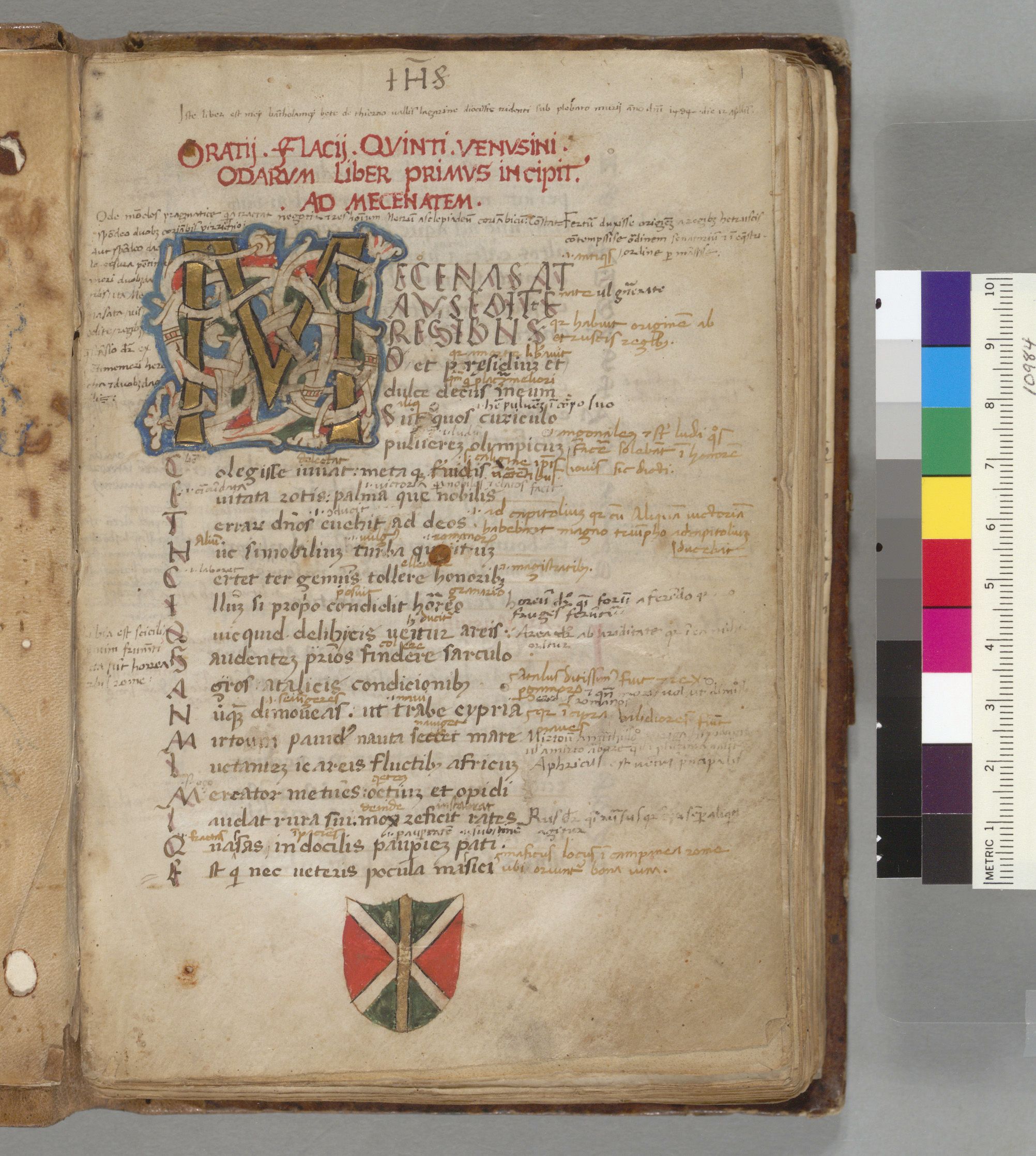
Why Doesn't My OCT Look Like This? (2)


Berkeley, University of California, The Bancroft Library, UCB 066
Part I 1. ff. 1-72 Italy s. XV
Folios: ff. 1-58 — Horace (Quintus Horatius Flaccus), Carmina

Tuesday, March 13, 2007

Why Doesn't My OCT Look Like This?

Actually, I don't even own an OCT of Horace at the moment, but I'm certain that, even if I did, this is not what I would be seeing.

Horace, Odes, Epodes, and Carmen saeculare, Italy, 1st quarter of the 16th century, 165 x 105 mm, Decorated initial
Burney 181, f. 90

Monday, March 12, 2007

A Brief Outline of Horace, Odes 2

2.1: For Pollio; civil wars; Horace ['H.' hereafter] prefers to sing of lighter subjects.

2.2: For Crispus Sallustius; moral poem; vanity of riches and supremacy of virtue.

2.3: For Delius; Golden Mean; enjoy life; death the great equalizer.

2.4: For Xanthus, in love with a slave girl; no need to be ashamed; mythological exempla; don't worry--H. not interested in the girl.

2.5: No addressee named, but the addressee interested in girl still too young for love; be patient; give it time.

2.6: For Septimius; bury me at Tibur; if that is not possible, then at Tarentum; praise of country/rural life.

2.7: For Pompeius; homecoming poem; had fought against Octavian; H. saved by Mercury at Battle of Phillipi.

2.8: For Barine, deceitful temptress of men.

2.9: For Volgius; it is not always winter; give up desiring your lost lover Mystes; sing instead of the victories of Augustus.

2.10: For Licinius; praise of the Golden Mean.

2.11:For Quinctius; time is short; enjoy the pleasures of leisure and wine while you can.

2.12: For Maecenas; war-themes not fit for lyre; they are better for prose histories; H. will sing love songs of Licymnia, who is better than all riches.

2.13: Addressed to tree that almost killed him; music in the Underworld.

2.14: For Postumus; death comes for everyone; your heir will get your possessions.

2.15: No addressee; private wealth is taking over everything against ancient custom instead of making things for public enjoyment.

2.16: For Pompeius Grosphus; peace of mind can't be found in war or bought with riches; Grosphus is rich, but H. has received a modest farm.

2.17: For Maecenas; we're best friends; we've both been saved from death; it will come eventually, but for now we should be grateful we've survived.

2.18: No addressee; H. is satisfied with his modest estate; on the other hand, the rich are greedy; but death will come for rich and poor alike.

2.19: Hymn to Bacchus; it is right to sing to him; he is powerful over many things, and was even able to go to the Underworld and escape unharmed.

2.20: For Maecenas; H. will not die, but his poetry will give him immortality; already he is turning into a swan; so, though he dies, he will not die, and his funeral will be corpseless, for 'the swan has flown' (West).

Friday, March 02, 2007

The Derveni Papyrus


This afternoon's colloquium looks to be interesting: our guest is Gabor Betegh, and his talk is titled 'The Derveni Papyrus and Early Stoicism'. Betegh is the author of The Derveni Papyrus: Cosmology, Theology and Interpretation, and you can read a review of the book by Richard Janko here. It opens:

The Derveni papyrus, containing a treatise by a follower of Anaxagoras probably written in the 420s B.C.E., is the most important new piece of evidence about Greek philosophy and religion to come to light since the Renaissance. It is also the hardest to understand, and all work on it is inevitably work in progress. This is the first book-length study of this text since 1997, when its crucial opening columns, plus an updated translation of the whole, were published.1 Betegh (henceforth 'B.') has made a major contribution to understanding both the thought of the Derveni author (henceforth 'D.') and the Orphic poem which D. interprets; his reconstruction of the Orphic theogony and of D.'s physical system should command wide assent. B. rightly concludes that D. 'is trying to make Orpheus' teaching up to date by providing it with an allegorical interpretation involving the conceptual and explanatory frameworks of late Presocratic speculation' (372).

You can also find a brief account of the papyrus here.

So, if you are in the Philadelphia area, this may be a good opportunity to learn about this incredible find.

Grandmaster Samuel Butler

NOTE: I can't seem to get anything right on this blog anymore. A little thought would have made it clear that the two Samuel Butlers couldn't be the same person. Thanks to the anonymous commenter for setting it straight. I was amusing myself while the kids took a test and just threw it up. But I still can't read Hudibras without hearing an old school hip hop beat.

I also forgot to quote this bit of it:

Beside, 'tis known he could speak Greek
As naturally as pigs squeak;
That Latin was no more difficile,
Than to a blackbird 'tis to whistle
(Notice the pronunciation of difficile.)


Samuel Butler (discussed previously regarding Homer's gender), is the source of a quotation that I use with one of my classes to illustrate 'ratiocination' (they learn the etymology, etc.).

The lines in question run as follows:
He'd run in debt by disputation,
And pay with ratiocination.
These are from a poem called Hudibras, which has given its name to a type of verse, a rhyming iambic tetrameter. I hadn't realized that Jonathan Swift wrote extensively in Hudibrastic, but then again I hadn't realized that many old school rappers did as well.

Compare Samuel Butler:
When civil fury first grew high,
And men fell out, they knew not why;
When hard words, jealousies, and fears,
Set folks together by the ears,
And made them fight, like mad or drunk,
For Dame Religion, as for punk;
Whose honesty they all durst swear for,
Though not a man of them knew wherefore:
When Gospel-Trumpeter, surrounded
With long-ear'd rout, to battle sounded,
And pulpit, drum ecclesiastic,
Was beat with fist, instead of a stick;
Then did Sir Knight abandon dwelling,
And out he rode a colonelling.
With wonder Mike of the Sugar Hill Gang:
A can of beer that's sweeter than honey,
Like a millionaire that has no money,
Like a rainy day that is not wet,
Like a gambling fiend that does not bet,
Like Dracula without his fangs,
Like the boogie to the boogie without the boogie bang,
Like collard greens that don't taste good,
Like a tree that's not made out of wood,
Like goin' up and not comin' down,
Is just like the beat without the sound
Wonder Mikes takes a few more liberties, but produces a more pleasing verse, adorned as it with anaphora and playing with the expectations of the meter by various substitutions. This makes up for the paucity of feminine rhymes and the weakness of those present, but Wonder Mike clearly viewed himself as a part of the hudibrastic tradition.

Wednesday, February 28, 2007

Classical Languages as 'Delicate Instruments of Communication'

'The ancient paideia was founded upon the literary classics. School-boys did not merely read them, they studied them with the utmost intensity, they savored in them the more recondite allusions, and they committed great portions of them to memory, with lastingly beneficial consequences, both for their own Greek and Latin style, and for the maintenance of the classical languages as uncommonly delicate instruments of communication among men.'

Arthur F. Stocker, 'Servius Servus Magistrorum' (Vergilius 9 (1963) 9-15), p. 9

Thursday, February 22, 2007

No Snow/Horace

The other day I posted a snippet of Horace that was appropriate to our snowy conditions. Since it's warmed up and everything has started to melt, I thought I'd post another snippet, even though it's not quite spring yet. These are the first four lines of Odes 1.4.

Solvitur acris hiems grata vice veris et Favoni
trahuntque siccas machinae carinas,
ac neque iam stabulis gaudet pecus aut arator igni
nec prata canis albicant pruinis.

Interpretation and Theory

I believe, then, that the classicist should see interpretation and theory as interdependent activities. But the interdependence is not symmetrical. Interpretation without theoretical reflection may be limited in scope and is vulnerable to various kinds of muddle; that certainly makes it worth less. But theory that is not rooted in our existing interpretative skills is at risk of being vacuous speculation; and that would make it worthless.'

Malcolm Heath, Interpreting Classical Texts (London: Duckworth, 2002), p. 21

Tuesday, February 20, 2007

Wilamowitz-Moellendorff/Homer's Iliad

BMCR has a new review of a book that looks very interesting, which is centered around 'the publication of a nearly word for word transcript of Wilamowitz's lectures on Homer's Iliad in 1887/1888'. The reviewer, Edith Foster, goes on to say:

Paul Draeger and a team of sub-editors surround these lectures with a very copious and responsible supporting apparatus. However, the book reaches far beyond the editing and publication of transcripts, since in addition to the lectures it offers a portrait and defense of Wilamowitz himself.

This many layered volume begins with a short essay in praise of Wilamowitz by Walter Burkert (who is simultaneously the dedicatee of the volume), after which Paul Draeger provides an essay on Wilamowitz's character as a lecturer. He describes Wilamowitz's broad activities both as a university and a public lecturer, citing many vivid eye-witness accounts. Student accounts emphasize the appeal of Wilamowitz's deep knowledge and rhetorical power.

This introduction to Wilamowitz as lecturer is followed by introductions to the lectures themselves. First, Draeger offers information on the student copyists and on the character and history of their transcripts of the Homer lectures. Second, he provides an outline of the lectures and detailed remarks on Wilamowitz's personality as it emerges from the lectures. For instance, he compares how Wilamowitz characterized scholars with whom he agreed or disagreed (62-64), and discusses how and how often Wilamowitz mentioned himself (65-66). Draeger also lists and evaluates Wilamowitz's terms of praise and blame (56-57). Other questions have a more practical orientation. Draeger argues about whether or not Wilamowitz used a blackboard and maps (probably, 54) or brought any books other than the Iliad with him to the lectures (probably not, 55-59). Without neglecting to mention Wilamowitz's errors, Draeger provides detailed demonstrations of his astonishing memory (56, 66-70). The description of the lectures is laudatory; 21st Century practices are seen in negative contrast (53, 55).

The third and penultimate element of the introduction is a description of the close connections between these lectures and Wilamowitz's book Die Ilias und Homer (1916). Draeger argues that Wilamowitz's Homer lectures of 1887/88 are still useful even though Wilamowitz's main hypotheses about book 11 of the Iliad are nearly universally rejected (77). He points out that the lectures offer a very comprehensive discussion of the material from book 11 and that this discussion is not available in Wilamowitz's later publications (77-78). He also provides a sequence of examples to show that the lecture notes contain readings which have not yet been considered for critical editions (79-81), as well as a list of passages about which Wilamowitz changed his mind by 1916 (82-83). He might have been better off to let Wilamowitz speak for himself by this point and to place such arguments after the lectures, or even in an appendix. They give the impression that the lectures will be interesting mainly to an audience studying Wilamowitz, whereas in fact, both readers studying Homer, as well as readers studying their own received practices in historical context will find them useful.

You can read the rest here.

Monday, February 19, 2007

An Ancient Way of 'Giving One's Two Cents'?

We’re all familiar with the idea of a person’s ‘two cents’. Someone pontificates on a given topic, and rounds it off with something like, ‘Well, those are my two cents, anyway.’ I’m wondering if I’ve come across an ancient way of expressing a similar sentiment.

Toward the end of Book 1 of Macrobius’ Saturnalia, Symmachus proposes that everyone present at their discussion tell of what they have noticed to be exceptional de Maronis ingenio. Here are his words:

reliquos omnes qui adestis impense precatus sim, ut quid vestrum quisque praecipuum sibi adnotaverit de Maronis ingenio, velut ex symbola conferamus.

Symbola can mean a contribution of money to a feast, so perhaps we could loosely paraphrase Symmachus’ proposal as, ‘I would ask all the rest of you here to give us your two cents concerning what you have noticed to be outstanding in Vergil’s talent.’

Vergil the Same, despite the Praises or Rebukes of Critics

So says Macrobius' Symmachus:

haec est quidem, Euangele, Maronis gloria ut nullius laudibus crescat, nullius vituperatione minuatur... .
Saturnalia 1.24.8

Thursday, February 15, 2007

Some Favorites

Two of my favorite scholars that I've been reading recently on Late Antiquity are Alan Cameron and Robert Kaster. Their writings are models of careful, well-documented scholarship, presenting interesting ideas in a lucid and clearly-argued fashion.

Two absolutely wonderful articles by Prof. Cameron on Macrobius, inter alia, are:

'The Date and Identity of Macrobius', JRS 56 (1966) 25-38
'Macrobius, Avienus, and Avianus', CQ 17 (1967) 385-99

Prof. Kaster has written, in addition to his monumental study on the Late Antique grammarian entitled Guardians of Language, a number of other fascinating articles on Late Antique education and literary culture. See, for example:

'The Grammarian's Authority', CP 75 (1980) 216-41
'Macrobius and Servius: Verecundia and the Grammarian's Function', HSCP 84 (1980) 219-62
'Notes on "Primary" and "Secondary" Schools in Late Antiquity', TAPA 113 (1983) 323-46
'Servius and Idonei Auctores', AJP 99 (1978) 181-209

If you have access to JStor, all of these articles can be found there.

Another List of Classics Blogs

While looking through our site visitation data at Site Meter, I was taken to a Wikipeda page that has a list of Classics and Ancient Languages blogs; you can find it here.

Bruce Metzger, R.I.P.

Bruce Metzger, an expert on the text of the New Testament (and a Ph.D. in Classics to boot!), has died. Anyone who has used the reddish-covered New Testament text published by United Bible Societies will be familiar with his name. One of the pre-eminent names in the field of biblical studies has departed from this earth.

May he rest in peace.

Tuesday, February 13, 2007

Snow/Horace

We've been getting some snow here in the Philadelphia area today, so I thought I would post the wintry opening stanzas of Horace Odes 1.9, followed by David West's translation:

Vides ut alta stet niue candidum
Soracte nec iam sustineant onus
siluae laborantes geluque
flumina constiterint acuto?

Dissolue frigus ligna super foco 5
large reponens atque benignius
deprome quadrimum Sabina,
o Thaliarche, merum diota.


You see Soracte standing white and deep
with snow, the woods in trouble, hardly able
to carry their burden, and the rivers
halted by sharp ice.

Thaw out the cold. Pile up the logs
on the hearth and be more generous, Thaliarchus,
as you draw the four-year-old Sabine
from its two-eared cask.

Any readers out there have any other favorites for 'wintry' passages in classical literature?

Sunday, February 11, 2007

Aristotle and the NBA

Today I was watching part of the Lakers/Cavs game on TV, and during one of the commercial breaks there was an ad for the NBA starring Yao Ming shooting the same shot over and over again. At the end was shown a black screen with this quote from Aristotle's Nicomachean Ethics in white lettering: 'Excellence is not an act, but a habit'.

Apparently this is a popular sentiment in the NBA. A quick Google search revealed the following portion of an article in a May, 2006, issue of the Miami Herald:

Miami Heat giant Shaquille O'Neal enjoys giving himself playful nicknames. A few years ago, when he stood alone atop his sport, he collected a trophy as basketball's most valuable player and dubbed himself "The Big Aristotle" while quoting the ancient philosopher.

"We are what we repeatedly do," O'Neal said. "Excellence is not an act but a habit."

O'Neal was not remotely close to excellent Monday night, and the New Jersey Nets dropped him and his Miami Heat teammates like a bad habit. What the Nets repeatedly did during this 100-88 scorching in Game 1 of this second-round playoff series was rain basket after basket upon Miami's baffled, weary head as Heat fans fled the arena early as if being chased by something equal parts hairy and scary.

Wednesday, February 07, 2007

Eternal embrace? Couple still hugging 5,000 years on

ROME (Reuters) - Call it the eternal embrace.

Real people. Real success stories. Yahoo! Personals. See Stephanie and Mike's story.

Archaeologists in Italy have discovered a couple buried 5,000 to 6,000 years ago, hugging each other.

"It's an extraordinary case," said Elena Menotti, who led the team on their dig near the northern city of Mantova.

"There has not been a double burial found in the Neolithic period, much less two people hugging -- and they really are hugging."

Menotti said she believed the two, almost certainly a man and a woman although that needs to be confirmed, died young because their teeth were mostly intact and not worn down.

"I must say that when we discovered it, we all became very excited. I've been doing this job for 25 years. I've done digs at Pompeii, all the famous sites," she told Reuters.

"But I've never been so moved because this is the discovery of something special."

A laboratory will now try to determine the couple's age at the time of death and how long they had been buried.

Tuesday, February 06, 2007

Lhomond's cento, "Viri Romae"

The work (more fully Viri Romae illustres) is alternately known as De viris illustribus. As its name implies it deals with those men in Roman history (and myth) whom posterity has honored, from Romulus through Augustus. Lhomond constructed the work as a cento, compiling his narratives from the works of a vast array of Roman writers: poets such as Vergil and Ovid were employed alongside Cicero, Livy, and even the likes of Eutropius (who wrote during the reigns of Julian and Valens).

I suspect that many will think the book somehow 'outdated,' but it was designed by a man dedicated to teaching Latin at the secondary level (he purportedly turned down several university posts) and published just three years after darwin's Origin of Species and Gibbon's Decline and Fall of the Roman Empire. Each is still a classic. And isn't Caesar, who died more than 20 centuries ago?

The text is available at the Latin Library, but a very nice student edition can be obtained through Google Books. I've just begun using this with one of my classes. Here's a sampling of the opening lines:

Proca, rex Albanorum, duos filios, Numitorem et Amulium habuit. Numitori, qui natu major erat, regnum reliquit; sed Amulius, pulso fratre, regnavit, et ut eum sobole privaret, Rheam Sylviam ejus filiam Vestae sacerdotem fecit, quae tamen Romulum et Remum uno partu edidit.
As well as being a fascinating chapter in the history of Latin pedagogy, I've found the text itself readable and interesting. Here's hoping the students do as well.

Wednesday, January 31, 2007

Another take on the value of Classics

These are the closing words of chapter 5, 'The Place of Classics in Education,' from The Aims of Education.

Europe is always flying apart because of the diverse explosive character of its inheritance, and coming together because it can never shake off that impress of unity it has received from Rome. The history of Europe is the history of Rome curbing the Hebrew and the Greek, with their various impulses of religion, and of science, and of art, and of quest for material comfort, and of lust of domination, which are all at daggers drawn with each other. The vision of Rome is the vision of the unity of civilisation.
--Alfred North Whitehead (1929)

Images from Livy (10)


'Tapestry of the History of Scipio: The Battle of Zama'. Giulio Romano (model), Francesco Penni (preparatory cartoon), François Bonnemer (Gobelins cartoon). Housed in Louvre. Here is what the Louvre's page for the work says:

Tapestry of the History of Scipio: the Battle of Zama

This is the tenth and last panel in a series the cartoons for which had been copied by François Bonnemer from a Brussels tapestry in the Royal Furniture Repository. The latter was itself based on a large tapestry depicting Scipio's military exploits, made for François I in 1535. Eight tapestries in the present series are on display at the Louvre; the other two are in the collections of the Mobilier National.

Description
The depiction of the battle

The scene, which is based on Livy's account of the second Punic War in his History of Rome (XXX, 33, 4-16), depicts the last battle pitting Scipio and the Roman army against the Carthaginians. Elephants in the Carthaginian army's front lines are charging the Romans, toppling men and horses. On the left, an elephant startled by the blare of a trumpet and a horn turns on its own camp. In the foreground, Scipio, wearing a starry blue mantle, leads his men, urging them to push back the enemy with swords and javelins.The border along the sides and lower edge features a broad garland of flowers, fruits, small animals, and frolicking children. The upper part consists of an architrave, probably to comply with the dimensions requested by the first patron to commission a tapestry on this theme, the Maréchal de Saint-André, whose arms grace the upper corners.

A glimpse into art history

François I owned a twenty-two-panel tapestry depicting the heroic deeds and ultimate triumph of Scipio Africanus. "Scipio the Great", finely woven and particularly rich in gold threads, was widely admired and copied several times. Jacques d'Albon, seigneur of Saint-André and maréchal de France since 1547, commissioned from Brussels, probably around 1558, a ten-panel history of Scipio depicting the Roman general's heroic deeds, six of which were copied directly from the king's tapestry. In the following century, it entered Mazarin's and, later, Louis XIV's collections, and, in the late seventeenth century, Louvois had it reproduced at the Gobelins, along with other Renaissance tapestries from the Royal Furniture Repository. During the Revolution, the panels were sold and dispersed. In 1797, François I's tapestry was burned along with other tapestries from the Royal Furniture Repository in order to recover the precious metals. This "copy" was preserved in the national collections and offers a partial but relatively accurate glimpse of the famous tapestry, since destroyed.

An innovative composition

Most of the models for the tapestry can be attributed to Giulio Romano, an artist who did a great deal of decorative painting in Italy, as well as drawings for tapestries. His colleague, Gian Francesco Penni, made preliminary cartoons for the artists who painted the full-scale cartoons. Several institutions, including the Louvre, have drawings Giulio made of the victory, as well as studies that can be related to the heroic deeds. The composition of the Battle of Zama tapestry is both original and bold. Traditionally, battle scenes had been presented in profile. Here, the artist shows the enemy bearing down on the viewer, putting him on the same plane as the Roman vanguard, thereby drawing him into the heart of the battle.

Documentation

Jules Romain. L'Histoire de Scipion. Tapisseries et dessins, Paris, Galeries nationales du Grand Palais, 1978.Lefebure Amaury, La galerie de Scipion, feuillet Louvre 6 27Lefebure Amaury, "La Bataille de Zama, tapisserie d'après Jules Romain", in Carthage, l'histoire, sa trace et son écho, Paris, Galeries nationales du Grand Palais, 1995, pp.164-169.

Tuesday, January 30, 2007

Essentials of Antiquity

The other day I was trying to think of a list of literary works from antiquity besides the Bible that could be described as 'essential' based on the criterion that most (or many) people have at least heard of them by title and/or author, even if that's all they know about them. It must, it seems to me, be a rather short list. Here is what I've come up with for the Greek side.

Aesop, Fables
Aristotle, Politics and, perhaps, Poetics
Homer, Iliad and Odyssey
Plato, Republic
Sophocles, Oedipus the King

Thoughts?

Sunday, January 28, 2007

"Perhaps you are lazy ..."

I'm just now memorizing this in order to respond to students:

(From The Relation of Latin to Practical Life by Frances Ellis Sabin, 1913)

Transcription (for those without graphics):


ANSWERS TO SOME COMMON OBJECTIONS TO THE STUDY OF LATIN

1. "It's too hard!"

Perhaps it's not so hard as you think. Perhaps you are lazy and do not like to do anything that does not immediately interest you and so calls for an effort of your will. Anyone who has had much experience in life will tell you that very few things that are really worth while come easily. Do you know Herbert Spencer's famous definition of education: "to accustom myself to do the thing I know I ought to do at the time when I ought to do it, whether I feel like doing it or not"?
Number 1 is the best of all, so we'll leave it there. I'm actually going to turn this into a poster.

One problem though: was it Herbert 'survival of the fittest' Spencer who said that, or another famed Darwinist of sorts T.H. Huxley?

Was ist das?

I've never wondered until now what exactly 'kleine Schriften' means, so I'm putting it to the kind visitors who've helped me in the past.

'Small' in the sense of notes, unpublished papers, and the like? Or can this include things like journal articles as opposed to monographs and other 'big' works? What exactly is small, semantically, about the works included? My dictionaries are no help.

Friday, January 26, 2007

Images from Livy (9)


'Landscape with She-Wolf Suckling Romulus and Remus', by Annibale Carracci (1560-1609), c. 1590. Pen, brown ink and brown wash, retouched in black ink, on white paper. Paris, Louvre.

There ought to be a word for that

Somebody recently traveled to the Campus after reading a post at Laudator Temporis Acti from 2004 in which Michael Gilleland wondered about a new coinage to capture the idea of hating one's own race. He ended up unhappy with misautogeny.

I think αὐτός feels out of place here. What you want is 'same,' not self.

I humbly submit misomophyly (secondary accent on the first syllable, primary accent on the third).

The phrase μισεῖν τούς ὁμοφύλους would mean 'to hate those of one's own race.' Racism, on the other hand, could find a synonym in misallophyly.

I like the way misomophyly sounds -- there's a certain pleasant sensation in the speech organs. Funny for such an ugly word.

Thursday, January 25, 2007

The (re)Birth of Athena

Once upon a time I said that I was tired of Athena and off she went, and the Campus had nice facelift in her absence. Now she's returned and brought some more changes with her. (Notice her, hiding up there in the header? But what has she done with Homer Boy?)

The changes were brought about by Eric's suggestion that we move over to Google's new Blogger system. This necessitated a change in the template, and though I've fancied myself a web designer of sorts since the mid-90s, I kind of like the simplicity of this setup.

You'll notice that I've stolen Laura Gibbs's Roman Calendar, and I've added the year (A.V.C., a change I'll only need to make once a year).

In addition we've now got an RSS feed of YLE's Nuntii Latini.

More relvant to the Campus, though, you'll next see in the sidebar that we've got a more navigable 'back catalogue' (archive) and a nifty 'filing cabinet' (post labels).

We're slowly adding labels to old posts, and while this has never exactly been a juggernaut, we do have several hundred.

Which brings up an advancing milestone: the Campus will turn three on April 4th (begun with an in-joke as humorous now as it never was). In just over two months Eric and I will have been intermittently mining homework, grasping at intellectual straws, and promising to post more often for a full three years. That's one for each of our readers. You guys deserve it.

Images from Livy (8)


'Romulus and Remus Given Shelter by Faustulus', by Pietro Berrettini, called Pierre de Cortone (1597-1669), around 1643 (Paris, Louvre)

Wednesday, January 24, 2007

Say What?

ATHENS, Greece (AP) -- A clutch of modern pagans honored Zeus at a 1,800-year-old temple in the heart of Athens on Sunday -- the first known ceremony of its kind held there since the ancient Greek religion was outlawed by the Roman Empire in the fourth century.

Watched by curious onlookers, some 20 worshippers gathered next to the ruins of the temple for a celebration organized by Ellinais, a year-old Athens-based group that is campaigning to revive old religious practices from the era when Greece was a fount of education and philosophy.

The group ignored a ban by the Culture Ministry, which declared the site off limits to any kind of organized activity to protect the monument.

But participants did not try to enter the temple itself, which is closed to everyone, and no officials sought to stop the ceremony.

Dressed in ancient costumes, worshippers standing near the temple's imposing Corinthian columns recited hymns calling on the Olympian Zeus, "King of the gods and the mover of things," to bring peace to the world.

"Our message is world peace and an ecological way of life in which everyone has the right to education," said Kostas Stathopoulos, one of three "high priests" overseeing the event, which celebrated the nuptials of Zeus and Hera, the goddess of love and marriage.

To the Greeks, ecological awareness was fundamental, Stathopoulos said after a priestess, with arms raised to the sky, called on Zeus "to bring rain to the planet."

A herald holding a metal staff topped with two snake heads proclaimed the beginning of the ceremony before priests in blue and red robes released two white doves as symbols of peace. A priest poured libations of wine and incense burned on a tiny copper tripod while a choir of men and women chanted hymns.

You can find the rest
here.

Images from Livy (7)


'Les Sabines', by Jacques-Louis David (1748-1825), 1799 (Paris, Louvre)

Liveblogging Homeroom

As I sit at my desk lethargic kids wander in and out. Only three have yet taken their seats and each is listening to his iPod, staring blankly at the agenda on the board. It's one day until the final exam and they're feeling uneasy (or worse) at the prospect of answering 250 questions and still having time left to write a translation unseen.

The coffee isn't bad this morning. The administration can't afford the best, but some kind soul among the faculty occasionally brings in little packets of half-and-half in abundance, and that makes all the difference. I suspect that somewhere a 7-11 manager is scratching his head: 'I thought I'd just refilled that.' It's a good thing, too, because it's helping me to forget my hunger and the fact that I haven't brought any money today.

So what's on the agenda today? We'll have no Channel 1, no school news broadcast either, because of the principal's noble effort of promoting reading every Wednesday morning. They'll probably read the latest texts from their friends.

But today it's review. Practice with verb tenses, cases of nouns, and a new game of team translation: the kids with the highest grades will lead teams, but may not write anything. This should help to keep the other kids active while the captains coach. Maybe we should call them coaches instead.

It's just about time for the Pledge, so I'm out.

Tuesday, January 23, 2007

ProfessoCop?

I came home today, made myself a nice bowl of soup, and caught the end of some documentary on Roman engineering when lo and behold I see Peter Weller.

When I see Peter Weller I can only think of RoboCop, and to Peter I apologize for that. It's just that I was an impressionable kid when he made that movie. I had no idea that Peter teaches at Syracuse and is pursuing a PhD:

Weller, 58, who holds a master's degree in Roman and Renaissance art and is working toward a Ph.D., has become one of Syracuse University's most popular professors.

"My fascination with ancient Rome started as a kid back in Texas when my father turned me on to Robert Graves, who wrote 'I, Claudius,'" says Weller, speaking from the South African set of the adventure movie "Prey." "I was always reading about the great emperors of Rome and then I started collecting first-century coins."

And he even has a good sense of humor:
Last year, Weller taught a course called "Hollywood and the Roman Empire."

"It's a classics course posing as a film course," he says. "Eighty kids signed up thinking they'd get an easy A from RoboCop. When they saw the reader was 450 pages, including Homer and Suetonius, a quarter of the class dropped out."
That was written in September of 2005. Does anyone have an update on Master Weller?

UPDATE (27 Jan 2007): David Meadows (courtesy of Laura Gibbs) reports that Wired has a brief article on the subject.

Images from Livy (6)


'The Introduction of the Cult of Cybele at Rome', by Andrea Mantegna (about 1430/1-1506), 1505-6. Glue on Linen. Housed in National Gallery (London).

The National Gallery's page on this picture says the following:

Inscribed in the centre: S HOSPES NUMINIS IDAEI C [By decree of the Senate host to the Idaean deity]. Various other inscriptions on the tombs.

In 204 BC the Romans brought the cult of Cybele, the eastern goddess of victory, from Pessina, Asia Minor, to Rome. Mantegna has combined the accounts of Ovid, Livy and Appian. Cybele is represented by her sacred stone - 'she fell to earth as a meteor' - and as a bust with a mural crown (associating her with a city state). According to Juvenal, Cornelius Scipio (probably in profile gesturing with his right hand) was the most worthy Roman citizen to receive Cybele.

This is one of four pictures commissioned in 1505 by Francesco Cornaro a Venetian nobleman, who claimed descent from the ancient Cornelii family (prominent in the picture). Mantegna only completed one before his death and Bellini supplied another (Washington, National Gallery).

Monday, January 22, 2007

Images from Livy (5)


'Marcus Curtius', attributed to Bacchiacca (1495-1557), probably about 1520-30. Oil on wood. Housed in National Gallery (London).

Friday, January 19, 2007

Images from Livy (4)


'The Death of Camilla', by Jacques-Louis David (1748-1825), black chalk with brush and gray wash on cream-colored laid paper (New York, Metropolitan Museum of Art)

Some Essential Anglophone Resources on Livy

This list is not meant to be exhaustive and does not include commentaries. Suggestions for additional resources are welcome. This is a very basic list that has a number of good places to start.

Cantor, H.V. 'Livy the Orator'. Classical Journal 9 (1913) 24-34.

McDonald, A.H. 'The Style of Livy'. Journal of Roman Studies 47 (1957) 155-72.

Syme, R. 'Livy and Augustus'. Harvard Studies in Classical Philology 64 (1959) 27-87.

Walsh, P.G. Livy. Greece and Rome. New Surveys in the Classics 8 (Oxford: Clarendon Press, 1974).

----. Livy: His Historical Aims and Methods. Cambridge, UK: University Press, 1961.

----. 'Livy's Preface and the Distortion of History'. American Journal of Philology 76 (1955) 369-81.

Thursday, January 18, 2007

Images from Livy (3)


'The Oath of the Horatii', by Jacques-Louis David (1748-1825), 1786 (Toledo, Toledo Museum of Art)

Wednesday, January 17, 2007

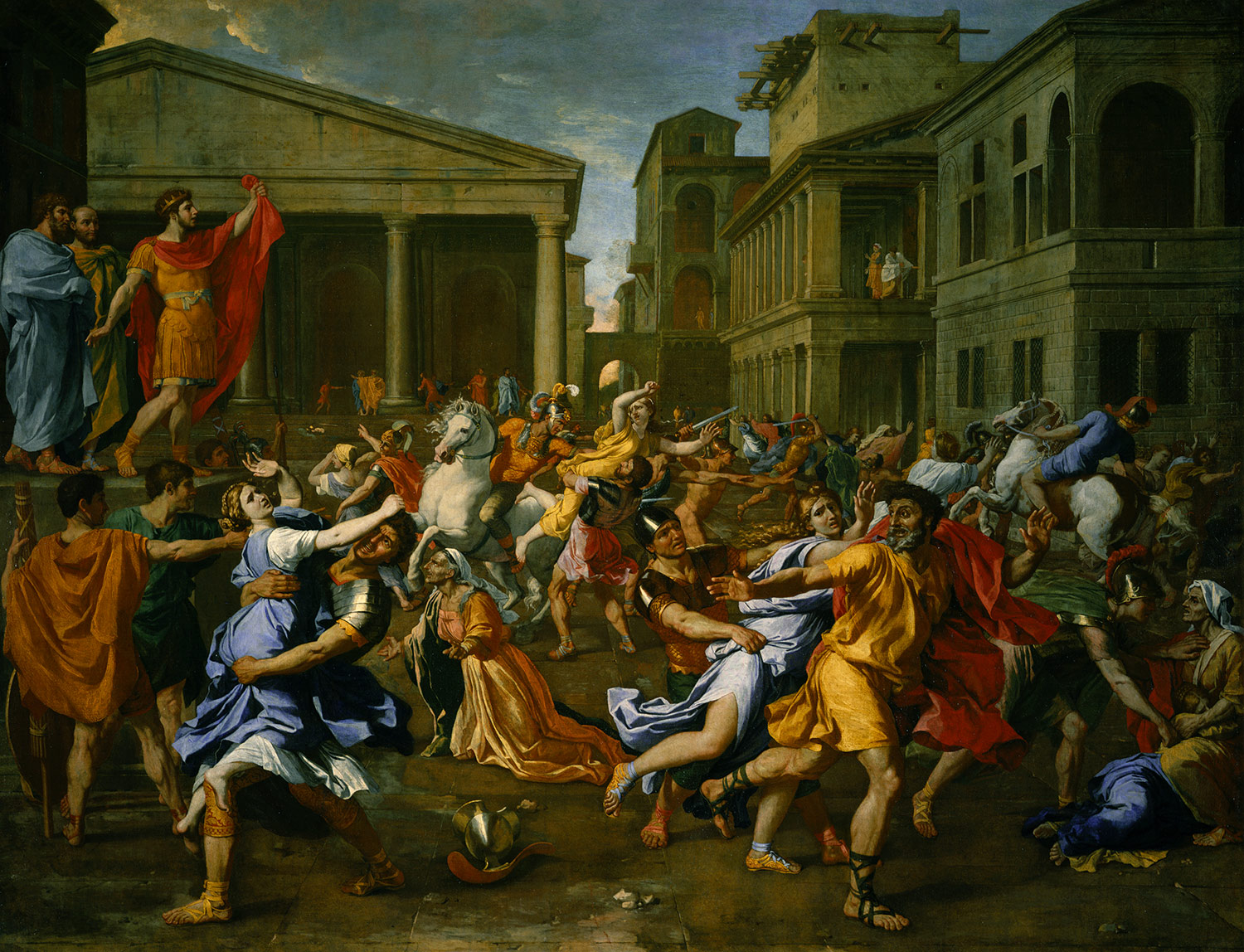
Images from Livy (2)


'The Rape of the Sabines', by Nicolas Poussin (1594-1665), ca. 1637-8 (Paris, Louvre)

Some Introductory Notes on Livy

The normal dates give for Livy's life are: born 59 BC, died AD 17 (Syme has challenged this dating and has made a case for 64 BC-AD 12; see his paper 'Livy and Augustus'). He was a native of Padua, hence Asinius Pollio's recriminations over his Patavinitas, though the meaning of this accusation remains in question.

His history, Ab urbe condita, consisted originally of 142 books. Of these, 35 books are extant: books 1-10 and 21-45. Summaries (epitomes or Periochae) of most of the remaining books have come down to us (with the exception of books 136 and 137), the value of which varies. The work spans Rome's legendary beginnings to, most likely, the death of Drusus in 9 BC, or perhaps the defeat of Varro in the Teutoberg Forest in AD 9.

For those interested in Late Antiquity, it is worth noting that 'Q. Aurelius Symmachus corrected a set of manuscripts containing the whole of Livy's work, as we know from a subscription; this was a large-scale cooperative venture of the Nicomachi and Symmachi families and is the ultimate source for all surviving manuscripts of the first decade' (Conte 374).

(For very brief introductions, see the Oxford Classical Dictionary and G.B. Conte's Latin Literature, pp. 367-76 (quoted above).)

Tuesday, January 16, 2007

Images from Livy (1)


'The Oath of the Horatii', by Armand Caraffe (1762-1822) (Moscow, Pushkin Museum)

Monday, January 15, 2007

Notes on Teaching Latin with 'Courses'

More than half a century ago Jacques Barzun wrote, in Teacher in America, something I feel strongly about everyday when I go to work and struggle to teach with the Cambridge Latin Course:

We have all had in our hands these little works, which start off "Wie geht's heute mit dir, teurer Hans?" and go on with chitchat, anecdotes, and pictures of Salzburg. This is chumminess misplaced. Let the teacher say "how do you do" and let the book remain what a book should be -- a systematic exposition of the subject, in which the student can find what he is looking for. Nothing is more exasperating than to have to wonder whether the subjunctive was given together with a description of Bremerhaven or later, with the sad story of Struwwelpeter. Besides, no student is better off for having all the verbs given in bits, half a tense at a time.
Instead of Bremerhaven we have the remains of Pompeii. We're not lucky enough to have Shock-headed Peter, but the ghost of a gladiator makes a brief appearance. The subjunctive will wait for the second or third year, along with probably the ablative and many other useful things. Instead of chitchat we have an unending stream of Latin in the vein of 'See Spot run': servus anulum conspectat. servus anulum capit. servus abit. *yawn*

The 'course' is useful if you have little more Latin than the book will teach you, and even less history and culture.

The problem with courses is that they're proscribed -- teach the genitive if you wish, but the kids won't see one for another year. Every time you step off the course you're bound to wonder whether you should ever step on again.

Poetry and Livy's Preface

It is interesting to me that Livy's preface begins with the first four feet of a dactylic hexameter:

Facturusne operae pretium sim...

In other words, he inaugurates his prose history with the trappings of epic. This is only the first indication in the preface that Livy has poets on his mind.

He refers again to poetry when commenting on his refusal either to attempt to substantiate or refute the accounts of Rome's earliest days:
Quae ante conditam condendamve urbem poeticis magis decora fabulis quam incorruptis rerum gestarum monumentis traduntur, ea nec adfirmare nec refellere in animo est.

And, in a nice bit of ring-composition-cum-variatio, he ends the preface with a reference to 'the poets':
Cum bonis potius omnibus votisque et precationibus deorum dearumque, si, ut poetis, nobis quoque mos esset, libentius inciperemus, ut orsis tantum operis successus prosperos darent.

This is a present contrary-to-fact condition: 'If I were a poet, I would begin...'; in other words, he's not a poet, so he won't begin in such a way.

Or will he? By raising the issue in the first place, in a sort of praeteritio, he's already put such an invocation in the minds of his readers, his denials notwithstanding. And it's not as though he hasn't been thinking about the gods in the course of this preface:
Datur haec venia antiquitati, ut miscendo humana divinis primordia urbium augustiora faciat, et si cui populo licere oportet consecrare origines suas et ad deos referre auctores, ea belli gloria est populo Romano ut, cum suum conditorisque sui parentem Martem potissimum ferat, tam et hoc gentes humanae patiantur aequo animo quam imperium patiuntur.


Some questions to ponder: what, exactly, is the relationship of Livy's history to epic poetry? Was he attempting to write 'epic in prose'? How close are the parallels we can draw between his treatment and use of foundation myths and the treatment and use of them made by Vergil?

I realize that these are questions that have probably been addressed at length in the scholarship. Nevertheless, they're some questions that came up as I was reading the preface, and it's always good to try to take a fresh look. And it's better, perhaps, to try to come up with some ideas and theories before rushing to the answers that have already been given.

As always, any comments or feedback is welcome.

Friday, December 29, 2006

The pretense of a classical education

Quoth Alan Rickman as Hans Gruber in Die Hard,

'When Alexander saw the breadth of his domain, he wept for there were no more worlds to conquer.' Benefits of a classical education.
Hans clearly presents this as a quotation, presumably from a classical source, but there seems to be no real antiquity to it. At least not in that form. It may be a distortion of a passage in Plutarch, as the page linked suggests, a suspicion I had come to just before reading that page. Plutarch had actually said that Alexander wept upon hearing that there were infinite worlds, realizing that he had not yet conquered even one of them.

The mistake is easy enough to understand. A) Everybody knows that Alexander conquered the world, B) we hear that Alexander wept ... hm ... something about other worlds ... ah-ha! C) Alexander wept when he realized there were no other worlds to conquer!

Variations on the theme crop up throughout 19th century works in much the same form as today, namely as vague references to something we all just know to be true. One book review I found from 1842 uses a slight variant and justifies itself by saying, 'the books tell us,' suggesting that it was already a commonplace:
Alexander wept for other worlds to conquer, the books tell us, because, forsooth, he had marched with an army in one direction through countries whose utmost extent was about two-thirds that of the United States.
This is clearly drawn from the passage in Plutarch referred to above, though through some intermediate source that has blurred the original and offered the wrong context. (Incidentally, the review in which this crops up is for a work of alternate history by Louis Geoffroy, apparently one of the first of its kind.)

Even before this and for long after it was a commonplace in English grammar and composition books. Searches like those I performed with Google Print show wild variations more than a century and a half ago, indicating that this non-classical quotation was, even then, used by those professing a classical education, doubtless unchecked by others eager to maintain the same pretense.

It's clear in their contexts that earlier writers such as Calvin and Molière understood the original, but the repetition of an obscure quotation seems, in this case, like a particularly romantic game of telephone.

In fact, I wonder now if a misreading of Calvin wasn't the original culprit. Calvin used the reference in his interpretation of Psalm 146 ('3. Trust not in princes; in the son of man in whom there is not safety. 4. His breath shall go forth; he shall return to his earth, in that day his thoughts [285] shall perish.'):
When he says that in that day all his thoughts perish, or flow away, perhaps under this expression he censures the madness of princes in setting no bounds to their hopes and desires, and scaling the very heavens in their ambition, like the insane Alexander of Macedon, who, upon hearing that there were other worlds, wept that he had not yet conquered one, although soon after the funeral urn sufficed him.
That Calvin juxtaposed this event closely with Alexander's death (which I'm not sure Plutarch hints at) made it easier to confuse conquering no world with conquering this world, a feat acknowledged by all for Alexander, who died young.

Martial's Drinking Game

David Meadows, the rogue classicist, is wondering about an epigram of Martial that is bandied about here and there to support the claim that 'the Romans' (always a loaded phrase) would toast their ladies with a drink for every letter of their names. Unable to find the epigram due to the old-fashioned habit among old-fashioned writers of forgoing citations (as though everyone with a proper education should recognize every classical reference, as when Tully ruefully remarked ... you get the picture), David has asked for help in locating a verse translated in part as 'Six cups to Naevia's health go quickly round!'

That would be Martial 1. 71:

Laevia sex cyathis, septem Iustina bibatur,
Quinque Lycas, Lyde quattuor, Ida tribus.
Omnis ab infuso numeretur amica Falerno,
Et quia nulla venit, tu mihi, Somne, veni.
The custom, via this epigram, has even found its way into the Oxford Latin Dictionary under bibo 1 d, 'to toast (a name, by drinking once for each letter).'
Let Laevia be drunk with six glasses, Justina seven,
Lycas five, Lyde four, Ida three.
Let all my loves be recounted from the Falernian (wine) consumed,
and since none comes, you, Sleep, come to me.
David was right, I think, in suspecting the claim to be spurious in that the context makes it clear that this wasn't a custom, but simply a sad and lonely night for poor old Martial, drinking himself to sleep over thoughts of girls gone by.

That's why I've translated bibatur as 'let her be drunk' rather than 'let her be toasted.' The idea of a toast is misleading. Martial is not 'drinking to the health' of all the girls he knew before; rather, the alcohol acts as a surrogate for each.

It's heart-breaking, really.

I'm kind of a big deal

I'm conflicted. Is this a compliment?

I'm a great fan of your site, and wish I'd known of the grad school cheat sheet when I was a student...I'm a great fan of your site, and wish I'd known of the grad school cheat sheet when I was a student...
Or is it an ad?
I wonder if you're familiar with the blog by the TLS classics editor, Mary Beard http://timesonline.typepad.com/dons_life/ - she discusses various aspects of classics (which she teaches at Cambridge) and today's entry discusses why the Romans didn't drink cocktails and why they should have
Either way, I'm honored as the author of that e-mail works for the TLS. Even if other (more consistent) blogs received similar messages, it's the TLS.

So that will allow me to rest on my laurels a bit more during what's left of Winter break. I'll play some more Nintendo Wii, read some soul-destroying books on education and teaching, and develop more lesson plans. What I am unlikely to do, however, is blog, so I reckon Mary Beard will have to keep picking up the slack for the Campus (I jest).

Monday, November 27, 2006

In Stabiano

Apologies for the long hiatus here from my end. Can't promise that's going to change in the near future.

While I was home briefly during the Thanksgiving break, I had the chance to check out the exhibition In Stabiano: Exploring the Ancient Seaside Villas of the Roman Elite at the Toledo Museum of Art (it is a traveling exhibition currently on display there). In addition to material artifacts such as vessels and some papyrus fragments (including a snippet of Thucydides), 'In Stabiano' boasts some magnificent frescoes from several villas in ancient Stabiae (destroyed, along with Herculaneum and Pompeii, in the eruption of Vesuvius in AD 79). If anyone is in the Toledo area, or in the vicinity of the other museums whither the exhibition will travel after departing thence, you might really enjoy checking it out.

Saturday, November 04, 2006

Because Learning about Words is Fun

Merriam-Webster's word for today:

doyen \DOY-un\ noun

*1 : the senior or most experienced member of a group
2 : the oldest example of a category

Example sentence:
We watched a TV documentary by Jacques Cousteau, the doyen of undersea explorers.

Did you know?
English picked up "doyen" from French in the 17th century. The French term in turn comes from the Late Latin word "decanus," which itself comes from the Greek "dekanos," meaning "chief of ten." A "doyen" can be a leader of a group, such as a diplomatic corps. In this regard, the word has been used to refer to someone who is specifically or tacitly allowed to speak for that group. More broadly, a "doyen" refers to a highly skilled and respected veteran of a particular field. The feminine form of "doyen" is "doyenne."

*Indicates the sense illustrated in the example sentence.

Wednesday, November 01, 2006

John Calvin, Near-Classicist

Unlike Luther, Calvin was not a university-trained theologian. He had, of course, been sent by his father to the University of Paris in order to study for the priesthood. But the original plans for John's ordination were scuttled when his father, a notary for the bishop of Noyon in Picardy, quarrelled with the cathedral chapter. In the aftermath of the quarrel Calvin was sent instead to Orleans and later to Bourges to study law. By inclination Calvin preferred to be neither a lawyer nor a priest, though he did obey his father by earning a doctorate in civil law. In the preface to his commentary on the Psalms, written many years after the events, Calvin claimed that his chief ambition as a young man had been to lead a quiet life as a reclusive scholar, one who edited and interpreted classical texts. He might very well have lived such a quiet life, had he not experienced what he later described as a rapid, if somewhat reluctant, conversion to the Protestant movement. This unexpected conversion propelled him within a remarkably short time to prominence withing Protestant circles of reform.

(From David C. Steinmetz, 'The Theology of John Calvin' (in The Cambridge Companion to Reformation Theology, edited by David Bagchi and David C. Steinmetz [2004], pp. 113-29), pp. 113-14.)

Tuesday, October 31, 2006

Auden's Thoughts on Catullus (et al.)

From 'New Year Letter', Part One:

There DRYDEN sits with modest smile,
The master of the middle style,
Conscious CATULLUS who made all
His gutter-language musical,
Black TENNYSON whose talents were
For an articulate despair,
Trim, dualistic BAUDELAIRE,
Poet of cities, harbours, whores,
Acedia, gaslight and remorse,
HARDY whose Dorset gave much joy
To one unsocial English boy,
And RILKE whom die Dinge bless,
The Santa Claus of loneliness.

An Article on Novels Set in Ancient Rome

You may find it here.

(Link via Arts&Letters Daily.)

Monday, October 30, 2006

'Sermo Beati Augustini super Verbis Apostoli ad Galatas...

The Boar's Head Tavern currently has a banner quote by Augustine (not sure how long it will remain up there) that reads as follows:

We, who preach and write books, write in a manner altogether different from the manner in which the canon of Scriptures has been written. We write while we make progress. We learn something new every day. We dictate at the same time as we explore. We speak as we still knock for understanding. … I urge your charity, on my behalf and in my own case, that you should not take any previous book or preaching of mine as Holy Scripture. … If anyone criticises me when I have said what is right, he does not do right. But I would be more angry with the one who praises me and takes what I have written for Gospel truth than the one who criticises me unfairly.

For anyone interested (which perhaps is only me), I believe this is pulled from one of Augustine's Dolbeau sermons (the 'Sermo Beati Augustini super Verbis Apostoli ad Galatas...'). Here is some of the Latin, which includes part of the passage quoted above:
Certe non quiesco, quantum possum, ubi esse possum utilis fratribus, et loquendo et scribendo. Admoneo caritatem vestram, a me, usque ad me, ne cuiusquam disputationis librum aut disputationem pro canonica scriptura habere velitis. In scripturis sanctis iudicare discimus, in scripturis nostris iudicari non dedignamur. Illud quidem eligendum est et hoc potius de duobus optandum, ut scribendo vel loquendo vera dicamus, nusquam erremus. Sed quoniam hoc implere difficile est, ideo aliud est firmamentum canonis, tamquam caelum ubi sunt constituta luminaria scripturarum, velut inter aquas et aquas, inter populos angelorum et populos hominum: illos supra, istos infra. Teneamus scripturam tamquam scripturam, tamquam deum loquentem; non ibi quaeramus hominem errantem. Non enim frustra canon in ecclesiam constitutus est: spiritus sancti hoc officium est. Si quis ergo legit librum meum, iudicet me: si rationabile dixi, sequatur non me, sed rationem ipsam; si hoc provavi testmonio evidentissimo atque divino, sequatur non me, sed scripturam divinam. Se autem aliquid quod ego recte dixi reprehendere voluerit, non rect facit, sed plus irascor tali lauditori meo qui librum meum tamquam canonicum accipit, quam ei qui in libro meo etiam non reprehendenda reprehendit. Rogo vos: quamvis intentos vos videam et paene recentissimos, velut modo audire coeperitis, tamen nolo aliquid amplius dicere, ut hoc quod ultimum dixi fortiter teneatis.

The whole sermon is an interesting survival from Late Antiquity and can be read with great profit.

Monday, October 23, 2006

An Exhortation to Read Better

The following is from Mortimer J. Adler's How to Read a Book. It can be found on pp. 6-10 of the 1940 edition of the book; it is here cited from the 1965 edition, the entirety of which is available online by clicking the title of this post. You can also find the link through the Wikipedia page for 'How to Read a Book'.

I did not discover I could not read until after I had left college. I found it out only after I tried to teach others how to read. Most parents have probably made a similar discovery by trying to teach their youngsters. Paradoxically, as a result, the parents usually learn more about reading than their children. The reason is simple. They have to be more active about the business. Anyone who teaches anything has to.

To get back to my story. So far as the registrar's records were concerned, I was one of the satisfactory students in my day at Columbia. We passed courses with creditable marks. The game was easy enough, once you caught on to the tricks. If anyone had told us then that we did not know much or could not read very well, we would have been shocked. We were sure we could listen to lectures and read the books assigned in such a way we could answer examination questions neatly. That was the proof of our ability.

Some of us took one course which increased our self-satisfaction enormously. I had just been started by John Erskine. It ran for two years, was called General Honors, and was open to a select group of juniors and seniors. It consisted of nothing but "reading" the great books, from the Greek classics through the Latin and medieval masterpieces right down to the best books of yesterday, William James, Einstein, and Freud. The books were in all fields: they were histories and books of science or philosophy, dramatic poetry and novels. We discussed them with our teachers one night a week in informal, seminar fashion.

That course had two effects on me. For one thing, it made me think I had struck educational gold for the first time. Here was real stuff, handled in a real way, compared to the textbook and lecture courses that merely made demands on one's memory. But the trouble was I not only thought I had struck gold; I also thought that I owned the mine. Here were the great books. I knew how to read. The world was my oyster.

If, after graduation, I had gone into business or medicine or law, I would probably still be harboring the conceit that I knew how to read and was well read beyond the ordinary. Fortunately, something woke me form this dream. For every illusion that the classroom can nourish, there is a school of hard knocks to destroy it. A few years of practice awaken the lawyer and the doctor. Business or newspaper work disillusions the boy who thought he was a trader or a reporter when he finished the school of commerce or journalism. Well, I thought I was liberally educated, that I knew how to read, and had read a lot. The cure for that was teaching, and the punishment that precisely fitted my crime was to having to teach, the year after I graduated, in this very Honors course which had so inflated me.

As a student, I had read all the books I was now going to teach but, being very young and conscientious, I decided to read them again- you know, just to brush up each week for class. To my growing amazement, week after week, I discovered that the books were almost brand new to me. I seemed to be reading them for the first time, these books which I thought I had "mastered" thoroughly.

As time went on, I found out not only that I did not know very much about any of these books, but also that I did not know how to read them very well. To make up for my ignorance and incompetence I did what any young teacher might do who was afraid of both his students and his job. I used secondary sources, encyclopedias, commentaries, all sorts of books about books about these books. In that way, I thought, I would appear to know more than the students. They wouldn't be able to tell that my questions or points did not come from my better reading of the book they too were working on.

Fortunately for me I was found out, or else I might have been satisfied with getting by as a teaching just as I had got by as a student. If I had succeeded in fooling others, I might soon have deceived myself as well. My first good fortune was in having as a colleague in this teaching Mark Van Doren, the poet. He led off in the discussion of poetry, as I was supposed to do in the case of history, science, and philosophy. He was several years my senior, probably more honest than I, certainly a better reader. Forced to compare my performance with his, I simply could not fool myself. I had not found out what the books contained by reading them, but by reading about them.

My questions about a book were of the sort anyone could ask or answer without having read the book—anyone who had had recourse to the discussion which a hundred secondary sources provide for those who cannot or do not want to read. In contrast, his questions seemed to arise from the pages of the book itself. He actually seemed to have some intimacy with the author. Each book was a large world, infinitely rich for exploration, and woe to the student who answered questions as if, instead of traveling therein, he had been listening to a travelogue. The contrast was too plain, and too much for me. I was not allowed to forget that I did not know to read.

My second good fortune lay in the particular group of students who formed that first class. They were not long in catching on to me. They knew how to use the encyclopedia, or a commentary, or the editor's introduction which usually graces the publication of a classic, just as well as I did. One of them, who has since achieved fame as a critic, was particularly obstreperous. He took what seemed to me endless delight in discussing the various about the book, which could be obtained from secondary sources, always to show me and the rest of the class that the book itself still remained to be discussed. I do not mean that he or the other students could read the book better than I, or had done so. Clearly none of us, with the exception of Mr. Van Doren, was doing the job of reading.

After the first year of teaching, I had few illusions left about my literacy. Since then, I have been teaching students how to read books, six years at Columbia with Mark Van Doren and for the last ten years at the University of Chicago with President Robert M. Hutchins. In the course of years, I think I have gradually learned to read a little better. There is no longer any danger of self-deception, of supposing that I have become expert. Why? Because reading the same books year after year, I discover each time what I found out the first year I began to teach: the book I am rereading is almost new to me. For a while, each time I reread it, that I had really read it well at last, only to have the next reading show up my inadequacies and misinterpretations. After this happens several times, even the dullest of us is likely to learn that perfect reading lies at the end of the rainbow. Although practice makes perfect, in this art of reading as in any other, the long run needed to prove the maxim is longer than the allotted span.