Tuesday, January 30, 2007

Essentials of Antiquity

The other day I was trying to think of a list of literary works from antiquity besides the Bible that could be described as 'essential' based on the criterion that most (or many) people have at least heard of them by title and/or author, even if that's all they know about them. It must, it seems to me, be a rather short list. Here is what I've come up with for the Greek side.

Aesop, Fables
Aristotle, Politics and, perhaps, Poetics
Homer, Iliad and Odyssey
Plato, Republic
Sophocles, Oedipus the King

Thoughts?

Sunday, January 28, 2007

"Perhaps you are lazy ..."

I'm just now memorizing this in order to respond to students:

(From The Relation of Latin to Practical Life by Frances Ellis Sabin, 1913)

Transcription (for those without graphics):


ANSWERS TO SOME COMMON OBJECTIONS TO THE STUDY OF LATIN

1. "It's too hard!"

Perhaps it's not so hard as you think. Perhaps you are lazy and do not like to do anything that does not immediately interest you and so calls for an effort of your will. Anyone who has had much experience in life will tell you that very few things that are really worth while come easily. Do you know Herbert Spencer's famous definition of education: "to accustom myself to do the thing I know I ought to do at the time when I ought to do it, whether I feel like doing it or not"?
Number 1 is the best of all, so we'll leave it there. I'm actually going to turn this into a poster.

One problem though: was it Herbert 'survival of the fittest' Spencer who said that, or another famed Darwinist of sorts T.H. Huxley?

Was ist das?

I've never wondered until now what exactly 'kleine Schriften' means, so I'm putting it to the kind visitors who've helped me in the past.

'Small' in the sense of notes, unpublished papers, and the like? Or can this include things like journal articles as opposed to monographs and other 'big' works? What exactly is small, semantically, about the works included? My dictionaries are no help.

Friday, January 26, 2007

Images from Livy (9)


'Landscape with She-Wolf Suckling Romulus and Remus', by Annibale Carracci (1560-1609), c. 1590. Pen, brown ink and brown wash, retouched in black ink, on white paper. Paris, Louvre.

There ought to be a word for that

Somebody recently traveled to the Campus after reading a post at Laudator Temporis Acti from 2004 in which Michael Gilleland wondered about a new coinage to capture the idea of hating one's own race. He ended up unhappy with misautogeny.

I think αὐτός feels out of place here. What you want is 'same,' not self.

I humbly submit misomophyly (secondary accent on the first syllable, primary accent on the third).

The phrase μισεῖν τούς ὁμοφύλους would mean 'to hate those of one's own race.' Racism, on the other hand, could find a synonym in misallophyly.

I like the way misomophyly sounds -- there's a certain pleasant sensation in the speech organs. Funny for such an ugly word.

Thursday, January 25, 2007

The (re)Birth of Athena

Once upon a time I said that I was tired of Athena and off she went, and the Campus had nice facelift in her absence. Now she's returned and brought some more changes with her. (Notice her, hiding up there in the header? But what has she done with Homer Boy?)

The changes were brought about by Eric's suggestion that we move over to Google's new Blogger system. This necessitated a change in the template, and though I've fancied myself a web designer of sorts since the mid-90s, I kind of like the simplicity of this setup.

You'll notice that I've stolen Laura Gibbs's Roman Calendar, and I've added the year (A.V.C., a change I'll only need to make once a year).

In addition we've now got an RSS feed of YLE's Nuntii Latini.

More relvant to the Campus, though, you'll next see in the sidebar that we've got a more navigable 'back catalogue' (archive) and a nifty 'filing cabinet' (post labels).

We're slowly adding labels to old posts, and while this has never exactly been a juggernaut, we do have several hundred.

Which brings up an advancing milestone: the Campus will turn three on April 4th (begun with an in-joke as humorous now as it never was). In just over two months Eric and I will have been intermittently mining homework, grasping at intellectual straws, and promising to post more often for a full three years. That's one for each of our readers. You guys deserve it.

Images from Livy (8)


'Romulus and Remus Given Shelter by Faustulus', by Pietro Berrettini, called Pierre de Cortone (1597-1669), around 1643 (Paris, Louvre)

Wednesday, January 24, 2007

Say What?

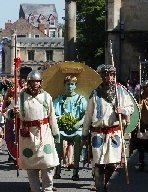
ATHENS, Greece (AP) -- A clutch of modern pagans honored Zeus at a 1,800-year-old temple in the heart of Athens on Sunday -- the first known ceremony of its kind held there since the ancient Greek religion was outlawed by the Roman Empire in the fourth century.

Watched by curious onlookers, some 20 worshippers gathered next to the ruins of the temple for a celebration organized by Ellinais, a year-old Athens-based group that is campaigning to revive old religious practices from the era when Greece was a fount of education and philosophy.

The group ignored a ban by the Culture Ministry, which declared the site off limits to any kind of organized activity to protect the monument.

But participants did not try to enter the temple itself, which is closed to everyone, and no officials sought to stop the ceremony.

Dressed in ancient costumes, worshippers standing near the temple's imposing Corinthian columns recited hymns calling on the Olympian Zeus, "King of the gods and the mover of things," to bring peace to the world.

"Our message is world peace and an ecological way of life in which everyone has the right to education," said Kostas Stathopoulos, one of three "high priests" overseeing the event, which celebrated the nuptials of Zeus and Hera, the goddess of love and marriage.

To the Greeks, ecological awareness was fundamental, Stathopoulos said after a priestess, with arms raised to the sky, called on Zeus "to bring rain to the planet."

A herald holding a metal staff topped with two snake heads proclaimed the beginning of the ceremony before priests in blue and red robes released two white doves as symbols of peace. A priest poured libations of wine and incense burned on a tiny copper tripod while a choir of men and women chanted hymns.

You can find the rest
here.

Images from Livy (7)


'Les Sabines', by Jacques-Louis David (1748-1825), 1799 (Paris, Louvre)

Liveblogging Homeroom

As I sit at my desk lethargic kids wander in and out. Only three have yet taken their seats and each is listening to his iPod, staring blankly at the agenda on the board. It's one day until the final exam and they're feeling uneasy (or worse) at the prospect of answering 250 questions and still having time left to write a translation unseen.

The coffee isn't bad this morning. The administration can't afford the best, but some kind soul among the faculty occasionally brings in little packets of half-and-half in abundance, and that makes all the difference. I suspect that somewhere a 7-11 manager is scratching his head: 'I thought I'd just refilled that.' It's a good thing, too, because it's helping me to forget my hunger and the fact that I haven't brought any money today.

So what's on the agenda today? We'll have no Channel 1, no school news broadcast either, because of the principal's noble effort of promoting reading every Wednesday morning. They'll probably read the latest texts from their friends.

But today it's review. Practice with verb tenses, cases of nouns, and a new game of team translation: the kids with the highest grades will lead teams, but may not write anything. This should help to keep the other kids active while the captains coach. Maybe we should call them coaches instead.

It's just about time for the Pledge, so I'm out.

Tuesday, January 23, 2007

ProfessoCop?

I came home today, made myself a nice bowl of soup, and caught the end of some documentary on Roman engineering when lo and behold I see Peter Weller.

When I see Peter Weller I can only think of RoboCop, and to Peter I apologize for that. It's just that I was an impressionable kid when he made that movie. I had no idea that Peter teaches at Syracuse and is pursuing a PhD:

Weller, 58, who holds a master's degree in Roman and Renaissance art and is working toward a Ph.D., has become one of Syracuse University's most popular professors.

"My fascination with ancient Rome started as a kid back in Texas when my father turned me on to Robert Graves, who wrote 'I, Claudius,'" says Weller, speaking from the South African set of the adventure movie "Prey." "I was always reading about the great emperors of Rome and then I started collecting first-century coins."

And he even has a good sense of humor:
Last year, Weller taught a course called "Hollywood and the Roman Empire."

"It's a classics course posing as a film course," he says. "Eighty kids signed up thinking they'd get an easy A from RoboCop. When they saw the reader was 450 pages, including Homer and Suetonius, a quarter of the class dropped out."
That was written in September of 2005. Does anyone have an update on Master Weller?

UPDATE (27 Jan 2007): David Meadows (courtesy of Laura Gibbs) reports that Wired has a brief article on the subject.

Images from Livy (6)


'The Introduction of the Cult of Cybele at Rome', by Andrea Mantegna (about 1430/1-1506), 1505-6. Glue on Linen. Housed in National Gallery (London).

The National Gallery's page on this picture says the following:

Inscribed in the centre: S HOSPES NUMINIS IDAEI C [By decree of the Senate host to the Idaean deity]. Various other inscriptions on the tombs.

In 204 BC the Romans brought the cult of Cybele, the eastern goddess of victory, from Pessina, Asia Minor, to Rome. Mantegna has combined the accounts of Ovid, Livy and Appian. Cybele is represented by her sacred stone - 'she fell to earth as a meteor' - and as a bust with a mural crown (associating her with a city state). According to Juvenal, Cornelius Scipio (probably in profile gesturing with his right hand) was the most worthy Roman citizen to receive Cybele.

This is one of four pictures commissioned in 1505 by Francesco Cornaro a Venetian nobleman, who claimed descent from the ancient Cornelii family (prominent in the picture). Mantegna only completed one before his death and Bellini supplied another (Washington, National Gallery).

Monday, January 22, 2007

Images from Livy (5)


'Marcus Curtius', attributed to Bacchiacca (1495-1557), probably about 1520-30. Oil on wood. Housed in National Gallery (London).

Friday, January 19, 2007

Images from Livy (4)


'The Death of Camilla', by Jacques-Louis David (1748-1825), black chalk with brush and gray wash on cream-colored laid paper (New York, Metropolitan Museum of Art)

Some Essential Anglophone Resources on Livy

This list is not meant to be exhaustive and does not include commentaries. Suggestions for additional resources are welcome. This is a very basic list that has a number of good places to start.

Cantor, H.V. 'Livy the Orator'. Classical Journal 9 (1913) 24-34.

McDonald, A.H. 'The Style of Livy'. Journal of Roman Studies 47 (1957) 155-72.

Syme, R. 'Livy and Augustus'. Harvard Studies in Classical Philology 64 (1959) 27-87.

Walsh, P.G. Livy. Greece and Rome. New Surveys in the Classics 8 (Oxford: Clarendon Press, 1974).

----. Livy: His Historical Aims and Methods. Cambridge, UK: University Press, 1961.

----. 'Livy's Preface and the Distortion of History'. American Journal of Philology 76 (1955) 369-81.

Thursday, January 18, 2007

Images from Livy (3)


'The Oath of the Horatii', by Jacques-Louis David (1748-1825), 1786 (Toledo, Toledo Museum of Art)

Wednesday, January 17, 2007

Images from Livy (2)


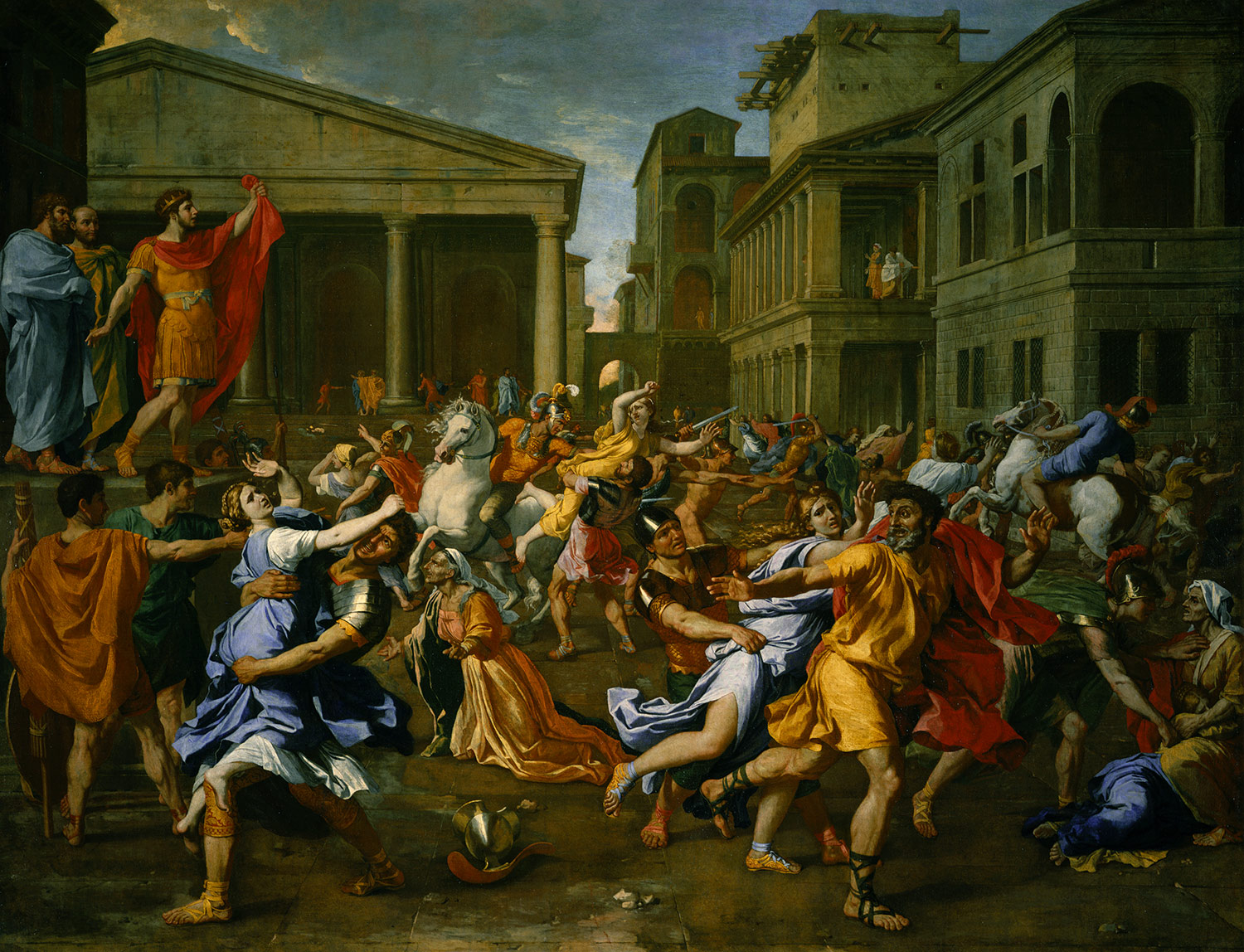
'The Rape of the Sabines', by Nicolas Poussin (1594-1665), ca. 1637-8 (Paris, Louvre)

Some Introductory Notes on Livy

The normal dates give for Livy's life are: born 59 BC, died AD 17 (Syme has challenged this dating and has made a case for 64 BC-AD 12; see his paper 'Livy and Augustus'). He was a native of Padua, hence Asinius Pollio's recriminations over his Patavinitas, though the meaning of this accusation remains in question.

His history, Ab urbe condita, consisted originally of 142 books. Of these, 35 books are extant: books 1-10 and 21-45. Summaries (epitomes or Periochae) of most of the remaining books have come down to us (with the exception of books 136 and 137), the value of which varies. The work spans Rome's legendary beginnings to, most likely, the death of Drusus in 9 BC, or perhaps the defeat of Varro in the Teutoberg Forest in AD 9.

For those interested in Late Antiquity, it is worth noting that 'Q. Aurelius Symmachus corrected a set of manuscripts containing the whole of Livy's work, as we know from a subscription; this was a large-scale cooperative venture of the Nicomachi and Symmachi families and is the ultimate source for all surviving manuscripts of the first decade' (Conte 374).

(For very brief introductions, see the Oxford Classical Dictionary and G.B. Conte's Latin Literature, pp. 367-76 (quoted above).)

Tuesday, January 16, 2007

Images from Livy (1)


'The Oath of the Horatii', by Armand Caraffe (1762-1822) (Moscow, Pushkin Museum)

Monday, January 15, 2007

Notes on Teaching Latin with 'Courses'

More than half a century ago Jacques Barzun wrote, in Teacher in America, something I feel strongly about everyday when I go to work and struggle to teach with the Cambridge Latin Course:

We have all had in our hands these little works, which start off "Wie geht's heute mit dir, teurer Hans?" and go on with chitchat, anecdotes, and pictures of Salzburg. This is chumminess misplaced. Let the teacher say "how do you do" and let the book remain what a book should be -- a systematic exposition of the subject, in which the student can find what he is looking for. Nothing is more exasperating than to have to wonder whether the subjunctive was given together with a description of Bremerhaven or later, with the sad story of Struwwelpeter. Besides, no student is better off for having all the verbs given in bits, half a tense at a time.
Instead of Bremerhaven we have the remains of Pompeii. We're not lucky enough to have Shock-headed Peter, but the ghost of a gladiator makes a brief appearance. The subjunctive will wait for the second or third year, along with probably the ablative and many other useful things. Instead of chitchat we have an unending stream of Latin in the vein of 'See Spot run': servus anulum conspectat. servus anulum capit. servus abit. *yawn*

The 'course' is useful if you have little more Latin than the book will teach you, and even less history and culture.

The problem with courses is that they're proscribed -- teach the genitive if you wish, but the kids won't see one for another year. Every time you step off the course you're bound to wonder whether you should ever step on again.

Poetry and Livy's Preface

It is interesting to me that Livy's preface begins with the first four feet of a dactylic hexameter:

Facturusne operae pretium sim...

In other words, he inaugurates his prose history with the trappings of epic. This is only the first indication in the preface that Livy has poets on his mind.

He refers again to poetry when commenting on his refusal either to attempt to substantiate or refute the accounts of Rome's earliest days:
Quae ante conditam condendamve urbem poeticis magis decora fabulis quam incorruptis rerum gestarum monumentis traduntur, ea nec adfirmare nec refellere in animo est.

And, in a nice bit of ring-composition-cum-variatio, he ends the preface with a reference to 'the poets':
Cum bonis potius omnibus votisque et precationibus deorum dearumque, si, ut poetis, nobis quoque mos esset, libentius inciperemus, ut orsis tantum operis successus prosperos darent.

This is a present contrary-to-fact condition: 'If I were a poet, I would begin...'; in other words, he's not a poet, so he won't begin in such a way.

Or will he? By raising the issue in the first place, in a sort of praeteritio, he's already put such an invocation in the minds of his readers, his denials notwithstanding. And it's not as though he hasn't been thinking about the gods in the course of this preface:
Datur haec venia antiquitati, ut miscendo humana divinis primordia urbium augustiora faciat, et si cui populo licere oportet consecrare origines suas et ad deos referre auctores, ea belli gloria est populo Romano ut, cum suum conditorisque sui parentem Martem potissimum ferat, tam et hoc gentes humanae patiantur aequo animo quam imperium patiuntur.


Some questions to ponder: what, exactly, is the relationship of Livy's history to epic poetry? Was he attempting to write 'epic in prose'? How close are the parallels we can draw between his treatment and use of foundation myths and the treatment and use of them made by Vergil?

I realize that these are questions that have probably been addressed at length in the scholarship. Nevertheless, they're some questions that came up as I was reading the preface, and it's always good to try to take a fresh look. And it's better, perhaps, to try to come up with some ideas and theories before rushing to the answers that have already been given.

As always, any comments or feedback is welcome.

Friday, December 29, 2006

The pretense of a classical education

Quoth Alan Rickman as Hans Gruber in Die Hard,

'When Alexander saw the breadth of his domain, he wept for there were no more worlds to conquer.' Benefits of a classical education.
Hans clearly presents this as a quotation, presumably from a classical source, but there seems to be no real antiquity to it. At least not in that form. It may be a distortion of a passage in Plutarch, as the page linked suggests, a suspicion I had come to just before reading that page. Plutarch had actually said that Alexander wept upon hearing that there were infinite worlds, realizing that he had not yet conquered even one of them.

The mistake is easy enough to understand. A) Everybody knows that Alexander conquered the world, B) we hear that Alexander wept ... hm ... something about other worlds ... ah-ha! C) Alexander wept when he realized there were no other worlds to conquer!

Variations on the theme crop up throughout 19th century works in much the same form as today, namely as vague references to something we all just know to be true. One book review I found from 1842 uses a slight variant and justifies itself by saying, 'the books tell us,' suggesting that it was already a commonplace:
Alexander wept for other worlds to conquer, the books tell us, because, forsooth, he had marched with an army in one direction through countries whose utmost extent was about two-thirds that of the United States.
This is clearly drawn from the passage in Plutarch referred to above, though through some intermediate source that has blurred the original and offered the wrong context. (Incidentally, the review in which this crops up is for a work of alternate history by Louis Geoffroy, apparently one of the first of its kind.)

Even before this and for long after it was a commonplace in English grammar and composition books. Searches like those I performed with Google Print show wild variations more than a century and a half ago, indicating that this non-classical quotation was, even then, used by those professing a classical education, doubtless unchecked by others eager to maintain the same pretense.

It's clear in their contexts that earlier writers such as Calvin and Molière understood the original, but the repetition of an obscure quotation seems, in this case, like a particularly romantic game of telephone.

In fact, I wonder now if a misreading of Calvin wasn't the original culprit. Calvin used the reference in his interpretation of Psalm 146 ('3. Trust not in princes; in the son of man in whom there is not safety. 4. His breath shall go forth; he shall return to his earth, in that day his thoughts [285] shall perish.'):
When he says that in that day all his thoughts perish, or flow away, perhaps under this expression he censures the madness of princes in setting no bounds to their hopes and desires, and scaling the very heavens in their ambition, like the insane Alexander of Macedon, who, upon hearing that there were other worlds, wept that he had not yet conquered one, although soon after the funeral urn sufficed him.
That Calvin juxtaposed this event closely with Alexander's death (which I'm not sure Plutarch hints at) made it easier to confuse conquering no world with conquering this world, a feat acknowledged by all for Alexander, who died young.

Martial's Drinking Game

David Meadows, the rogue classicist, is wondering about an epigram of Martial that is bandied about here and there to support the claim that 'the Romans' (always a loaded phrase) would toast their ladies with a drink for every letter of their names. Unable to find the epigram due to the old-fashioned habit among old-fashioned writers of forgoing citations (as though everyone with a proper education should recognize every classical reference, as when Tully ruefully remarked ... you get the picture), David has asked for help in locating a verse translated in part as 'Six cups to Naevia's health go quickly round!'

That would be Martial 1. 71:

Laevia sex cyathis, septem Iustina bibatur,
Quinque Lycas, Lyde quattuor, Ida tribus.
Omnis ab infuso numeretur amica Falerno,
Et quia nulla venit, tu mihi, Somne, veni.
The custom, via this epigram, has even found its way into the Oxford Latin Dictionary under bibo 1 d, 'to toast (a name, by drinking once for each letter).'
Let Laevia be drunk with six glasses, Justina seven,
Lycas five, Lyde four, Ida three.
Let all my loves be recounted from the Falernian (wine) consumed,
and since none comes, you, Sleep, come to me.
David was right, I think, in suspecting the claim to be spurious in that the context makes it clear that this wasn't a custom, but simply a sad and lonely night for poor old Martial, drinking himself to sleep over thoughts of girls gone by.

That's why I've translated bibatur as 'let her be drunk' rather than 'let her be toasted.' The idea of a toast is misleading. Martial is not 'drinking to the health' of all the girls he knew before; rather, the alcohol acts as a surrogate for each.

It's heart-breaking, really.

I'm kind of a big deal

I'm conflicted. Is this a compliment?

I'm a great fan of your site, and wish I'd known of the grad school cheat sheet when I was a student...I'm a great fan of your site, and wish I'd known of the grad school cheat sheet when I was a student...
Or is it an ad?
I wonder if you're familiar with the blog by the TLS classics editor, Mary Beard http://timesonline.typepad.com/dons_life/ - she discusses various aspects of classics (which she teaches at Cambridge) and today's entry discusses why the Romans didn't drink cocktails and why they should have
Either way, I'm honored as the author of that e-mail works for the TLS. Even if other (more consistent) blogs received similar messages, it's the TLS.

So that will allow me to rest on my laurels a bit more during what's left of Winter break. I'll play some more Nintendo Wii, read some soul-destroying books on education and teaching, and develop more lesson plans. What I am unlikely to do, however, is blog, so I reckon Mary Beard will have to keep picking up the slack for the Campus (I jest).

Monday, November 27, 2006

In Stabiano

Apologies for the long hiatus here from my end. Can't promise that's going to change in the near future.

While I was home briefly during the Thanksgiving break, I had the chance to check out the exhibition In Stabiano: Exploring the Ancient Seaside Villas of the Roman Elite at the Toledo Museum of Art (it is a traveling exhibition currently on display there). In addition to material artifacts such as vessels and some papyrus fragments (including a snippet of Thucydides), 'In Stabiano' boasts some magnificent frescoes from several villas in ancient Stabiae (destroyed, along with Herculaneum and Pompeii, in the eruption of Vesuvius in AD 79). If anyone is in the Toledo area, or in the vicinity of the other museums whither the exhibition will travel after departing thence, you might really enjoy checking it out.

Saturday, November 04, 2006

Because Learning about Words is Fun

Merriam-Webster's word for today:

doyen \DOY-un\ noun

*1 : the senior or most experienced member of a group
2 : the oldest example of a category

Example sentence:
We watched a TV documentary by Jacques Cousteau, the doyen of undersea explorers.

Did you know?
English picked up "doyen" from French in the 17th century. The French term in turn comes from the Late Latin word "decanus," which itself comes from the Greek "dekanos," meaning "chief of ten." A "doyen" can be a leader of a group, such as a diplomatic corps. In this regard, the word has been used to refer to someone who is specifically or tacitly allowed to speak for that group. More broadly, a "doyen" refers to a highly skilled and respected veteran of a particular field. The feminine form of "doyen" is "doyenne."

*Indicates the sense illustrated in the example sentence.

Wednesday, November 01, 2006

John Calvin, Near-Classicist

Unlike Luther, Calvin was not a university-trained theologian. He had, of course, been sent by his father to the University of Paris in order to study for the priesthood. But the original plans for John's ordination were scuttled when his father, a notary for the bishop of Noyon in Picardy, quarrelled with the cathedral chapter. In the aftermath of the quarrel Calvin was sent instead to Orleans and later to Bourges to study law. By inclination Calvin preferred to be neither a lawyer nor a priest, though he did obey his father by earning a doctorate in civil law. In the preface to his commentary on the Psalms, written many years after the events, Calvin claimed that his chief ambition as a young man had been to lead a quiet life as a reclusive scholar, one who edited and interpreted classical texts. He might very well have lived such a quiet life, had he not experienced what he later described as a rapid, if somewhat reluctant, conversion to the Protestant movement. This unexpected conversion propelled him within a remarkably short time to prominence withing Protestant circles of reform.

(From David C. Steinmetz, 'The Theology of John Calvin' (in The Cambridge Companion to Reformation Theology, edited by David Bagchi and David C. Steinmetz [2004], pp. 113-29), pp. 113-14.)

Tuesday, October 31, 2006

Auden's Thoughts on Catullus (et al.)

From 'New Year Letter', Part One:

There DRYDEN sits with modest smile,
The master of the middle style,
Conscious CATULLUS who made all
His gutter-language musical,
Black TENNYSON whose talents were
For an articulate despair,
Trim, dualistic BAUDELAIRE,
Poet of cities, harbours, whores,
Acedia, gaslight and remorse,
HARDY whose Dorset gave much joy
To one unsocial English boy,
And RILKE whom die Dinge bless,
The Santa Claus of loneliness.

An Article on Novels Set in Ancient Rome

You may find it here.

(Link via Arts&Letters Daily.)

Monday, October 30, 2006

'Sermo Beati Augustini super Verbis Apostoli ad Galatas...

The Boar's Head Tavern currently has a banner quote by Augustine (not sure how long it will remain up there) that reads as follows:

We, who preach and write books, write in a manner altogether different from the manner in which the canon of Scriptures has been written. We write while we make progress. We learn something new every day. We dictate at the same time as we explore. We speak as we still knock for understanding. … I urge your charity, on my behalf and in my own case, that you should not take any previous book or preaching of mine as Holy Scripture. … If anyone criticises me when I have said what is right, he does not do right. But I would be more angry with the one who praises me and takes what I have written for Gospel truth than the one who criticises me unfairly.

For anyone interested (which perhaps is only me), I believe this is pulled from one of Augustine's Dolbeau sermons (the 'Sermo Beati Augustini super Verbis Apostoli ad Galatas...'). Here is some of the Latin, which includes part of the passage quoted above:
Certe non quiesco, quantum possum, ubi esse possum utilis fratribus, et loquendo et scribendo. Admoneo caritatem vestram, a me, usque ad me, ne cuiusquam disputationis librum aut disputationem pro canonica scriptura habere velitis. In scripturis sanctis iudicare discimus, in scripturis nostris iudicari non dedignamur. Illud quidem eligendum est et hoc potius de duobus optandum, ut scribendo vel loquendo vera dicamus, nusquam erremus. Sed quoniam hoc implere difficile est, ideo aliud est firmamentum canonis, tamquam caelum ubi sunt constituta luminaria scripturarum, velut inter aquas et aquas, inter populos angelorum et populos hominum: illos supra, istos infra. Teneamus scripturam tamquam scripturam, tamquam deum loquentem; non ibi quaeramus hominem errantem. Non enim frustra canon in ecclesiam constitutus est: spiritus sancti hoc officium est. Si quis ergo legit librum meum, iudicet me: si rationabile dixi, sequatur non me, sed rationem ipsam; si hoc provavi testmonio evidentissimo atque divino, sequatur non me, sed scripturam divinam. Se autem aliquid quod ego recte dixi reprehendere voluerit, non rect facit, sed plus irascor tali lauditori meo qui librum meum tamquam canonicum accipit, quam ei qui in libro meo etiam non reprehendenda reprehendit. Rogo vos: quamvis intentos vos videam et paene recentissimos, velut modo audire coeperitis, tamen nolo aliquid amplius dicere, ut hoc quod ultimum dixi fortiter teneatis.

The whole sermon is an interesting survival from Late Antiquity and can be read with great profit.

Monday, October 23, 2006

An Exhortation to Read Better

The following is from Mortimer J. Adler's How to Read a Book. It can be found on pp. 6-10 of the 1940 edition of the book; it is here cited from the 1965 edition, the entirety of which is available online by clicking the title of this post. You can also find the link through the Wikipedia page for 'How to Read a Book'.

I did not discover I could not read until after I had left college. I found it out only after I tried to teach others how to read. Most parents have probably made a similar discovery by trying to teach their youngsters. Paradoxically, as a result, the parents usually learn more about reading than their children. The reason is simple. They have to be more active about the business. Anyone who teaches anything has to.

To get back to my story. So far as the registrar's records were concerned, I was one of the satisfactory students in my day at Columbia. We passed courses with creditable marks. The game was easy enough, once you caught on to the tricks. If anyone had told us then that we did not know much or could not read very well, we would have been shocked. We were sure we could listen to lectures and read the books assigned in such a way we could answer examination questions neatly. That was the proof of our ability.

Some of us took one course which increased our self-satisfaction enormously. I had just been started by John Erskine. It ran for two years, was called General Honors, and was open to a select group of juniors and seniors. It consisted of nothing but "reading" the great books, from the Greek classics through the Latin and medieval masterpieces right down to the best books of yesterday, William James, Einstein, and Freud. The books were in all fields: they were histories and books of science or philosophy, dramatic poetry and novels. We discussed them with our teachers one night a week in informal, seminar fashion.

That course had two effects on me. For one thing, it made me think I had struck educational gold for the first time. Here was real stuff, handled in a real way, compared to the textbook and lecture courses that merely made demands on one's memory. But the trouble was I not only thought I had struck gold; I also thought that I owned the mine. Here were the great books. I knew how to read. The world was my oyster.

If, after graduation, I had gone into business or medicine or law, I would probably still be harboring the conceit that I knew how to read and was well read beyond the ordinary. Fortunately, something woke me form this dream. For every illusion that the classroom can nourish, there is a school of hard knocks to destroy it. A few years of practice awaken the lawyer and the doctor. Business or newspaper work disillusions the boy who thought he was a trader or a reporter when he finished the school of commerce or journalism. Well, I thought I was liberally educated, that I knew how to read, and had read a lot. The cure for that was teaching, and the punishment that precisely fitted my crime was to having to teach, the year after I graduated, in this very Honors course which had so inflated me.

As a student, I had read all the books I was now going to teach but, being very young and conscientious, I decided to read them again- you know, just to brush up each week for class. To my growing amazement, week after week, I discovered that the books were almost brand new to me. I seemed to be reading them for the first time, these books which I thought I had "mastered" thoroughly.

As time went on, I found out not only that I did not know very much about any of these books, but also that I did not know how to read them very well. To make up for my ignorance and incompetence I did what any young teacher might do who was afraid of both his students and his job. I used secondary sources, encyclopedias, commentaries, all sorts of books about books about these books. In that way, I thought, I would appear to know more than the students. They wouldn't be able to tell that my questions or points did not come from my better reading of the book they too were working on.

Fortunately for me I was found out, or else I might have been satisfied with getting by as a teaching just as I had got by as a student. If I had succeeded in fooling others, I might soon have deceived myself as well. My first good fortune was in having as a colleague in this teaching Mark Van Doren, the poet. He led off in the discussion of poetry, as I was supposed to do in the case of history, science, and philosophy. He was several years my senior, probably more honest than I, certainly a better reader. Forced to compare my performance with his, I simply could not fool myself. I had not found out what the books contained by reading them, but by reading about them.

My questions about a book were of the sort anyone could ask or answer without having read the book—anyone who had had recourse to the discussion which a hundred secondary sources provide for those who cannot or do not want to read. In contrast, his questions seemed to arise from the pages of the book itself. He actually seemed to have some intimacy with the author. Each book was a large world, infinitely rich for exploration, and woe to the student who answered questions as if, instead of traveling therein, he had been listening to a travelogue. The contrast was too plain, and too much for me. I was not allowed to forget that I did not know to read.

My second good fortune lay in the particular group of students who formed that first class. They were not long in catching on to me. They knew how to use the encyclopedia, or a commentary, or the editor's introduction which usually graces the publication of a classic, just as well as I did. One of them, who has since achieved fame as a critic, was particularly obstreperous. He took what seemed to me endless delight in discussing the various about the book, which could be obtained from secondary sources, always to show me and the rest of the class that the book itself still remained to be discussed. I do not mean that he or the other students could read the book better than I, or had done so. Clearly none of us, with the exception of Mr. Van Doren, was doing the job of reading.

After the first year of teaching, I had few illusions left about my literacy. Since then, I have been teaching students how to read books, six years at Columbia with Mark Van Doren and for the last ten years at the University of Chicago with President Robert M. Hutchins. In the course of years, I think I have gradually learned to read a little better. There is no longer any danger of self-deception, of supposing that I have become expert. Why? Because reading the same books year after year, I discover each time what I found out the first year I began to teach: the book I am rereading is almost new to me. For a while, each time I reread it, that I had really read it well at last, only to have the next reading show up my inadequacies and misinterpretations. After this happens several times, even the dullest of us is likely to learn that perfect reading lies at the end of the rainbow. Although practice makes perfect, in this art of reading as in any other, the long run needed to prove the maxim is longer than the allotted span.

Saturday, October 21, 2006

Dante on Drugs?

Peter Hainsworth, in his TLS review of Barbara Renolds' Dante: The Poet, the Political Thinker, the Man, notes that Reynolds suggests that Dante may have enjoyed cannabis (this would, of course, put him in line with many a modern hip-hop versifier):

But the novelties come thick and fast, beginning (so far as I was concerned) with the suggestion on page 10 that Dante and other poets he associated with in Florence as a young man might have given their visionary and dreamlike imaginings a boost with the stimulus of love-potions. These herbal stimulants, cannabis perhaps, may, it turns out later, be what Dante is referring to in the comparison, near the start of Paradiso, between his own “trans-human” experience and what Glaucus felt “on tasting of the herb” (nel gustar dell’erba) which made him into a sea-god. As Reynolds explains at greater length when she comes to the final vision of the Godhead, mystics did often use drugs of one kind or another in conjunction with fasting and meditation in their pursuit of visionary illumination. There is no reason, she argues, why Dante should not have done so too.

This was news to me. I'd never heard or read that medieval mystics were fond of these, ahem, stimulants. Does anyone have any additional information on this topic?

Monday, October 16, 2006

Bundy Online

Although the Rogueclassicist (from whom I got this information) has already mentioned it, I thought I would link to it to because it's very useful news: E.L. Bundy's Studia Pindarica is now available online here.

Friday, October 13, 2006

Did Lucan Understand Condensation and Evaporation?

We report. You decide. Here is Housman's text, followed by Braund's traslation.

iamque polo pressae largos densantur in imbres
spissataeque fluunt; nec seruant fulmina flammas
quamuis crebra micent: extinguunt fulgura nimbi.
hinc inperfecto conplectitur aera gyro
arcus uix ulla uariatus luce colorem
Oceanumque bibit raptosque ad nubila fluctus
pertulit et caelo defusum reddidit aequor. (Bellum Civile 4.76-82)

And now, they [i.e., the clouds] are squeezed and thickened by the sky into abundant rains
and pour down condensed; thunderbolts cannot preserve their flames;
although they flash incessantly, the rain-clouds quench the lightning-flashes.
Then the rainbow embraces the air with its hoop
incomplete, its colour hardly varied by light,
and drank the Ocean and swiftly carried up the waves
to the clouds and restored the water which had flooded from the sky.

Ancient Cemetery to Open in Rome

Here's the beginning; click on the post title to read the rest.

In cemetery, clues to ancient Rome's middle class
By Frances D'Emilio, Associated Press | October 10, 2006

VATICAN CITY -- Visitors to the Vatican soon will be able to descend into an ancient world of the dead, a newly unveiled necropolis that was a burial place for the rich and not-so-affluent during Roman imperial rule.

The necropolis, which was unearthed three years ago during construction of a parking lot, will open to the public this week. One archeologist said yesterday that sculptures, engravings, and other objects found entombed with the dead made the find a ``little Pompeii" of cemeteries.

The burial sites, ranging from simple terra-cotta funerary urns with ashes still inside to ornately sculptured sarcophagi, date from between the era of Augustus (23 BC to 14 AD) to that of Constantine in the first part of the fourth century.

From specially constructed walkways, visitors can look down on some skeletons, including that of an infant buried by loved ones who left a hen's egg beside the body. The egg, whose smashed shell was reconstructed by archeologists, might have symbolized hopes for a rebirth, officials at a Vatican Museums news conference said yesterday.

Regarding the last paragraph quoted here: does anyone know of any parallels for eggs in funeral goods or visual art representing hopes for rebirth?

Thursday, October 12, 2006

A Reference to Ovid in Calvin's Commentaries

2 Thess. 1:5 reads:

...Ostensionem iusti iudicii Dei: ut digni habeamini regno Dei, pro quo et patimini.

...Which is a manifest token of the righteous judgment of God, that ye may be counted worthy of the kingdom of God, for which ye also suffer...

In commenting on the phrase 'a demonstration of the righteousness of God', Calvin refers to a remark of Ovid in the Amores:
Without mentioning the exposition given by others, I am of opinion that the true meaning is this — that the injuries and persecutions which innocent and pious persons endure from the wicked and abandoned, shew clearly, as in a mirror, that God will one day be the judge of the world. And this statement is quite at antipodes with that profane notion, which we are accustomed to entertain, whenever it goes well with the good and ill with the wicked. For we think that the world is under the regulation of mere chance, and we leave God no control. Hence it is that impiety and contempt take possession of men’s hearts, as Solomon speaks, (Ecclesiastes 9:3) for those that suffer anything undeservedly either throw the blame upon God, or do not think that he concerns himself as to the affairs of men. We hear what Ovid says, — “I am tempted to think that there are no gods.”

The footnote gives the reference:
“ Solicitor nullos esse putare deos .” — Ovid in. Am. 9:36. In order to see the appropriateness of the quotation, it is necessary to notice the connection of the words “ Cum rapiant mala fata bonos.... Solicitor ,” etc. ; — “When misfortunes overtake the good, I am tempted,” etc. — Ed

In addition, Calvin makes another 'classics reference' immediately after the passage
just cited:
Nay more, David confesses (Psalm 73:1-12) that, because he saw things in so confused a state in the world, he had well-nigh lost his footing, as in a slippery place. On the other hand, the wicked become more insolent through occasion of prosperity, as if no punishment of their crimes awaited them; just as Dionysius, when making a prosperous voyage, boasted that the gods favored the sacrilegious. [The note explains thus: "Our author alludes to a saying of Dionysius the younger, tyrant of Sicily, on occasion of his plundering the temple of Proserpine."] In fine, when we see that the cruelty of the wicked against the innocent walks abroad with impunity, carnal sense concludes that there is no judgment of God, that there are no punishments of the wicked, that there is no reward of righteousness.

Friday, September 29, 2006

How to be a Classicist, pt. 1

I've been shirking my duties here to focus on those of being a full-time Latin teacher, but now that I have a three day weekend, I thought I'd write up a little guide for burgeoning classicists trying to make their way through the academy. This is really very simple: success is adherence to a number of predictable formulae.

Our first installment: How to Choose a Title.

Never make the mistake of giving away a paper's subject with an accurate title. Repeat after me: mystery invites interest, cleverness invites admiration, accuracy invites your reader to question your politics, or at least to yawn.

You have two ways to go here: (1) quotation + alliteration, or (2) the magical number three.

The first is probably the most popular (and successful) today, and consists of quoting a profound-ish line ripped from its context (though sometimes a 'cleverly' altered cliche will do), followed (usually) by a two-term alliterative phrase (...: x and y in the ...).

You really can't go wrong with 'Blah blah blah blah: poetics and politics of such-and-such in whatchamacallit of so-and-so.' Another winner (currently on the rise): 'gender and genre in the such-and-such of so-and-so.'

Don't worry if you're unsure what poetics is, or how gender and genre can be manipulated to make a point. That doesn't matter. Professional classicists will be so impressed by your cleverness that they'll let such small concerns slide. Attention to detail is what led to the extinction of the Philologists, and good riddance.

The second option, the magical number three, has the distinct advantage of not being the number two. Two is such a small number, and binary opposition is frankly gauche. Let me explain:

If you were to write a paper on, say, motherhood and murder in Euripidean tragedy, your subject would appear to be just as arbitrary as it actually is. But along comes magical number three, and we suddenly have the suggestion of a theme. Anything will do, but how do we decide? Alliteration to the rescue again! Let's say 'myth.'

Plug them into the formula: 'Myth, Murder, and Motherhood in the Tragedies of Euripides.' That sure sounds like a paper!

If you simply begin arranging words according to established patterns, your papers will seem to write themselves. Here's a term paper for one of our more adventurous readers: 'Unmovable Feast: Symposium and Sin in the Poetry of Archaic Greece.

Half the fun is pretending that it makes sense.

Wednesday, September 13, 2006

Update on Quintilian

I'm planning to take a few days off from blogging Quintilian so that I can actually catch up with the readings. I know, I know--of all people, I should be caught up since I'm the one actually posting them. But, hey.

Anyway, I'll try to get it going again after a few days.

Tuesday, September 12, 2006

Today's Quintilian: 8.6.28

XXVIII. Est etiam huic tropo quaedam cum synecdoche vicinia; nam cum dico "vultus hominis" pro vultu, dico pluraliter quod singulare est: sed non id ago, ut unum ex multis intellegatur (nam id est manifestum), sed nomen inmuto: et cum aurata tecta "aurea", pusillum ab ea discedo, quia non est pars auratura. Quae singula persequi minutioris est curae etiam non oratorem instruentibus.

28. The following kind of trope has also some affinity with the synecdoche. When I say vultus hominis, "the looks of a man," I express in the plural that which is singular. Yet I do not make it my object that one may be understood out of many (for my meaning is evident), but make an alteration only in the term. When I call, also, gilded ceilings "golden ceilings," I deviate a little from the truth, as the gilding is but a part. To notice all such expressions, however, would be too trifling an employment, even for those who are not forming an orator.

Sunday, September 10, 2006

Today's Quintilian: 8.6.27

Sorry I've missed the last few days. We don't have internet set up yet at our new apartment and things have been a little hectic. Apologies aside...back to Quintilian!

XXVII. Illud quoque et poetis et oratoribus frequens, quo id quod efficit ex eo quod efficitur ostendimus. Nam et carminum auctores "pallida mors aequo pulsat pede pauperum tabernas", et pallentesque habitant morbi tristisque senectus", et orator "praecipitem iram", "hilarem adulescentiam", "segne otium" dicet.

27. That kind of metonymy, too, by which we signify the cause from the effect is very common both among poets and orators. Thus the poets have,

Pallida mors aequo pulsat pede pauperum tabernas,

Pale death, with equal foot, knocks at the gate
Of poor man's cottage, etc.
and,

Pallentesque habitant morbi, tristisque senectus,

And pale diseases dwell, and sad old age;
and an orator will speak of "rash anger," "cheerful youth," and "slothful inactivity."

Wednesday, September 06, 2006

Today's Quintilian: 8.6.26

XXVI. huius enim sunt generis cum "ab Hannibale" caesa [et apud tragicos aegialeo] apud Cannas sexaginta milia dicimus, et carmina Vergili "Vergilium", "venisse" commeatus qui adferantur, "sacrilegium" deprehensum, non sacrilegum, "armorum" scientiam habere, non artis.

26. We adopt it when we say that "sixty thousand were killed by Hannibal at Cannae"; when we say "Virgil" for Virgil's poetry; when we say that "provisions," which have been brought, "have come"; that a "sacrilege has been found out" instead of the person who committed it; and that "a soldier has a knowledge of arms" instead of a knowledge of the military art.

Tuesday, September 05, 2006

Today's Quintilian: 8.6.24-25

XXIV. Quod fit retrorsum durius. Refert autem in quantum hic tropos oratorem sequatur. Nam ut "Vulcanum" pro igne vulgo audimus et "vario Marte pugnatum" eruditus est sermo et "Venerem" quam coitum dixisse magis decet, ita "Liberum et Cererem" pro vino et pane licentius quam ut fori severitas ferat. Sicut ex eo quod continet id quod continetur: usus recipit "bene moratas urbes" et "poculum epotum" et "saeculum felix", at id quod contra est raro audeat nisi poeta: XXV. "iam proximus ardet Vcalegon". Nisi forte hoc potius est a possessore quod possidetur, ut "hominem devorari", cuius patrimonium consumatur: quo modo fiunt innumerabiles species.

The reverse would be offensive.

24. It is of great importance, however, to consider how far the use of the trope is permitted to the orator, for though we daily hear "Vulcan" used for fire, though it is elegant to say vario Marte pugnatum for "the fortune of the battle was various," and though it is more becoming to say "Venus" than coitus, yet to use "Bacchus" and "Ceres" for wine and bread would be more venturesome than the severity of the forum would allow. Thus, too, custom permits us to signify that which is contained from that which contains it, as "well-mannered cities," "a cup was drunk," "a happy age." But the opposite mode of expression scarcely any one would use but a poet, as Proximus ardet Ucalegon, "Ucalegon burns next." 25. It may perhaps be more allowable, however, to signify from the possessor that which is possessed, such as "a man is eaten up" when his estate is squandered. But there are numberless forms of metonymy of this sort.

Monday, September 04, 2006

Today's Quintilian: 8.6.23

XXIII. Nec procul ab hoc genere discedit metonymia, quae est nominis pro nomine positio, [cuius vis est pro eo quod dicitur causam propter quam dicitur ponere] sed, ut ait Cicero, hypallagen rhetores dicunt. Haec inventas ab inventore et subiectas res ab optinentibus significat, ut "Cererem corruptam undis", et "receptus terra Neptunus classes aquilonibus arcet".

23. From synecdoche, metonymy is not very different. It is the substitution of one word for another, and the Greek rhetoricians, as Cicero observes, call it ὑπαλλαγή (hypallage). It indicates an invention, by the inventor, or a thing possessed, by the possessor. Thus Virgil says,

Cererem, corruptam undis,

Ceres by water damaged,
and Horace,

receptus
Terra Neptunus classes Aquilonibus arcet,

Neptune, received
Within the land, from north winds shields the fleets.

Jargon

This is just a note to ask if any teachers out there feel that 'professionalism' obscures a lot of common sense. I'm just starting out, but so much of the jargon reminds me of the sort of thing I abhorred in journals in graduate school, where the adoption of a hip vocabulary allows anyone to sound like a technically proficient specialist. Often, theorese (the language of theory) can be broken down in simple, almost laughably common ideas that are made to seem larger than life, and just as often the proponents of a given theory pretend that talking about the same old things with new terms is a revolution.

I don't think educationese (I thought I'd just coined that!) goes that far--i.e., I don't think it's consciously elitist, just consciously 'professional'--, but it is obscure.

For example, I've been reading in teacher's manuals and in lesson plan guidelines that I need to be sure I build 'formative and summative assessment' into each lesson.

I diligently sought out the precise meaning of this precise phrase that gets bandied about in education circles. It must be very important to have been codified and to be constantly repeated, I thought.

But it turns out that this is just a fancy way of saying something I had already planned to do: pay attention to how the lesson's going, then try to get some feedback at the end to see that it worked. The former is encoded as 'formative assessment' and the latter as 'summative.'

Did I need to be told to do that, and did I need to be told in cold, lifeless jargon?

I'm reminded now of Richard A. Lanham's little book, Revising Prose. He called this 'the Official Style.' I don't think it's even suited to the office.

Lepide!

Eh. Not so fast.

What the *bleep* is this?

That'll really get my students (and their parents) excited about Latin.

And I haven't even mentioned the one that asks, 'Hey! Where's my toilet paper?' What else could it mean?

Browse around and you'll see that some Latinists like dancing, while others are just crazy about ointment.

I would like to take this opportunity to tell my fellow Latin teachers that if your students seem amused by this kind of stuff, they are, but not in the way you think.

They think you're a dork. Those who don't, however, are themselves dorks. It is our civic duty to make Latin cool by not trying to make it 'cool'.

Saturday, September 02, 2006

Classics Watch

In today's Philadelphia Inquirer there are at least two Classics references. The first is from a letter to the editor:

It's quite a commentary on the state of America today that a major network feels a race-baiting reality show is good for prime time and a newspaper's Editorial Board tells its readers they "shouldn't be reluctant to watch" it.

The real question is: Why is such a blatant prime-time racial provocation any worse than much of the garbage American TV viewers already support with their viewing and consumer habits? The Romans had gladiator matches as part of the "bread and circus" that kept the Roman citizenry from asking too many questions about what was really going on. Survivor and other TV reality competitions may not be as violent as Roman gladiator games, but they seem to serve the same purpose.

Maybe it's only a matter of time before the impresarios of wrestling link up with the impresarios of reality TV to meld into a modern gladiator show as in the days of old, featuring strapping representatives of all the races beating the hell out of each other.

As the nation heads for its destiny - avoiding engagement with its tremendous indebtedness, its addiction to oil and its militaristic hubris - let the games begin!

The second is in the crossword puzzle, where the answer for the clue 'Roman magistrates' is 'praetors', except they make you spell it 'pretors'.

The Classical Tradition Lives On in Modern Greece

This is from an article about Greece tearing up the U.S. in the current basketball world tournament. Notice Baby Shaq's first name:

The Greeks don't have an NBA player on their roster, although guard Vassilis Spanoulis is headed for the Houston Rockets. Spanoulis led Greece with 22 points, Mihalis Kakiouzis added 15 and 6-foot-10 Sofoklis Schortsianitis -- nicknamed "Baby Shaq" -- bulled his way to 14 on 6-of-7 shooting.

Thursday, August 31, 2006

The Cost of Sea Travel in Ancient Greece

Near the end of the Gorgias, in the midst of his effort to convince Callicles of the relative unimportance of oratory, Socrates makes the following interesting remark about the price of ferry tickets (511, trans. Walter Hamilton):

Navigation is a modest art that knows her place; she does not put on airs or make out that she has performed some brilliant feat, even though she achieves as much as forensic oratory; she brings a man safe from Aegina for no more than two obols, I believe, and even if he comes from Egypt or Pontus or ever so far away the utmost she charges for this great service, for conveying in safety, as I said, a man and his children and property and womenfolk, is two drachmae when he disembarks at the Piraeus; and the man who possesses this skill and has accomplished all this lands and walks about on the shore beside his ship in a quite unassuming way.

Today's Quintilian: 8.6.21-22

XXI. Quod genus non orationis modo ornatus sed etiam cotidiani sermonis usus recipit. Quidam synecdochen vocant et cum id in contextu sermonis quod tacetur accipimus: verbum enim ex verbis intellegi, quod inter vitia ellipsis vocatur: "Arcades ad portas ruere". Mihi hanc figuram esse magis placet, illic ergo reddetur. XXII. Aliud etiam intellegitur ex alio: "aspice, aratra iugo referunt suspensa iuvenci", unde apparet noctem adpropinquare. Id nescio an oratori conveniat nisi in argumentando, cum rei signum est: sed hoc ab elocutionis ratione distat.

21. This mode of expression not only adorns oratorical speeches, but finds its place even in common conservation [this must be a typo for 'conversation']. Some say that synecdoche is also used when we understand something that is not actually expressed in the words employed, as one word is then discovered from another. But this is sometimes numbered among defects in style under the name of ellipsis, as,

Arcades ad portas ruere;

The Arcadians to the gates began to rush;
22. I consider it rather a figure, and among figures it shall be noticed. But from a thing actually expressed another may be understood, as,

Aspice aratra jugo referunt suspensa juvenci,

Behold the oxen homeward, bring their ploughs
Suspended from the yoke,
whence it appears that night is approaching. I do not know whether this mode of expression is allowable to an orator, unless in argumentation, when one thing is shown to indicate another. But this has nothing to do with elocution.

Wednesday, August 30, 2006

Today's Quintilian: 8.6.19-20

XIX. Quod [aliquando] paene iam magis de synecdoche dicam. Nam tralatio permovendis animis plerumque et signandis rebus ac sub oculos subiciendis reperta est: haec variare sermonem potest, ut ex uno pluris intellegamus, parte totum, specie genus, praecedentibus sequentia, vel omnia haec contra, liberior poetis quam oratoribus. XX. Nam prorsa, ut "mucronem" pro gladio et "tectum" pro domo recipiet, ita non "puppem" pro navi nec "abietem" pro tabellis, et rursus, ut pro gladio "ferrum", ita non pro equo "quadrupedem". Maxime autem in orando valebit numerorum illa libertas. Nam et Livius saepe sic dicit: "Romanus proelio victor", cum Romanos vicisse significat, et contra Cicero ad Brutum "populo" inquit "imposuimus et oratores visi sumus", cum de se tantum loqueretur.

19. What I say of metaphor may be applied, perhaps with more force, to synecdoche, for metaphor has been invented for the purpose of exciting the mind, giving a character to things, and setting them before the eye. Synecdoche is adapted to give variety to language by letting us understand the plural from the singular, the whole from a part, a genus from the species, something following from something preceding, and vice versa, but it is more freely allowed to poets than to orators. 20. For prose, though it may admit mucro, "a point" for a sword, and tectum, "a roof" for a house, will not let us say puppis, "a stern" for a ship, or quadrupes, "a quadruped" for a horse. But it is liberty with regard to number that is most admissible in prose. Thus Livy often says, Romanus praelio victor, "The Roman was victorious in the battle," when he means the Romans. Cicero, on the other hand, writes to Brutus, Populo imposuimus et oratores visi sumus, "We have imposed on the people and made ourselves be thought orators," when he speaks only of himself.

Tuesday, August 29, 2006

Today's Quintilian: 8.6.17-18

XVII. sunt et durae, id est a longinqua similitudine ductae, ut "capitis nives" et "Iuppiter hibernas cana nive conspuit Alpes". In illo vero plurimum erroris, quod ea quae poetis, qui et omnia ad voluptatem referunt et plurima vertere etiam ipsa metri necessitate coguntur, permissa sunt convenire quidam etiam prorsae putant. XVIII. At ego in agendo nec "pastorem populi" auctore Homero dixerim nec volucres per a‰ra "nare", licet hoc Vergilius in apibus ac Daedalo speciosissime sit usus. Metaphora enim aut vacantem locum occupare debet aut, si in alienum venit, plus valere eo quod expellit.

17. Some are harsh, that is, based on a resemblance not sufficiently close, as "The snows of the head," and,

Jupiter hibernas canâ nive conspuit Alpes,

Jove over the Alps spits forth the wintry snows.
But the greatest source of error in regard to this subject is that some speakers think whatever is allowed to poets (who make it their sole object to please and are obliged by the necessity of the meter to adopt many metaphorical expressions) is permissible also to those who express their thoughts in prose. 18. But I, in pleading, would never say the "shepherd of the people" on the authority of Homer, nor speak of "birds rowing with their wings," though Virgil, in writing of bees and of Daedalus, has used that phrase with great happiness. For a metaphor ought either to occupy a place that is vacant, or, if it takes possession of the place of something else, to appear to more advantage in it than that which it excludes.

Monday, August 28, 2006

Today's Quintilian: 8.6.14-16

XIV. Vt modicus autem atque oportunus eius usus inlustrat orationem, ita frequens et obscurat et taedio complet, continuus vero in allegorian et aenigmata exit. sunt etiam quaedam et humiles tralationes, ut id de quo modo dixi,"saxea est verruca", et sordidae. XV. Non enim, si Cicero recte "sentinam rei publicae" dixit, foeditatem hominum significans, idcirco probem illud quoque veteris oratoris: "persecuisti rei publicae vomicas". Optimeque Cicero demonstrat cavendum ne sit deformis tralatio, qualis est (nam ipsis eius utar exemplis): "castratam morte Africani rem publicam", et "stercus curiae Glauciam": XVI. ne nimio maior aut, quod saepius accidit, minor, ne dissimilis. Quorum exempla nimium frequenter deprendet qui scierit haec vitia esse. Sed copia quoque modum egressa vitiosa est, praecipue in eadem specie.

14. But as a moderate and judicious use of metaphors adorns language, so a too frequent introduction of them obscures it and renders the perusal of it fatiguing, while a continuous series of them runs into allegory and enigma. Some metaphors, too, are mean, as that which I recently mentioned, "There is a wart of stone, etc." 15. Some are repulsive, for though Cicero uses the _expression sentina rei publicae, "sink of the commonwealth," with great happiness, to signify a herd of bad characters, yet I cannot for that reason approve of the saying of an old orator, Persecuists rei publicae vomicas, "You have lanced the ulcers of the commonwealth." Cicero himself excellently shows that we must take care that a metaphor be not offensive, as in his own examples that "the republic was castrated by the death of Africanus," or that "Glaucia was the excrement of the senate"; 16. that it be not too great, or, as more frequently happens, too little for the subject; and that it be not inapplicable. He who knows that they are faults will find numerous such examples. But an excess of even good metaphors is vicious, especially if they are of the same kind.

Sunday, August 27, 2006

Today's Quintilian: 8.6.11-13

XI. Praecipueque ex his oritur mira sublimitas quae audaci et proxime periculum tralatione tolluntur, cum rebus sensu carentibus actum quendam et animos damus, qualis est "pontem indignatus Araxes" et illa Ciceronis: XII. "Quid enim tuus ille, tubero, destrictus in acie Pharsalica gladius agebat? cuius latus ille mucro petebat? Qui sensus erat armorum tuorum"? duplicatur interim haec virtus, ut apud Vergilium: "ferrumque armare veneno", nam et "veneno armare" et "ferrum armare" tralatio est. XIII. Secantur haec in pluris partis, ut a rationali ad rationale et idem de inrationalibus et haec invicem, quibus similis ratio est et a toto et a partibus. Sed iam non pueris praecipimus, ut accepto genere species intellegere non possint.

11. From the last kind of metaphor, when inanimate things are exalted by a bold and daring figure, and when we give energy and feeling as it were to objects that are without them, extraordinary sublimity is produced, as in Virgil,

Pontem indignatus Araxes,

Araxes that disdained a bridge;
12. in Cicero, "What was your drawn sword, Tubero, doing in the field of Pharsalia? At whose body did its point direct itself? What was the meaning of your arms?" Sometimes this beauty is doubled, as in Virgil,

Ferrumque armare veneno,

To arm the steel with poison,
for to arm with poison and to arm steel are both metaphors. 13. These four might be distinguished into more species, as a word may be taken from one sort of rational animal and applied metaphorically to another, and the same may be done with regard to irrational animals. In like manner, we may apply a metaphor from the rational to the irrational, or from the irrational to the rational, and from the whole of a thing to a part, or from the part to the whole. But I am not now giving directions to boys, or supposing that my readers, when they understand the genus, cannot master the species.

Gleek Ranguage

That title doesn't make a whole lot of sense, but I saw this on a t-shirt at Sears today and it reminded me of Engrish.com:

Friday, August 25, 2006

Today's Quintilian: 8.6.8-10

VIII. Quaedam etiam parum speciosa dictu per hanc explicantur: "hoc faciunt nimio ne luxu obtunsior usus sit genitali arvo et sulcos oblimet inertes". In totum autem metaphora brevior est similitudo, eoque distat quod illa comparatur rei quam volumus exprimere, haec pro ipsa re dicitur. IX. Comparatio est cum dico fecisse quid hominem "ut leonem", tralatio cum dico de homine "leo est". huius vis omnis quadruplex maxime videtur: cum in rebus animalibus aliud pro alio ponitur, ut de agitatore "gubernator magna contorsit equum vi", aut [ut Livius Scipionem a Catone "adlatrari" solitum refert] inanima pro aliis generis eiusdem sumuntur, ut "classique inmittit habenas", aut pro rebus animalibus inanima: X. "ferron an fato moerus Argivom occidit"? aut contra: "sedet inscius alto accipiens sonitum saxi de vertice pastor".

8. Some things also, which are unfit to be expressed plainly, are intimated metaphorically, as,

Hoc faciunt, nimio ne luxu obtusior usus
Sit genitalis arvo, et sulcos oblimet inertes;

This they do, lest by too much indulgence
the action of the genital field should grow
too unenergetic and obstruct the inert furrows.
On the whole, the metaphor is a short comparison, differing from the comparison in this respect, that, in the one, an object is compared with the thing which we wish to illustrate. In the other, the object is put instead of the thing itself. 9. It is a comparison, when I say that a man has done something like a lion; it is a metaphor, when I say of a man that he is a lion.

Of metaphors in general there seem to be four kinds: the first, when one sort of living thing is put for another, as, in speaking of a driver of horses,

Gubernator magnâ contorsit equum vi,

The steersman turn'd his horse with mighty force;
or as Livy says that Scipio used to be barked at by Cato. 10. The second, when one inanimate thing is put for another, as,

Classique inmittit habenas,

He gives his fleet the reins.
The third, when inanimate things are put for things having life, as,

Ferro, non fato, maerus Argivum occidit,

By steel, not fate, the wall of Greece fell down;
and the fourth, when things having life are put for things inanimate,

Sedet insicius alto
Accipiens sonitum saxi de vertice pastor,

The shepherd sits amazed,
Listening the sound from the high mountain's head.

Thursday, August 24, 2006

Today's Quintilian: 8.6.6-7

VI. Id facimus aut quia necesse est aut quia significantius est aut, ut dixi, quia decentius. Vbi nihil horum praestabit quod transferetur, inproprium erit. Necessitate rustici "gemmam" in vitibus (quid enim dicerent aliud?) et "sitire segetes" et "fructus laborare", necessitate nos "durum hominem" aut "asperum": non enim proprium erat quod daremus his adfectibus nomen. VII. Iam "incensum ira" et "inflammatum cupiditate" et "lapsum errore" significandi gratia: nihil enim horum suis verbis quam his arcessitis magis proprium erit. Illa ad ornatum, "lumen orationis" et "generis claritatem" et "contionum procellas" et "eloquentiae fulmina", ut Cicero pro Milone Clodium "fontem gloriae eius" vocat et alio loco "segetem ac materiem".

6. This change we make, either because it is necessary, or because it adds to significance, or, as I said, because it is more ornamental. Where the transference produces no one of these effects, it will be vicious. From necessity the rustics speak of the gemma, "bud," of the vines (for how else could they express themselves?) and say that the corn thirsts and that the crops suffer. From necessity we say that a man is hard or rough because there is no proper term for us to give to these dispositions of the mind. 7. But we say that a man is inflamed with anger, burning with desire, and has fallen into error, with a view to significance or force of expression, for none of these phrases would be more significant in its own words than in those adopted metaphorically. The expressions, luminousness of language, illustrious birth, storms of public assemblies, thunderbolts of eloquence, are used merely for ornament; and it is thus that Cicero calls Clodius in one place a source, and in another a harvest and foundation, of glory to Milo.

Wednesday, August 23, 2006

Today's Quintilian: 8.6.4-5

IV. Incipiamus igitur ab eo qui cum frequentissimus est tum longe pulcherrimus, tralatione dico, quae metaphora Graece vocatur. Quae quidem cum ita est ab ipsa nobis concessa natura ut indocti quoque ac non sentientes ea frequenter utantur, tum ita iucunda atque nitida ut in oratione quamlibet clara proprio tamen lumine eluceat. V. Neque enim vulgaris esse neque humilis nec insuavis haec recte modo adscita potest. Copiam quoque sermonis auget permutando aut mutuando quae non habet, quodque est difficillimum, praestat ne ulli rei nomen deesse videatur. Transfertur ergo nomen aut verbum ex eo loco in quo proprium est in eum in quo aut proprium deest aut tralatum proprio melius est.

4. Let us commence, however, with that species of trope, which is both the most common and by far the most beautiful, I mean that which consists in what we call translatio, and the Greeks μεταφορά (metaphora). Metaphor is not only so natural to us, that the illiterate and others often use it unconsciously, but is so pleasing and ornamental, that, in any composition, however brilliant, it will always make itself apparent by its own luster. 5. If it be but rightly managed, it can never be either vulgar, mean, or disagreeable. It increases the copiousness of a language by allowing it to borrow what it does not naturally possess; and, what is its greatest achievement, it prevents an appellation from being wanting for anything whatever. A noun or a verb is accordingly transferred, as it were, from that place in the language to which it properly belongs, to one in which there is either no proper word, or in which the metaphorical word is preferable to the proper.

Tuesday, August 22, 2006

Today's Quintilian: 8.6.1-3

[6] I. Tropos est verbi vel sermonis a propria significatione in aliam cum virtute mutatio. Circa quem inexplicabilis et grammaticis inter ipsos et philosophis pugna est quae sint genera, quae species, qui numerus, quis cuique subiciatur. II. Nos, omissis quae nihil ad instruendum oratorem pertinent cavillationibus, necessarios maxime atque in usum receptos exsequemur, haec modo in his adnotasse contenti, quosdam gratia significationis, quosdam decoris adsumi, et esse alios in verbis propriis, alios in tralatis, vertique formas non verborum modo sed et sensuum et compositionis. III. Quare mihi videntur errasse qui non alios crediderunt tropos quam in quibus verbum pro verbo poneretur. Neque illud ignoro, in isdem fere qui significandi gratia adhibentur esse et ornatum, sed non idem accidet contra, eruntque quidam tantum ad speciem accommodati.

1. A trope is the conversion of a word or phrase, from its proper signification to another, in order to increase its force. Concerning tropes grammarians have carried on interminable disputes among themselves and with the philosophers; disputes as to what genera there are of them, what species, what number, and which are subordinate to others. 2. For myself omitting all such subtilties as useless to form an orator, I shall speak only of those tropes which are most important and most in use; and in regard to these, too, I shall content myself with observing, that some are adopted for the purpose of adding to significance, others for the sake of ornament; that some take place in words used properly, and others in words used metaphorically; and that tropes occur, not only in single words, but also in thoughts, and in the structure of composition. 3. Those, therefore, appear to me to have been in error, who thought that there were no tropes but when one word is put for another; nor am I insensible, that in the tropes which are used with a view to significance, there is also embellishment; but the reverse is not the case, as, there are some that are intended for embellishment only.

New Feature/Quintilian on Figures and Tropes

Anyone interested in classical literature can always use more work on figures and tropes, so I'm hoping to blog through the parts of Quintilian's Institutio Oratoria relevant to this, beginning at 8.6. I am hoping to post one passage each day (we'll see whether that actually happens or not) in Latin and English. I'll take the Latin text from here and the English translation from here.

So, as soon as I hit 'publish' for this post I'll get to work posting our first segment--and, as always, feel free to discuss the passages in the comment sections, especially if you have additional bibliographical references that supplement what the big Q is talking about.

At Your Servius

Perhaps this has been up for a while, but I just noticed it for the first time--Servius' commentary on the Aeneid is available at Perseus.

QB, ed., ...

And you thought Warren Moon was just a Hall of Fame quarterback.

MORE: And you thought Pete Rose was just the all-time hits leader, banned from the Hall of Fame.

Sedulian Influence on the Roman Liturgy

Salve, sancta parens, enixa puerpera regem,
Qui caelum terramque tenet per saecula, cuius
Nomen et aeterno conplectens omnia gyro
Imperium sine fine manet; quae uentre beato
Gaudia matris habens cum uirginitatis honore
Nec primam similem uisa es nec habere sequentem:
Sola sine exemplo placuisti femina Christo.
(Sedulius, Paschale Carmen 2. 63-9)

In commenting on the above passage about Mary in his book The Gospel as Epic in Late Antiquity: The Paschale Carmen of Sedulius (Brill 1988), Carl P.E. Springer points out the ecclesiastical influence that this passage was to have. In addition to the incorporation of Salve, sancta parens into the Roman liturgy, '[l]ines 63-4 were adapted with a few small changes as the Introit for the Common feasts of Mary. Lines 67-8 became part of the second antiphon of Christmas Lauds and line 69 was used in the Magnificat antiphon on the feast of the Presentation of Mary' (p. 91). And Vergil aficionados will note the allusion in line 66 (imperium sine fine manet) to Aen.1.279 (imperium sine fine dedi), which comes shortly after the prophecy of a miraculous birth:
Hic iam ter centum totos regnabitur annos
gente sub Hectorea, donec regina sacerdos,
Marte gravis, geminam partu dabit Ilia prolem.
Inde lupae fulvo nutricis tegmine laetus
Romulus excipiet gentem, et Mavortia condet
moenia, Romanosque suo de nomine dicet.
His ego nec metas rerum nec tempora pono;
imperium sine fine dedi.
(Aen.1.272-9)

For What It's Worth

I was watching the Phillies/Cubs game tonight, and I noticed that the Cubs have a player named Angel Pagan. I thought this a rather odd juxtaposition.

Monday, August 21, 2006

Here's Something I Just Learned

In his recent review of Monte Johnson's Aristotle on Teleology, Thornton Lockwood points out that the word 'teleology' is an 18th century coinage--one which seems to have been minted by the German philosopher Christian Wolff.

Saturday, August 19, 2006

A War Like No Other

Perhaps folks have already seen this, but I just noticed (via ALDaily again!) that E. Christian Kopff has a review of Victor Davis Hanson's book A War Like No Other: How the Athenians and Spartans Fought the Peloponnesian War in the Claremont Review of Books.

Scholarly Smackdown

That's what S. Douglas Olson just laid down on Jean-Fabrice Nardelli in the BMCR.

It was wholly deserved, and I almost blogged about the offending incident when it arrived in my mailbox, but I was too busy to blog that day. Nardelli issued an oddly acerbic and unsupported attack on Olson for the 'style' of his reviews, but specifically in response to his review of Bernabé's Poetae Epici Graeci, which was apparently the straw that broke the camel's back and prompted this from Nardelli:

It behooves every author to acknowledge mistakes and accept criticism; now there is not a single one piece of his in this journal that does not reek of venom and is not bitter in the extreme -- a true pain to the reader, who is certainly not subscribing to BMCR for such dubious pleasures.
Nardelli alluded to Olson's supposedly venomous and reckless approach by vague references and paraphrases taken out of context. When I went back to read Olson's reviews I was struck by just how wrong Nardelli was. What Nardelli had done was a careful hatchet job. He hacked away at the facts until something very different and very ugly was left.

Skim through a few of Olson's entries for yourself and you'll find nothing that Nardelli claims to find, but rather a series of consistent, fair, helpful, and sufficiently critical reviews. (Scroll down to find Olson.)

I was still thinking of blogging on the matter when David Konstan joined the fray and felt the same way many of BMCR's readers must have felt:
This is wholly unjust. Olson writes: "Bernabé's wide learning and devotion to his subject are apparent on every page of this volume, which seems destined to become the standard edition of this odd and fascinating material for a generation or more." This is hardly venomous. Olson goes on to note, and to document carefully, some inconvenient features in the presentation, and a rather large number of typographical errors, erroneous citations, and the like. The purpose of this list, which certainly cost Olson plenty of time, is to facilitate corrections in a future edition, which Olson hopes to see published in the near future. This is just what a responsible reviewer should do; were Olson to correct me in this way, I should be grateful -- not resentful.
Finally Olson himself has responded, and you owe it to yourself to read every word, though I'll offer a small part:
On this matter, I refer him to the APA's Statement on Professional Ethics, which notes specifically (Section III, first paragraph) that classicists are ethically obliged to offer "accurate citations to help readers assess evidence." It would serve no purpose for me to respond to Nardelli's other remarks, except to say that I imagine he now regrets them -- and the alacrity with which they were published in BMCR. Instead, I would like to reflect briefly on why we as scholars disown ad hominem argumentation, and on the obligation of editors to refuse to publish such material when it is presented to them.
Accordingly, he takes on not only Nardelli, but the editors of the BMCR for 'a serious abdication of their professional responsibility, which deserves to be publicly described as such.'

Ouch.

Friday, August 18, 2006

Simon Blackburn on Plato's Republic

The Guardian (August 5, 2006) has an extract from Simon Blackburn's recent book Plato's Republic: A Biography, which can be found here. Needless to say, he doesn't seem to be a big fan of the Plato (or Socrates) presented therein, and Plato is said to have 'utterly betrayed his teacher' in the dialogue.

Anyway, check it out if interested.

(Link via ALDaily.)

Thursday, August 10, 2006

A (Two-Thirds) Campus Reunion

I thought I'd peek out from under the covers for a moment to comment on an enjoyable Campus reunion this evening with Dennis and his ladyfriend Sarah at Roache's (in Haverford, PA), which happens to have the best burgers in the word, in my humble opinion. When my wife and I entered, Dennis, studious as always, was reading M.I. Finley's The World of Odysseus. The biggest news of the night was the announcement of Dennis' great new teaching job, scheduled to begin this coming semester, and it was nice to be able to celebrated it. All in all, a pleasant evening.

Ok, back into hiding.

Thursday, July 27, 2006

Happy Anniversary

This blog just can't seem to escape Constantine.

Christians in York have just celebrated the 1700th anniversary of Constantine's accession (25 July, 306), though the details seem confused. He was not made Augustus, but rather Caesar, and he at one time served with as many as five other emperors divided between the eastern and western empires. It took eighteen years before he ruled as sole emperor.

Wednesday, July 26, 2006

Emendationes

Emendationes is the newest in our continuing series of short-lived features (much like our old series of pithy quotes by Housman that numbered two or three). But we'll see how it goes. The idea is to correct misinformation in the press, and I've found a great example to start us off.

Alan Farago, writing in his Notes from Istanbul for the Orlando Sentinel, wants to use milennia of the city's history to support his claim that the citizens are war-weary, a dubious claim that reduces an entire people to the history of several other peoples.

But the issue is this:

Rivers of blood accompanied the change of each temple from ancient Greece to Christian church to mosque. Constantinople was renamed Byzantium before it was ever called Istanbul.
The fact is that Byzantium was the ancient name for the site, which came to be regarded as a 'second Rome.'

Let's take a second to remember that the name 'Byzantine Empire' has no historical basis, but it has been established practice among historians for so long to use it as a descriptive term because Constantinopolitan doesn't have quite the same zing as Byzantine.

And we're back. Constantine later made Byzantium the official seat of the Empire under the name New Rome. Before long it was renamed again to Constantinople, 'City of Constantine.' Though some reputable sites claim that the Ottoman Turks renamed the city Istanbul when the Byzantine Empire fell, the name was not officially adopted until 1930. The general use of Istanbul predates the official use, though I don't know how old it is.

The likely source of this mistake was trusting in the vague knowledge that the Byzantine Empire fell to the Ottoman Turks. The assumption would be that Byzantine Byzantium yielded to Turkish Istanbul. And since Constantinople -- as we all know, thanks to They Might Be Giants -- was the former name of Istanbul, it must be older than Byzantium.

Tuesday, July 25, 2006

"art squad v tomb raiders"

A general piece on the illicit antiquities trade.

Antiquities theft seems to me a serious issue, though I find myself differing from most of the people I've seen quoted on the issue (not that I've read much on the subject). Identity politics and nationalism make me very uncomfortable, and I have a hard time accepting that ethnicity or nationailty gives someone a special claim to culture, particularly ancient culture, which is equally accessible to all. I get the feeling that a lot of outrage over antiquities theft has to do with some vague notion of the works as belonging to a given people.

I never feel for the aggrieved nation, but rather for history. My only concern is that raided antiquities can tell us far less about history than those properly excavated. It angers me as much as the 'theft of culture' angers others. And yet I'm inclined to think that my reaction is the more sensible: while my primary motivation is to increase our store of certain historical evidence, many others seem motivated primarily by a belief in the sanctity of cultural identity and national pride.

unto the children of Israel

A Byzantine mosaic has been uncovered in Jerusalem by an unorthodox archaeological team:

"It is not every day that children ages 9 to 12 years old, Jewish and Arabs, uncover Christian archaeological remains which are an integral part of the cultural heritage of this land," said Hagit Noigbern, director of the Jerusalem Archaeological Center of the Israel Antiquities Authority, which organized the enrichment program.

"The Constant Emperor"

Constantine the Great, whose famous vision probably ranks as the number one web search bringing visitors to this site (thanks to Eric's posts on the subject), is the subject of an exhibition at the Yorkshire Museum in York till Oct. 29. The curator has a well written summary of the period of Constantine's accession and reign and the importance of his personality in shaping and guiding the empire (that's her clever title linked above). If you don't know anything about Constantine, it's a great introduction that might inspire you to learn more.


PS: Constantine reminded me a conversation I had once (was it with you, Eric?) about whether in English Augustine should be pronounced AugusTEEN rather than AuGUStin, just as Constantine is ConstanTEEN. ConSTANtin would sound ridiculous. I've setteled on AugusTEEN because Augustinus and Constantinus are of the same formation (the -i- is long and takes the accent). I think AuGUStin only seems acceptible by anology with Augustus, and many people, even some scholars, occasionally confuse the two.

a2 + b2 = c2

Here's proof (no pun intended) of the value of the classical tradition: Euclidean geometry and the Pythagorean theorem working their simple magic on the minds philosophers, scientists, and soldiers through the centuries, demonstrating two simple elements of critical thought: discovery and proof.

Sunday, July 23, 2006

An obscure lexicon

I'm searching in vain for information on a work known as the Lexicon Patmense, alternately known as Λέξεις μεθ’ ἱστοριῶν ἐκ τῶν Δημοσθένους καὶ Αἰσχίνου λόγων or Lexicon in Demosthenem et Aeschinem. So far L'Année and Jstor have turned up nothing, and Google hasn't been much better.

Any ideas? According to the TLG, where I found the text, it was published as part of Sakkelion's Lexica Graeaca minora, Olms 1965. The TLG gives the date as uncertain.

At the moment I'm in a little suburban town without a good library, and I'm trying to find out the opinions any scholars might have regarding its date and provenance. My early efforts working strictly from the text have been frustrating.

The lexicon cites Nicander for the notion that fennel is attractive to snakes, because they doff their slough upon it (apologies to Seuss):

Καὶ ἡ μὲν μάραθρος ὄφεων ἀγωγός ἐστι διὰ τὴν ὀσμήν· Νίκανδρος γάρ
φησιν ὅτι ἐπὶ τῆς μαράθρου οἱ ὄφεις τὸ γῆρας ἀποδύονται.
This is an odd statement and a clear case of a misreading. Nicander says that snakes in springtime rejuvenate themselves in part by eating fennel (Th. 31). This establishes that they find it attractive, though there's no mention of their slough. But much later, while discussing the Amphisbaena, a mythical snake with a twin head upon its tail, he says that in springtime, when 'earth reveals serpents,' the amphisbaena 'does not feed upon a flowing shoot of fennel spray when it casts flesh round its body 'neath the sun.'
οὐδ’ ἄρ’, ὅταν χαράδρεια λίπῃ καὶ ῥωγάδα κοίλην
ἦρος ἀεξομένου ὁπόθ’ ἑρπετὰ γαῖα φαείνῃ, (390)
ἀκρεμόνος μαράθοιο χυτὸν περιβόσκεται ἔρνος,
εὖτ’ ἂν ὑπ’ ἠελίοιο περὶ φλόον ἅψεα βάλλῃ,
ἀλλ’ ἥγ’ ἀρπέζαις τε καὶ ἐν νεμέεσσι πεσοῦσα
φωλεύει βαθύυπνος, ἀπ’ εἰκαίης δὲ βοτεῖται
γαίης οὐδ’ ἀπὸ δίψος ἀλέξεται ἱεμένη περ.
He's clearly contrasting the amphisbaena with more typical snakes, and the fennel is recalled not because it relates to sloughing skin in any way, but because the amphisbaena's odd behavior, not eating fennel in spring, sets it apart. That last temporal clause is to be negated along with the eating of fennel, not taken as a positive. It fleshes out the idea of springtime, a time of rejuvenation. This is a common use of such clauses in Nicander, who tends to use them to add vivid images to a subject not rich in narrative potential.

The amphisbaena neither eats fennel, nor does what other snakes do in springtime, namely put on their new skin.

The interpretation is confused, I suspect in part due to the poor state of Nicander's text in the early Byzantine period. It was once described as 'illegible' and virtually written in a foreign tongue before the Palaeologan renaissance, and in such a corrupted state it would have been easier to misinterpret the passage.

But I'd like to be more certain about the date of the Lexicon before I make too much of it.