Thursday, August 07, 2008

Bulgarian archaeologists discover ancient chariot

By VESELIN TOSHKOV, Associated Press Writer 1 hour, 13 minutes ago

SOFIA, Bulgaria - Archaeologists have unearthed a 1,900-year-old well-preserved chariot at an ancient Thracian tomb in southeastern Bulgaria, the head of the excavation said Thursday.

Daniela Agre said her team found the four-wheel chariot during excavations near the village of Borisovo, around 180 miles east of the capital, Sofia.

"This is the first time that we have found a completely preserved chariot in Bulgaria," said Agre, a senior archaeologist at the Bulgarian Academy of Sciences.

She said previous excavations had only unearthed single parts of chariots — often because ancients sites had been looted.

At the funerary mound, the team also discovered table pottery, glass vessels and other gifts for the funeral of a wealthy Thracian aristocrat.

In a separate pit, they unearthed skeletons of two riding horses apparently sacrificed during the funeral of the nobleman, along with well preserved bronze and leather objects, some believed to horse harnesses.

The Culture Ministry confirmed the find and announced $3,900 in financial assistance for Agre's excavation.

Agre said an additional amount of $7,800 will be allocated by the Bulgarian Academy of Sciences for an initial restoration and conservation of the chariot and the other Thracian finds.

The Thracians were an ancient people that inhabited the lands of present day Bulgaria and parts of modern Greece, Turkey, Macedonia and Romania between 4,000 B.C. and the 6th century, when they were assimilated by the invading Slavs.

Some 10,000 Thracian mounds — some of them covering monumental stone tombs — are scattered across Bulgaria.

Sunday, July 20, 2008

Bad comic Latin

This came through on one of the listservs:

This is some of the worst bad Latin we've seen.

"My infancy ... because ... my traveling money ... I seek ... O Romus! ... ???"

Try something like this:

ACADEMIAE ROMANAE ADSVNT MEI PVER PECVNIAQVE

UPDATE: I've touched a nerve. Something calling itself "Psy" had this to say:

um...who the hell cares...it's a comic...you know...HUMOR? Latin is called a dead language for a reason. Cause no one gives a ****.
You can guess what I've censored, and why I rejected the comment.

Psy, I like my humor to be humorous and literate when appropriate. Take a look at Monty Python's Life of Brian for a good example of Latin humor.

But this careless mess could just as well have been done with a conquistador on horseback with this nonsense slogan stitched to his pack: "mi infancia porque gastos de viajes pedo Spain universidaded." Oh, ho, ho! What merry fun we have!

Wednesday, July 09, 2008

Cicero'Reilly?

Here's a stunning example of praeteritio from what passes for an orator in the cable news age: it's Bill O'Reilly on playing the tape of Jesse Jackson's whispered comments re: Barack Obama's testiculi:

We held back some of this conversation ... we didn't feel it had any relevance to the conversation this evening. We are not out to get Jesse Jackson. We are not out to embarrass him and we are not out to make him look bad. If we were, we would have used what we had, which is more damaging than what you have heard...

BMCRn't you glad you're not Stuart?

My all-time favorite BMCR contributor, Steven J. Willett, has a new review of Stuart Lyons's Horace's Odes and the Mystery of Do-Re-Mi.

He touches on some of my favorite topics:

1) The fallacy of biographical reading.

The Roman Odes have long been a quarry from which critics try to extract hard traces of sincerity or insincerity, as if these were binary opposites, but the job of a court-poet is to reflect court agendas and not his own private opinions. ... Sincerity is a poetic illusion created by the poet's verbal and structural dexterity. We have no instrument to probe behind the illusion to mental states, even in the case of modern poets where we possess letters and contemporary documents.


2) The performance of Latin verse.
Whatever Horace's own theatrical performance might have involved, there is nothing to suggest his contemporary readers sang such complex, intricate, allusive, ambiguous and rhetorically informed odes. The only way to comprehend their riches is by reading. Lyons shows himself far too confident in drawing "inescapable" conclusions from literary conventions that lack the slightest external corroboration.


3) Versification.
[Lyons's] decision to use traditional English versification has dressed Horace in such traditional garb that he vanishes into the mob of pallid imitations that stretch back to the sixteenth century. No matter how hard Lyons tries to make the odes sing, they sound like Thomas Gray on a bad day when he had nothing better to do than write his "Ode on the Death of a Favorite Cat."


Ouch.

Monday, June 30, 2008

CONGRATULATIONS!

You just may be the 50,000th visitor to the site!

The prize committee is still working out the details so an announcement is still forthcoming, but it will most likely involve bragging rights and a free lifetime pass to view the site free of charge.

Yes, Campus Mawrtius, after four years filled with tears and laughter, wisdom and tomfoolery, has finally reached 50,000 hits and 75,000 page views.

So thanks to all of those who made this possible: Eric and me. Sometimes Coke.

But mostly to all of you. What? You thought I'd forgotten you?

Saturday, June 28, 2008

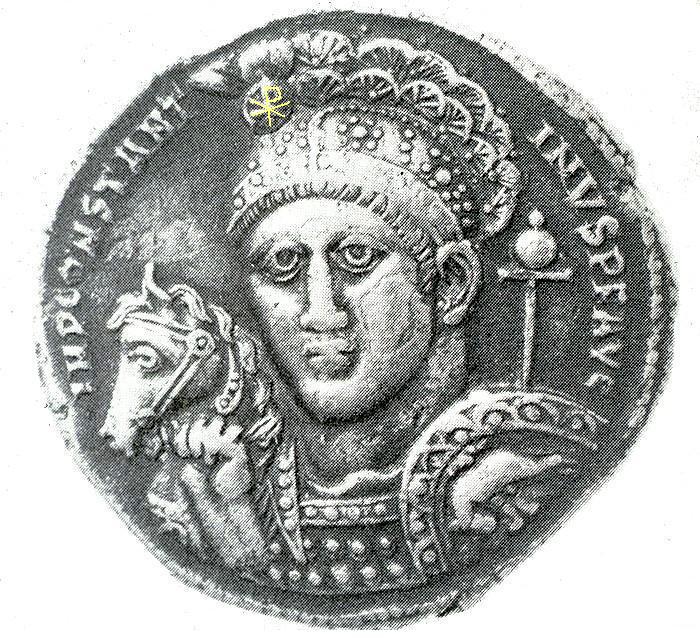
Constantine's Silver Medallion: Ticinum, 315

I was doing a search for a specific silver medallion of Constantine struck in 315 and, surprisingly to me, the third google result was apost from here from a few years ago, in which I quoted Averil Cameron as follows:

Like other Christian signs, the chi-rho emblem is in fact rare on Constantine's coins, and the early silver medallions of 315 from Ticinum (Pavia) showing the Emperor wearing a high-crested helmet with the Christogram are exceptional.

As it turns out, the medallion referred to there was the one I was looking for today, from here:

What is interesting about this one especially is the chi-rho on the helmet, and the traditional she-wolf suckling the twins in the bottom right on the shield.

Bad tattoo Latin!

Okay, this one actually makes me feel bad. I hate the thought that some well-meaning Marines have (semi-)permanently scarred themselves with something nonsensical:

It's supposed to say, "Father and Son: Brothers Forever." Of course it really says "Father and Growth: Brother! Endlessness!"

(Punctuation added, of course, for emphasis.)

NOTE: I know that natus (2nd declension) can mean son (or at least man-child), but why not use filius? I think it's funnier this way (4th declension).

Thursday, June 26, 2008

Studia Callimachea

There was a footnote in something I was reading today referring to Koenraad Kuiper's discussion of oppositio in imitando, so I decided to check Google Books to see if they have it, and they do:
Studia Callimachea (1896)

Actually, use this one instead. I went to p. 114, which is the page to which the footnote pointed (or toed) me, and a little bit of the right side of the page is cut off. This is not a problem in the second link.

The discussion starts thus:
Text not available
Studia Callimachea By Koenraad Kuiper

Luttwak on Millar

Just when I was considering dropping my BMCR subscription (how many times can I delete a dry paean to pedantic postmodernist drivel?), along comes the HESPEROS review and now something perhaps more intriguing: the controversial American military historian Edward Luttwak reviews Fergus Millar, the great British historian of the Late Roman Near East, on the transition of Rome from a Latin- to a Greek-speaking empire. Has someone been reading my thoughts?

Wednesday, June 25, 2008

HESPEROS: Studies in Ancient Greek Poetry Presented to M. L. West on his Seventieth Birthday

The cleverly-titled Hesperos, a Festschrift for M.L. West (get it?), has just been reviewed in the BMCR and has opened a hole in my library that I hadn't noticed. As the reviewer notes in his curt close, "The price of the book is hideous." It's listed at $199, a small sum for Croesus, but Amazon has knocked off 32% for the moderately wealthy among us.

I'm most intrigued by Kenneth Dover's contribution, a 'lyric Encomium' that

sets itself the familiar task of encoding the honorand's achievement in a few well-chosen phrases. In West's case, this would be hard enough to do in English, but Dover pulls it off in clever and elegant Greek. His epode praises West's pioneering efforts to make students of Greek poetry more aware of its interactions with Near Eastern culture.
So without further ado:
ΕΣΠΕΡΩΙ
ΣΟΦΙΑΙ

μελετᾶν ἄνδρ' ἔμπειρον ἀκριβέων      (στρ.)
ἔδοξε βουλᾷ συνετῶν ἐπαινέσαι
ἀφνειόν τ' οὐ κατὰ δαμόταν θέμεν,
ἄξιον ὄντα χρέος πράσσειν μέγ' ὀφειλόμενον·
τοσαῦτα κείνου μεμαθήκαμεν ἄμμες.      (5)

γενεὰς τὰς καθ' Ἡσίοδον θεῶν      (ἀντ.)
σαφανίσας κ' Ἀρχίλοχον καὶ Θεόγνιδας,
τέτραπται πρὸς Διόνυσον ἠδ' Ἄρη
ἁρμονίας τε λυρᾶν καὶ τέθμα Τερψιχόρας
ὥστ' ἐξικέσθαι σοφίας ἐπ' ἄωτον.      (10)

τολμᾷ δ' ὑπερβαίνειν ὅρους ἐθνέων παλαιῶν·      (ἐπ.)
ἀλλ' οὐ γὰρ ἑλλανίδα μῆτιν ἐλέγξας
ἀπώσατ', ἰχνεύει δ' ἰδέας ἀοιδᾶν
φαίνων ἄρα μοῦνον ἐὸν Μοισᾶν γένος.
     K.J.D
I should point out the synizesis in Θεόγνιδας at the end of line 7.

'Silver Age' Again

Chris comments in the post below:

If I recall, some "silver age" authors actually first designated Cicero, Vergil, and company as authors of the "Golden Age". So naturally taken up from that Silver Age would be a complement. My OED is packed before the move, so I cannot check it at the moment.

I would be interested in any references in which 'silver' writers refer to the Augustan writers (or even to late Republican literature if we want to extend back to Cicero, as we probably should) as having written in a 'Golden Age'. To be sure, 'silver' writers sometimes made a trope of their secondariness; for example, Statius Thebaid 10.445-6 (Hinds discusses this and other passages relating to 'secondariness'):
vos quoque sacrati, quamvis mea carmina surgant
inferiore lyra, memores superabitis annos.

Also of interest is the pseudo-Ovidian Argumenta Aeneidis, praefatio 1-4 (text from Ziolkowski and Putnam's The Virgilian Tradition):
Vergilius magno quantum concessit Homero,
tantum ego Vergilio, Naso poeta, meo.
Nec me praelatum cupio tibi ferre, poeta;
ingenio si te subsequor, hoc satis est.

Vergil refers to the return of a golden age in general terms in Eclogue 4, which he specifically relates to Saturnian myth (e.g., redeunt Saturnia regna, 6): ac toto surget gens aurea mundo (9); but a quick glance through Ziolkowski and Putnam's index s.v. 'golden age' didn't yield anything relating to literary designations (but I was skimming pretty quickly and don't have time at the moment for a really thorough search).

In English, the term 'golden age' to refer to Augustan literature seems to have come into play earlier than 'silver age'. The OED's earliest reference is from Dryden in 1700: 'With Ovid ended the golden age of the Roman tongue.' Interestingly, Dryden uses the term mythically 15 years previous to this: 'Those first times, which Poets call the Golden Age.'

'Silver Age' Literature

I was intrigued by a footnote in Stephen Hinds' Allusion and Intertext regarding the post-antique designation of early imperial literature as 'silver'--namely, how long this designation has been around, which according to the OED goes back at least to 1736 (p. 83 n. 66).

So I went to the OED entry for 'silver age'. The first meaning is the mythical one: 'The second age of the world, according to the Greek and Roman poets, inferior in simplicity and happiness to the first or golden age.'

Definition 1.b is the literary meaning: 'The period of Latin literature from the death of Augustus to that of Hadrian.' And indeed, the first use is from 1736, where Ainsworth writes: 'Tacitus, Pliny the historian, Suetonius, and some other prose writers, flourished in the silver age.' The next use comes in Charles Butler's Life of Hugo Grotius:'The language of the Pandects is of the silver age.'

What I find most interesting is the way in which a term used to describe a mythical period in ancient literature (cf. subiit argentea proles, Ovid Met.1.114) has made its way into English as a literary-historical term to describe the actual poetry (and prose) of certain ancient writers. Huh.

Tuesday, June 24, 2008

Cumont on Google Books

I was just poking around on Google Books and thought I'd post some Franz Cumont bibliography.

The Oriental Religions in Roman Paganism

Les religions orientales dans le paganisme romain

After Life in Roman Paganism

Astrology and Religion Among the Greeks and Romans

The Mysteries of Mithra

Die Mysterien des Mithra

Les mystères de Mithra

Sur l'authenticité de quelques lettres de Julien

Alexandre d'Abonotichos: Un épisode de l'histoire du paganisme au IIe siecle de notre ere

Philonis de aeternitate mundi (ed. + prolegomena)

Seven Hills Mnemonic

I picked up Robert Harris's Imperium as a little bedtime reading and as I opened to the map of Republican Rome just before the start of the book my eyes passed over the first letters of Quirinal, Viminal, and Esquiline. In a flash I'd read them as QVE, and it wasn't a second before I read the top half of the map as CapitolinvsQVE.

The bottom half gave me AC Palatinvs, but putting these two together in that order didn't quite work, so I decided to take another tack:

What are the three most important hills in the city's history?

Ianicvlvm
AC Palatinvs
CapitolinvsQVE.


This has the advantages of (1) requiring students to memorize only three names (while they can more easily recall the others from the abbreviations), (2) using Latin conjunctions for the abbreviations, reinforcing a bit of the language, and (3) being somewhat visual. It gives the Seven Hills and the Janiculan, an important defense across the Tiber, read in a kind of S shape from bottom to top. I can't help but visualize a map of Rome when I recite this and follow a steady S-shaped trail (Janiculan, then Aventine, Caelian, Palatine, Capitoline, Quirinal, Viminal, and Esquiline).


You can also think of the first line as giving what's west of the Tiber, the second line naming the hills of the southern half of the city, and the third line those of the northern half of the city.

However you break it down, I think it may turn out to be effective and I plan to use it next semester.

Monday, June 23, 2008

'Profusely Illustrated'

I got a kick out of the title page of Rodolfo Lanciani's Pagan and Christian Rome and thought I'd post it here.
"PAGAN AND ROiME RODOLFO J ANCIANI AUTHOR OF ANCIENT BOMB IN Tl lJGHT OF RECBNT D1SCOVBS1BS PROFUSELY ILLUSTRATED "
That's right. If you've got a lot of illustrations, own it.

Henry Chadwick, R.I.P.

Rowan Williams' obituary of the great church historian is here.

(L/v Ref21.)

Macrobius Stuff

Just wanted to post some links here to a couple of items on Google Books that are useful for the study of Macrobius.

Ludwig von Jan's edition of Macrobius' Works (2 voll., 1848-52):
Volume 1
Volume 2

The older Teubner edition of the text, ed. Eyssenhardt, here (There is also a newer Teubner edition, ed. J. Willis, but not available on Google Books.)

Sunday, June 22, 2008

O TEMPORA! O FVRES!

The Scottish Parent Teacher Council (SPTC) said pupils are turning to websites and internet resources that contain inaccurate or deliberately misleading information before passing it off as their own work.

The group singled out online encyclopedia Wikipedia, which allows entries to be logged or updated by anyone and is not verified by researchers, as the main source of information.
(Emphasis added.)

Remember the good old days, when students plagiarized from BOOKS and actually PASSED the exams and wrote respectable papers? And then along came Wikipedia!

Isn't the real problem that students are passing something off as their own (and probably always have?)--not that they're now using a less reliable and more easily identifiable source?

Do we really want to hearken back to the days of unverified theft?

Google Books, however, is beginning to make it more difficult for the old school plagiarists.

NOTE: The best and easiest way to prevent plagiarism is to give students very specific guidelines with a personal response component. I would assign a set number of paragraphs (say 5), with limits as to where the student is expected to report facts or research, and where opinion and reactions should be recorded. Citations are a must. When reading 60 or more essays the uniformity helps in so many ways: you already know what belongs where, and have a better idea which bits should be checked on the internet for plagiarism. But next year I may use www.turnitin.com, as many other teachers do already.

Friday, June 20, 2008

On the Virtues of Keeping Your Mouth Shut

Inspired by Dennis, I was looking through the Disticha Catonis and found a few good ones on holding your tongue, and thought I'd post them here.

3. Virtutem primam esse puto compescere linguam:
Proximus ille deo est, qui scit ratione tacere.

10. Contra verbosos noli contendere verbis:
Sermo datur cunctis, animi sapientia paucis.

12. Rumores fuge, ne incipias novus auctor haberi,
Nam nulli tacuisse nocet, nocet esse locutum.

Wednesday, June 18, 2008

New Latin School in Philadelphia

A really interesting article on the new Boys' Latin School in the Philadelphia Weekly. Here's the beginning:

An ambitious Southwest Philadelphia charter school uses an ancient language as a new formula for learning.

There are minefields on the path to maturity for every young person in this city. But for many young male Philadelphians, the danger runs deeper.

Young men in Philadelphia public schools are more likely than most to live with one parent, have a parent in jail, reside in drug-addled neighborhoods or experience violence. Students in too many Philadelphia public schools can’t be guaranteed basic safety, let alone a decent education.

Enter the Boys’ Latin of Philadelphia Charter School, a new college prep school at 55th and Cedar in Southwest Philadelphia with an ambitious plan to avert the tragedy that defines the city’s public school system. Boys’ Latin’s first batch of students—144 ninth-graders—occupy a 10-room temporary structure as they wait for contractors to finish renovations on the building next door.

Last year there were 11 murders within five blocks of where Boys’ Latin sits. “I worry about the students,” says teacher Paula Sahm, who lives in the Art Museum area of Philadelphia. “I’ll sit and watch the news, and if I even hear Southwest Philly, I get chills.”

Next to the trailer setup is the shell of a former school, once attached to Transfiguration Church, which was destroyed by fire in 2006. Boards cover most of the windows, and pickup trucks occupy most of the adjacent lot. But by next year the school building plans to house 300 Boys’ Latin students, with plans to grow enrollment to 600 by 2010.

The school's website is here.