Friday, June 30, 2006

Ravenna/Arian Baptistery

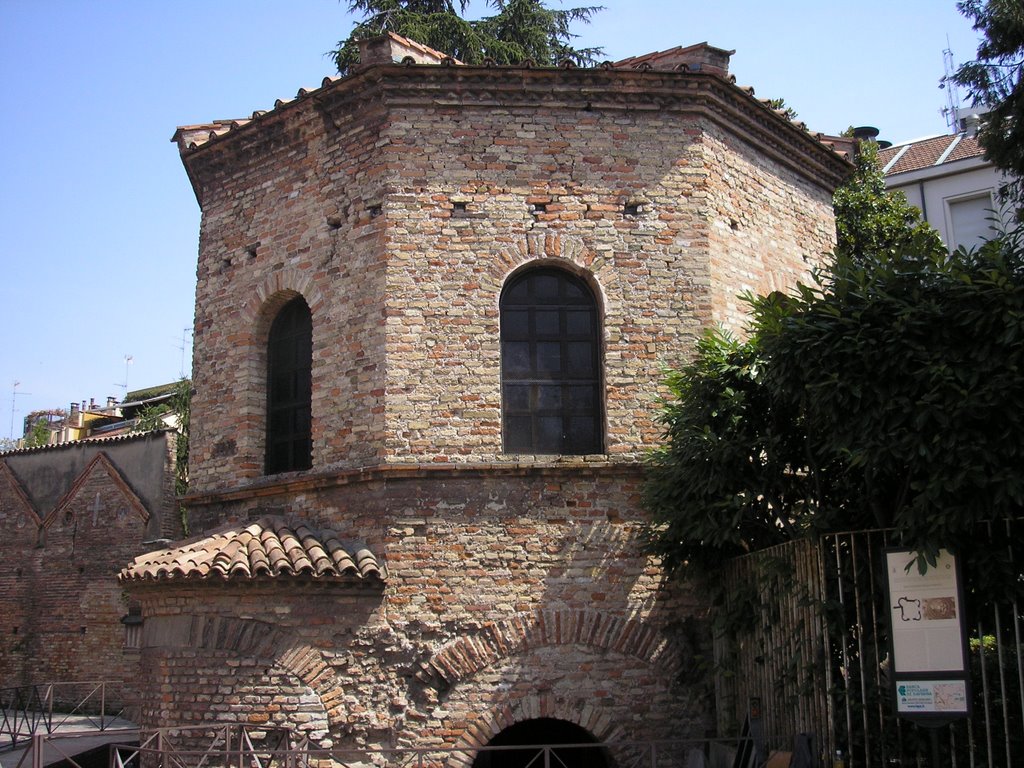
Exterior of building, the base of which is now far below current ground level.

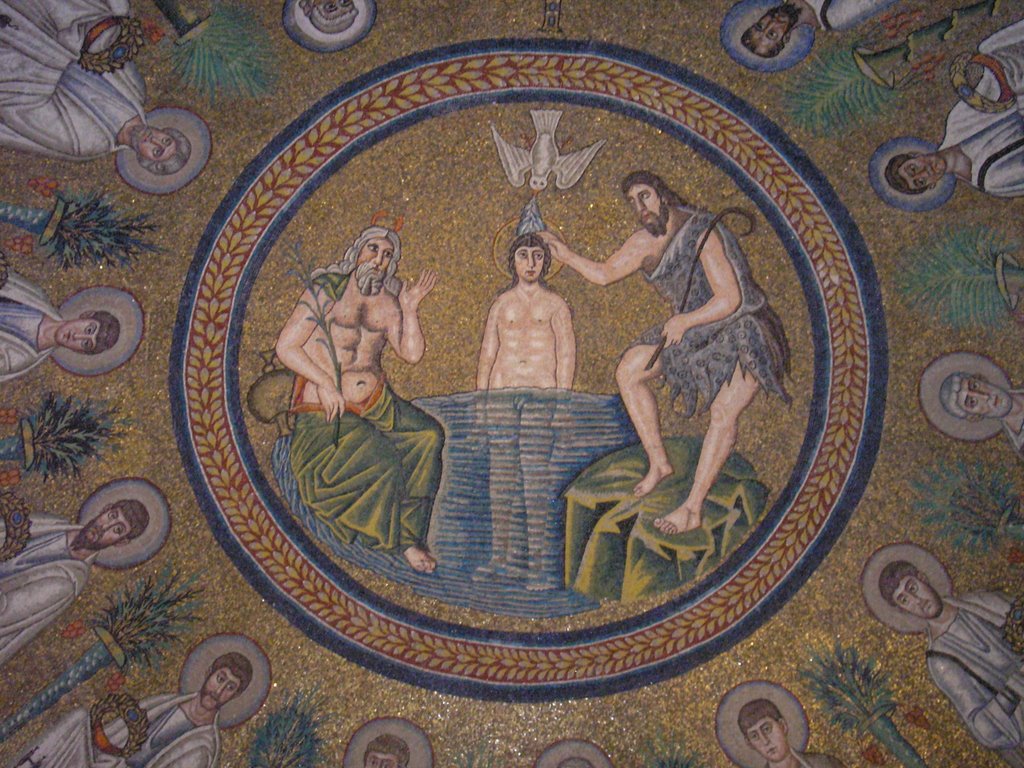
Dome mosaic of baptism of Christ. From left to right: personification of River Jordan; Christ of beardless type (with dove of Holy Spirit); John the Baptist. Ringed by procession of Apostles.

Same, but closer.

It is interesting to compare the scene on this dome with that on the dome of the Orthodox, or Neonian, Baptistery, which has many similiarities but is overall a much more complex composition. But for some reason I forgot to take pictures in there. Maybe I can find a few online at a later time to put up here for comparison.

Wednesday, June 28, 2006

Ravenna 1

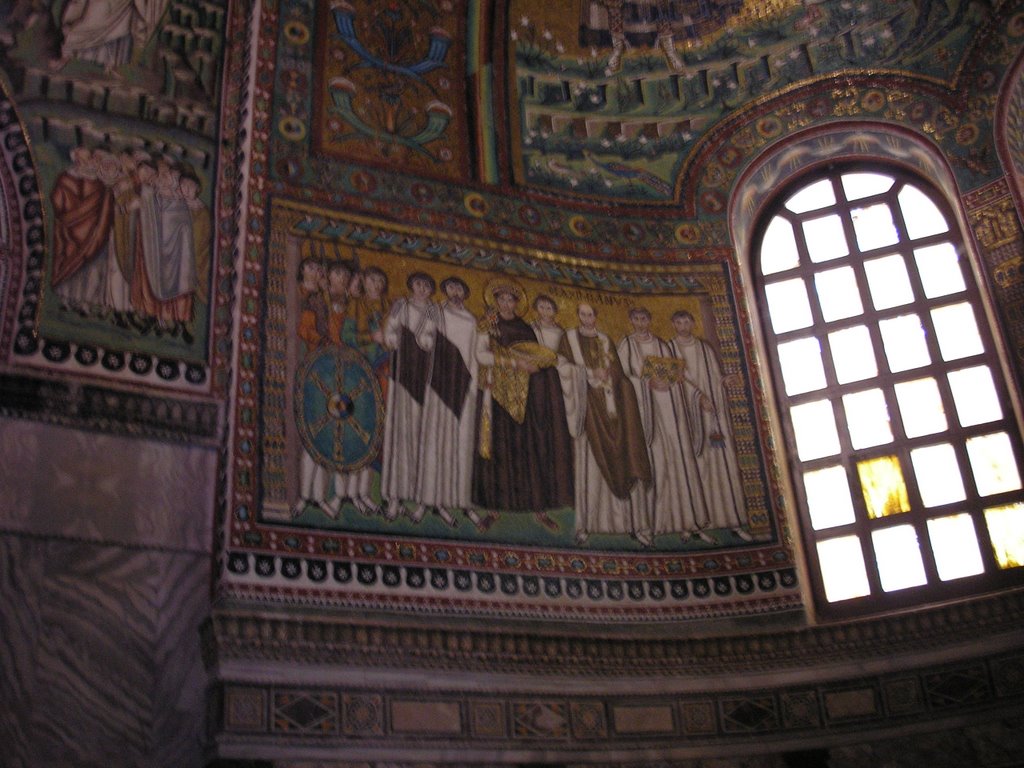
Ravenna is sort of like a Late Antique amusement park. It boasts several 5th and 6th century structures (especially religious buildings) and some of the most incredible mosaics I've ever seen. Here are a couple of photos from the 6th-century Basilica of San Vitale. The first is of a mosaic, made after Justinian's reconquest of Ravenna (which had been under Gothic control), of the emperor with attendants bringing a paten as an offering to the church. Opposite this in the church is one of his wife Theodora bringing a jeweled chalice.

The second is of the interior of the church, looking toward the apse and altar.

Wednesday, June 21, 2006

Moderns on Ancients

The Fall of Rome
by W. H. Auden

(for Cyril Connolly)

The piers are pummelled by the waves;
In a lonely field the rain
Lashes an abandoned train;
Outlaws fill the mountain caves.

Fantastic grow the evening gowns;
Agents of the Fisc pursue
Absconding tax-defaulters through
The sewers of provincial towns.

Private rites of magic send
The temple prostitutes to sleep;
All the literati keep
An imaginary friend.

Cerebrotonic Cato may
Extol the Ancient Disciplines,
But the muscle-bound Marines
Mutiny for food and pay.

Caesar's double-bed is warm
As an unimportant clerk
Writes I DO NOT LIKE MY WORK
On a pink official form.

Unendowed with wealth or pity,
Little birds with scarlet legs,
Sitting on their speckled eggs,
Eye each flu-infected city.

Altogether elsewhere, vast
Herds of reindeer move across
Miles and miles of golden moss,
Silently and very fast.


From Another Time by W. H. Auden, published by Random House. Copyright © 1940 W. H. Auden, renewed by The Estate of W. H. Auden. Used by permission of Curtis Brown, Ltd.

Thursday, June 15, 2006

Dentistical Archaeological Find

Some evidence for the work of ancients equivalent to our guys in white coats with inspiration posters all over the ceiling. This doesn't have anything to do with the Greco-Roman world, but it is old--and interesting.

WASHINGTON - Thousands of years before screen idols began beautifying themselves with cosmetic dentistry ancient Mexicans were getting ceremonial dentures.

Researchers report Wednesday that they found a 4,500-year-old burial in Mexico that had the oldest known example of dental work in the Americas.

The upper front teeth of the remains had been ground down so they could be mounted with animal teeth, possibly wolf or panther teeth, for ceremonial purposes, according to researchers led by Tricia Gabany-Guerrero of the University of Connecticut.

"It's like he was using the mouth of some other animal in his mouth," explained James Chatters, an archaeologist and paleontologist with AMEC Earth and Environmental Inc. in Seattle, Wash., and a member of the research team.

You can read the rest here.

Tuesday, June 13, 2006

Why study classical antiquity?

It's a question asked often, especially by classicists who despair for self-justification. Well, here's one humble response from 1964:

In the days when they formed the basis of a common culture for all educated Europeans, classical studies, together with the Bible, provided an outline of nearly all that was known or believed about world history and a background to the history of modern times and of the Middle Ages. Today, to speak of 'two cultures' is to understate: the Arts themselves are fragmented. Modern history, reaching back only a few generations, lacks depth; mediaeval history both begins and leaves off in the middle of the story; classical studies have become too narrowly philological.


     Our civilization needs classical scholars, as it needs sinologists, not only to train their successors but primarily for the sake of the wider public. There is a wide and spontaneous demand for knowledge about the origins and development of our civilization, manifested both in sales of books and in willingness to spend money on travel in the Near East. We could, and ought to, be satisfying this demand.


     At first sight the length of time — some 5,000 years since the first recorded dynasties — sounds overwhelming. But the appropriate measure of time is the human generation: the number of perhaps 200 since the beginning of recorded history and less than 100 since Homer is a modest one.


     We can here learn from American colleges, which have long taught world history or 'western civilization', not least that the study of Greek and Roman history can play a great part by bringing out the extraordinary resemblances between some of the great processes villain that history and the history of the Christian West. The re-growth of a culture, under stimulation from the East after the collapse of a previous civilization; the expansion to a more spacious world in the West and its effects on the old world's economy and society; the bold astronomical and geological speculations; the class-struggles and revolutions; the disastrous failure to transcend inter-state rivalries and wars — all these things have reminded scholars of the history of their own age. At the same time Greek thought and art have in some ways more resemblance to those of mediaeval Christendom than to modern trends.


     Even an outline knowledge of Greek and Roman history could be of immense value to specialists in modern fields. We should be devoting our best efforts to trying to convince our colleagues of this, and should be training our pupils to restore some unity to our culture, as well as training their successors.
The author was A.R. Burn (Proceedings of the Classical Association LXI, 1964, 27–28), most widely known by students as the author of The Penguin (formerly Pelican) History of Greece, first published under the title A Traveler's History of Greece a year after this talk was given. (I suppose this could be another's summary of his talk — it's given in a list of 'reports' from the General Meeting — but I suspect that it was his abstract.

Still sound sensible enough to me.

Monday, June 12, 2006

Speaking of Erasmus' Adages...

Here is a review by Richard Joines of a recent edition of Adages III.iv.1-IV.ii.100 by John N. Grant and Denis L. Drysdall.

Friday, June 09, 2006

Neologisms in Augustine's Sermon Super Verbis Apostoli Ad Galatas...

In his introduction to this sermon of Augustine, F. Dolbeau remarks that Augustine uses two words here not found in the TLL. (Sorry, I just noticed that when I pasted this citation in, all the French accents disappeared. I don't have time to fix it right now and don't know how to anyway, so I'm just going to replace them with unaccented letters. Hope that doesn't make it too unintelligible.)

Deux substantifs employes par Augustin sont absent du Thesaurus Linguae Latinae. Ce sont des noms d’agent en -tor, dont le sens ne fait pas difficulte. Le premier, obtestator (sec. 5), ne figure apparement dans aucun dictionnaire; le second, decretor (sec. 9), etait jusqu’ici atteste pour la premiere fois chez Raoul Glaber. Tous deux pourraient etre des creations deliberees d’Augustin, car ils fonctionnent en symetrie, repectivement avec praedicator et impletor.

Thursday, June 08, 2006

Julian the Apostate Quiz

Via Bread and Circuses, I learned about this fun online quiz on Julian the Apostate. Enjoy!

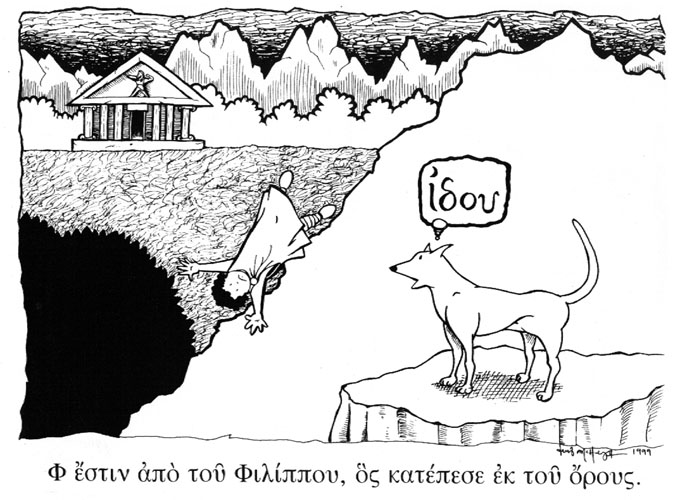
By the way, Dennis, love the cartoon!

No, Philippos! Not again!


I drew this in my first year of baby Greek while at UMass: an homage to Athenaze's hapless young hero and his trusty dog, Argo. It was supposed to be in the style of Edward Gorey's Gashlycrumb Tinies, but I was lazy and hadn't drawn in a long time, so this was the result. Posted by Picasa

Ludi in AD 204

Today the Rogueclassicist asks for information on something called the ludi Latini et Graeci honorarii in AD 204, of which today is supposed to be the fifth day. I'm not sure if these are the same games, but Septimius Severus presided over a 10-day celebration of the ludi saeculares in 204 and, according to this report, he used Augustan calculations; Augustus had first celebrated the ludi saeculares in 17 BC and they took place in late May and early June. Now, I'm assuming that the ludi saeculares and the ludi Latini et Graeci honorarii must be the same games, since the Rogueclassicist also has a listing for the Latini et Graeci on this day in 17 BC, which roughly coincides with the timing for the saeculares in that year (though it is off by a few days).

Mr. Meadows--I'm not sure if any of this is the sort of information you're looking for. If it's all old news and you were inquiring about something different, please ignore!

Wednesday, June 07, 2006

The Remains of a Senarius in a Letter of Jerome?

In a letter written by Jerome to Augustine (Ep. 68 in editions of Augustine's letters; Ep. 102 in editions of Jerome), dated to 402 (see Fuerst's monograph on the correspondence), Jerome threatens Augustine via classical and proverbial metaphors:

nunc te currente et longa spatia transmittente nobis debetur otium simulque, ut cum venia et honore tuo dixerim, ne solus mihi de poetis aliquid proposuisse videaris, memento Daretis et Entelli et vulgaris proverbii, quod bos lassus fortius figat pedem.

In a brief but interesting note in Wiener Studien 19 (1897) 317, Karl Schenkl makes a case that the 'proverb' (italicized in the above citation) is not merely a proverb, but is a citation of a poet--the 'remains' or the 'left-overs' ('die Reste') of a senarius. For support, he offers four reasons: the balance of the phrase, its 'poetic coloring', the placing of the words, and the prominent (or 'pronounced') alliteration of fortius figat.

He says that he is not able to unravel whence it comes; Schenkl points out that Erasmus, in his Adagia, refers it to the Greek proverb Atremas bous (Diog. III.9, Arsen. VI.8, Apost. IV.24), but he states that this contributes nothing to its explanation. He theorizes that Jerome found the proverb in a Gnomologium, and that it was probably included in the fragmenta adespota of iambic poets.

Wednesday, May 31, 2006

J.P. Postgate's 'Flaws in Classical Research'

I'm reading J.P Postgate's classic essay 'Flaws in Classical Research' (Proceedings of the British Academy, 1908, 161-211), which, by the way, should be tempered with Paul Shorey's review (Classical Philology 5.2 225-228) which attempts to 'guard against the impression which it will make upon the student or the hostile layman.' Shorey notes Postgate's 'impatience of human frailty,' which puts one in mind of A.E. Housman. Incidentally, Housman (cited approvingly in the essay) beat out Postgate for the Latin chair at Cambridge.

Currently what's interesting me is Postgate's criticsm of modern 'lineal' thinking which is prone to misunderstand the 'circular' thought behind utterances in classical languages.

I was reminded of a recent article in the Guardian (linked by ALDaily) that dealt with the difficulties caused by syntax in the translation of humor from English to German. This difficulty has led some Brits to the conclusion that Germans are humorless, and in the same way the divide betwee 'lineal' and 'circular' habits of mind has led modern readers of the Classics to mistranslation, misleading commentary, and the attribution to the ancients of convoluted metaphorical expression alien to their native sensibility:

One main principle which it takes some trouble to grasp, and still more to apply with precision, is that, within certain wide limits, order in modern sentences is syntactically essential and in ancient sentences syntactically indifferent. The modern sentence, to put it roughly, is an arrangement in line, the ancient one within a circle. Now the lineal habit of mind, if I may call it so, is often at a loss when it has to understand the circular; it is devoid of the sense of grouping; it has not been trained to the necessary attention. If the groups are small, the trouble thus caused is small; but it is not absent altogether.
Now comes a great but simple example, the kind I've seen belabored by would-be critical theorists in their first semesters seeking out the foul stench of patriarchy and cultural imperialism at every turn:
In the second half of the pentameter Tibullus writes vir mulierque (ii. 2. 2), Ovid femina virque. The difference of order is absolutely without significance. But the lineal mind is apt to imagine that some subtle distinction between the places of man and woman is intended, as though Ovid were a sort of pro- and Tibullus an anti-suffragette.
Come to think of it, I've probably seen that in some of our leading journals.

From here he recalls the views of T.E. Page (note: Page's commentary on the Eclogues and Georgics of Vergil is still a classic -- go get it!) who 'called attention to the irrationality of current views of the figure called hysteron proteron':
To the lineal mind these 'inversions' are nonsense; to the circular but legitmate variations. ... The real character of such arrangements is seen in passages like Ter. Ad. 917 'tu illas abi et traduce; and Lucan, viii. 342 sq. 'quem captos ducere reges | vidit ab Hyrcanis Indoque a litore siluis', which almost shriek at us the warning respice finem.
There's more, and I recommend that you seek it out (taking Shorey's reservations into consideration). This kind of criticism, taken properly, keeps critics alert.

Tuesday, May 30, 2006

Concerning the Literacy of Augustine's Late 4th Century Congregation

We are often told that late antique sermons are geared toward an audience with a lower level of education (sermo humilis and all that) than the audience for written works of erudite theology and exegesis. And it is certainly true that one often finds an easier, simpler Latin in sermons. While reading one of Augustine's Dolbeau sermons (Sermo Beati Augustini Super Verbis Apostoli Ad Galatas, Ubi Paulus Reprehendit Petrum, Ubi Primo Docet Qaulis Esse Debeat Episcopus, preached in 397), however, I came across a couple of lines that imply at least some level of literacy in his congretation. At the point in the sermon in which we are interested, Augustine is discussing the decisions of the Council of Jerusalem in Acts 15, in which a solution was developed as to how Jewish Law should (and should not) be construed in relation to Gentile converts. Here are lines 183-4:

Hoc in Actibus apostolorum scriptum esse multi recolunt; legant qui non recolunt.

'Many recall that this was written in the Acts of the Apostles. Let those who do not recall it read it.'

More on the Concept of Philology

'An unrestricted concept of philology had to be established in order to get rid of all arbitrary distinctions and to discover its actual reality. But the more unrestricted the concept, the more necessary becomes limitation in developing it. It can accordingly be given an arbitrary limitation for the area in which any scholar works it out. The concept is absolute, the area relative. One can then set up limitations by disciplines, e.g., philology of language, of literature. One can also restrict the scope by time or space, as when one considers a specific period or some particular people. Thus we can have ancient and modern, oriental and occidental, Greek, Roman, Indian, Hebrew, and other philologies. Such division is quite in keeping with the nature of philology. Reichardt says justly with reference to ancient times: "Knowledge of antiquity is not the history of literature, of art, nor of religion--such histories exist without philology--but a history of the life of a people, which consists in the intermingling and cooperation of all these." Every special branch of knowledge historically presented proceeds in one line of development; philology collects all these into noe bundle, and from a focal point, the mind of a people, spreads them out as radii of a circle.'

--August Boeck, from On Interpretation and Criticism (tr. John Paul Pritchard)


Discuss.

Thursday, May 25, 2006

Georgics on my Mind: Merriam-Webster's Word of the Day

georgic \JOR-jik\ adjective

: of or relating to agriculture

Example sentence:
"Lanford Wilson has created yet another remarkable play... a fascinating tale of a georgic Midwestern community and the secrets lurking beneath the surface of its bucolic hum." (Adweek, March 25, 2004)

Did you know?
The adjective "georgic," which dates from the first half of the 18th century, derives by way of Latin "georgicus" and Greek "geōrgikos" from the Greek noun "geōrgos," meaning "farmer." That noun, in turn, was formed by a combination of the prefix "geō-" (meaning "earth") and "ergon" ("work"), the latter of which gave us words such as "allergy" and "ergonomics." The noun sense of "georgic," which dates from the early 16th century, refers to a poem that deals with the practical aspects of agriculture and rural affairs. The standard for such poems, Virgil's Georgics, is responsible for its name. The poem, written between 37 and 30 B.C., called for a restoration of agricultural life in Italy after its farms fell into neglect during civil war.

*Indicates the sense illustrated in the example sentence.

Tuesday, May 23, 2006

Life Imitates Art

Toward the beginning of Henry James' story 'The Last of the Valerii', we read this description from the story's narrator, who is a painter, of his American goddaughter's Roman husband-to-be:

'Strong the Conte Valerio certainly was; he had a head and throat like some of the busts in the Vatican. To my eye, which has looked at things now so long with the painter's purpose, it was a real perplexity to see such a throat rising out of the whit cravat of the period. It sustained a head as massively round as that of the familiar bust of the Emperor Caracalla and covered with the same dense sculptural crop of curls. The young man's hair grew superbly; it was such hair as the old Romans must have had when they walked bareheaded and bronzed about the world.'

Monday, May 22, 2006

On the Development of Philology

'Now that the defining of the philological activity has removed the one-sided ideas of it, the sole remaining task is to show how these ideas have arisen. They are easily accounted for through the division into separate elements of the definition just now established. Since the most usual vehicle of knowledge--rather, the pure reproduction of all knowledge--is speech, the first task of philology is to fathom the mystery of speech. The deepest and most illimitable human undertaking is the comprehension of speech in its freedom and necessity, and whoever has such knowledge has come to know all human knowledge.'

--August Boeckh, On Interpretation and Criticism, p. 10 (tr. John Paul Pritchard)

Discuss.

Thursday, May 18, 2006

Santa Giulia (4)

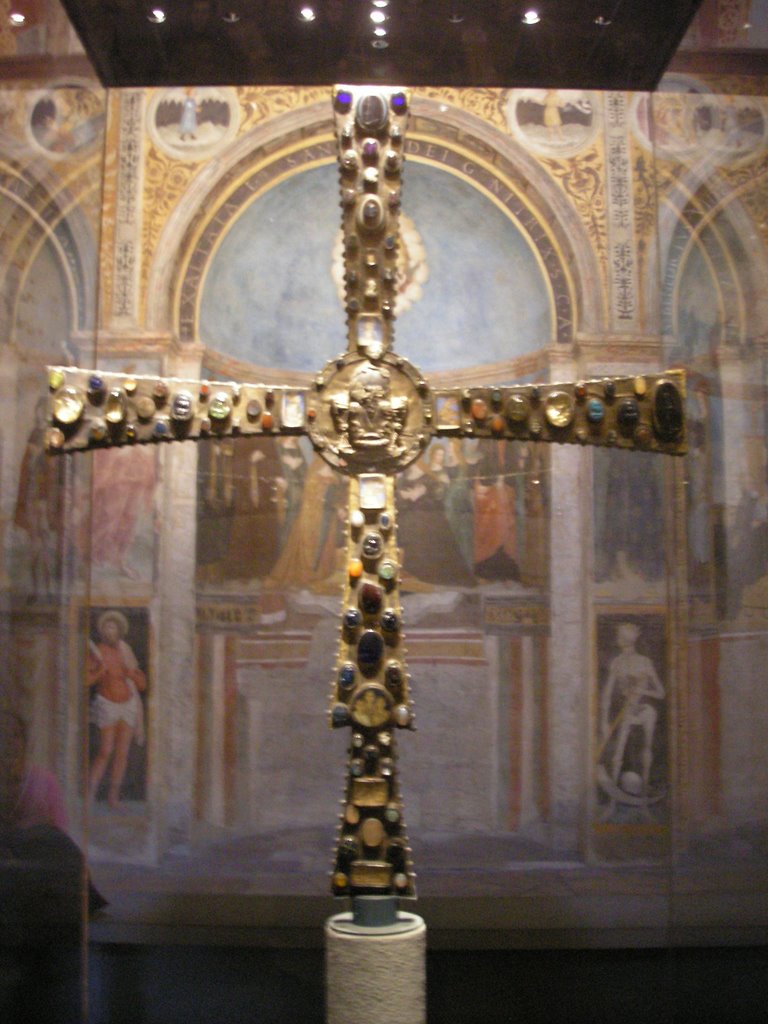
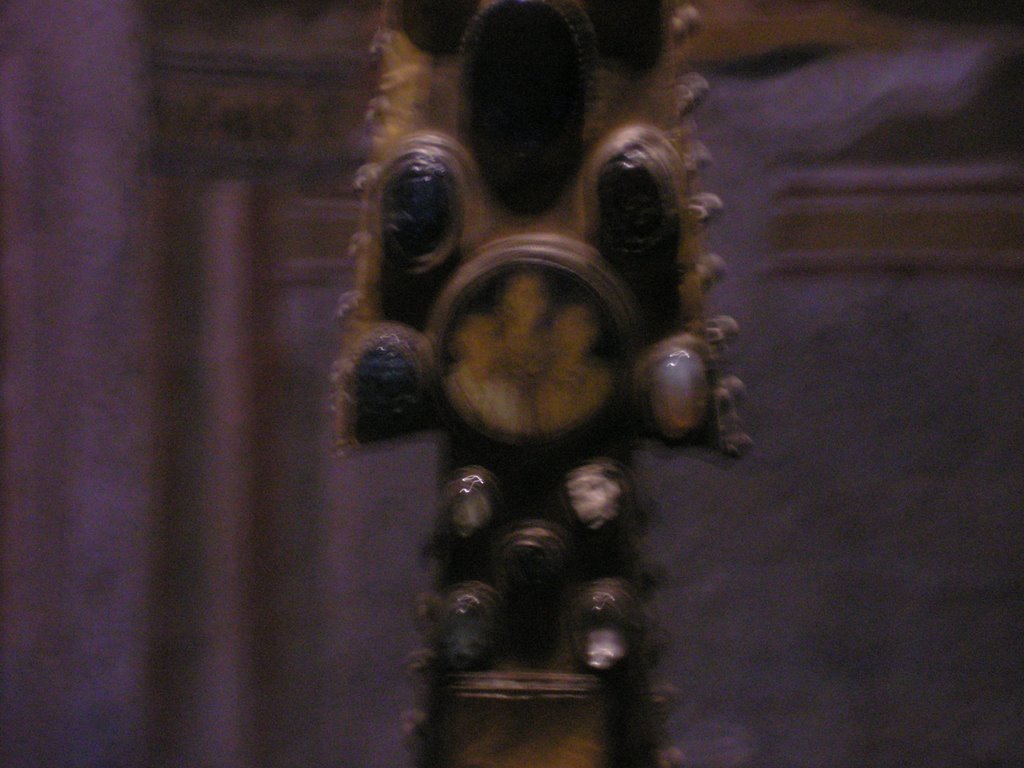
On the other itinerary at the museum, one finds an incredibly ornate jeweled cross, put together out of various pieces in the seventh century. One of those pieces, just over half-way down the lower arm of the cross, is a medallion from the Roman Empire (if you click on the photo to view it in a larger size in its own window, you might be able at least to make it out in general terms; my zoom-in shot is too blurry to see any details, though I’ve included it anyway).


Jas Elsner briefly discusses the object in the introduction to Imperial Rome and Christian Triumph: The Art of the Roman Empire AD 100-450 (Oxford, 1998). In his caption, he writes (p. 22), ‘Gold-glass medallion, perhaps from Alexandria, dated anywhere between the early third and the mid-fifth centuries AD. This family group of a mother, in a richly embroidered robe and jewels, with her son and daughter, bears the inscription BOUNNERI KERAMI. This may be an artist’s signature or the name of the family represented.’

In his remarks in the text, he states (p. 23):

...[T]here are...profound continuities between the visual productions of the pagan and Christian empires, as the following chapters will show. Take, for example, the beautiful gold-glass medallion from Brescia, which could have been made at any point in our period–its transfixing naturalism gestures towards the second century, while its technique is more typical of objects from the fourth. Perhaps from Alexandria, since its inscription is in the Alexandrian dialect of Greek, it probably found its way early to Italy–at any rate, it was incorporated there in the seventh century in a ceremonial, jewelled, cross. Whenever it was made, and for the duration of its use in antiquity, the imagery of this gem speaks of the continuity and values of family life, of the wealth and patronage of aristocratic elites, of the high value placed on exquisite workmanship from the second century to the fifth.

Tuesday, May 16, 2006

Santa Giulia (3)

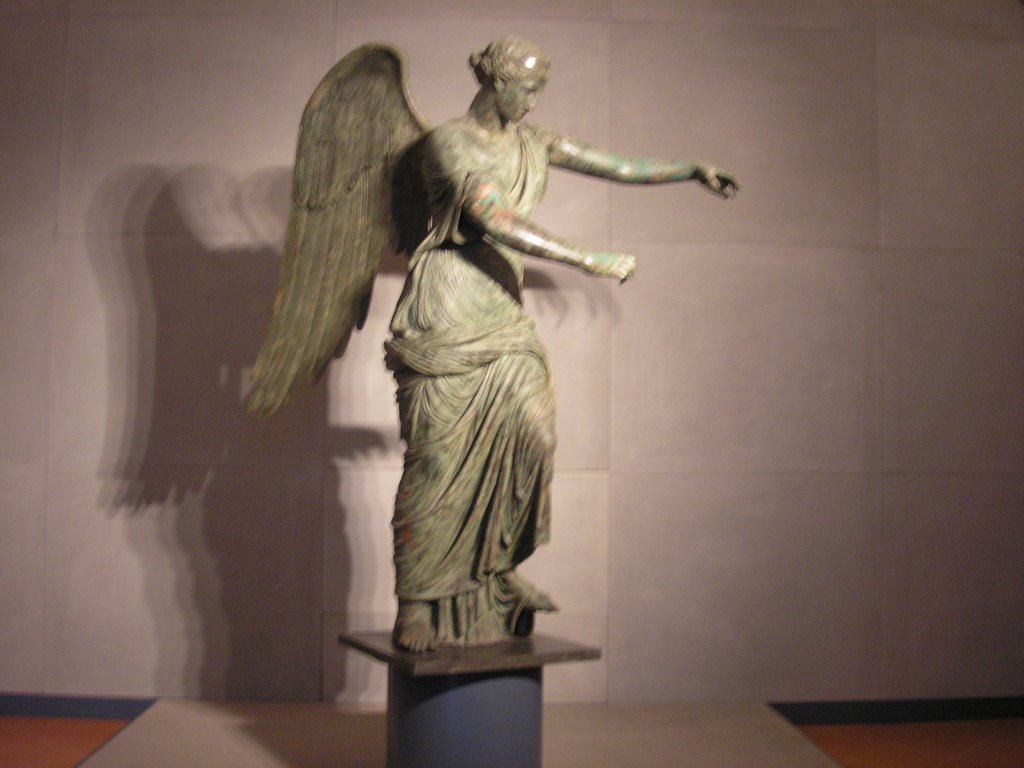
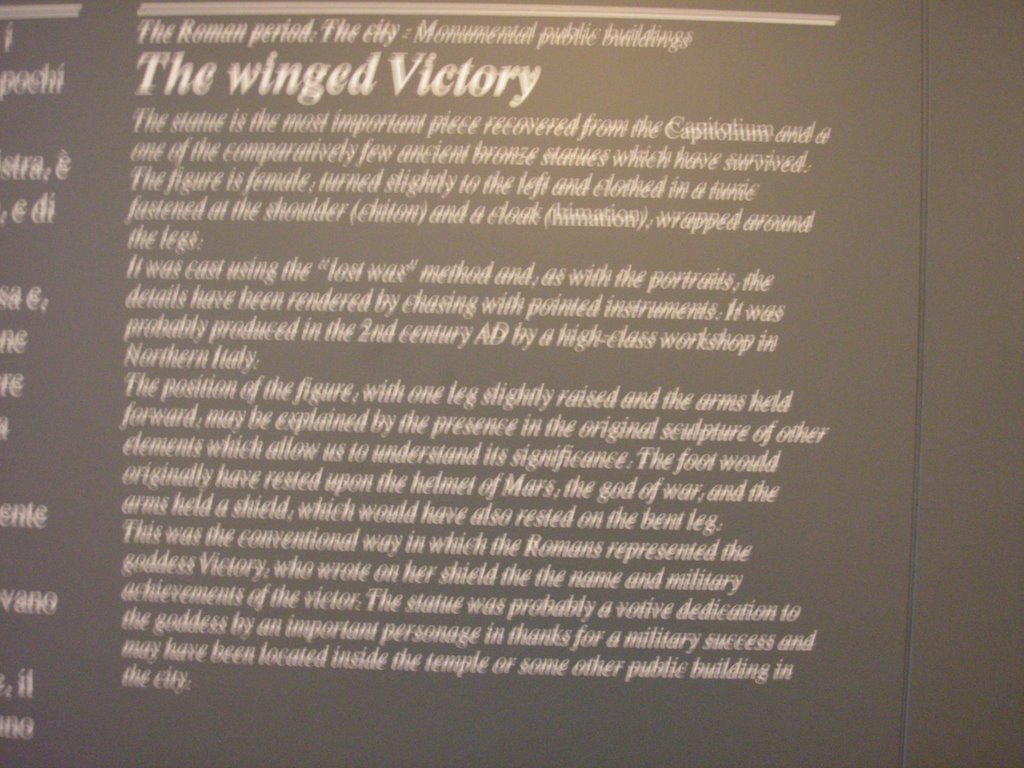
One of the surprising things to me about the museum was their impressive and substantial collection of antique bronze sculptures and ornamention. By far their most famous bronze is this incredible Winged Victory from the Capitolium.


Why Not Keep Talking about Hercules and the Merchant of Venice?

In Act III, Scene II, another suitor-scene in front of the caskets (as was the previous scene recently discussed on the Campus), Hercules comes up twice. The first is in a speech of Portia:

...Now he goes
With no less presence, but with much more love
Than young Alcides, when he did redeem
The virgin tribute, paid by howling Troy
To the sea-monster: I stand for sacrifice,
The rest aloof are the Dardanian wives,
With bleared visages come forth to view
The issue of th' exploit: go Hercules!
Live thou, I live--with much much more dismay,
I view the fight, than thou that mak'st the fray.

(53-62)

Shortly thereafter, as Bassanio is deliberating his choice and commenting on the deceptive attraction of outward ornament, he states:
How many cowards whose hearts are all as false
As stairs of sand, wear yet upon their chings
The beards of Hercules and frowning Mars,
Who inward search'd, have livers white as milk?--
And these assume but valour's excrement
To render them redoubted.

(83-8)