Friday, November 25, 2005

No Direction Home

I saw one of the best correctives I've come across in a while to academic extravagance in mountain-out-of-a-molehill-making (often in evidence in my own papers) while watching part two of Scorsese's recent Bob Dylan bio-pic No Direction Home. During the footage of a 1965 press conference in San Francisco, a reporter tries to inquire into the 'significance' of the Triumph Motorcycle t-shirt he is wearing on the cover of Highway 61 Revisited, telling him that there is a 'philosophy' embedded in it. Dylan's response is to laugh and tell the reporter he hasn't really spent a lot of time looking at it (the reporter says he has spent a lot of time looking at it) and says it was just a picture somebody took one day while he was sitting on the steps.

Not one to give up, the reporter asks if he can talk about the meaning of the motorcycle image in his song-writing. Dylan's only response to this is, 'Well, we all like motorcycles, don't we?', or something to that effect.

The moral of this story is: sometimes a t-shirt is just a t-shirt. I have to remind myself of that sometimes, when puzzling over individual words in a poem and attempting to make an entire interpretation hang on what, to the author, might have been a rather insignificant detail. That doesn't mean these details are always insignificant, but it seems good at least to pause over them, to take a step back and ask the more general questions: does this interpretation I'm gleaning from this one word make sense in the broader scope of the poem? How does it fit in with the whole body of data I'm working with? Would the author have used the word in this way and with this significance? What is his normal practice? How does he mark what is important and what is not in his poem, if at all? Am I foisting my own intent on the author, trying to make a square poem fit in a round hole, as it were? Or does it cohere with the rest of the work?

Ok. I'm done babbling. But it is always nice to find a reminder in a surprising place which causes some reflection on the pitfalls of interpretation--one which pulls me for a moment from the hermetically-sealed bubble in which I often attempt to work with ancient texts out into the wider world.

M-W's Word of the Day for All Y'all Late Antique and Numismatic Types

solidus \SAH-luh-dus\ noun

1 : an ancient Roman gold coin introduced by Constantine and used to the fall of the Byzantine Empire
*2 : a mark / used typically to denote "or" (as in and/or), "and or" (as in straggler/deserter), or "per" (as in feet/second)

Example sentence:
In her latest thriller, the author manipulates her readers into believing there are two killers until the final page, where she connects their two names with a solidus.

Did you know?
Call it a solidus, or call it a slash/diagonal/slant/virgule — whatever you call it, you are bound to run into this useful mark with some regularity. These days, one place the mark is commonly seen is in Internet addresses (http://www.merriam-webster.com/cgi-bin/mwwod.pl, for example), but the history of the word "solidus" takes us back to a time well before computers. The ancient Roman emperor Constantine the Great borrowed the Latin term for "solid" ("solidus") for the gold coin that was the successor to the aureus. And in Medieval Latin, "solidus" designated the shilling. Before the introduction of decimal coinage, abbreviations of the shilling ("s," "sh," or "shil") were used. Eventually, the abbreviations were replaced with the simple symbol "/," which became known as a solidus.

*Indicates the sense illustrated in the example sentence.

I never knew that the mark '/' was called a solidus. So perhaps now we should begin saying things such as 'The web address is aitch tee tee pee colon solidus solidus...'?

Thursday, November 24, 2005

Milton as a Reader of Nicander

In Milton's essay Of Education we learn that if only we should teach children, in addition to the usual arts and sciences, 'the helpful experience of hunters, fowlers, fisherman, shepherds, gardners, apothecaries,' then 'those poets which are now counted most hard will be both facile and pleasant: Orpheus, Hesiod, Theocritus, Aratus, Nicander, Oppian, Dionysius, and in Latin, Lucretius, Manilius, and the rural part of Virgil.'

It comes as no surprise then when we find Nicander creeping up in book X of Paradise Lost. Satan has returned triumphantly to Hell and makes a self-congratulatory speech which doesn't go over quite so well. Note, particularly, the list of snakes, which even includes a scorpion, from verses 524-529:

504    So having said, awhile he stood expecting
505    Their universal shout and high applause
506    To fill his ear; when, contrary, he hears
507    On all sides from innumerable tongues
508    A dismal universal hiss, the sound
509    Of public scorn. He wonder'd, but not long
510    Had leisure, wond'ring at himself now more:
511    His visage drawn he felt to sharp and spare,
512    His arms clung to his ribs, his legs entwining
513    Each other till, supplanted, down he fell
514    A monstrous serpent on his belly prone,
515    Reluctant but in vain: a greater power
516    Now rul'd him, punish'd in the shape he sinn'd,
517    According to his doom. He would have spoke,
518    But hiss for hiss return'd with forked tongue
519    To forked tongue; for now were all transform'd
520    Alike, to serpents all, as accessories
521    To his bold riot. Dreadful was the din
522    Of hissing through the hall, thick-swarming now
523    With complicated monsters, head and tail:
524    Scorpion and asp and amphisbaena dire,
525    Cerastes horn'd, hydrus, and ellops drear,
526    And dipsas (not so thick swarm'd once the soil
527    Bedropp'd with blood of Gorgon, or the isle
528    Ophiusa); but still greatest he, the midst,
529    Now dragon grown, larger than whom the sun
530    Engender'd in the Pythian vale on slime,
531    Huge Python; and his power no less he seem'd
532    Above the rest still to retain. They all
533    Him follow'd, issuing forth to th' open field,
534    Where all yet left of that revolted rout,
535    Heav'n-fall'n, in station stood or just array,
536    Sublime with expectation when to see
537    In triumph issuing forth their glorious Chief.
538    They saw, but other sight instead--a crowd
539    Of ugly serpents. Horror on them fell,
540    And horrid sympathy; for what they saw
541    They felt themselves now changing. Down their arms,
542    Down fell both spear and shield, down they as fast;
543    And the dire hiss renew'd, and the dire form
544    Catch'd by contagion, like in punishment
545    As in their crime. Thus was th' applause they meant
546    Turn'd to exploding hiss, triumph to shame
547    Cast on themselves from their own mouths. There stood
548    A grove hard by, sprung up with this their change
549    (His will who reigns above) to aggravate
550    Their penance, laden with fair fruit, like that
551    Which grew in Paradise, the bait of Eve
552    Us'd by the Tempter. ...

Milton has clearly read Apollonius, Nicander, and Lucan.

If only more of us had been educated in his manner, we'd more easily see the allusion.

Wednesday, November 23, 2005

D gets in on the book action

Here are all (I think all) of my book finds for the past month:

  • 101 Puzzles in Thought and Logic (Math & Logic Puzzles), C. R. Wylie
  • ABC of atoms, Bertrand Russell
  • American Heritage dictionary of idioms, Christine Ammer
  • Anthology of Latin poetry, Robert Yelverston Tyrell
  • Brideshead revisited, Evelyn Waugh
  • Byzantium and Europe, Speros Vryonis
  • Cassell's Italian dictionary,
  • The Charioteer, Mary Renault
  • The Cherry orchard a comedy, Anton Pavlovich Chekhov
  • Christmas holiday, W. Somerset Maugham
  • Classical hand-list;, John Arbuthnot Nairn
  • The classical heritage and its beneficiaries, R. R. Bolgar
  • A clerk of Oxenford; essays on literature and life, Gilbert Highet
  • The crown the Philippics and ten other orations, Demosthenes
  • Das Nibelungenlied,
  • De l'Institution des Enfants, Essais, liv. I, chap. xxv, Michel de Montaigne
  • Dean's December, Saul Bellow
  • Deutscher lehrgang, Eduard Prokosch
  • A dictionary of economics, John Black
  • Dictionary of historical terms, Chris Cook
  • A dictionary of linguistics, Mario Pei
  • Did you ever see a dream walking? American conservative thought in the twentieth century, William F. Buckley
  • Dutch vocabulary, B. C. Donaldson
  • The education of Henry Adams, Henry Adams
  • The eleven comedies, Aristophanes
  • The empire of reason : how Europe imagined and America realized the enlightenment, Henry Steele Commager
  • End of History and the Last Man, Francis Fukuyama
  • The end of racism : principles for a multiracial society, Dinesh D'Souza
  • English stress; its form, its growth, and its role in verse, Morris Halle
  • The essays of Michel de Montaigne, Michel de Montaigne
  • Framley parsonage, Anthony Trollope
  • Frankenstein, Mary Shelley
  • French Revolution: a history, Thomas Carlyle
  • Goethe, J.-F. Angelloz
  • Golden lion of Granpere, Anthony Trollope
  • Graphically speaking : an illustrated guide to the working language of design and printing, Mark Beach
  • Greek: A Complete Course for Beginners (Teach Yourself Books), Aristarhos Matsukus
  • A handbook of Greek mythology including its extension to Rome, H. J. Rose
  • Henderson, the rain king, Saul Bellow
  • Herzog, Saul Bellow
  • Histoire de l'eloquence latine depuis l'origine de Rome jusqu'à Ciceron, Victor Cucheval
  • Histoire de l'éloquence romaine depuis la mort de Cicéron jusqu'à l'avènement de l'emper, Victor. [from old catalog] Cucheval
  • Histoire des oracles Du bonheur. Essai sur l'histoire. Dialogues des morts, Fontenelle, M. de
  • Historians' fallacies; toward a logic of historical thought, David Hackett Fischer
  • A history of Greece to the death of Alexander the Great, J. B. Bury
  • A history of private life, (vols. 1 & 2)
  • The house of intellect, Jacques Barzun
  • Humboldt's gift, Saul Bellow
  • An introduction to linguistic science, Edgar H. Sturtevant
  • An introduction to Roman history, literature, and antiquities, Alexander Petrie
  • Johnson's London; selected source materials for freshman research papers, Roland Bartel
  • La guerre civile la pharsale . tome 1, livres I-V, texte établi par a. bourgery., Lucain
  • Langenscheidt's new college German dictionary,
  • Latter-day pamphlets, Thomas Carlyle
  • Le Symbolisme dans la mythologie grecque, Paul Diel
  • Learning to look; a handbook for the visual arts, Joshua Charles Taylor
  • Les Phéniciens et l'Odyssée, Victor Bérard
  • Liberal education (Beacon paperback no. 86), Mark Van Doren
  • The life and strange surprising adventures of Robinson Crusoe, Daniel Defoe
  • Linguaphone; introduction to Russian grammar,
  • Lucky Jim, Kingsley Amis
  • Man's unconquerable mind; studies of English writers, Raymond Wilson Chambers
  • Method of philological study of the English language, Francis Andrew March
  • Michelet oeuvres choisies, Gaillard H.
  • The natural, Bernard Malamud
  • A new introduction to Greek, Alston Hurd Chase
  • A new Russian grammar in two parts, Anna Hering Semeonoff
  • Nieuw volledig Engelsch-Nederlandsch en Nederlandsch-Engelsch woordenboek, I. M. Calisch
  • Notre-Dame de Paris, Victor Hugo
  • Oeuvres, François Rabelais
  • Official Scrabble Players Dictionary,
  • On heroes, hero-worship, and the heroic in history, Thomas Carlyle
  • Patriotic gore; studies in the literature of the American Civil War, Edmund Wilson
  • Pensées de Pascal, Blaise Pascal
  • Point Counter Point, Aldous Huxley
  • The rights of woman, Mary Wollstonecraft
  • Samuel Johnson, John Wain
  • Say It In French: Phrase Book for Travelers, Leon J. Cohen
  • The small house at Allington, Anthony Trollope
  • Songwriting : a complete guide to the craft, Stephen Citron
  • Source readings in music history from classical antiquity through the romantic era, W. Oliver Strunk
  • The story of Apollonius, King of Tyre : a study of its Greek origin and an edition of the two oldest Latin recensions, G. A. A. Kortekaas
  • The story of philosophy; the lives and opinions of the greater philosophers, Will Durant
  • The synonym finder, J. I. Rodale
  • Thomas Mann: profile and perspectives with two unpublished letters and a chronological list of important events, André Von Gronicka
  • Three comedies: The circle, Our betters, The constant wife, W. Somerset Maugham
  • To Jerusalem and back a personal account, Saul Bellow
  • The voyage of the Beagle, Charles Darwin
  • The way of all flesh, Samuel Butler
  • Winnie ille Pu, A. A. Milne

Wow ... an even 90. And I paid about $30 for the lot.

MORE: Eric ... do you think the W. Oliver Strunk who wrote Source readings in music history from classical antiquity through the romantic era is your Oliver Strunk?

More on 'd.d.'

Caelestis suggests below that the abbreviation stands for 'donum dat/dedit'. I was looking through the epigraphy book mentioned below and have found some confirming evidence. In it is reproduced an inscription from an obelisk in Rome:

IMP.CAESAR.DIVI.F
AVGVSTVS
PONTIFEX.MAXIMUS
IMP.XII.COS.XI.TRIB.POT.XIV
AEGVPTO.INPOTESTATEM
POPVLI.ROMANI.REDACTA
SOLI.DONVM.DEDIT
And here are a few more abbreviations (the second of which lends support to Dennis' suggestion 'dedit') listed in chapter 7 employing the letter 'D':
D: dat
D, D.D: dedit
D, DED, DD: dedicavit
D.D.D: dedit idemque dedicavit
D.D: dono dedit (is dono some sort of predicative dative here? Or is this a parallel construction to one in which we would find the accusative of the person and the ablative of the thing (cf. Allen & Greenough 225d)?)

Book Buys 2

Ok, so today I returned to the book sale and stuck more to the task at hand (which is not to say that I still didn't have a few divergences). Thankfully there were still some items of interest that I hadn't noticed yesterday, and some that I had, but put off getting.

Bloch, Raymon. L'epigraphie latine (in the 'que sais-je?' series).
Brueder Grimm. Kinder- und Hausmaerchen.
Christ, W., and M. Paranakis. Anthologia Graeca Carminum Christianorum (Hildesheim 1963).
Dickens, Charles. The Life of Our Lord (the title of the work in the original manuscript written for his own children is The History of Our Saviour Jesus Christ).
Dolan, John P., ed. and trans. The Essential Erasmus.
Fraser, W.H., and J. Square. Heath's Practical French Grammar.
Friend, A.M., Jr. The Portraits of the Evangelists in Greek and Latin Manuscripts (reprinted from Art Studies: 1927).
Lateinische Gedichte Deutscher Humanisten (Lateinisch/Deutsch).
Lawall, Gilbert. Theocritus' Coan Pastorals: A Poetry Book.
Langenscheidt's German-English/English-German Dictionary.
Lesky, Albin. Die Tragische Dichtung Der Hellenen (paperback).
Porphyry. Peri Apochhs Empsuchwn (De l'abstinence), tome 1, livre 1 in the Bude series, edited with French translation by Jean Bouffartigue.
Waugh, Evelyn. Black Mischief.

Ok, so maybe I went a little overboard. But I was given the advice previously to build the library (Field of Dreams style?...Well, maybe not).

Tuesday, November 22, 2005

St. Cecilia

Rogueclassicism tells us that today is the anniversary of the martyrdom of St. Cecilia, patron saint of music. Here is a shot of the facade of S. Cecilia in Trastevere, Rome, thought (I think) to be on the site of her house and martyrdom:

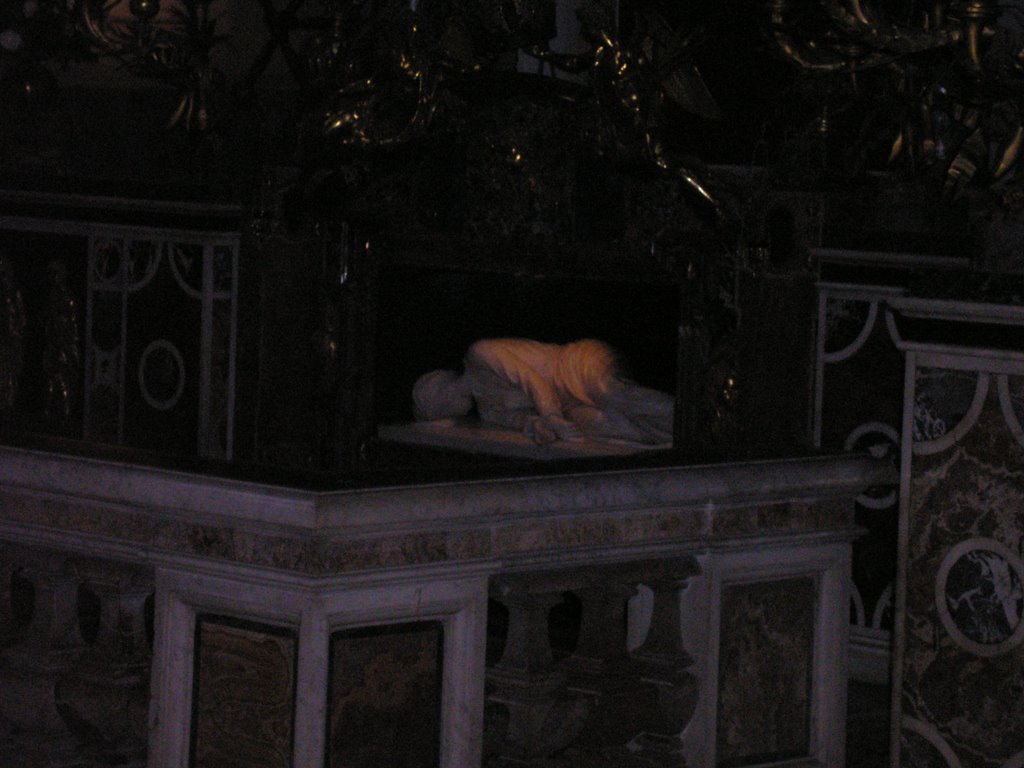
When her tomb was opened in the late 1599, supposedly her body was found in tact and undecayed, and the sculptor Stefano Maderno, present at the opening, was able to depict it:


There are some excavations underneath the church of Roman remains which I haven't visited yet, but would like to. If and when I do, I'll try to get some pics up from them.

UPDATE: I had a feeling that some of the information I read on the catholic-forum.com site conflicted with something I had read before. Here is what the Blue Guide for Rome says (whence some of the above information also comes):

[The church of Santa Cecilia in Trastevere is] on the site of the house of St. Cecilia and her husband St. Valerian, whome she converted to Christianity. This building was adapted to Christian use probably in the 5C, and the body of St. Cecilia was transferred here and a basilica erected by Paschal I (817-24). The church, radically altered from the 16C onwards, was partly restored to its original form in 1899-1901. The slightly leaning campanile dates from 1120.

St. Cecilia, a patrician lady of the gens Cornelia, was martyred in 230, during the reign of Alexander Severus. She was shut up in the calidarium of her own baths, to be scalded to death. Emerging unscathed, she was beheaded in her own house, but the executioner did such a bad job that she lived for three days afterwards. She was buried in the Catacombs of St. Calixtus, where her body remained until its reinterment in her church in 820. As the inventor of the organ, she is the patron saint of music. On 22 November churches hold musical services in her honour.

Book Sale Scores

The library had a book sale today, and I picked up a few things:

Berg, William. Early Virgil.
Bunyan, John. The Pilgrim's Progress.
Die Bibel (Luther's German translation)
Cassell's New French Dictionary. (I actually like Harper/Collins/Robert, but I wanted to get a copy of this as well.)
James, Henry. Italian Hours.
Kierkegaard, Soren. Either/Or (translation).
Pascal, Blaise. Pensees (translation by W.F. Trotter with an introduction by T.S. Eliot).
Septuaginta X (ed. A Rahlfs): Psalmi cum Odis (the 'Odes' are Novem Odae ecclesiae graecae). Handwritten in the front is, I believe, the name of William Strunk's (of 'Strunk and White' fame) son Oliver. Perhaps someone can tell me what this inscription means. It reads: 'O. Strunk d.d. J. Raasted, Sept. '63'. Does anyone know what the 'd.d.' stands for?

As you can tell, I didn't do a very good job of sticking to classics books, but I am very glad to have gotten a copy of Berg; there's a lot I enjoy in that book. There were some others in the classics field I wanted to get, but I was getting outside of what I thought I should spend. The one I'm most disappointed to have passed up was John Jones' On Aristotle and Greek Tragedy, my personal favorite as far as works on the Poetics and Greek Tragedy go. I also passed on a Cassell's Latin Dictionary, which I don't actually own. There was a pristine copy of the Appolonius Rhodius Loeb as well, and Merrill's Catullus. In addition, they had the first part of an edition of the Catalepton, with Latin, English, and Latin commentary. Finally, I had to pass on A.P. Burnett's The Art of Bacchylides.

Dennis: they had a very nice edition of Victor Bers' Greek Poetic Syntax in the Classical Age. I think it was about EUR 8 ($10 or $12). Let me know if you want it and I could try to pick it up if it's still there.

UPDATE: I have a hunch 'd.d.' could stand for dedicavit. Can anyone confirm or deny?

UPDATE 2: I was just poking around at the book sale again and came across Charles Segal's copy of Anne Lebeck's Studies in Aeschylus. They seem to have had several tragedy books that I missed the first time around, as I saw someone absconding with Winnington-Ingram's Studies in Aeschylus. Ah, well.

Monday, November 21, 2005

Comment Moderation and Numismatics

First a bit of business: apologies to anyone who posted a comment recently only to find it no appear. We don't know how comment moderation was enabled (perhaps all of that numismatic wine Eric's been drinking?) but it wasn't intentional, it's been turned off, and all such comments have been indiscriminately approved and posted.

But back to that wine, I said in the comments that I'd link to Sarah's blog if she posted about the coin we identified the other day, and sure enough she has. So here it is: a Cilician coin from Tarsus featuring the emperor Gallus Trebonianus (Gaius Vibius) with interesting translations and transliterations from Latin into Greek.

Friday, November 18, 2005

Golden Latin Artistry

The epigraph in L.P. Wilkinson's Golden Latin Artistry is too good not to share:

Gaius Lucilius...used to say that he wished to be read neither by the very unlearned nor by the very learned; for the former would understand nothing, the latter perhaps more than himself. (Cicero, De Oratore, II, 25)

Numismatists, Unite! (Part 2)

All right, I have another wine-bottle numismatics question for you. This picture's a lot blurrier than the last one, but it purports to be a coin of one of the Marcus Porcius Catos (or 'Porky', as I like to call them). I'm assuming it must be Cato the Elder, since he was from Tusculum. I say this because Tusculum is south-east of Rome, and this particular wine, Frascati, comes from the region south-east of Rome. (Cato the Younger, on the other hand, was born in Rome.) I suppose the photo might be too blurry even to ask, but can anyone make this out well enough to know if it's real, as Sarah proved the last one to be?

Tuesday, November 15, 2005

Meter rant, cont'd.

The last post should still have been in draft mode, but I'll let it stand since people have presumably read it, and it makes sense as it goes.

The basic argument, I think, is sound: the meters of Greek and Latin poetry are a tricky business, still rife with controversy and theories and still a fertile field for further study.

A lot of good and important books were left out of the last post. The Sounds of Greek by W.B. Stanford comes to mind, though it isn't really about meter. That gives you a clue that meter alone isn't much of a study. Even when prosody is given its due attention (cf. the work of Devine & Stephens) the work is inadequate. When you talk about 'the prosody of Greek speech' which Greeks in which era speaking which dialect do you mean, and how does that impact, say, the analysis of the metrical practices of a Hellenistic poet mimicking those of an archaic model?

It's for reasons like these that I'll always remain a positivist, however dirty a word it has become in the academy. Imagine the sort of synchronistic analysis found in this area applied to numismatics: we take coins of all periods, because, afterall, COINAGE is our concern, and extrapolate a set of rules and laws, then publish countless articles about how individual coins break the rules.

The kind of rudimentary diachronic work that West did in his Greek Metre is a step in the right direction, but what's really needed is for students to look at the individual texts of individual poets.

Having done that with Nicander I learned more about meter in general than I ever had by reading manuals, but I also learned that the statistics published in every relevant source--e.g., Lingenberg's dissertation and it's followers (Kroll's RE entry, West in GM) and J.-M. Jacques--are demonstrably incorrect and that it's not accurate to classify Nicander as 'very Callimachean' as everyone does.

This isn't going anywhere ... just another rambling post.

Monday, November 14, 2005

Did somebody say meter?

(This was going to be a comment to Eric's latest post, but it seems too long for that.)

As for meter, it's a tough and tricky business to get involved in. You need to read a number of things very actively, but most importantly you need to actively read verse aloud. Not only do the various meters have their own rhythms, but so do individual poets. I first noticed this reading Roman satire. When we moved from Horace to Persius to Juvenal I found myself stumbling at first. But familiarity with Juvenal's rhythms led me to mark a few lines as spurious in the margin only to find later that Edward Courtney doubted the very same lines, I think on different grounds.

You should begin with poetry that you enjoy, preferably that you care about, and you should let the verse tell you what it's doing without trying to impose rules gleaned from handbooks (many supposed laws are nothing more than tendencies, and are often tendencies of only specific, usually late writers). Remember that Greek meter apparently grew out of music, out of rhythm, which is measured in time as perceived aurally. You must then read the verse so that you can hear it, and must try to read it not only as linguists have restored the sounds for us, but also so that you can hear the differences between different sounds (this means pronouncing eta differently from epsilon iota, etc., or in Latin pronouncing classical verse classically, and not in the manner of the Church).

Halporn, Ostwald, and Rosenmeyer can be a valuable guide at this stage, but it, and all of the other handbooks, will be largely useless if you can't hear the verse.

Here's a quick take on some of the more prominent books:

Halporn, Ostwald, and Rosenmeyer (a translation of H. & O.'s Lateinische Metrik with R.'s liberal adaptation of Bruno Snell's Griechische Metrik) is great for what it is but so much that students will want to know is omitted, presumably because they should be able to ask their teachers. But teachers increasingly know less and less (or nothing) about it. For those who can read French I'd recommend W.J.W. Koster Traité de métrique grecque. It's not the same kind of reference, but it's more useful as you advance.

In fact, Koster recommends Masqueray's book of the same name which is very old and hard to come by, but I've found it to be very useful for all sorts of odd questions (like the placement of the caesura when dealing with enclitics, which may seem obvious, but which doubtless plagues students).

I actually think you should read Thomas Dwight Goodell's Chapters on Greek Metric at some point, preferably early. A lot of it is dated, but it'll put a number of things into context, and Goodell duly appreciates the ancient tradition which is too often referred to obliquely or simply discounted.

In addition I would read two essays by Hardie in Lectures on Classical Subjects: The Language of Poetry, and the Metrical Form of Poetry.

Paul Maas's Greichische Metrik is important and in some ways idiosyncratic (in some ways that's a good thing, as when he clarifies the nature of the 'bucolic diaeresis' by reference to a corresponding 'bucolic bridge' and illustrates the significance of the phenomenon by Theocritus' use). If you get Hugh Lloyd Jones's translation you'll want to make a number of corrections (as I've done with our library's copy) from L.P.E. Parker's review (JHS 84, 1964, 173-5).

M.L. West's Greek Metre is good but I think not very useful to students, with the possible exception of his initial treatment of the hexameter in which he follows Haslam's lead: hemiepes + paroemiac (cf. Haslam, 'The Versification of the New Stesichorus' GRBS 19, 1978, 29-57). West is something to read when you've done a fair amount of work with meter and can check his statistics against your own and understand where he agrees or diverges from tradition.

Avoid Raven's books on meter at all costs. I don't have the strength to attack them here. Just save yourself the agony.

I still haven't been able to give C.M.J. Sicking's Griechische Verslehre (Handbuch der Altertumswissenschaft 2.4, 1993) a proper inspection, mainly because my German is only strong enough to handle what I absolutely need to read for my thesis, but it looks good, is clearly the most up-to-date of all the handbooks, and has a very attractive and detailed approach to diagramming the schemata.

Eventually you have to read A.M. Dale's The Lyric Meters of Greek Drama as well as her Collected Papers. There are a number of good individual works.

Everything You Ever Wanted to Know about Texts but Were Afraid to Ask (Part Deux)

Previously, I asked for suggestions for an essential reading list of secondary sources on the ancient world. Here's what we've got so far:

Bing, Peter. The Well-Read Muse.
Buck, Carl Darling. The Greek Dialects.
Burkert, Walter. Greek Religion.
Dill, Samuel. Roman Society from Nero to Marcus Aurelius.
Dodds, E.R. The Greeks and the Irrational.
Finley, M.I. The Ancient Economy.
Frazer, James. The Golden Bough.
Gibbon, Edward. The Decline and Fall of the Roman Empire.
Guthrie, W.K.C. A History of Greek Philosophy.
Harrison, Jane Ellison. Prolegomena to the Study of Greek Religion.
Heinze, Richard. Virgil's Epic Technique.
Jaeger, Werner. Paideia.
Lord, A.B. The Singer of Tales.
Meiggs, R., and D. Lewis, A selection of Greek historical inscriptions to the end of the fifth century B.C.
Nagy, Gregory. The Best of the Achaeans.
Pickard-Cambridge, A.W. Dithyramb, Tragedy And Comedy (the original of 1927, not T.B.L. Webster's 1962 update).
Pickard-Cambridge, A.W. Dramatic Festivals of Athens.
Sandys, John Edwin. A History of Classical Scholarship.
Snell, Bruno. The Discovery of the Mind.
Syme, Ronald. The Roman Revolution.
Vermeule, Emily. Greece in the Bronze Age.
Wilamowitz. History of Classical Scholarship (tr. Hugh Lloyd-Jones).
Wilkinson, L.P. Golden Latin Artistry.
Williams, Bernard. Shame and Necessity.

Thanks to everyone for some great suggestions. I think we can still do a little more, though. If anyone has recommendations for histories or handbooks of Greek and Latin literature (for example, I have some familiarity with Lesky for Greek lit. and Conte for Latin; perhaps I'll add those) or meter (both Greek and Latin--preferably something that would be understandable for undergraduates; perhaps Halporn/Otswald/Rosenmeyer?), please please please drop them in the comments box.

Thursday, November 10, 2005

Structures with Walls that Aren't Falling

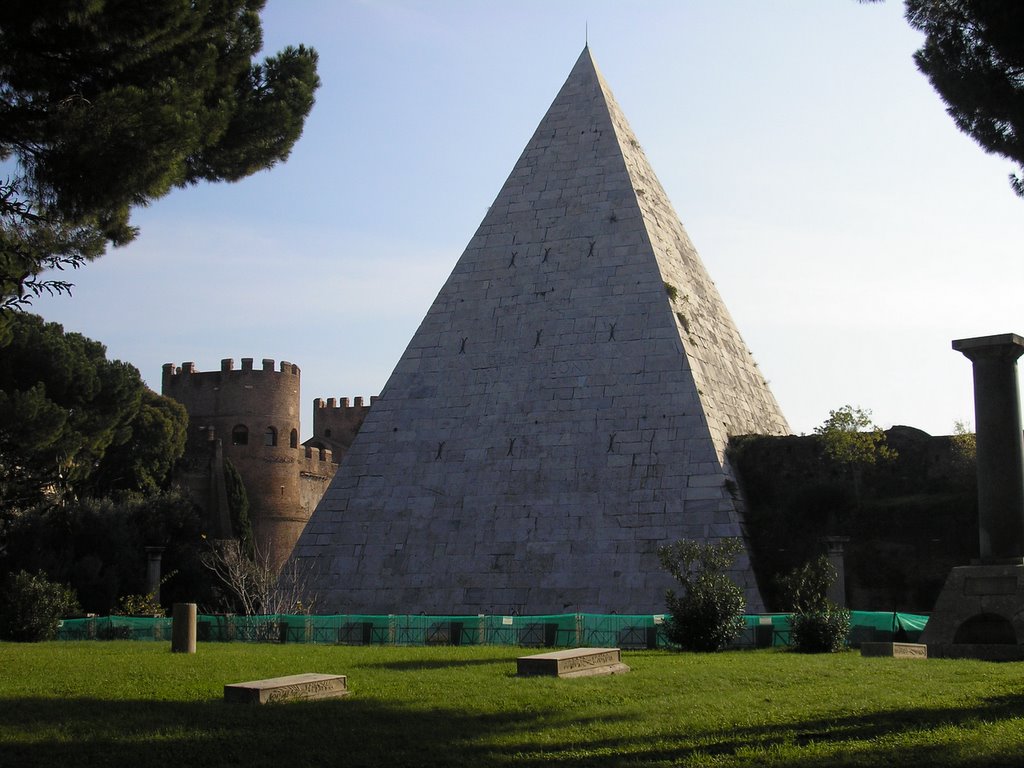
I went on a little tour of the 'Protestant' Cemetery today down by the Pyramid/Tomb of Cestius and under the shade of the Aurelian Walls. Here is a picture of the Pyramid, which supposedly took around 330 days to build, if I'm remembering correctly.


For all you Late Antique/Early and Medieval Christian Art and Architecture types, here is a picture of the grave of Richard Krautheimer, a civis Romanus.

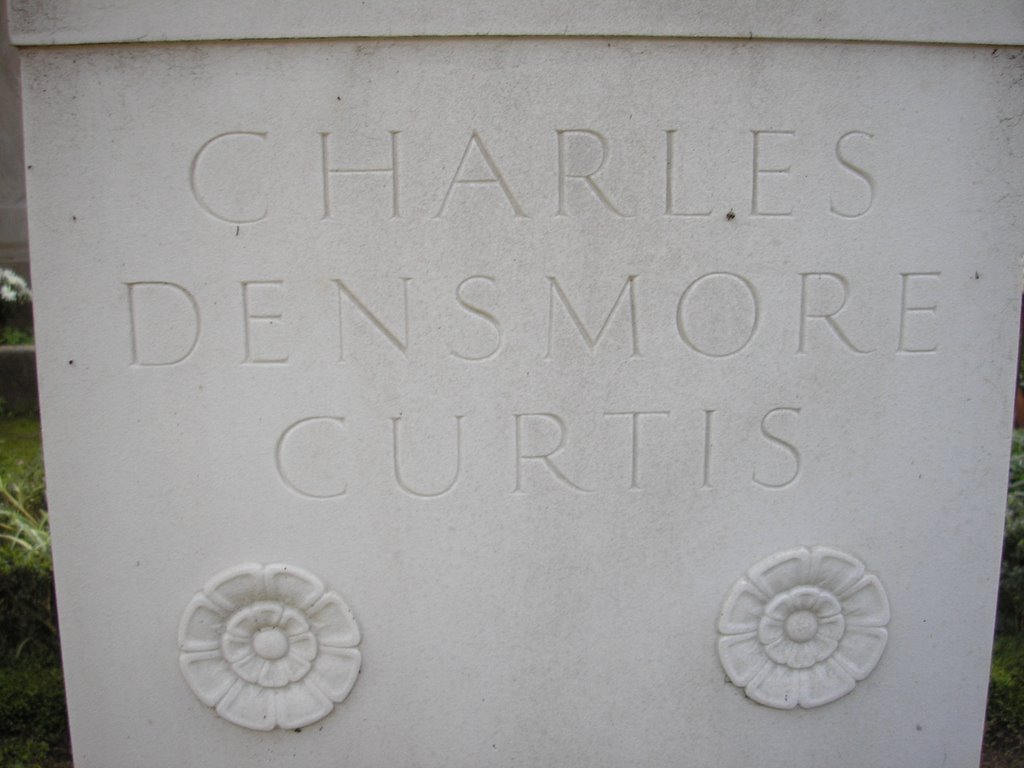
And for all you Bryn Mawr types, here is a picture of the grave of Charles Densmore Curtis.


UPDATE: I also have some non-classical photos from the cemetery here.

Tuesday, November 08, 2005

Merriam-Webster's Word of the Day

Here is Merriam-Webster's word for today, of Latin heritage.

vulnerary \VUL-nuh-rair-ee\ adjective

: used for or useful in healing wounds

Example sentence:
Native Americans prized the herb echinacea for its vulnerary properties, using it to treat burns and snakebite as well as arrow wounds.

Did you know?
"Vulnus," in Latin means "wound." You might think, then, that the English adjective "vulnerary" would mean "wounding, causing a wound." And, indeed, "vulnerary" has been used that way, along with two obsolete adjectives, "vulnerative" and "vulnific." But for the lasting and current use of "vulnerary," we took our cue from the Roman scholar Pliny the Elder. In his Natural History, he used the Latin adjective "vulnerarius" to describe a plaster, or dressing, for healing wounds. And that's fine — the suffix "-ary" merely indicates that there is a connection, which, in this case, is to wounds. (As you may have already suspected, "vulnerable" is related; it comes from the Latin verb "vulnerare," which means "to wound.")

*Indicates the sense illustrated in the example sentence.

Monday, November 07, 2005

Wall in Forum

One more thing from rogueclassicism: there are a couple of confusing stories floating around about a wall collapsing in the Forum and the Colosseum being closed. I was a little surprise that I hadn't heard anything about this, so my wife went down to investigate this afternoon. She reports that everything appears to be open today, including the Colosseum; this doesn't mean that there wasn't a wall-collapse, but only that (so far, at least) it doesn't seem to have had a significant impact on site-accessibility. I'll update this as and when I come across any other information.

Father Foster

In reference to Magister Coke's teaching of AP Vergil, he might find the latest installment of Father Foster worth sharing with his class, in which the esteemed Latinist says a couple of times that Vergil is overdone, and that he prefers Horace. In fact, I think he even says at one point that there are 10,000 other Latin authors as good as Vergil (but I may be remembering incorrectly). I listened to it last night, and it was quite entertaining. Here is the link to rogueclassicism, from which you can click on a link to download the mp3 file.

And speaking of Vergil and Horace, I also learn from the rogue that today is the anniversary of Maecenas' death.

Maecenas atauis edite regibus,
o et praesidium et dulce decus meum,
sunt quos curriculo puluerem Olympicum
collegisse iuuat metaque feruidis
euitata rotis palmaque nobilis 5
terrarum dominos euehit ad deos;
hunc, si mobilium turba Quiritium
certat tergeminis tollere honoribus;
illum, si proprio condidit horreo
quicquid de Libycis uerritur areis. 10
Gaudentem patrios findere sarculo
agros Attalicis condicionibus
numquam demoueas, ut trabe Cypria
Myrtoum pauidus nauta secet mare.
Luctantem Icariis fluctibus Africum 15
mercator metuens otium et oppidi
laudat rura sui; mox reficit rates
quassas, indocilis pauperiem pati.
Est qui nec ueteris pocula Massici
nec partem solido demere de die 20
spernit, nunc uiridi membra sub arbuto
stratus, nunc ad aquae lene caput sacrae.
Multos castra iuuant et lituo tubae
permixtus sonitus bellaque matribus
detestata. Manet sub Ioue frigido 25
uenator tenerae coniugis inmemor,
seu uisa est catulis cerua fidelibus,
seu rupit teretis Marsus aper plagas.
Me doctarum hederae praemia frontium
dis miscent superis, me gelidum nemus 30
Nympharumque leues cum Satyris chori
secernunt populo, si neque tibias
Euterpe cohibet nec Polyhymnia
Lesboum refugit tendere barbiton.
Quod si me lyricis uatibus inseres, 35
sublimi feriam sidera uertice.

Saturday, November 05, 2005

AP Vergil

I am teaching AP Vergil this year, and I have a student who is trying to write in meter. I check his work, show him his mistakes, and he comes back with more mistakes than before. He is a rather smart guy, and he does not give up easily. I like to see his efforts, but I feel that somehow, his time might be spent better in other Latinic pursuits. I want to encourage him to pursue communication through other means until his vocabulary and his awareness of meter are more consolidated. So, I wrote a little poem for him in dactyllic hexameter. His latin name is Tertullus. I need some feedback.

Tu, Tertulle, loqui nunc visne aut scribere metro?
non facile est mihi simpliciter fandum vacuumque
verbum adipisci, verum est insanum modulate.

How's my meter? Have I missed anything? I am concerned about the use of "metro" and "modulate." Does the poem make sense to you? Any suggestions for word choice? Thanks!
Magister Coke

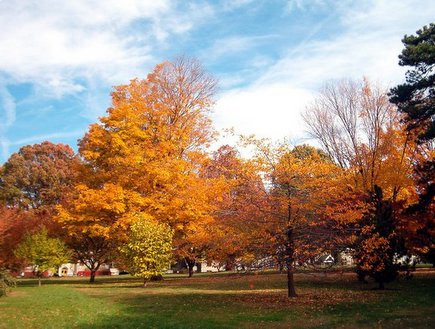
Fall at Bryn Mawr


There are about 30 more where that came from, freshly uploaded to Flickr.

My favorite is the bottle of Lion's Head by an ivy covered tree. Nothing beats it for $11 a case. Posted by Picasa