Saturday, November 05, 2005

AP Vergil

I am teaching AP Vergil this year, and I have a student who is trying to write in meter. I check his work, show him his mistakes, and he comes back with more mistakes than before. He is a rather smart guy, and he does not give up easily. I like to see his efforts, but I feel that somehow, his time might be spent better in other Latinic pursuits. I want to encourage him to pursue communication through other means until his vocabulary and his awareness of meter are more consolidated. So, I wrote a little poem for him in dactyllic hexameter. His latin name is Tertullus. I need some feedback.

Tu, Tertulle, loqui nunc visne aut scribere metro?
non facile est mihi simpliciter fandum vacuumque
verbum adipisci, verum est insanum modulate.

How's my meter? Have I missed anything? I am concerned about the use of "metro" and "modulate." Does the poem make sense to you? Any suggestions for word choice? Thanks!
Magister Coke

Fall at Bryn Mawr


There are about 30 more where that came from, freshly uploaded to Flickr.

My favorite is the bottle of Lion's Head by an ivy covered tree. Nothing beats it for $11 a case. Posted by Picasa

Not funny, but relevant.


Not funny, but relevant. Posted by Picasa

Illuminated Manuscripts at the NY Public Library

Illuminated manuscripts, because they are handmade and often contain miniature masterpieces of painting on paper, seem to belong more to the art museum than to a public library.

But a hundred of them are on display in the library's dimly lit D. Samuel and Jeane H. Gottesman Exhibition Hall on the first floor of the stately building at 42nd Street and Fifth Avenue. This is the cream of the library's 300 or so illuminated books. It includes Bibles, prayer books, atlases, scientific texts and romances, dating from the 10th to the 16th centuries.


Sounds like fun ... if you're a NERD!

(...which I think we all are.)

Thursday, November 03, 2005

For Magister Coke

Magister: Last night as I was walking down Fratelli Bonnet I saw Father Foster through the back window of a bus. I know it was him; the briefcase and clean-shorn head are unmistakable. I thought about trying to track him down to say hello on your behalf, but ultimately did not. Apologies.

On a somewhat unrelated note: last night I also watched an old episode of Seinfeld called 'The Cafe'. Toward the beginning of the episode, she keeps repeating the phrase casus belli because she had just read it in a book and wanted to say it. George persists in asking what it means, and she replies, 'It's just a Latin phrase, George; it doesn't mean anything'--and this right before she boasts of her 145 IQ!

Tuesday, November 01, 2005

The Uses and Disadvantages of History for Life

... and in this case death:

A UNIVERSITY student died after being hurled 100ft through the air by a medieval-style "trebuchet" catapult, an inquest heard yesterday.

Kostydin Yankov, 19, an Oxford University student, suffered multiple injuries and serious spinal damage when he fell short of the safety net.

. . . . . . . . . .

The device is based on the trebuchets used in medieval times to hurl rocks and dead animals over castle walls during sieges. It uses a tonne of lead weight to give a see-saw effect and propel volunteers hundreds of feet into the air.

German abbreviation question

I've come across the abbreviation a.O. in a German article and I think it must mean the same thing as a.a.O, 'am angeführten Orte,' which is essentially ad loc.

Does anyone know for certain? Reference works have been absolutely no help.

Monday, October 31, 2005

The Oldest Opus Reticulatum in Rome

This specimen, so far as I know, is the oldest extant bit of opus reticulatum in the city of Rome. It formed part of the structure of Rome's first permanent theater, the Theater of Pompey. It now forms part of the basement of a restaurant.


This same restaurant has a nice model reconstruction of the theater:

10,000 Hits!

The Campus should reach 10,000 hits today, and that's no small feat.

I attribute it to things like this: someone found us yesterday by searching Yahoo for 'funniest aminals.' (Yes, aminals ... not animals.)

And you know what? We came up as number 9.

(See the previous posts in the sidebar if you're not sure how that happened.)

Saturday, October 29, 2005

A Bookish Popularity Contest

'Saranike' takes an entertaining and idiosyncratic trip through the OCLC's list of the top 1000 books. And she even mentions me at the end.

She pointed me toward the Reference list, so let's see what I own:

#4 -- MLA Handbook for Writers of Research Papers, Joseph Gibaldi
#5 -- History of Art, H. W. Janson
#7 -- Elements of Style, William Strunk
#10 -- Oxford Companion to American Literature, James David Hart
#11 -- Art through the Ages, Helen Gardner
#27 -- Oxford Companion to English Literature, Margaret Drabble
(n.b.: I don't have this edition, 'updated' by Margaret drabble, but rather the original by Sir Paul Harvey)
#30 -- Dictionary of Modern English Usage, H. W. Fowler
#34 -- Outline of History, H. G. Wells

Looking over the list, I don't want anything I haven't got, and I think I'm better with the other stuff I have than most of what pass for libraries today.

This could become a meme: which books do you own from which lists. I see the banned books list being particularly popular.

the Myth of Myth

Mary Beard has a good, readable review of a number of books which rework classical myth. One of them, Margaret Atwood's Penelopiad (which she actually enjoyed), led her to lash out at a weak 'feminist' reading, and then at Robert Graves, whom she blames:

The only blot on this brilliant book is a chapter entitled "An Anthropology Lecture". This insists, through the mouth of the murdered maids, that deep beneath the story of Penelope lies the cult of the Mother Goddess, and that anyone who does not accept the matriarchal substrate of Greek myth has not learned the lessons of feminism. This is complete rubbish (most feminists I know think that matriarchy is itself a myth invented by patriarchal culture). But I suspect that Robert Graves has a lot to answer for here.

Graves was one of the few people who believed Butler's claims about the authoress of the Odyssey, and his bonkers White Goddess is a founding tract of New Age matriarchy. More influential, though, is his Greek Myths, which has been the standard reference work for half a century now (and is acknowledged by Atwood as a "crucial" source). The success of this book is a mystery; it is dry and dense, with almost as much footnote as text over its 800 pages. It is hard not to suspect that most buyers, attracted by the combination of famous author and authoritative title, do not get very far in actually reading it. But you need to skim only a few pages of the introduction to get the clear message that the Great Mother is the key to most of what will follow.

A former professor of mine once remarked that Graves's The White Goddess was that greatest parody of scholarship he'd ever read.

Beard is right when she notes that there is no orthodox version of myth, which means you need to be careful when reading what anyone says about a given myth. Which sources are they using, combining, leaving out, and why?

It doesn't help anything to manufacture narratives 'informed' by theory.

Friday, October 28, 2005

A Question for Our Readers

Can anyone recommend a good standard reference for poetic hymn- and prayer-form (classical/non-Christian)? I realize that individual writers make a lot of modifications to the forms; I'm just looking for something very basic that lays out the components.

Thursday, October 27, 2005

Let's get classical, classical ...

That's what's finally happened to Sanskrit, anyway: it's now officially a classical language in India, joining the ranks of Tamil.

Hard to believe it's taken this long (if I read one more article/preface/etc. that opens, 'In 1786 Sir William Jones declared to the Asiatick Society of Calcutta ...' I don't know what I'll do).

maGgalavAdin!

On poetry and mimesis

Peter Bing opened The Well-Read Muse with the following inscription taken from the opening soliloquy of Plautus' Pseudolus, Act I Scene 4:

sed quasi poeta, tabulas quom cepit sibi,
quaerit quod nusquamst gentium, reperit tamen,
facit illud veri simile, quod mendacium est,
nunc ego poeta fiam

What interests me most is that it captures the sentiment of the Muses statement to Hesiod at his poetic initiation (Theog. 26-8), that the Muses are capable of telling the truth as well as specious falsehoods, but it does this while acknowledging the active role of the poet against the dominant tradition of the inspired vessel, which itself is largely a Platonic invention (or rather a liberal extension of the 'divine voice').

It occurs to me that when most of us think of the Muses and the role of the poet we are dominated by Plato's view, but that even in Hesiod there was no enthusiasmos, but rather a kind of gift, which was poetry. Of course Hesiod dissociates himself from the content of the poem which follows, and thus from any falsehoods, but he is not mad. He chooses the subject, consciously summons the Muses, and merely relies on them for the facts.

This is merely a poetic conceit, one which becomes clear in Pindar, in whom the Muses are thinly veiled personifications. Even in the Modern era a poet-scholar like Robert Graves, who makes a fine parallel to the Alexandrians, championed the 'true' Muse-Poet against the 'rational' devotee of Apollo (see his Oxford Addresses on Poetry, which almost invariably revisit this theme).

I think of Nicander as a prime example of the Apollinian poet. Afterall, he was apparently a priest of Apollo, and positioned himself in his poetry by the 'Clarian tripods of the Far-Darter' (Alex. 12) and claimed that 'Claros' snow-white citadel' had nursed him.

He called himself Homeric and doubtless favored his native Colophon as the birthplace of Homer (cf. the Margites) in his lost work on the poets of Colophon (of which there were many, including Mimnermus and Antimachus). Despite being 'Homeric Nicander,' and despite his status as a poet, which he takes care to show us, he ignored the Muses.

As I'll argue in my thesis, though, he wants us to remember the daughters of memory and to notice their absence. He returns us to the place of Hesiod's initiation, doubting a spurious ascription, and immediately we recall the lies of the poets, for which Hesiod shifts responsibility, which philosopher-poets as early as Xenophanes decried, and which later Plautus squarely put on the agency of the poet: 'facit illud veri simile, quod mendacium est.'

But this now would take us in another direction, I think. It's something I aim to cover in my thesis, and that is the nature of mimesis, which I think all of this centers around. I'll leave you with this, that mimesis is not imitation or representation (and certainly not, as Fantuzzi and Hunter have taken it by misreading Plato Laws 4.719c, 'the representation of characters.')

I'll give you a hint. Mimesis was also current in rhetorical training as the 'imitation' of famous writers. Yet semantics fails us here. Are we truly imitating writers, or their style? And if their style, then what is the aim of that imitation?

It involves memory.

And that is the key to the ambiguity of poetry, the nature of mimesis.

Wednesday, October 26, 2005

OBITUARY: Robert Johnston

Robert H. Johnston, whose work in the digital restoration of archaeological finds resulted in ways to read ancient degraded texts such as the Dead Sea Scrolls, died Oct. 19 at his suburban Rochester home. He was 77.

OBITUARY: Marshall Clagett

"His influential body of work has had an indelible impact on the history of medieval science, and the depth and clarity of his scholarship has enlightened our understanding of subject areas as diverse as medieval physics and Egyptology," Peter Goddard, the institute's director said in a statement.

Tuesday, October 25, 2005

Cambridge Ancient History

One more thing: my wife called me a 'big dork' today because I ran upstairs excited that the new edition of the Cambridge Ancient History vol. XII, covering the years 193-337 AD, was spotted by yours truly this morning on the new acquisitions table of the library. Maybe I AM a big dork (maybe? Come on, who am I kidding?), but I was nonetheless enthused to find it now available--I really would have like to have gotten my hands on it a couple of months ago in preparation for exams and all that, but alas, it was not to be.

Anyway, I skimmed through the contents and it looks like there might be some good stuff in there, especially for the Late Antique crowd. If anyone comes across a review of the book, please bring it to my attention.

The Taste of Imperialism?

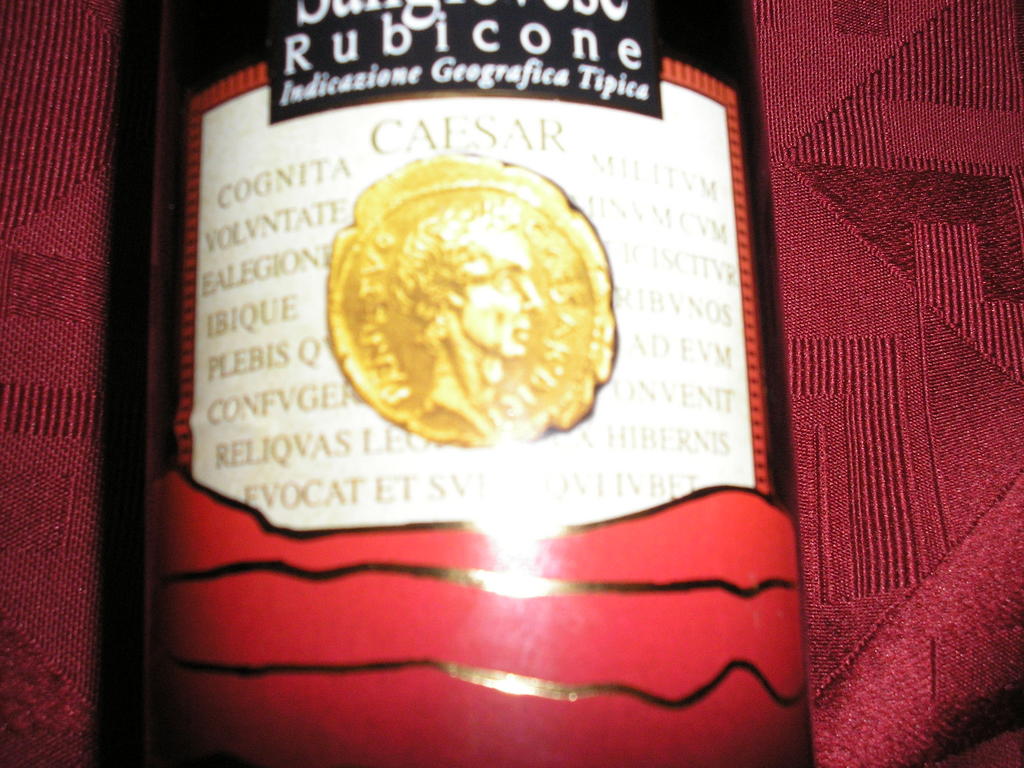
My wife and I opened a bottle of a wine called 'Merlot Sangiovese Rubicone' tonight that has a rather interesting label. I reproduce it for you here:


There's a little bit of a glare on the picture, but you can probably see the word 'Caesar' at the top above a Caesarean coin, surrounded by Latin. Here is how the broken Latin reads:

COGNITA MILITVM VOLVNTATE [...]MINVM CVM EALEGIONE [...]FICISCITVR IBIQUE [...]RIBVNOS PLEBIS QV[...] AD EVM CONFVGER[...] CONVENIT RELIQVAS LEG[...] EX HIBERNIS EVOCAT ET SVBSEQVI IVBET

Numismatists and epigraphers of the world, unite!

Monday, October 24, 2005

Jeopardy in need of a Latinist

Tonight on Jeopardy we learned that the Latin for the old Charlie Rich song 'Behind Closed Doors' would be 'januis clausis.'

Not 'post januas clausas' or even 'pone januas clausas.'

My response? 'What is "with the doors being closed, ..."?'

Etruscan Texts Project

I haven't been keeping as close an eye on this as I should, but my alma mater, UMass, maintains an online database of Etruscan texts and other resources.

The project is headed by Prof. Rex E. Wallace, with whom I had the honor of studying Faliscan, Oscan, Umbrian, and yes Etruscan (along with a bit of Cisalpine Gaulish).

(After that class we had a department shirt emblazoned with a refrain from the purifications in the Iguvine Tables: 'place the testicles on the tray.' This was, of course, in the original Umbrian.)

The site promises a new version in development, but it's well worth checking out in its current incarnation.