Tuesday, July 25, 2006

"art squad v tomb raiders"

A general piece on the illicit antiquities trade.

Antiquities theft seems to me a serious issue, though I find myself differing from most of the people I've seen quoted on the issue (not that I've read much on the subject). Identity politics and nationalism make me very uncomfortable, and I have a hard time accepting that ethnicity or nationailty gives someone a special claim to culture, particularly ancient culture, which is equally accessible to all. I get the feeling that a lot of outrage over antiquities theft has to do with some vague notion of the works as belonging to a given people.

I never feel for the aggrieved nation, but rather for history. My only concern is that raided antiquities can tell us far less about history than those properly excavated. It angers me as much as the 'theft of culture' angers others. And yet I'm inclined to think that my reaction is the more sensible: while my primary motivation is to increase our store of certain historical evidence, many others seem motivated primarily by a belief in the sanctity of cultural identity and national pride.

unto the children of Israel

A Byzantine mosaic has been uncovered in Jerusalem by an unorthodox archaeological team:

"It is not every day that children ages 9 to 12 years old, Jewish and Arabs, uncover Christian archaeological remains which are an integral part of the cultural heritage of this land," said Hagit Noigbern, director of the Jerusalem Archaeological Center of the Israel Antiquities Authority, which organized the enrichment program.

"The Constant Emperor"

Constantine the Great, whose famous vision probably ranks as the number one web search bringing visitors to this site (thanks to Eric's posts on the subject), is the subject of an exhibition at the Yorkshire Museum in York till Oct. 29. The curator has a well written summary of the period of Constantine's accession and reign and the importance of his personality in shaping and guiding the empire (that's her clever title linked above). If you don't know anything about Constantine, it's a great introduction that might inspire you to learn more.


PS: Constantine reminded me a conversation I had once (was it with you, Eric?) about whether in English Augustine should be pronounced AugusTEEN rather than AuGUStin, just as Constantine is ConstanTEEN. ConSTANtin would sound ridiculous. I've setteled on AugusTEEN because Augustinus and Constantinus are of the same formation (the -i- is long and takes the accent). I think AuGUStin only seems acceptible by anology with Augustus, and many people, even some scholars, occasionally confuse the two.

a2 + b2 = c2

Here's proof (no pun intended) of the value of the classical tradition: Euclidean geometry and the Pythagorean theorem working their simple magic on the minds philosophers, scientists, and soldiers through the centuries, demonstrating two simple elements of critical thought: discovery and proof.

Sunday, July 23, 2006

An obscure lexicon

I'm searching in vain for information on a work known as the Lexicon Patmense, alternately known as Λέξεις μεθ’ ἱστοριῶν ἐκ τῶν Δημοσθένους καὶ Αἰσχίνου λόγων or Lexicon in Demosthenem et Aeschinem. So far L'Année and Jstor have turned up nothing, and Google hasn't been much better.

Any ideas? According to the TLG, where I found the text, it was published as part of Sakkelion's Lexica Graeaca minora, Olms 1965. The TLG gives the date as uncertain.

At the moment I'm in a little suburban town without a good library, and I'm trying to find out the opinions any scholars might have regarding its date and provenance. My early efforts working strictly from the text have been frustrating.

The lexicon cites Nicander for the notion that fennel is attractive to snakes, because they doff their slough upon it (apologies to Seuss):

Καὶ ἡ μὲν μάραθρος ὄφεων ἀγωγός ἐστι διὰ τὴν ὀσμήν· Νίκανδρος γάρ
φησιν ὅτι ἐπὶ τῆς μαράθρου οἱ ὄφεις τὸ γῆρας ἀποδύονται.
This is an odd statement and a clear case of a misreading. Nicander says that snakes in springtime rejuvenate themselves in part by eating fennel (Th. 31). This establishes that they find it attractive, though there's no mention of their slough. But much later, while discussing the Amphisbaena, a mythical snake with a twin head upon its tail, he says that in springtime, when 'earth reveals serpents,' the amphisbaena 'does not feed upon a flowing shoot of fennel spray when it casts flesh round its body 'neath the sun.'
οὐδ’ ἄρ’, ὅταν χαράδρεια λίπῃ καὶ ῥωγάδα κοίλην
ἦρος ἀεξομένου ὁπόθ’ ἑρπετὰ γαῖα φαείνῃ, (390)
ἀκρεμόνος μαράθοιο χυτὸν περιβόσκεται ἔρνος,
εὖτ’ ἂν ὑπ’ ἠελίοιο περὶ φλόον ἅψεα βάλλῃ,
ἀλλ’ ἥγ’ ἀρπέζαις τε καὶ ἐν νεμέεσσι πεσοῦσα
φωλεύει βαθύυπνος, ἀπ’ εἰκαίης δὲ βοτεῖται
γαίης οὐδ’ ἀπὸ δίψος ἀλέξεται ἱεμένη περ.
He's clearly contrasting the amphisbaena with more typical snakes, and the fennel is recalled not because it relates to sloughing skin in any way, but because the amphisbaena's odd behavior, not eating fennel in spring, sets it apart. That last temporal clause is to be negated along with the eating of fennel, not taken as a positive. It fleshes out the idea of springtime, a time of rejuvenation. This is a common use of such clauses in Nicander, who tends to use them to add vivid images to a subject not rich in narrative potential.

The amphisbaena neither eats fennel, nor does what other snakes do in springtime, namely put on their new skin.

The interpretation is confused, I suspect in part due to the poor state of Nicander's text in the early Byzantine period. It was once described as 'illegible' and virtually written in a foreign tongue before the Palaeologan renaissance, and in such a corrupted state it would have been easier to misinterpret the passage.

But I'd like to be more certain about the date of the Lexicon before I make too much of it.

Friday, July 21, 2006

Dalby Strikes Back

Andrew Dalby has commented on an earlier post in which I was skeptical of the very idea of his book (i.e., that the Homeric poems were written by a woman) and specifically challenged the claim that no ancient author ascribed the Iliad or the Odyssey to Homer. This, incidentally, didn’t require that I read his book. I was responding to ideas, and specifically to a direct quote by Dalby that 'the idea that Homer was the author was first proposed in "one ill-informed post-classical text -- the anonymous Life of Homer, fraudulently ascribed to Herodotus".’

Dalby accuses me of misquoting him and takes umbrage with the word ‘author’, though he never makes it clear what’s wrong with the word. I can only assume that he thinks ‘author’ presupposes writing. (Incidentally, since I quoted the writer who quoted him –notice the quotes within quotes there--, Dalby is incorrect to claim that I misquoted him.)

In his response Dalby focuses almost exclusively on oral theory, which says nothing to the testimony I offered in response to his claim about ps.-Herodotus. Dalby actually restates the same misinformation reported in the article cited.

But I’m sure that Homer-as-oral-poet is central to the argument of the book and was neglected in the article. The problem is that oral theory changes nothing on this question. In this case, Dalby insists that ‘all the earlier authors insist he [Homer] worked purely orally. Right?'

Wrong. As I pointed out in my post, there are countless examples of direct quotations from Homer that imply a standard written text. I say imply because none says anything whatsoever about Homer’s compositional technique, despite Dalby’s desire to see ancient support for oral composition theory.

The earliest authors who offer testimony on Homer lived centuries after the likely period of composition, and this span of time is marked by a distinct lack of critical historical record. This was a time in which statesmen still claimed mythic origins and propagandized their own past to legitimize rule by tyranny, for example. This was a time when Greeks still believed in kings who slew dragons and thought themselves not far removed from an age filled with demigods and sea monsters. Whether the writers of the classical period considered Homer to be an oral poet or one who composed verse in writing is no test of historical truth, and I can’t see how it would lead one to argue that the author of the Homeric poems was really a woman or to think it a worthwhile endeavor to reconstruct prehistoric persons out of scattered, inconclusive, and inaccurate testimony. In this case, Dalby’s grasp of ancient sources seems to be unacceptably slim.

However, no one to my knowledge *insists* that Homer was an oral poet. Dalby suggests that the ancients believed Homer to have taught his poems to his family (these would be the Homeridae) who continued to repeat and teach his poems orally. I ask you to show me one ancient author who *insists* that Homer composed his poems orally in accord with the Parry-Lord thesis.

I still don’t know how oral theory justifies the book, but I have to take issue with Dalby’s claim that oral theory is proven and legitimate. I think it’s short-sighted to say the least to believe that poems of such length with all their subtlety were both spontaneously composed and taught orally.

Oral theory argues that the poet composes as he performs, not that he composes orally and then memorizes and teaches his songs. The oral poet is believed to compose his songs afresh each time he performs, and while he may sing on the same themes from the same perspective and repeat major ideas, the composition itself is never an exact replica of prior compositions or performances. In short, even if you accept oral composition and allow for the possibility of memorization and the teaching of composed songs, then the only thing separating this from written composition is the act of writing. That’s a superficial distinction, because when someone composes a set piece, whether they memorize it or they write it down, they have composed a set piece. Memorization and repetition are not the same as oral composition.

Dalby, and he is in good company here, simply misses the point. He, like many people who have accepted oral theory without understanding it (some of whom are respected classicists), confuses the essence of oral composition with performance. In the archaic and classical periods, all poetry was performed, even when it was carefully composed. Some of this poetry was performed in simpler, more casual contexts like symposia with the appearance of spontaneity, some, such as hymns, were performed during religious events as though divine agents spoke through the poet who was simply a medium, and others were performed as part of elaborate productions involving actors, a chorus, musical accompaniment, and staging. All were composed, all had set texts, and all were composed in order to be performed.

The second of these examples reflects a common pretense among the ancients, which is that the poet is divinely inspired. He does not write or compose his songs, but rather some god endows him with the gift of song and the Muses sing through him. Hesiod, at least, was smart enough to have his Muses admit that they could tell the truth as well as specious falsehoods, which allowed him to claim divine authority without committing heresy.

But Hesiod raises a serious question about oral composition. Ancient references to oral composition all indicate divine inspiration, and yet Hesiod surely can not have believed himself to have been swept away, to have met with the Muses, and to have become a conduit of divine knowledge. Some of his audience, especially those of later generations for whom poets like Homer and Hesiod had become legendary figures, may have believed it, but Hesiod could not have. This was a poetic convention. Similar ideas are found in rhetoric, as in the Defense of Helen by Gorgias, who argues that poetry has magical properties and that verse, by its very nature, has the power to persuade. Here, in traditional imagery, Gorgias was pointing to the same thing that poets like Hesiod and critics like Plato discussed in terms of inspiration. The ‘mad poet’ had something of the divine about him. His mode of speech (i.e., verse) was distinct, aesthetically pleasing, much like the hymns to gods or their oracular responses. Poetry was thought to be a spiritual thing and to speak to the soul, and those who recited poetry were the agents of the gods. Of course, they weren’t really. And neither were they really linguistic virtuosos able to compose perfect songs spontaneously. But it was good for business to pretend that they were.

Oral composition in antiquity meant nothing other than divine inspiration in the truest sense of the word. And yet Homer himself offers a picture of a rhapsode taking requests and singing poems on epic themes that he had sung before. These were compositions, and we have no reason to assume that Greek poets spontaneously composed verses simply because it was possible for some illiterate poets in Yugoslavia to sing charming songs for a visiting scholar.

But this has taken us rather far from the argument.

Dalby’s comment suggests that his book is about oral theory. Okay. But that doesn’t change my critique of his own false statements. He continues to insist that only ps.-Herodotus claims that Homer was the author of the poems after I offered examples in Herodotus (yes, the real Herodotus) in which he cites Homer.

And I still don’t know how oral theory is supposed to discredit the notion of an original composer conveniently labeled Homer. This is the view of M.L. West who was famously accused of being ignorant of oral theory (by Nagy and Nardelli), but who responded beautifully to his critics by pointing out their own short-sightedness. West, and I think he’s right, believes that it is more likely that each poem was composed by an individual who drew upon a rich poetic tradition, and whose great literary achievement was later affected in places by accretions and alterations.

The tradition from which 'Homer' worked may have employed oral composition in the manner of the Parry-Lord thesis, but the subsequent tradition was that of a written text (despite the fact that those who promoted his verse may have performed it orally in the traditional Greek manner of the rhapsode), but the composer of the Iliad and that of the Odyssey (if different from that of the Iliad) must have been a writer.

West is in my view a most sensible and judicious critic of oral theory who understands its proper place and does not allow it to overrun reason and impose absolutes that tidily aid us on our way to the conclusions we seek.

Dalby’s argument from silence isn’t worth considering. He wants to know why none of Homer’s near-contemporary writers mention his ‘world-shaking’ feat. We know almost nothing about the period and retain next to nothing of the literature produced, let alone any commentary that is truly ancient (the antiquity of scholia vetera is almost always greatly exaggerated). This kind of argument allows us to plug in whatever we want and to argue by a series of guesses and inferences mixed with innuendo and novelty. It’s a fun game to play, guessing at what history has not recorded, but I don’t care for it.

And I still fail to see what oral theory has to do with Dalby’s refusal to accept the testimony that we do possess.

I guess I should just say for the record, if I haven't made this clear enough yet, that I don't believe anyone who talks seriously about Homer believes that they know him to have been a particular individual with a particular personality, or necessarily believes that the same Homer wrote both poems. Those of us who talk about Homer tend to do so because it's impossible to know who wrote the poems and how, and we use the traditional terminology, in the same way that the ancients discussed Orpheus. Whether there was an individual poet called Homer doesn't matter much. But there are two important poems that were most certainly composed, each by a particular genius, and each ultimately composed in writing.

Whether that genius was a woman is impossible to know, though the ancients thought they knew Homer to be a man. Does it really matter?

Well, if you decide that it does, you're best served understanding the tradition and the ancient testimony and not simply discounting what you disagree with by word games such as what constitutes an author and when precisely the word is used.

Wednesday, July 19, 2006

Notae

Every so often I scan news and web sources for classical references, but rogueclassicism does such a good job of keeping the classical blogosphere abreast that I'd feel like I was stepping on David's toes to post much of what I found.

But one thing that really sticks in my craw recurs so often that it needs to be addressed: 'Greek and Latin' are indiscriminately cited as though they were one language, or had jointly agreed to donate individual words to our language. Countless times I've read that a given word 'comes from the Greek and Latin for' something, and as we've discussed here in the past, that's only true for words like television and homosexual (Gk root + Lat. root).

A piece at FtWayne.com on choosing the right words for a eulogy repeats the error in a weird way:

Miller says the aim of any eulogy – the word comes from the Greek word for “praise” and the Latin for “epitaph” – is to honor the deceased.


Eulogy, then, comes from two sources: (1) the greek word for praise, and (2) the Latin word for 'epitaph.'

Knowledge of Greek and Latin is not required to see the error here, which is purely one of logic. The Greek word for praise intended here is clearly εὐλογία, and eulogizing is the putting-in of a 'good word,' as it were. But the Latin word for epitaph in the normal sense isn't eulogy, but 'titulus.'

ἐπιτάφιος was an adjective that could describe anything done at a tomb, from a speech given to games conducted. An ἐπιτάφιος λόγος was what we would call a eulogy, 'a speech at a grave.' But what we would call an epitaph would be ἡ ἐπιγραφή or τὸ ἐπίγραμμα to the Greeks, simply an inscription clarified by context.

It's tough to say how this specific error was reached, but it's easy to see that the shifting and interrelatedness of the terms over time has made it easy.

Monday, July 10, 2006

The Greek Tyrants

Here's a post that was left in draft mode for a few weeks. I think I wanted to polish it, but that's not what blogs are about, and I'm already thinking about other things (like getting my Certificate of Eligibility to teach in NJ). I forgot about it until now:

So I'm reading Andrewes the Greek Tyrants, which I picked up for 50 cents somewhere, and I can't help but think he completely misread the story of Cypselus' birth.

So first a little background.

Cypselus is recognized as the first of the Greek tyrants in the archaic period, and here 'tyrant' refers to what is esssentially a monarch who rules without hereditary right or constitutional authority; in short, not a king. Greece, it is held, was moving out of a period marked by aristocratic rule, and Andrewes believed that the reason lay in hoplite warfare and the subsequent involvement of a lower social tier in war and government: a strong individual with the support of the hoplites could easily overtake the minority ruling classes. Much of Andrewes's argument is guesswork, but it isn't badly done for the most part.

I have a serious problem, however, with Andrewes's acceptance of the myth of Cypselus' birth.

The aristocrats ruling Corinth at the time Cypselus seized power were called the Bacchiadae, a family which Herodotus tells us only married from within. A Bacchiad called Amphion had a daughter named Labda who was lame, and no one in the family would marry her. She was taken as wife by a certain Aetion from the district of Petra, by descent a Lapith and a son of Caeneus (Herodotus 5.92).

Now let's stop right here, because Andrewes passes over this casually and later calls Cypselus' father 'non-Dorian.' The OCD3 entry on Cypselus actually refers to the 'Lapithi' in a way that suggests they were simply an indigenous, pre-Dorian tribe. This smacks of rationalization: historians accept that Aetion exised and was a Lapith, ignoring the mythical signification.

The Lapiths, of course, are best known for their war with the Centaurs at the wedding of Perithous. During this war Caeneus, who had also participated in the Argonautic expedition and the Calydonian boar hunt, was buried under a mass of trees by the Centaurs but emerged as a bird. Caeneus was also praised by Nestor as one of the mightiest men of the greatest generation. It strikes me that such ancestry is precisely what tyrants of later times claim to justify their rule, though Heracles is the overwhelming favorite. But you have to cut Cypselus some slack; afterall, he may have been the first of the tyrants, or at least one of the earliest to employ this kind of propaganda.

Coupled with this mythic ancestry is the claim that his mother was a shunned Bacchiad, which actually gives him a legitimate claim to power in Corinth, especially when we consider that the Bacchiad's were said to have rotated power to different members of the clan. As a member of the clan, he was legitimate, and as a man descended from legendary kings and warriors who traced their lineage back to Zeus, he was a prime candidate to topple the existing order.

This reads as classic propaganda, like the Attalids who claimed descent through Telephus from Heracles and, by adoption, the native royal line of the ancient Mysian kingdom. The Attalids could claim to be both legitimate Greek kings and legitimate Asian kings. Isn't that convenient?

Andrewes focused too much attention on the 'racial' factor in the case of Cypselus because he wanted a thread of anti-Doric sentiment to lead him partway through the labyrinth of Archaic history, but I think he was simply mistaken and led astray by his own efforts to distinguish tyranny in the early period from its later incarnations.

Wednesday, July 05, 2006

Alcaic Fragment

There was a time when English poets could also write Latin verse. Thomas Gray was one such poet. Here is an 'Alcaic Fragment':

O Lacrymarum fons, tenero sacros
Ducentium ortus ex animo; quater
Felix! in imo qui scatentem
Pectore te, pia Nympha, sensit.

Monday, July 03, 2006

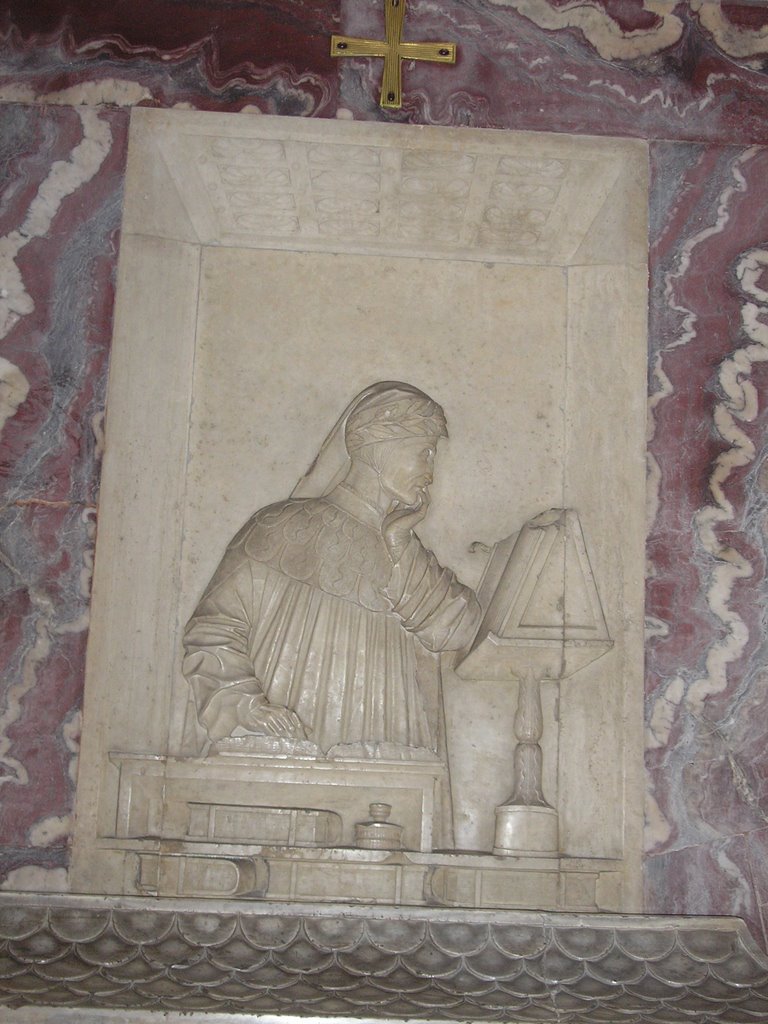
Dante's Tomb

This isn't directly related to the ancient world, but I figured that as long as I was posting pictures from Ravenna, I might as well include some of the tomb of Dante, who eventually lived (and died) in Ravenna after having been exiled from Florence. I thought that since he took Vergil as a guide and since there's a fair amount of Latin in his tomb, we could slip him into the Campus.


Wherefore art thou Homer? And not say, Phantasia?

David Meadows quotes from an article on a book by a certain Andrew Dalby who argues that the Iliad and the Odyssey may have been written by a woman. David thinks this is weird, but I have another view: it's silly, and it's been done before by a better scholar.

Samuel Butler, perhaps best known for his novels The Way of All Flesh and Erewhon, also translated Homer and published a book in 1897 called The Authoress of the Odyssey: where and when she wrote, who she was, the use she made of the Iliad, & how the poem grew under her hands.

But Butler was not the first to hold that view. Butler himself was asked why he made no mention of the post-classical tradition that not only the Odyssey but also the Iliad were written by a woman (his critic is known only as 'The Librarian'). It turns out that Butler was 'entirely ignorant, though he had taken a very good degree in classics.'

[A] certain critic of Homer, Naucrates by name, asserts that Odyssey (and the Iliad!) were written by one Phantasia, daughter of Nicaritius, a professor of philosophy, and were preserved in the library of Memphis, where Homer found them.
Not perfect (she was the daughter of Nicarchus, not Nicaritius, perhaps a typesetter's error), but accurate enough. Note that Phantasia (fantasy) means imagination. This should send up a red flag, especially when we consider the fascination which Egypt held for the Greeks as a fairy land full of magic, mystery, and divine knowledge. It was very romantic, and in later periods virtually every Greek poet, philosopher, and statesman was said to have studied there under the priests and to have attained its secrets, regardless of anachronisms and wild inconsistencies in the tales.

While a difficult source to track, the story of Phantasia comes from the great Byzantine scholar Eustathius, archbishop of Thessalonica (12th c. A.D.), teacher of Michael Choniates, whom I've mentioned before (Michael, archbishop of Athens, delivered a eulogy at Eustathius' funeral). This is what Eustathius had to say in his commentary on Homer:
φασὶ γὰρ Ναυκράτην τινὰ ἱστορῆσαι, ὡς ἄρα Φαντασία γυνὴ Μεμφῆτις, σοφίας ὑποφῆτις, Νικάρχου θυγάτηρ, συντάξασα τόν τε ἐν Ἰλιάδι πόλεμον καὶ τὴν Ὀδυσσέως πλάνην, ἀπέδοτο τὰς βίβλους εἰς τὸ κατὰ Μέμφιν τοῦ Ἡφαίστου ἄδυτον. ἔνθα τὸν ποιητὴν ἐλθόντα, λαβεῖν παρά τινος τῶν ἱερογραμματέων ἀντίγραφα, κἀκεῖθεν συντάξαι τὴν Ἰλιάδα καὶ τὴν Ὀδύσσειαν. ὅτι δὲ ἢ Αἰγύπτιος ὁ ποιητὴς ἢ εἰς Αἴγυπτον φοιτήσας ἐμαθήτευσε τοῖς ἐκεῖ, ἱστοροῦσι τινές. καὶ ἐν τῷ περὶ τῶν πλαγκτῶν δὲ λόγῳ ἐν τοῖς ἑξῆς τοῦ βιβλίου τούτου τεθήσεταί τις ἱστορία τούτου δηλωτική.

They say that a certain Naucrates records that Phantasia, a woman from Memphis--a skilfull and inspired poetess and daughter of Nicarchus--, having composed works on the war in Ilias and the wandering of Odysseus, deposited the books in the sanctuary of Hephaestus in Memphis. Then (they say), after the poet (i.e. Homer) arrived, he took copies from a certain one of the sacred scribes, and at last composed the Iliad and the Odyssey. And some say either that he was an Egyptian poet, or that studying in (literally "frequenting") Egypt, he was their pupil.
Homer, like all the rest, was a student in Egypt ('frequenting' here is the usual idiom). The whole of Plato's philosophy was supposedly taken from sacred Egyptian scrolls, so this comes as no surprise. It's part of the strain of apocryphal stories mentioned above.

Unaware of this story, Dalby is at least as ignorant as Butler, though I suspect more (his talk page at Wikipedia suggests less familiarity with the Greek alphabet than with the Cyrillic, so I suspect that he does not read Greek). For example, how can he argue that the 'the idea that Homer was the author was first proposed in "one ill-informed post-classical text -- the anonymous Life of Homer, fraudulently ascribed to Herodotus"?' This argument can only be used to show that the Iliad and the Odyssey were not identified by those names in classical antiquity, but even then it would be just plain wrong.

Lines routinely ascribed to Homer by authors such as Plato are those of the Iliad and Odyssey, both directly and indirectly cited. Any good text with an index will bear this out. I'll point to just one of the (at least) dozens: Republic 393a (book 3), where Plato quotes Iliad 1.15-16 and says that 'the poet himself is the speaker' but that the poet then switches,
and tries as far as may be to make us feel that not Homer is the speaker, but the priest, an old man. And in this manner he has carried about the affairs in Ilium, all that happened in Ithaca, and the entire Odyssey. (translator Paul Shorey in Hamilton & Cairns, Collected Dialogues of Plato)
(Yes, I checked the Greek, and that's what it says.) One cannot deny that Homer was regarded in antiquity as the author of both the Iliad and the Odyssey. But let's return to Herodotus. Dalby suggests that Herodotus was credited with naming Homer as the author of the Iliad and the Odyssey only in a spurious Life of Homer, but this is incredibly misleading.
In Book II section 116 Herodotus not only names Homer explicitly as the author of the Iliad, but also quotes several line from both the Iliad (6.289) and the Odyssey (4.227 and 4.359). I'm not making this up. It's all easily checked. He cites Homer elsewhere, but I recommend you see for yourself using the most basic research tools at your disposal. It takes minutes -- far less time than researching, writing, and publishing a book.

But let's set all that aside. Can anyone take seriously the premise that a woman is better suited to write sensitively about human affairs than a man, because men are mere brutish pigs thirsting for blood? I guess reverse sexism sells.

This book smells of amateurish provocation and would-be-valiant lances at straw men such as misogyny in the modern academy. We have no shortage of critics who pretend to challenge doctrines that do not exist, constantly conjuring ghosts of the 19th century in place of the stodgy professors who are no longer there. They epitomize style over substance.

The fact is that this idea is not new, it is not challenging -- it is not even sound. Dalby will be able to pretend that misogyny or the power of received opinion is what fuels his critics, but he can not escape his own miserable failure.

Friday, June 30, 2006

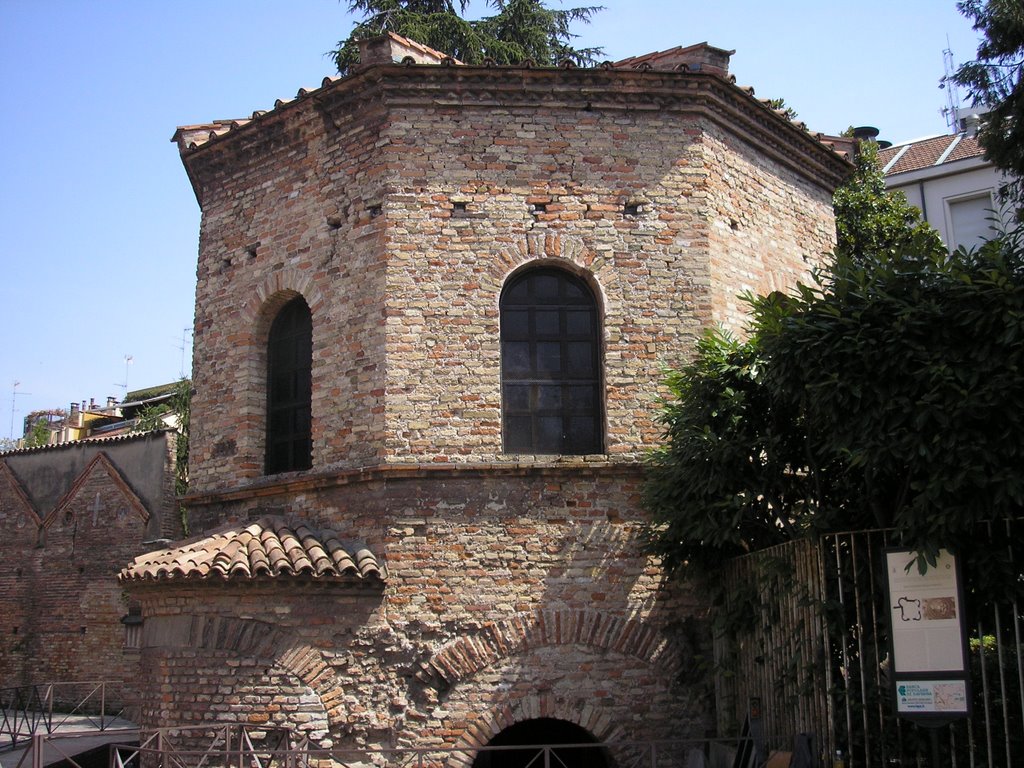
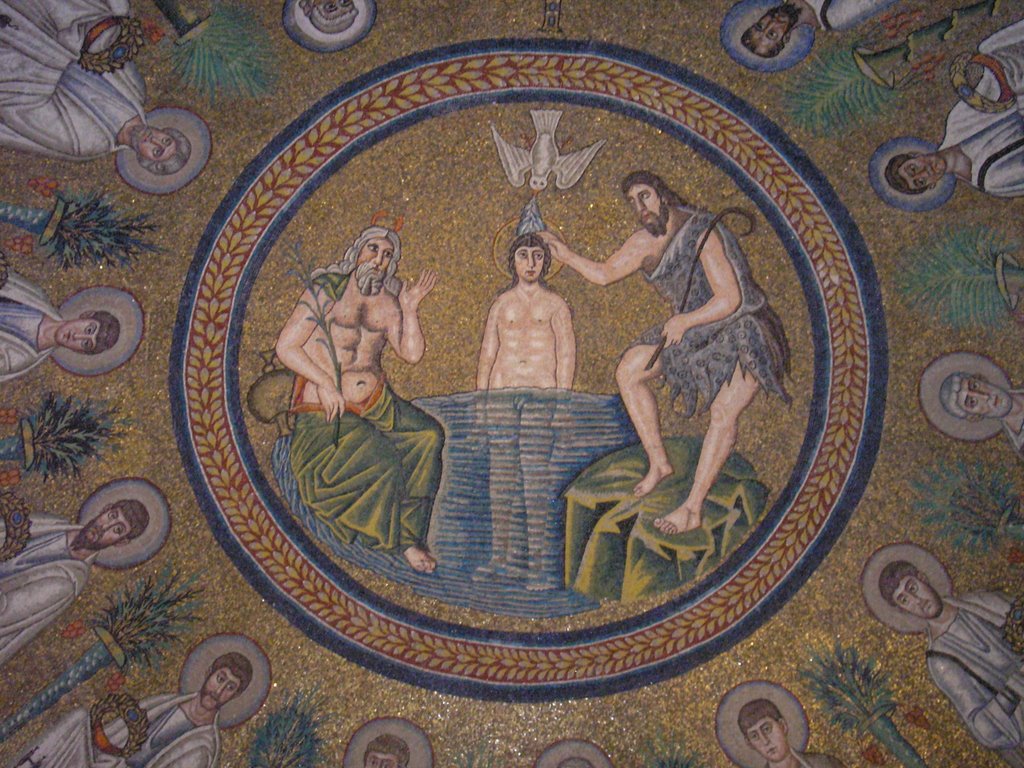
Ravenna/Arian Baptistery

Exterior of building, the base of which is now far below current ground level.

Dome mosaic of baptism of Christ. From left to right: personification of River Jordan; Christ of beardless type (with dove of Holy Spirit); John the Baptist. Ringed by procession of Apostles.

Same, but closer.

It is interesting to compare the scene on this dome with that on the dome of the Orthodox, or Neonian, Baptistery, which has many similiarities but is overall a much more complex composition. But for some reason I forgot to take pictures in there. Maybe I can find a few online at a later time to put up here for comparison.

Wednesday, June 28, 2006

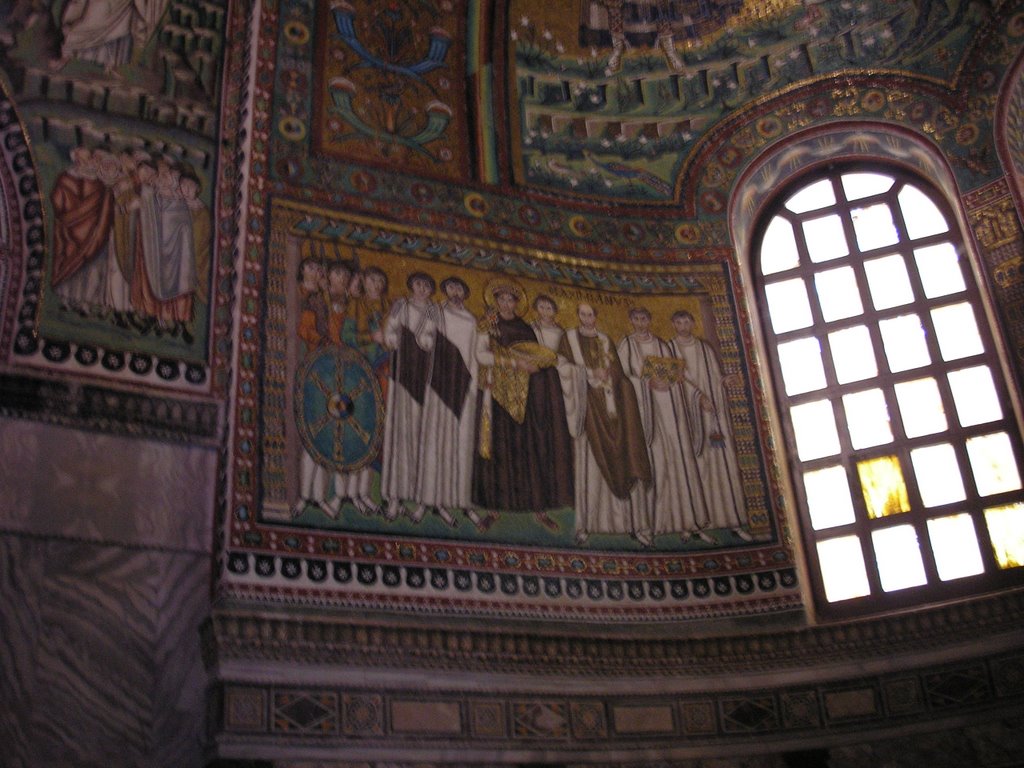
Ravenna 1

Ravenna is sort of like a Late Antique amusement park. It boasts several 5th and 6th century structures (especially religious buildings) and some of the most incredible mosaics I've ever seen. Here are a couple of photos from the 6th-century Basilica of San Vitale. The first is of a mosaic, made after Justinian's reconquest of Ravenna (which had been under Gothic control), of the emperor with attendants bringing a paten as an offering to the church. Opposite this in the church is one of his wife Theodora bringing a jeweled chalice.

The second is of the interior of the church, looking toward the apse and altar.

Wednesday, June 21, 2006

Moderns on Ancients

The Fall of Rome
by W. H. Auden

(for Cyril Connolly)

The piers are pummelled by the waves;
In a lonely field the rain
Lashes an abandoned train;
Outlaws fill the mountain caves.

Fantastic grow the evening gowns;
Agents of the Fisc pursue
Absconding tax-defaulters through
The sewers of provincial towns.

Private rites of magic send
The temple prostitutes to sleep;
All the literati keep
An imaginary friend.

Cerebrotonic Cato may
Extol the Ancient Disciplines,
But the muscle-bound Marines
Mutiny for food and pay.

Caesar's double-bed is warm
As an unimportant clerk
Writes I DO NOT LIKE MY WORK
On a pink official form.

Unendowed with wealth or pity,
Little birds with scarlet legs,
Sitting on their speckled eggs,
Eye each flu-infected city.

Altogether elsewhere, vast
Herds of reindeer move across
Miles and miles of golden moss,
Silently and very fast.


From Another Time by W. H. Auden, published by Random House. Copyright © 1940 W. H. Auden, renewed by The Estate of W. H. Auden. Used by permission of Curtis Brown, Ltd.

Thursday, June 15, 2006

Dentistical Archaeological Find

Some evidence for the work of ancients equivalent to our guys in white coats with inspiration posters all over the ceiling. This doesn't have anything to do with the Greco-Roman world, but it is old--and interesting.

WASHINGTON - Thousands of years before screen idols began beautifying themselves with cosmetic dentistry ancient Mexicans were getting ceremonial dentures.

Researchers report Wednesday that they found a 4,500-year-old burial in Mexico that had the oldest known example of dental work in the Americas.

The upper front teeth of the remains had been ground down so they could be mounted with animal teeth, possibly wolf or panther teeth, for ceremonial purposes, according to researchers led by Tricia Gabany-Guerrero of the University of Connecticut.

"It's like he was using the mouth of some other animal in his mouth," explained James Chatters, an archaeologist and paleontologist with AMEC Earth and Environmental Inc. in Seattle, Wash., and a member of the research team.

You can read the rest here.

Tuesday, June 13, 2006

Why study classical antiquity?

It's a question asked often, especially by classicists who despair for self-justification. Well, here's one humble response from 1964:

In the days when they formed the basis of a common culture for all educated Europeans, classical studies, together with the Bible, provided an outline of nearly all that was known or believed about world history and a background to the history of modern times and of the Middle Ages. Today, to speak of 'two cultures' is to understate: the Arts themselves are fragmented. Modern history, reaching back only a few generations, lacks depth; mediaeval history both begins and leaves off in the middle of the story; classical studies have become too narrowly philological.


     Our civilization needs classical scholars, as it needs sinologists, not only to train their successors but primarily for the sake of the wider public. There is a wide and spontaneous demand for knowledge about the origins and development of our civilization, manifested both in sales of books and in willingness to spend money on travel in the Near East. We could, and ought to, be satisfying this demand.


     At first sight the length of time — some 5,000 years since the first recorded dynasties — sounds overwhelming. But the appropriate measure of time is the human generation: the number of perhaps 200 since the beginning of recorded history and less than 100 since Homer is a modest one.


     We can here learn from American colleges, which have long taught world history or 'western civilization', not least that the study of Greek and Roman history can play a great part by bringing out the extraordinary resemblances between some of the great processes villain that history and the history of the Christian West. The re-growth of a culture, under stimulation from the East after the collapse of a previous civilization; the expansion to a more spacious world in the West and its effects on the old world's economy and society; the bold astronomical and geological speculations; the class-struggles and revolutions; the disastrous failure to transcend inter-state rivalries and wars — all these things have reminded scholars of the history of their own age. At the same time Greek thought and art have in some ways more resemblance to those of mediaeval Christendom than to modern trends.


     Even an outline knowledge of Greek and Roman history could be of immense value to specialists in modern fields. We should be devoting our best efforts to trying to convince our colleagues of this, and should be training our pupils to restore some unity to our culture, as well as training their successors.
The author was A.R. Burn (Proceedings of the Classical Association LXI, 1964, 27–28), most widely known by students as the author of The Penguin (formerly Pelican) History of Greece, first published under the title A Traveler's History of Greece a year after this talk was given. (I suppose this could be another's summary of his talk — it's given in a list of 'reports' from the General Meeting — but I suspect that it was his abstract.

Still sound sensible enough to me.

Monday, June 12, 2006

Speaking of Erasmus' Adages...

Here is a review by Richard Joines of a recent edition of Adages III.iv.1-IV.ii.100 by John N. Grant and Denis L. Drysdall.

Friday, June 09, 2006

Neologisms in Augustine's Sermon Super Verbis Apostoli Ad Galatas...

In his introduction to this sermon of Augustine, F. Dolbeau remarks that Augustine uses two words here not found in the TLL. (Sorry, I just noticed that when I pasted this citation in, all the French accents disappeared. I don't have time to fix it right now and don't know how to anyway, so I'm just going to replace them with unaccented letters. Hope that doesn't make it too unintelligible.)

Deux substantifs employes par Augustin sont absent du Thesaurus Linguae Latinae. Ce sont des noms d’agent en -tor, dont le sens ne fait pas difficulte. Le premier, obtestator (sec. 5), ne figure apparement dans aucun dictionnaire; le second, decretor (sec. 9), etait jusqu’ici atteste pour la premiere fois chez Raoul Glaber. Tous deux pourraient etre des creations deliberees d’Augustin, car ils fonctionnent en symetrie, repectivement avec praedicator et impletor.

Thursday, June 08, 2006

Julian the Apostate Quiz

Via Bread and Circuses, I learned about this fun online quiz on Julian the Apostate. Enjoy!

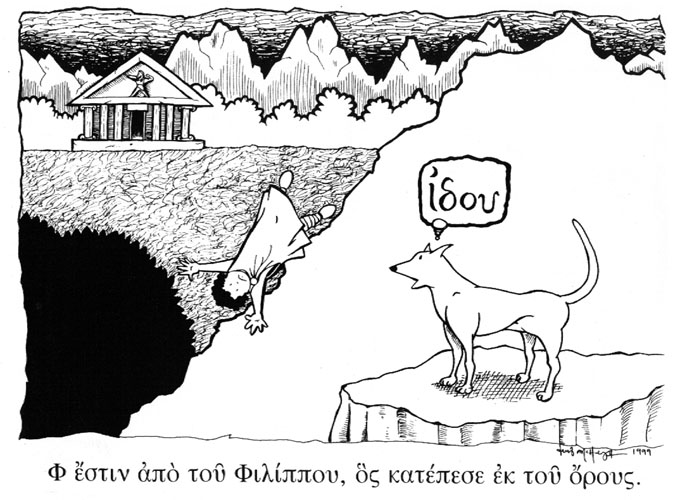
By the way, Dennis, love the cartoon!

No, Philippos! Not again!


I drew this in my first year of baby Greek while at UMass: an homage to Athenaze's hapless young hero and his trusty dog, Argo. It was supposed to be in the style of Edward Gorey's Gashlycrumb Tinies, but I was lazy and hadn't drawn in a long time, so this was the result. Posted by Picasa