Thursday, June 08, 2006

Ludi in AD 204

Today the Rogueclassicist asks for information on something called the ludi Latini et Graeci honorarii in AD 204, of which today is supposed to be the fifth day. I'm not sure if these are the same games, but Septimius Severus presided over a 10-day celebration of the ludi saeculares in 204 and, according to this report, he used Augustan calculations; Augustus had first celebrated the ludi saeculares in 17 BC and they took place in late May and early June. Now, I'm assuming that the ludi saeculares and the ludi Latini et Graeci honorarii must be the same games, since the Rogueclassicist also has a listing for the Latini et Graeci on this day in 17 BC, which roughly coincides with the timing for the saeculares in that year (though it is off by a few days).

Mr. Meadows--I'm not sure if any of this is the sort of information you're looking for. If it's all old news and you were inquiring about something different, please ignore!

Wednesday, June 07, 2006

The Remains of a Senarius in a Letter of Jerome?

In a letter written by Jerome to Augustine (Ep. 68 in editions of Augustine's letters; Ep. 102 in editions of Jerome), dated to 402 (see Fuerst's monograph on the correspondence), Jerome threatens Augustine via classical and proverbial metaphors:

nunc te currente et longa spatia transmittente nobis debetur otium simulque, ut cum venia et honore tuo dixerim, ne solus mihi de poetis aliquid proposuisse videaris, memento Daretis et Entelli et vulgaris proverbii, quod bos lassus fortius figat pedem.

In a brief but interesting note in Wiener Studien 19 (1897) 317, Karl Schenkl makes a case that the 'proverb' (italicized in the above citation) is not merely a proverb, but is a citation of a poet--the 'remains' or the 'left-overs' ('die Reste') of a senarius. For support, he offers four reasons: the balance of the phrase, its 'poetic coloring', the placing of the words, and the prominent (or 'pronounced') alliteration of fortius figat.

He says that he is not able to unravel whence it comes; Schenkl points out that Erasmus, in his Adagia, refers it to the Greek proverb Atremas bous (Diog. III.9, Arsen. VI.8, Apost. IV.24), but he states that this contributes nothing to its explanation. He theorizes that Jerome found the proverb in a Gnomologium, and that it was probably included in the fragmenta adespota of iambic poets.

Wednesday, May 31, 2006

J.P. Postgate's 'Flaws in Classical Research'

I'm reading J.P Postgate's classic essay 'Flaws in Classical Research' (Proceedings of the British Academy, 1908, 161-211), which, by the way, should be tempered with Paul Shorey's review (Classical Philology 5.2 225-228) which attempts to 'guard against the impression which it will make upon the student or the hostile layman.' Shorey notes Postgate's 'impatience of human frailty,' which puts one in mind of A.E. Housman. Incidentally, Housman (cited approvingly in the essay) beat out Postgate for the Latin chair at Cambridge.

Currently what's interesting me is Postgate's criticsm of modern 'lineal' thinking which is prone to misunderstand the 'circular' thought behind utterances in classical languages.

I was reminded of a recent article in the Guardian (linked by ALDaily) that dealt with the difficulties caused by syntax in the translation of humor from English to German. This difficulty has led some Brits to the conclusion that Germans are humorless, and in the same way the divide betwee 'lineal' and 'circular' habits of mind has led modern readers of the Classics to mistranslation, misleading commentary, and the attribution to the ancients of convoluted metaphorical expression alien to their native sensibility:

One main principle which it takes some trouble to grasp, and still more to apply with precision, is that, within certain wide limits, order in modern sentences is syntactically essential and in ancient sentences syntactically indifferent. The modern sentence, to put it roughly, is an arrangement in line, the ancient one within a circle. Now the lineal habit of mind, if I may call it so, is often at a loss when it has to understand the circular; it is devoid of the sense of grouping; it has not been trained to the necessary attention. If the groups are small, the trouble thus caused is small; but it is not absent altogether.
Now comes a great but simple example, the kind I've seen belabored by would-be critical theorists in their first semesters seeking out the foul stench of patriarchy and cultural imperialism at every turn:
In the second half of the pentameter Tibullus writes vir mulierque (ii. 2. 2), Ovid femina virque. The difference of order is absolutely without significance. But the lineal mind is apt to imagine that some subtle distinction between the places of man and woman is intended, as though Ovid were a sort of pro- and Tibullus an anti-suffragette.
Come to think of it, I've probably seen that in some of our leading journals.

From here he recalls the views of T.E. Page (note: Page's commentary on the Eclogues and Georgics of Vergil is still a classic -- go get it!) who 'called attention to the irrationality of current views of the figure called hysteron proteron':
To the lineal mind these 'inversions' are nonsense; to the circular but legitmate variations. ... The real character of such arrangements is seen in passages like Ter. Ad. 917 'tu illas abi et traduce; and Lucan, viii. 342 sq. 'quem captos ducere reges | vidit ab Hyrcanis Indoque a litore siluis', which almost shriek at us the warning respice finem.
There's more, and I recommend that you seek it out (taking Shorey's reservations into consideration). This kind of criticism, taken properly, keeps critics alert.

Tuesday, May 30, 2006

Concerning the Literacy of Augustine's Late 4th Century Congregation

We are often told that late antique sermons are geared toward an audience with a lower level of education (sermo humilis and all that) than the audience for written works of erudite theology and exegesis. And it is certainly true that one often finds an easier, simpler Latin in sermons. While reading one of Augustine's Dolbeau sermons (Sermo Beati Augustini Super Verbis Apostoli Ad Galatas, Ubi Paulus Reprehendit Petrum, Ubi Primo Docet Qaulis Esse Debeat Episcopus, preached in 397), however, I came across a couple of lines that imply at least some level of literacy in his congretation. At the point in the sermon in which we are interested, Augustine is discussing the decisions of the Council of Jerusalem in Acts 15, in which a solution was developed as to how Jewish Law should (and should not) be construed in relation to Gentile converts. Here are lines 183-4:

Hoc in Actibus apostolorum scriptum esse multi recolunt; legant qui non recolunt.

'Many recall that this was written in the Acts of the Apostles. Let those who do not recall it read it.'

More on the Concept of Philology

'An unrestricted concept of philology had to be established in order to get rid of all arbitrary distinctions and to discover its actual reality. But the more unrestricted the concept, the more necessary becomes limitation in developing it. It can accordingly be given an arbitrary limitation for the area in which any scholar works it out. The concept is absolute, the area relative. One can then set up limitations by disciplines, e.g., philology of language, of literature. One can also restrict the scope by time or space, as when one considers a specific period or some particular people. Thus we can have ancient and modern, oriental and occidental, Greek, Roman, Indian, Hebrew, and other philologies. Such division is quite in keeping with the nature of philology. Reichardt says justly with reference to ancient times: "Knowledge of antiquity is not the history of literature, of art, nor of religion--such histories exist without philology--but a history of the life of a people, which consists in the intermingling and cooperation of all these." Every special branch of knowledge historically presented proceeds in one line of development; philology collects all these into noe bundle, and from a focal point, the mind of a people, spreads them out as radii of a circle.'

--August Boeck, from On Interpretation and Criticism (tr. John Paul Pritchard)


Discuss.

Thursday, May 25, 2006

Georgics on my Mind: Merriam-Webster's Word of the Day

georgic \JOR-jik\ adjective

: of or relating to agriculture

Example sentence:
"Lanford Wilson has created yet another remarkable play... a fascinating tale of a georgic Midwestern community and the secrets lurking beneath the surface of its bucolic hum." (Adweek, March 25, 2004)

Did you know?
The adjective "georgic," which dates from the first half of the 18th century, derives by way of Latin "georgicus" and Greek "geōrgikos" from the Greek noun "geōrgos," meaning "farmer." That noun, in turn, was formed by a combination of the prefix "geō-" (meaning "earth") and "ergon" ("work"), the latter of which gave us words such as "allergy" and "ergonomics." The noun sense of "georgic," which dates from the early 16th century, refers to a poem that deals with the practical aspects of agriculture and rural affairs. The standard for such poems, Virgil's Georgics, is responsible for its name. The poem, written between 37 and 30 B.C., called for a restoration of agricultural life in Italy after its farms fell into neglect during civil war.

*Indicates the sense illustrated in the example sentence.

Tuesday, May 23, 2006

Life Imitates Art

Toward the beginning of Henry James' story 'The Last of the Valerii', we read this description from the story's narrator, who is a painter, of his American goddaughter's Roman husband-to-be:

'Strong the Conte Valerio certainly was; he had a head and throat like some of the busts in the Vatican. To my eye, which has looked at things now so long with the painter's purpose, it was a real perplexity to see such a throat rising out of the whit cravat of the period. It sustained a head as massively round as that of the familiar bust of the Emperor Caracalla and covered with the same dense sculptural crop of curls. The young man's hair grew superbly; it was such hair as the old Romans must have had when they walked bareheaded and bronzed about the world.'

Monday, May 22, 2006

On the Development of Philology

'Now that the defining of the philological activity has removed the one-sided ideas of it, the sole remaining task is to show how these ideas have arisen. They are easily accounted for through the division into separate elements of the definition just now established. Since the most usual vehicle of knowledge--rather, the pure reproduction of all knowledge--is speech, the first task of philology is to fathom the mystery of speech. The deepest and most illimitable human undertaking is the comprehension of speech in its freedom and necessity, and whoever has such knowledge has come to know all human knowledge.'

--August Boeckh, On Interpretation and Criticism, p. 10 (tr. John Paul Pritchard)

Discuss.

Thursday, May 18, 2006

Santa Giulia (4)

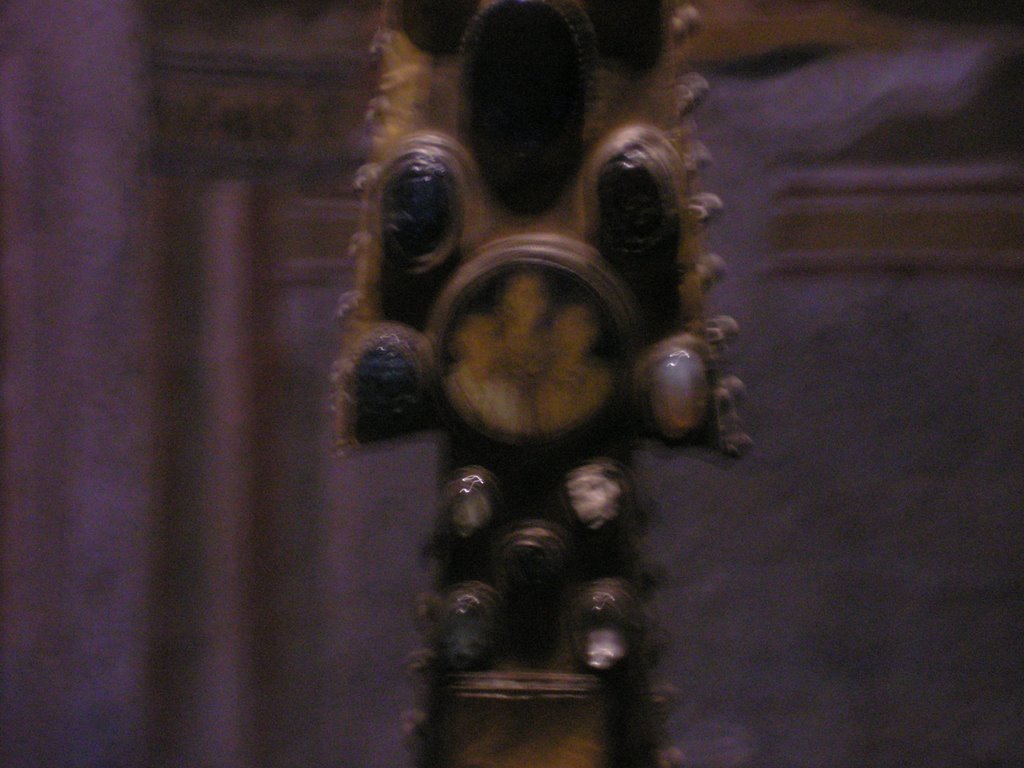
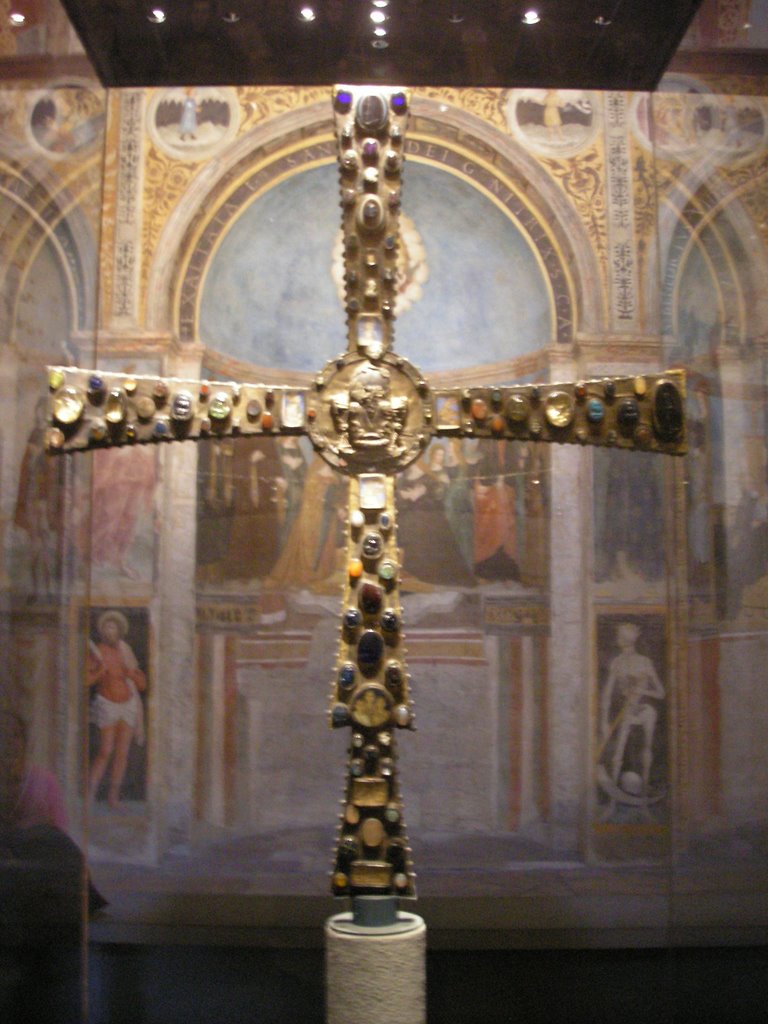
On the other itinerary at the museum, one finds an incredibly ornate jeweled cross, put together out of various pieces in the seventh century. One of those pieces, just over half-way down the lower arm of the cross, is a medallion from the Roman Empire (if you click on the photo to view it in a larger size in its own window, you might be able at least to make it out in general terms; my zoom-in shot is too blurry to see any details, though I’ve included it anyway).


Jas Elsner briefly discusses the object in the introduction to Imperial Rome and Christian Triumph: The Art of the Roman Empire AD 100-450 (Oxford, 1998). In his caption, he writes (p. 22), ‘Gold-glass medallion, perhaps from Alexandria, dated anywhere between the early third and the mid-fifth centuries AD. This family group of a mother, in a richly embroidered robe and jewels, with her son and daughter, bears the inscription BOUNNERI KERAMI. This may be an artist’s signature or the name of the family represented.’

In his remarks in the text, he states (p. 23):

...[T]here are...profound continuities between the visual productions of the pagan and Christian empires, as the following chapters will show. Take, for example, the beautiful gold-glass medallion from Brescia, which could have been made at any point in our period–its transfixing naturalism gestures towards the second century, while its technique is more typical of objects from the fourth. Perhaps from Alexandria, since its inscription is in the Alexandrian dialect of Greek, it probably found its way early to Italy–at any rate, it was incorporated there in the seventh century in a ceremonial, jewelled, cross. Whenever it was made, and for the duration of its use in antiquity, the imagery of this gem speaks of the continuity and values of family life, of the wealth and patronage of aristocratic elites, of the high value placed on exquisite workmanship from the second century to the fifth.

Tuesday, May 16, 2006

Santa Giulia (3)

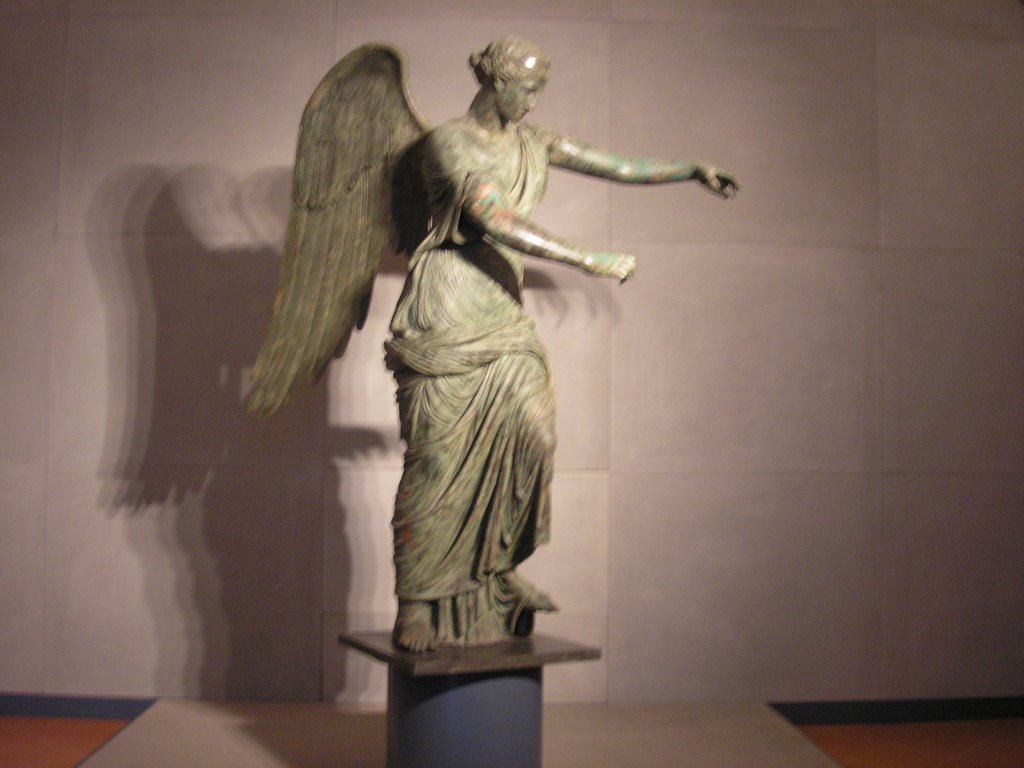
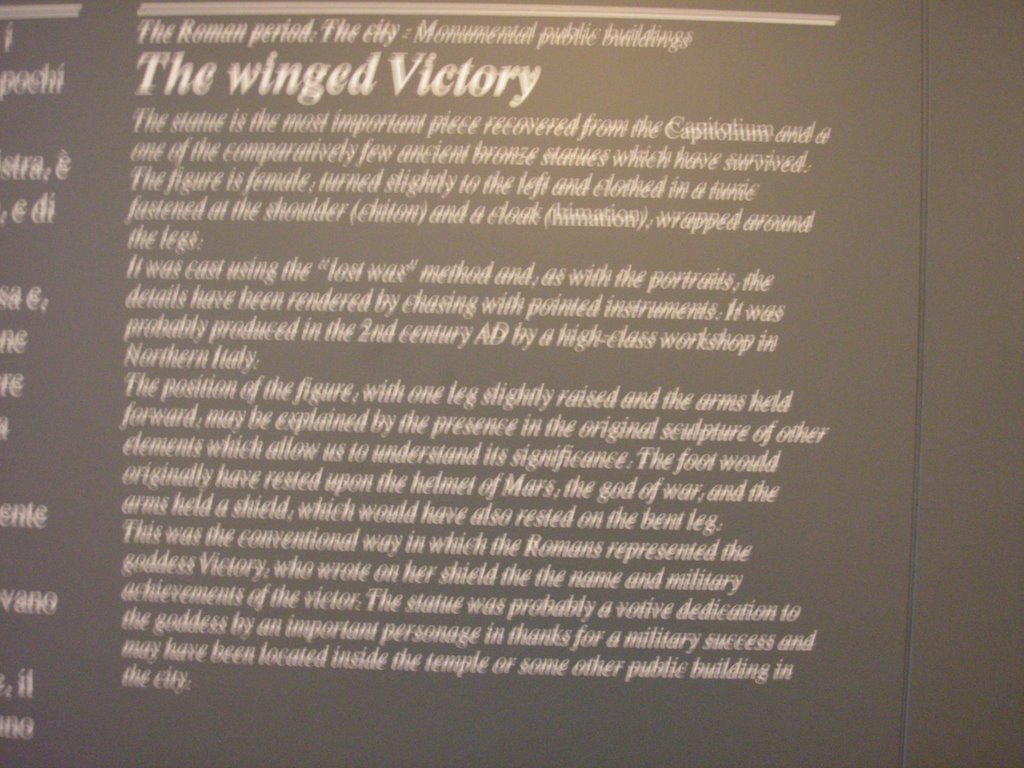
One of the surprising things to me about the museum was their impressive and substantial collection of antique bronze sculptures and ornamention. By far their most famous bronze is this incredible Winged Victory from the Capitolium.


Why Not Keep Talking about Hercules and the Merchant of Venice?

In Act III, Scene II, another suitor-scene in front of the caskets (as was the previous scene recently discussed on the Campus), Hercules comes up twice. The first is in a speech of Portia:

...Now he goes
With no less presence, but with much more love
Than young Alcides, when he did redeem
The virgin tribute, paid by howling Troy
To the sea-monster: I stand for sacrifice,
The rest aloof are the Dardanian wives,
With bleared visages come forth to view
The issue of th' exploit: go Hercules!
Live thou, I live--with much much more dismay,
I view the fight, than thou that mak'st the fray.

(53-62)

Shortly thereafter, as Bassanio is deliberating his choice and commenting on the deceptive attraction of outward ornament, he states:
How many cowards whose hearts are all as false
As stairs of sand, wear yet upon their chings
The beards of Hercules and frowning Mars,
Who inward search'd, have livers white as milk?--
And these assume but valour's excrement
To render them redoubted.

(83-8)

Book Buys

There was another sale at the library here today. Not tons of stuff that I was interested in, but I did get a couple of Classics-related things--Oliver Strunk's Antiquity and the Middle Ages from the 'Source Readings in Music History' series and a book by Edward W. Spofford called The Social Poetry of the Georgics. But the grand prize of the day was the Alfred Rahlfs' 1935 edition of the Septuagint, voll. 1 and 2.

Monday, May 15, 2006

Is nothing sacred?

A reader has e-mailed to ask about the correct Latin translation of the phrase 'is nothing sacred?', made famous in Wes Anderson's classic Rushmore as 'nihilo sanctum estne?'

The problem with that translation was discussed here previously, but I thought I'd post my reply to this latest question, which may be inadequate so feel free to add your two cents on the issue in the comments.

It's almost a philosophical question. You have to think about the meaning behind the idiom rather than the literal translation.

Nihilo sanctum estne is close to a literal translation, but it's grammatically incorrect. A literal translation might be "nihilne sanctum est?" The interrogative particle (-ne) attaches to the first word (which is why "estne" would be a question unto itself in the Rushmore version). The verb "est" isn't technically necessary, so: nihilne sanctum?

This could work, but it's not said anywhere in Latin literature, though similar statements exist, e.g., "dictitat ... nihil esse tam sanctum quod non violari ... possit," i.e., "he asserts that ... nothing is so sacred that it can not be violated" (Cicero, In Verrem I. 2). This same thought is expressed elsewhere in nearly identical terms.

So it's possible to use "nihil sanctum (est)" to say "nothing's sacred." But still, the question "is nothing sacred" isn't asked.

It can be difficult to pinpoint the essential meaning of an idiom and then to translate it into the idiom of another language in a way that would be culturally relevant. In the same context that an English speaker says "is nothing sacred?", a Roman might have said, "mehercule!", an exclamation like our "my god!" which originally meant "by Hercules!" It expresses disbelief, maybe even disgust. But then again, there are probably better Latin idioms that I can't think of that would suit in different contexts.

Saturday, May 13, 2006

the Merchant of Venice again

The earliest reference I can find to Hercules and Lichas occurs in Hesiod fr. 25, which mentions Lichas in the same context that Ovid does, i.e., Deianara 'having besmeared the tunic, gave it to the herald Lichas to bring" (21-22). This is, of course, treated in the Trachiniae, so both characters are present, but there are no dice games.

Shakespeare knew this story well because he used it in Antony and Cleopatra. Antony says the following after dismissing Cleopatra in anger (Act IV scene 8, 53-61):

... ‘Tis well th’art gone,
If it be well to live; but better ‘twere
Thou fell’st into my fury, for one death
Might have prevented many. Eros, ho!
The shirt of Nessus is upon me; teach me,
Alcides, thou mine ancestor, thy rage.
Let me lodge Lichas on the horns o’ th’ moon,
And with those hands that grasp’d the heaviest club
Subdue my worthiest self. The witch shall die.


I suspect that Shakespeare chose to have Hercules and Lichas play dice for two reasons. First is the surface meaning, as Morochus intends it, viz. to place the greatest of the Greek heroes against a lowly servant in a game not of skill, but chance, in which the superiority of Hercules has no bearing, just as the supposed natural superiority of Morochus is neutralized by the game here. Second, and I think more significant, Shakespeare may also have been prefiguring Morochus's lot, for when he makes his choice, the golden casket, his 'prize' is figurative death (answering the riddle 'Who chooseth me shall gain what many men desire'):

O hell! what have we here?
A carrion Death, within whose empty eye
There is a written scroll! I'll read the writing.

"All that glitters is not gold;
Often have you heard that told:
Many a man his life hath sold
But my outside to behold:
Gilded tombs do worms enfold.
Had you been as wise as bold,
Young in limbs, in judgment old,
Your answer had not been inscroll'd:
Fare you well; your suit is cold."


Morochus likened himself to Hercules in an imagined game with Lichas, but he ended up (figuratively, at least) as Hercules did in the familiar story.

Sunday, May 07, 2006

The Merchant of Venice and Hercules

In The Merchant of Venice today I read the following, spoken by Morocco (Act II, Scene I, 32-8):

If Hercules and Lichas play at dice
Which is the better man, the greater throw
May turn by fortune from the weaker hand:
So is Alcides beaten by his rage,
And so may I, blind Fortune leading me,
Miss that which one unworthier may attain,
And die with grieving.

In the 'Arden Shakespeare' edition of the play, edited by John Russell Brown, the note for 'Lichas' in line 32 reads:
'the attendant who brought Hercules the poisoned shirt of Nessus (see Ovid, Met., IX); no story of a game at dice is known [my emphasis].'

Is this correct? Has anyone ever come across an ancient reference to a game of dice?

Thursday, May 04, 2006

Continuing the Tour: Santa Giulia (2)

Two more late antique milestones:


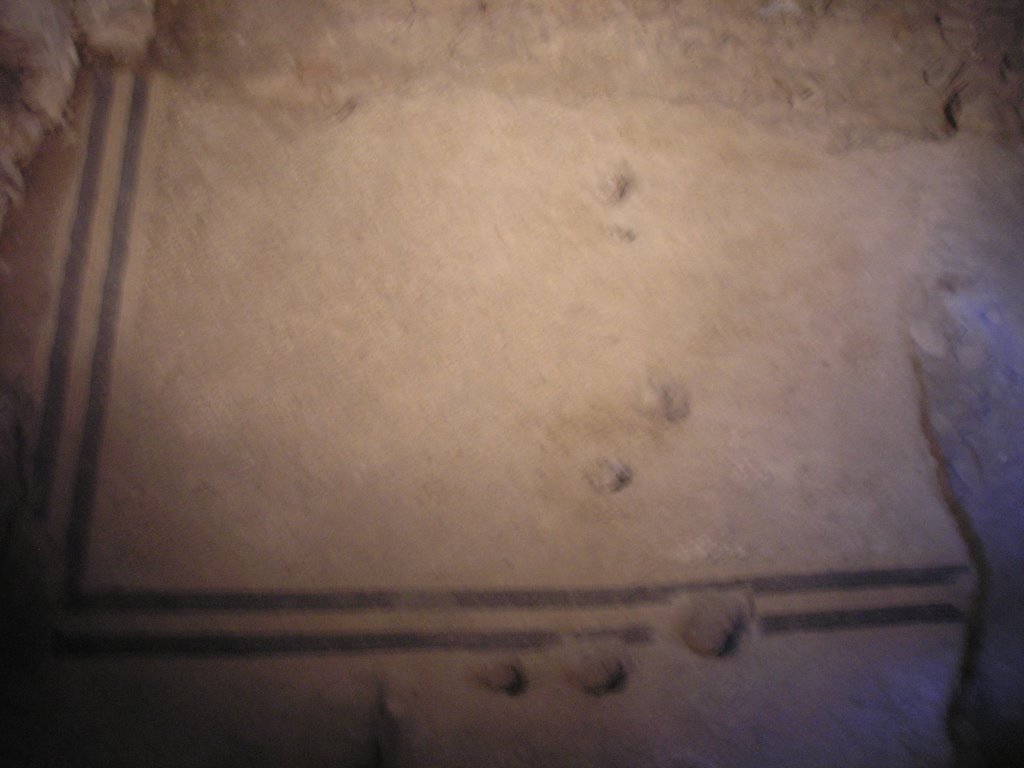
A mosaic floor from a Roman house discovered underneath the monastery--a site later reused by the Lombards to build their huts, as the post-holes cut into the mosaic indicate. I've included a shot (unfortunately blurry) of the didactic plaque:

Wednesday, May 03, 2006

Brescia/Santa Giulia Museo della Citta' (1)

This past weekend I visited the Museo della Citta' in Brescia (Northern Italy), and am convinced that it is one of Italy's best-kept secrets. The museum, housed in a former monastery and a couple of church buildings and located on a street that follows the path of the ancient Decumanus Maximus of the Roman city Brixia, is enormous. It has two itineraries: one which takes you through the history of the town and its surroundings from the prehistoric period all the way through the Venetian period. The other itinerary takes you through the history of the monastery. This post and the next (at least) will focus on some highlights of the first itinerary, and I'll try to do another post on the second. For interested parties, here are some links for the museum: one, two, three.

(Some of these photographs will be blurry, since parts of the museum were a little dark and the use of a flash is not allowed.)

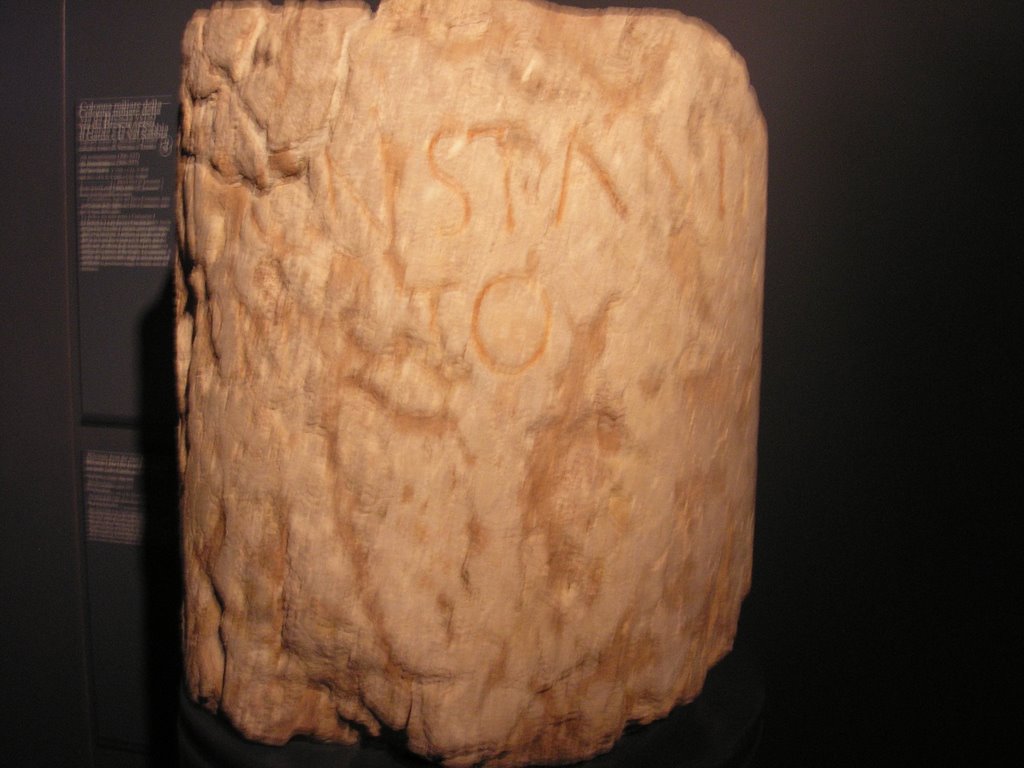
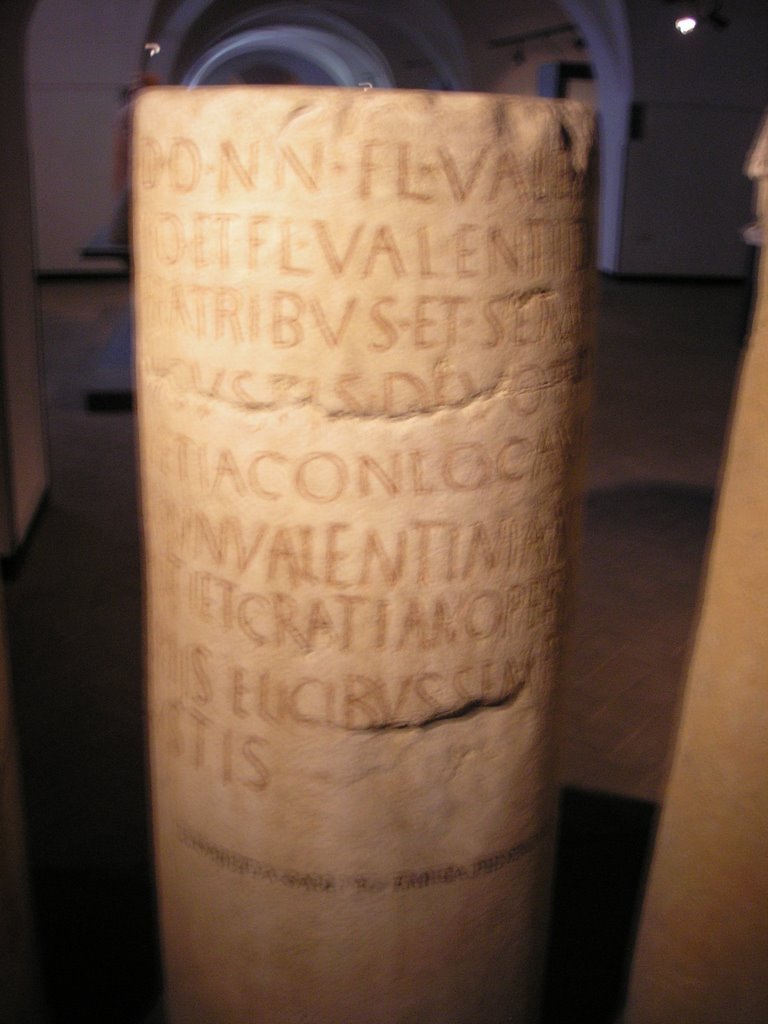
The exhibit on the Roman period had several milestones from the area from the late antique period (Constantine, Valens, Valentinian, etc.). Here is one example:

They also had fragments of fresco from a Republican temple on display. I especially like the second with it's imitation of different types of marble veneer:


That's all I have time for at the moment, but I'll try to continue the series soon.

Archaeologists discover unusual network of burial chambers in Rome

This is the first I've heard about this...

By John Thavis
Catholic News Service

ROME (CNS) -- Archaeologists repairing a Roman catacomb have discovered an unusual network of underground burial chambers containing the elegantly dressed corpses of more than 1,000 people, a Rome official said.

The rooms appear to date back to the second century and are thought to be a place of early Christian burial. Because of the large number of bodies deposited over a relatively short period, experts believe a natural disaster or epidemic may have occurred at the time.

The corpses, dressed in fine clothes embroidered with gold thread, were carefully wrapped in sheets and covered in lime. Balsamic fragrances were also applied, according to Raffaella Giuliani, chief inspector of the Roman catacombs, who spoke with Vatican Radio May 1.

The discovery will be officially presented in June by the Pontifical Roman Academy of Archaeology, which excavated the site in collaboration with Rome's Ecole Francaise and the University of Bordeaux in France.

Giuliani said the burial chambers were found accidentally in 2003, when experts were repairing a cave-in located in the Catacomb of Sts. Peter and Marcellinus, one of Rome's lesser-known catacombs that is closed to the public.

The archaeologists discovered a large room behind one of the painted walls of the catacombs, then a series of similar rooms.

"These were not galleries or cubicles, but big rooms completely full of skeletons. We had to work very carefully to excavate them without destroying them," Giuliani said.

"We were amazed at the high number of individual corpses found in these rooms," she said. The rooms appear to predate the catacombs, which were built in the third century.

Giuliani said the experts believe they were Christian burial places, in part because Christians of that time dedicated great care to burial. Early Christians buried rich and poor with great dignity, in expectation of the resurrection of the dead -- a fact that helps explain the presence in Rome of more than 50 miles of underground catacombs.

UPDATE: Well, I see that the Rogueclassicist beat me to this one, but I'll leave it up in case anyone missed it!

Tuesday, April 25, 2006

Books!

Heck ... Eric just keeps on posting away and apologizing about no posting more often, and here I am keeping quiet.

Let's see what kinds of excuses I can come up with, but first I'll list some recent booksale acqusitions (recent meaning Sunday morning):


Macaulay's Lays of Ancient Rome.
A famous an influential imagining of the 'lost' ballads of the early Roman Republic by the great essayist and historian of England.
T.Z. Lavine's From Socrates to Sartre
A popular survey.
Lily Ross Taylor's Party Politics in the Age of Caesar
A classic on politics at the end of the Republic by a Bryn Mawr professor.
Harold Lamb's Alexander of Macedon
A biography apparently bordering on historical fiction.
G.E. Duckworth's The Nature of Roman Comedy: a Study in Popular Entertainment
Described by Sander M. Goldberg as "the single most comprehensive guide to Roman comedy." Dope.
John Summerson's The Classical Language of Architecture
Looks to be a very readable guide with essays, illustrations, and a nice glossary.
Will Durant's The Life of Greece
Volume 2 in the series 'The Story of Civilization.' It apparently sweeps through from 3500 to 146 BC, and is said to be enjoyable.
The Works of Geoffrey Chaucer from the Riverside Press, Cambridge
Complete text with notes and glossary.
A Conrad Argosy, edited by William McFee
A large, pretty anthology (Heart of Darkness, the Secret Sharer, ...) with woodcuts.
Justin Kaplan's Mr. Clemens and Mark Twain
Winner of the Pulitzer Prize and the National Book Award. And it's about Mark Twain!

That last book leads me to excuses. I've been obsessed with Mark Twain lately. While his works are classics, they're classics of a different sort. In the past week I've read The Adventures of Tom Sawyer, the Adventures of Huckleberry Finn, Tom Sawyer Abroad, Tom Sawyer Detective, and numerous short pieces, and have begun Life on the Mississippi.

There's that and my current job search. And being sick.

But here's hoping all turns out well in the end.

Good book buys always help, especially when you get all of the above for $16.

A Portrait of Vergil

Sorry for the lack of posts around here lately. In the meantime, here's an image of Vergil from the manuscript Vat. lat. 3867 (folio 14, recto).