Friday, July 21, 2006

Dalby Strikes Back

Andrew Dalby has commented on an earlier post in which I was skeptical of the very idea of his book (i.e., that the Homeric poems were written by a woman) and specifically challenged the claim that no ancient author ascribed the Iliad or the Odyssey to Homer. This, incidentally, didn’t require that I read his book. I was responding to ideas, and specifically to a direct quote by Dalby that 'the idea that Homer was the author was first proposed in "one ill-informed post-classical text -- the anonymous Life of Homer, fraudulently ascribed to Herodotus".’

Dalby accuses me of misquoting him and takes umbrage with the word ‘author’, though he never makes it clear what’s wrong with the word. I can only assume that he thinks ‘author’ presupposes writing. (Incidentally, since I quoted the writer who quoted him –notice the quotes within quotes there--, Dalby is incorrect to claim that I misquoted him.)

In his response Dalby focuses almost exclusively on oral theory, which says nothing to the testimony I offered in response to his claim about ps.-Herodotus. Dalby actually restates the same misinformation reported in the article cited.

But I’m sure that Homer-as-oral-poet is central to the argument of the book and was neglected in the article. The problem is that oral theory changes nothing on this question. In this case, Dalby insists that ‘all the earlier authors insist he [Homer] worked purely orally. Right?'

Wrong. As I pointed out in my post, there are countless examples of direct quotations from Homer that imply a standard written text. I say imply because none says anything whatsoever about Homer’s compositional technique, despite Dalby’s desire to see ancient support for oral composition theory.

The earliest authors who offer testimony on Homer lived centuries after the likely period of composition, and this span of time is marked by a distinct lack of critical historical record. This was a time in which statesmen still claimed mythic origins and propagandized their own past to legitimize rule by tyranny, for example. This was a time when Greeks still believed in kings who slew dragons and thought themselves not far removed from an age filled with demigods and sea monsters. Whether the writers of the classical period considered Homer to be an oral poet or one who composed verse in writing is no test of historical truth, and I can’t see how it would lead one to argue that the author of the Homeric poems was really a woman or to think it a worthwhile endeavor to reconstruct prehistoric persons out of scattered, inconclusive, and inaccurate testimony. In this case, Dalby’s grasp of ancient sources seems to be unacceptably slim.

However, no one to my knowledge *insists* that Homer was an oral poet. Dalby suggests that the ancients believed Homer to have taught his poems to his family (these would be the Homeridae) who continued to repeat and teach his poems orally. I ask you to show me one ancient author who *insists* that Homer composed his poems orally in accord with the Parry-Lord thesis.

I still don’t know how oral theory justifies the book, but I have to take issue with Dalby’s claim that oral theory is proven and legitimate. I think it’s short-sighted to say the least to believe that poems of such length with all their subtlety were both spontaneously composed and taught orally.

Oral theory argues that the poet composes as he performs, not that he composes orally and then memorizes and teaches his songs. The oral poet is believed to compose his songs afresh each time he performs, and while he may sing on the same themes from the same perspective and repeat major ideas, the composition itself is never an exact replica of prior compositions or performances. In short, even if you accept oral composition and allow for the possibility of memorization and the teaching of composed songs, then the only thing separating this from written composition is the act of writing. That’s a superficial distinction, because when someone composes a set piece, whether they memorize it or they write it down, they have composed a set piece. Memorization and repetition are not the same as oral composition.

Dalby, and he is in good company here, simply misses the point. He, like many people who have accepted oral theory without understanding it (some of whom are respected classicists), confuses the essence of oral composition with performance. In the archaic and classical periods, all poetry was performed, even when it was carefully composed. Some of this poetry was performed in simpler, more casual contexts like symposia with the appearance of spontaneity, some, such as hymns, were performed during religious events as though divine agents spoke through the poet who was simply a medium, and others were performed as part of elaborate productions involving actors, a chorus, musical accompaniment, and staging. All were composed, all had set texts, and all were composed in order to be performed.

The second of these examples reflects a common pretense among the ancients, which is that the poet is divinely inspired. He does not write or compose his songs, but rather some god endows him with the gift of song and the Muses sing through him. Hesiod, at least, was smart enough to have his Muses admit that they could tell the truth as well as specious falsehoods, which allowed him to claim divine authority without committing heresy.

But Hesiod raises a serious question about oral composition. Ancient references to oral composition all indicate divine inspiration, and yet Hesiod surely can not have believed himself to have been swept away, to have met with the Muses, and to have become a conduit of divine knowledge. Some of his audience, especially those of later generations for whom poets like Homer and Hesiod had become legendary figures, may have believed it, but Hesiod could not have. This was a poetic convention. Similar ideas are found in rhetoric, as in the Defense of Helen by Gorgias, who argues that poetry has magical properties and that verse, by its very nature, has the power to persuade. Here, in traditional imagery, Gorgias was pointing to the same thing that poets like Hesiod and critics like Plato discussed in terms of inspiration. The ‘mad poet’ had something of the divine about him. His mode of speech (i.e., verse) was distinct, aesthetically pleasing, much like the hymns to gods or their oracular responses. Poetry was thought to be a spiritual thing and to speak to the soul, and those who recited poetry were the agents of the gods. Of course, they weren’t really. And neither were they really linguistic virtuosos able to compose perfect songs spontaneously. But it was good for business to pretend that they were.

Oral composition in antiquity meant nothing other than divine inspiration in the truest sense of the word. And yet Homer himself offers a picture of a rhapsode taking requests and singing poems on epic themes that he had sung before. These were compositions, and we have no reason to assume that Greek poets spontaneously composed verses simply because it was possible for some illiterate poets in Yugoslavia to sing charming songs for a visiting scholar.

But this has taken us rather far from the argument.

Dalby’s comment suggests that his book is about oral theory. Okay. But that doesn’t change my critique of his own false statements. He continues to insist that only ps.-Herodotus claims that Homer was the author of the poems after I offered examples in Herodotus (yes, the real Herodotus) in which he cites Homer.

And I still don’t know how oral theory is supposed to discredit the notion of an original composer conveniently labeled Homer. This is the view of M.L. West who was famously accused of being ignorant of oral theory (by Nagy and Nardelli), but who responded beautifully to his critics by pointing out their own short-sightedness. West, and I think he’s right, believes that it is more likely that each poem was composed by an individual who drew upon a rich poetic tradition, and whose great literary achievement was later affected in places by accretions and alterations.

The tradition from which 'Homer' worked may have employed oral composition in the manner of the Parry-Lord thesis, but the subsequent tradition was that of a written text (despite the fact that those who promoted his verse may have performed it orally in the traditional Greek manner of the rhapsode), but the composer of the Iliad and that of the Odyssey (if different from that of the Iliad) must have been a writer.

West is in my view a most sensible and judicious critic of oral theory who understands its proper place and does not allow it to overrun reason and impose absolutes that tidily aid us on our way to the conclusions we seek.

Dalby’s argument from silence isn’t worth considering. He wants to know why none of Homer’s near-contemporary writers mention his ‘world-shaking’ feat. We know almost nothing about the period and retain next to nothing of the literature produced, let alone any commentary that is truly ancient (the antiquity of scholia vetera is almost always greatly exaggerated). This kind of argument allows us to plug in whatever we want and to argue by a series of guesses and inferences mixed with innuendo and novelty. It’s a fun game to play, guessing at what history has not recorded, but I don’t care for it.

And I still fail to see what oral theory has to do with Dalby’s refusal to accept the testimony that we do possess.

I guess I should just say for the record, if I haven't made this clear enough yet, that I don't believe anyone who talks seriously about Homer believes that they know him to have been a particular individual with a particular personality, or necessarily believes that the same Homer wrote both poems. Those of us who talk about Homer tend to do so because it's impossible to know who wrote the poems and how, and we use the traditional terminology, in the same way that the ancients discussed Orpheus. Whether there was an individual poet called Homer doesn't matter much. But there are two important poems that were most certainly composed, each by a particular genius, and each ultimately composed in writing.

Whether that genius was a woman is impossible to know, though the ancients thought they knew Homer to be a man. Does it really matter?

Well, if you decide that it does, you're best served understanding the tradition and the ancient testimony and not simply discounting what you disagree with by word games such as what constitutes an author and when precisely the word is used.

Wednesday, July 19, 2006

Notae

Every so often I scan news and web sources for classical references, but rogueclassicism does such a good job of keeping the classical blogosphere abreast that I'd feel like I was stepping on David's toes to post much of what I found.

But one thing that really sticks in my craw recurs so often that it needs to be addressed: 'Greek and Latin' are indiscriminately cited as though they were one language, or had jointly agreed to donate individual words to our language. Countless times I've read that a given word 'comes from the Greek and Latin for' something, and as we've discussed here in the past, that's only true for words like television and homosexual (Gk root + Lat. root).

A piece at FtWayne.com on choosing the right words for a eulogy repeats the error in a weird way:

Miller says the aim of any eulogy – the word comes from the Greek word for “praise” and the Latin for “epitaph” – is to honor the deceased.

Eulogy, then, comes from two sources: (1) the greek word for praise, and (2) the Latin word for 'epitaph.'

Knowledge of Greek and Latin is not required to see the error here, which is purely one of logic. The Greek word for praise intended here is clearly εὐλογία, and eulogizing is the putting-in of a 'good word,' as it were. But the Latin word for epitaph in the normal sense isn't eulogy, but 'titulus.'

ἐπιτάφιος was an adjective that could describe anything done at a tomb, from a speech given to games conducted. An ἐπιτάφιος λόγος was what we would call a eulogy, 'a speech at a grave.' But what we would call an epitaph would be ἡ ἐπιγραφή or τὸ ἐπίγραμμα to the Greeks, simply an inscription clarified by context.
It's tough to say how this specific error was reached, but it's easy to see that the shifting and interrelatedness of the terms over time has made it easy.

Monday, July 10, 2006

The Greek Tyrants

Here's a post that was left in draft mode for a few weeks. I think I wanted to polish it, but that's not what blogs are about, and I'm already thinking about other things (like getting my Certificate of Eligibility to teach in NJ). I forgot about it until now:

So I'm reading Andrewes the Greek Tyrants, which I picked up for 50 cents somewhere, and I can't help but think he completely misread the story of Cypselus' birth.

So first a little background.
Cypselus is recognized as the first of the Greek tyrants in the archaic period, and here 'tyrant' refers to what is esssentially a monarch who rules without hereditary right or constitutional authority; in short, not a king. Greece, it is held, was moving out of a period marked by aristocratic rule, and Andrewes believed that the reason lay in hoplite warfare and the subsequent involvement of a lower social tier in war and government: a strong individual with the support of the hoplites could easily overtake the minority ruling classes. Much of Andrewes's argument is guesswork, but it isn't badly done for the most part.
I have a serious problem, however, with Andrewes's acceptance of the myth of Cypselus' birth.

The aristocrats ruling Corinth at the time Cypselus seized power were called the Bacchiadae, a family which Herodotus tells us only married from within. A Bacchiad called Amphion had a daughter named Labda who was lame, and no one in the family would marry her. She was taken as wife by a certain Aetion from the district of Petra, by descent a Lapith and a son of Caeneus (Herodotus 5.92).

Now let's stop right here, because Andrewes passes over this casually and later calls Cypselus' father 'non-Dorian.' The OCD3 entry on Cypselus actually refers to the 'Lapithi' in a way that suggests they were simply an indigenous, pre-Dorian tribe. This smacks of rationalization: historians accept that Aetion exised and was a Lapith, ignoring the mythical signification.

The Lapiths, of course, are best known for their war with the Centaurs at the wedding of Perithous. During this war Caeneus, who had also participated in the Argonautic expedition and the Calydonian boar hunt, was buried under a mass of trees by the Centaurs but emerged as a bird. Caeneus was also praised by Nestor as one of the mightiest men of the greatest generation. It strikes me that such ancestry is precisely what tyrants of later times claim to justify their rule, though Heracles is the overwhelming favorite. But you have to cut Cypselus some slack; afterall, he may have been the first of the tyrants, or at least one of the earliest to employ this kind of propaganda.

Coupled with this mythic ancestry is the claim that his mother was a shunned Bacchiad, which actually gives him a legitimate claim to power in Corinth, especially when we consider that the Bacchiad's were said to have rotated power to different members of the clan. As a member of the clan, he was legitimate, and as a man descended from legendary kings and warriors who traced their lineage back to Zeus, he was a prime candidate to topple the existing order.

This reads as classic propaganda, like the Attalids who claimed descent through Telephus from Heracles and, by adoption, the native royal line of the ancient Mysian kingdom. The Attalids could claim to be both legitimate Greek kings and legitimate Asian kings. Isn't that convenient?

Andrewes focused too much attention on the 'racial' factor in the case of Cypselus because he wanted a thread of anti-Doric sentiment to lead him partway through the labyrinth of Archaic history, but I think he was simply mistaken and led astray by his own efforts to distinguish tyranny in the early period from its later incarnations.

Wednesday, July 05, 2006

Alcaic Fragment

There was a time when English poets could also write Latin verse. Thomas Gray was one such poet. Here is an 'Alcaic Fragment':

O Lacrymarum fons, tenero sacros
Ducentium ortus ex animo; quater
Felix! in imo qui scatentem
Pectore te, pia Nympha, sensit.

Monday, July 03, 2006

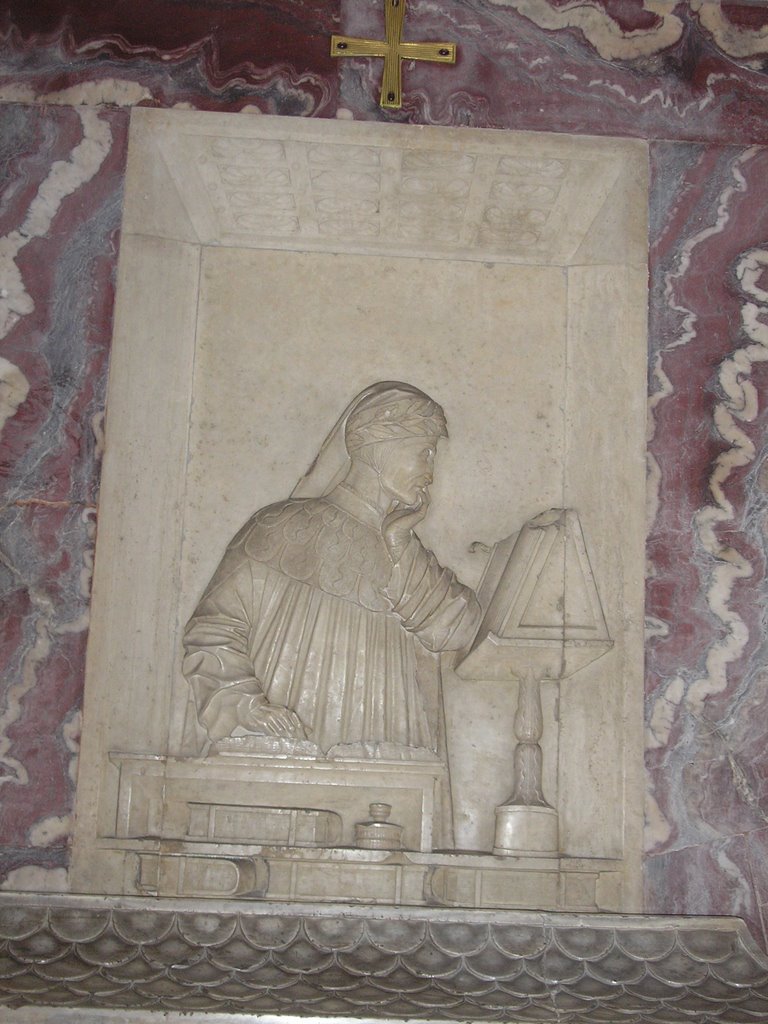
Dante's Tomb

This isn't directly related to the ancient world, but I figured that as long as I was posting pictures from Ravenna, I might as well include some of the tomb of Dante, who eventually lived (and died) in Ravenna after having been exiled from Florence. I thought that since he took Vergil as a guide and since there's a fair amount of Latin in his tomb, we could slip him into the Campus.


Wherefore art thou Homer? And not say, Phantasia?

David Meadows quotes from an article on a book by a certain Andrew Dalby who argues that the Iliad and the Odyssey may have been written by a woman. David thinks this is weird, but I have another view: it's silly, and it's been done before by a better scholar.

Samuel Butler, perhaps best known for his novels The Way of All Flesh and Erewhon, also translated Homer and published a book in 1897 called The Authoress of the Odyssey: where and when she wrote, who she was, the use she made of the Iliad, & how the poem grew under her hands.

But Butler was not the first to hold that view. Butler himself was asked why he made no mention of the post-classical tradition that not only the Odyssey but also the Iliad were written by a woman (his critic is known only as 'The Librarian'). It turns out that Butler was 'entirely ignorant, though he had taken a very good degree in classics.'

[A] certain critic of Homer, Naucrates by name, asserts that Odyssey (and the Iliad!) were written by one Phantasia, daughter of Nicaritius, a professor of philosophy, and were preserved in the library of Memphis, where Homer found them.
Not perfect (she was the daughter of Nicarchus, not Nicaritius, perhaps a typesetter's error), but accurate enough. Note that Phantasia (fantasy) means imagination. This should send up a red flag, especially when we consider the fascination which Egypt held for the Greeks as a fairy land full of magic, mystery, and divine knowledge. It was very romantic, and in later periods virtually every Greek poet, philosopher, and statesman was said to have studied there under the priests and to have attained its secrets, regardless of anachronisms and wild inconsistencies in the tales.

While a difficult source to track, the story of Phantasia comes from the great Byzantine scholar Eustathius, archbishop of Thessalonica (12th c. A.D.), teacher of Michael Choniates, whom I've mentioned before (Michael, archbishop of Athens, delivered a eulogy at Eustathius' funeral). This is what Eustathius had to say in his commentary on Homer:
φασὶ γὰρ Ναυκράτην τινὰ ἱστορῆσαι, ὡς ἄρα Φαντασία γυνὴ Μεμφῆτις, σοφίας ὑποφῆτις, Νικάρχου θυγάτηρ, συντάξασα τόν τε ἐν Ἰλιάδι πόλεμον καὶ τὴν Ὀδυσσέως πλάνην, ἀπέδοτο τὰς βίβλους εἰς τὸ κατὰ Μέμφιν τοῦ Ἡφαίστου ἄδυτον. ἔνθα τὸν ποιητὴν ἐλθόντα, λαβεῖν παρά τινος τῶν ἱερογραμματέων ἀντίγραφα, κἀκεῖθεν συντάξαι τὴν Ἰλιάδα καὶ τὴν Ὀδύσσειαν. ὅτι δὲ ἢ Αἰγύπτιος ὁ ποιητὴς ἢ εἰς Αἴγυπτον φοιτήσας ἐμαθήτευσε τοῖς ἐκεῖ, ἱστοροῦσι τινές. καὶ ἐν τῷ περὶ τῶν πλαγκτῶν δὲ λόγῳ ἐν τοῖς ἑξῆς τοῦ βιβλίου τούτου τεθήσεταί τις ἱστορία τούτου δηλωτική.

They say that a certain Naucrates records that Phantasia, a woman from Memphis--a skilfull and inspired poetess and daughter of Nicarchus--, having composed works on the war in Ilias and the wandering of Odysseus, deposited the books in the sanctuary of Hephaestus in Memphis. Then (they say), after the poet (i.e. Homer) arrived, he took copies from a certain one of the sacred scribes, and at last composed the Iliad and the Odyssey. And some say either that he was an Egyptian poet, or that studying in (literally "frequenting") Egypt, he was their pupil.
Homer, like all the rest, was a student in Egypt ('frequenting' here is the usual idiom). The whole of Plato's philosophy was supposedly taken from sacred Egyptian scrolls, so this comes as no surprise. It's part of the strain of apocryphal stories mentioned above.

Unaware of this story, Dalby is at least as ignorant as Butler, though I suspect more (his talk page at Wikipedia suggests less familiarity with the Greek alphabet than with the Cyrillic, so I suspect that he does not read Greek). For example, how can he argue that the 'the idea that Homer was the author was first proposed in "one ill-informed post-classical text -- the anonymous Life of Homer, fraudulently ascribed to Herodotus"?' This argument can only be used to show that the Iliad and the Odyssey were not identified by those names in classical antiquity, but even then it would be just plain wrong.

Lines routinely ascribed to Homer by authors such as Plato are those of the Iliad and Odyssey, both directly and indirectly cited. Any good text with an index will bear this out. I'll point to just one of the (at least) dozens: Republic 393a (book 3), where Plato quotes Iliad 1.15-16 and says that 'the poet himself is the speaker' but that the poet then switches,
and tries as far as may be to make us feel that not Homer is the speaker, but the priest, an old man. And in this manner he has carried about the affairs in Ilium, all that happened in Ithaca, and the entire Odyssey. (translator Paul Shorey in Hamilton & Cairns, Collected Dialogues of Plato)
(Yes, I checked the Greek, and that's what it says.) One cannot deny that Homer was regarded in antiquity as the author of both the Iliad and the Odyssey. But let's return to Herodotus. Dalby suggests that Herodotus was credited with naming Homer as the author of the Iliad and the Odyssey only in a spurious Life of Homer, but this is incredibly misleading.
In Book II section 116 Herodotus not only names Homer explicitly as the author of the Iliad, but also quotes several line from both the Iliad (6.289) and the Odyssey (4.227 and 4.359). I'm not making this up. It's all easily checked. He cites Homer elsewhere, but I recommend you see for yourself using the most basic research tools at your disposal. It takes minutes -- far less time than researching, writing, and publishing a book.

But let's set all that aside. Can anyone take seriously the premise that a woman is better suited to write sensitively about human affairs than a man, because men are mere brutish pigs thirsting for blood? I guess reverse sexism sells.

This book smells of amateurish provocation and would-be-valiant lances at straw men such as misogyny in the modern academy. We have no shortage of critics who pretend to challenge doctrines that do not exist, constantly conjuring ghosts of the 19th century in place of the stodgy professors who are no longer there. They epitomize style over substance.

The fact is that this idea is not new, it is not challenging -- it is not even sound. Dalby will be able to pretend that misogyny or the power of received opinion is what fuels his critics, but he can not escape his own miserable failure.

Friday, June 30, 2006

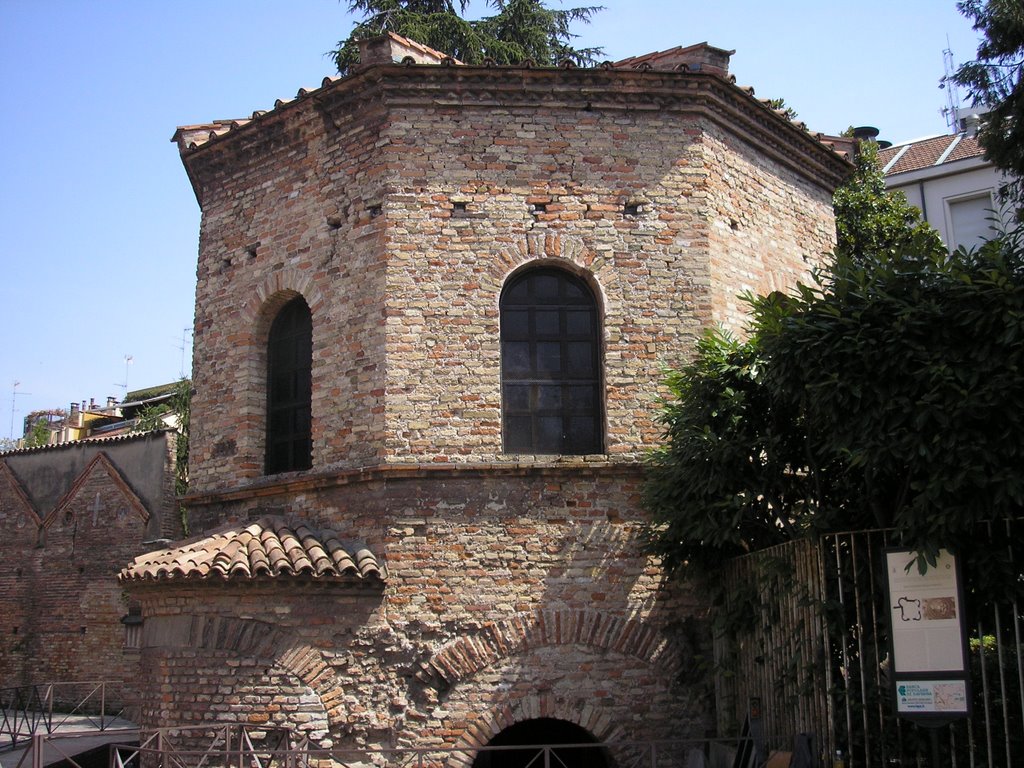
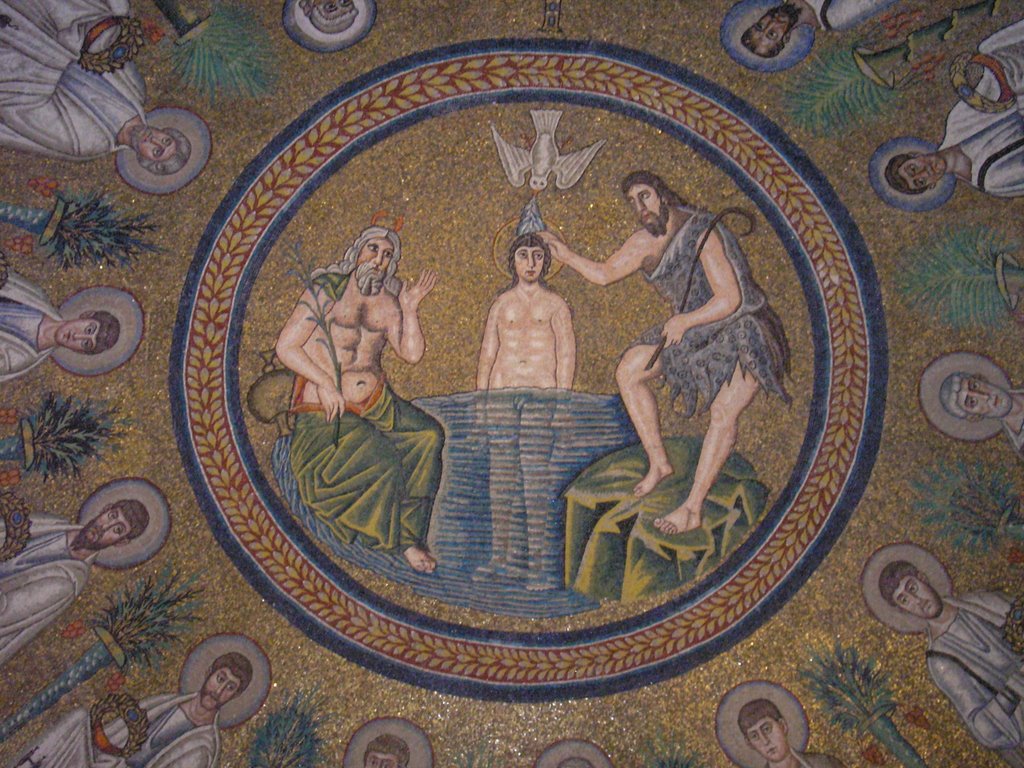
Ravenna/Arian Baptistery

Exterior of building, the base of which is now far below current ground level.

Dome mosaic of baptism of Christ. From left to right: personification of River Jordan; Christ of beardless type (with dove of Holy Spirit); John the Baptist. Ringed by procession of Apostles.

Same, but closer.

It is interesting to compare the scene on this dome with that on the dome of the Orthodox, or Neonian, Baptistery, which has many similiarities but is overall a much more complex composition. But for some reason I forgot to take pictures in there. Maybe I can find a few online at a later time to put up here for comparison.

Wednesday, June 28, 2006

Ravenna 1

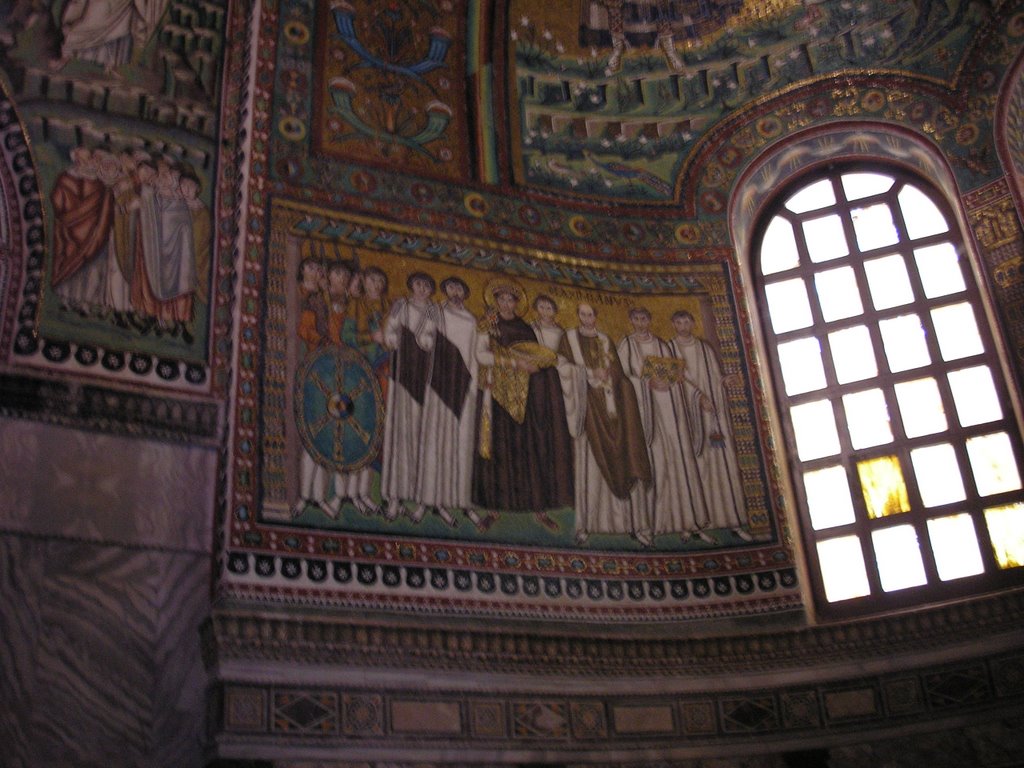
Ravenna is sort of like a Late Antique amusement park. It boasts several 5th and 6th century structures (especially religious buildings) and some of the most incredible mosaics I've ever seen. Here are a couple of photos from the 6th-century Basilica of San Vitale. The first is of a mosaic, made after Justinian's reconquest of Ravenna (which had been under Gothic control), of the emperor with attendants bringing a paten as an offering to the church. Opposite this in the church is one of his wife Theodora bringing a jeweled chalice.

The second is of the interior of the church, looking toward the apse and altar.

Wednesday, June 21, 2006

Moderns on Ancients

The Fall of Rome
by W. H. Auden

(for Cyril Connolly)

The piers are pummelled by the waves;
In a lonely field the rain
Lashes an abandoned train;
Outlaws fill the mountain caves.

Fantastic grow the evening gowns;
Agents of the Fisc pursue
Absconding tax-defaulters through
The sewers of provincial towns.

Private rites of magic send
The temple prostitutes to sleep;
All the literati keep
An imaginary friend.

Cerebrotonic Cato may
Extol the Ancient Disciplines,
But the muscle-bound Marines
Mutiny for food and pay.

Caesar's double-bed is warm
As an unimportant clerk
Writes I DO NOT LIKE MY WORK
On a pink official form.

Unendowed with wealth or pity,
Little birds with scarlet legs,
Sitting on their speckled eggs,
Eye each flu-infected city.

Altogether elsewhere, vast
Herds of reindeer move across
Miles and miles of golden moss,
Silently and very fast.


From Another Time by W. H. Auden, published by Random House. Copyright © 1940 W. H. Auden, renewed by The Estate of W. H. Auden. Used by permission of Curtis Brown, Ltd.

Thursday, June 15, 2006

Dentistical Archaeological Find

Some evidence for the work of ancients equivalent to our guys in white coats with inspiration posters all over the ceiling. This doesn't have anything to do with the Greco-Roman world, but it is old--and interesting.

WASHINGTON - Thousands of years before screen idols began beautifying themselves with cosmetic dentistry ancient Mexicans were getting ceremonial dentures.

Researchers report Wednesday that they found a 4,500-year-old burial in Mexico that had the oldest known example of dental work in the Americas.

The upper front teeth of the remains had been ground down so they could be mounted with animal teeth, possibly wolf or panther teeth, for ceremonial purposes, according to researchers led by Tricia Gabany-Guerrero of the University of Connecticut.

"It's like he was using the mouth of some other animal in his mouth," explained James Chatters, an archaeologist and paleontologist with AMEC Earth and Environmental Inc. in Seattle, Wash., and a member of the research team.

You can read the rest here.

Tuesday, June 13, 2006

Why study classical antiquity?

It's a question asked often, especially by classicists who despair for self-justification. Well, here's one humble response from 1964:

In the days when they formed the basis of a common culture for all educated Europeans, classical studies, together with the Bible, provided an outline of nearly all that was known or believed about world history and a background to the history of modern times and of the Middle Ages. Today, to speak of 'two cultures' is to understate: the Arts themselves are fragmented. Modern history, reaching back only a few generations, lacks depth; mediaeval history both begins and leaves off in the middle of the story; classical studies have become too narrowly philological.


     Our civilization needs classical scholars, as it needs sinologists, not only to train their successors but primarily for the sake of the wider public. There is a wide and spontaneous demand for knowledge about the origins and development of our civilization, manifested both in sales of books and in willingness to spend money on travel in the Near East. We could, and ought to, be satisfying this demand.


     At first sight the length of time — some 5,000 years since the first recorded dynasties — sounds overwhelming. But the appropriate measure of time is the human generation: the number of perhaps 200 since the beginning of recorded history and less than 100 since Homer is a modest one.


     We can here learn from American colleges, which have long taught world history or 'western civilization', not least that the study of Greek and Roman history can play a great part by bringing out the extraordinary resemblances between some of the great processes villain that history and the history of the Christian West. The re-growth of a culture, under stimulation from the East after the collapse of a previous civilization; the expansion to a more spacious world in the West and its effects on the old world's economy and society; the bold astronomical and geological speculations; the class-struggles and revolutions; the disastrous failure to transcend inter-state rivalries and wars — all these things have reminded scholars of the history of their own age. At the same time Greek thought and art have in some ways more resemblance to those of mediaeval Christendom than to modern trends.


     Even an outline knowledge of Greek and Roman history could be of immense value to specialists in modern fields. We should be devoting our best efforts to trying to convince our colleagues of this, and should be training our pupils to restore some unity to our culture, as well as training their successors.
The author was A.R. Burn (Proceedings of the Classical Association LXI, 1964, 27–28), most widely known by students as the author of The Penguin (formerly Pelican) History of Greece, first published under the title A Traveler's History of Greece a year after this talk was given. (I suppose this could be another's summary of his talk — it's given in a list of 'reports' from the General Meeting — but I suspect that it was his abstract.

Still sound sensible enough to me.

Monday, June 12, 2006

Speaking of Erasmus' Adages...

Here is a review by Richard Joines of a recent edition of Adages III.iv.1-IV.ii.100 by John N. Grant and Denis L. Drysdall.

Friday, June 09, 2006

Neologisms in Augustine's Sermon Super Verbis Apostoli Ad Galatas...

In his introduction to this sermon of Augustine, F. Dolbeau remarks that Augustine uses two words here not found in the TLL. (Sorry, I just noticed that when I pasted this citation in, all the French accents disappeared. I don't have time to fix it right now and don't know how to anyway, so I'm just going to replace them with unaccented letters. Hope that doesn't make it too unintelligible.)

Deux substantifs employes par Augustin sont absent du Thesaurus Linguae Latinae. Ce sont des noms d’agent en -tor, dont le sens ne fait pas difficulte. Le premier, obtestator (sec. 5), ne figure apparement dans aucun dictionnaire; le second, decretor (sec. 9), etait jusqu’ici atteste pour la premiere fois chez Raoul Glaber. Tous deux pourraient etre des creations deliberees d’Augustin, car ils fonctionnent en symetrie, repectivement avec praedicator et impletor.

Thursday, June 08, 2006

Julian the Apostate Quiz

Via Bread and Circuses, I learned about this fun online quiz on Julian the Apostate. Enjoy!

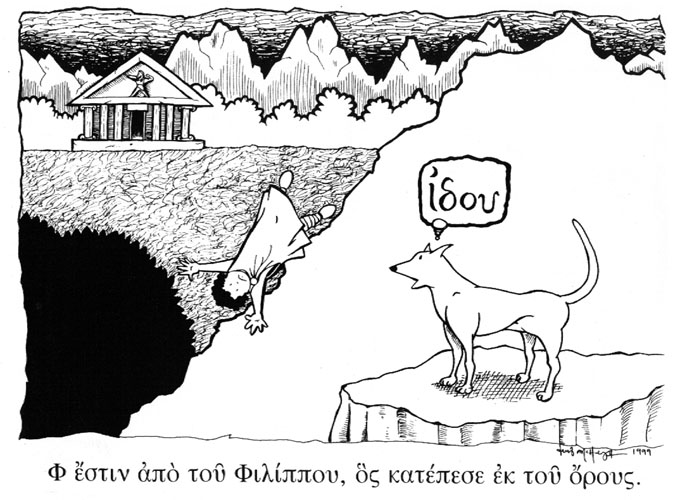
By the way, Dennis, love the cartoon!

No, Philippos! Not again!


I drew this in my first year of baby Greek while at UMass: an homage to Athenaze's hapless young hero and his trusty dog, Argo. It was supposed to be in the style of Edward Gorey's Gashlycrumb Tinies, but I was lazy and hadn't drawn in a long time, so this was the result. Posted by Picasa

Ludi in AD 204

Today the Rogueclassicist asks for information on something called the ludi Latini et Graeci honorarii in AD 204, of which today is supposed to be the fifth day. I'm not sure if these are the same games, but Septimius Severus presided over a 10-day celebration of the ludi saeculares in 204 and, according to this report, he used Augustan calculations; Augustus had first celebrated the ludi saeculares in 17 BC and they took place in late May and early June. Now, I'm assuming that the ludi saeculares and the ludi Latini et Graeci honorarii must be the same games, since the Rogueclassicist also has a listing for the Latini et Graeci on this day in 17 BC, which roughly coincides with the timing for the saeculares in that year (though it is off by a few days).

Mr. Meadows--I'm not sure if any of this is the sort of information you're looking for. If it's all old news and you were inquiring about something different, please ignore!

Wednesday, June 07, 2006

The Remains of a Senarius in a Letter of Jerome?

In a letter written by Jerome to Augustine (Ep. 68 in editions of Augustine's letters; Ep. 102 in editions of Jerome), dated to 402 (see Fuerst's monograph on the correspondence), Jerome threatens Augustine via classical and proverbial metaphors:

nunc te currente et longa spatia transmittente nobis debetur otium simulque, ut cum venia et honore tuo dixerim, ne solus mihi de poetis aliquid proposuisse videaris, memento Daretis et Entelli et vulgaris proverbii, quod bos lassus fortius figat pedem.

In a brief but interesting note in Wiener Studien 19 (1897) 317, Karl Schenkl makes a case that the 'proverb' (italicized in the above citation) is not merely a proverb, but is a citation of a poet--the 'remains' or the 'left-overs' ('die Reste') of a senarius. For support, he offers four reasons: the balance of the phrase, its 'poetic coloring', the placing of the words, and the prominent (or 'pronounced') alliteration of fortius figat.

He says that he is not able to unravel whence it comes; Schenkl points out that Erasmus, in his Adagia, refers it to the Greek proverb Atremas bous (Diog. III.9, Arsen. VI.8, Apost. IV.24), but he states that this contributes nothing to its explanation. He theorizes that Jerome found the proverb in a Gnomologium, and that it was probably included in the fragmenta adespota of iambic poets.

Wednesday, May 31, 2006

J.P. Postgate's 'Flaws in Classical Research'

I'm reading J.P Postgate's classic essay 'Flaws in Classical Research' (Proceedings of the British Academy, 1908, 161-211), which, by the way, should be tempered with Paul Shorey's review (Classical Philology 5.2 225-228) which attempts to 'guard against the impression which it will make upon the student or the hostile layman.' Shorey notes Postgate's 'impatience of human frailty,' which puts one in mind of A.E. Housman. Incidentally, Housman (cited approvingly in the essay) beat out Postgate for the Latin chair at Cambridge.

Currently what's interesting me is Postgate's criticsm of modern 'lineal' thinking which is prone to misunderstand the 'circular' thought behind utterances in classical languages.

I was reminded of a recent article in the Guardian (linked by ALDaily) that dealt with the difficulties caused by syntax in the translation of humor from English to German. This difficulty has led some Brits to the conclusion that Germans are humorless, and in the same way the divide betwee 'lineal' and 'circular' habits of mind has led modern readers of the Classics to mistranslation, misleading commentary, and the attribution to the ancients of convoluted metaphorical expression alien to their native sensibility:

One main principle which it takes some trouble to grasp, and still more to apply with precision, is that, within certain wide limits, order in modern sentences is syntactically essential and in ancient sentences syntactically indifferent. The modern sentence, to put it roughly, is an arrangement in line, the ancient one within a circle. Now the lineal habit of mind, if I may call it so, is often at a loss when it has to understand the circular; it is devoid of the sense of grouping; it has not been trained to the necessary attention. If the groups are small, the trouble thus caused is small; but it is not absent altogether.
Now comes a great but simple example, the kind I've seen belabored by would-be critical theorists in their first semesters seeking out the foul stench of patriarchy and cultural imperialism at every turn:
In the second half of the pentameter Tibullus writes vir mulierque (ii. 2. 2), Ovid femina virque. The difference of order is absolutely without significance. But the lineal mind is apt to imagine that some subtle distinction between the places of man and woman is intended, as though Ovid were a sort of pro- and Tibullus an anti-suffragette.
Come to think of it, I've probably seen that in some of our leading journals.

From here he recalls the views of T.E. Page (note: Page's commentary on the Eclogues and Georgics of Vergil is still a classic -- go get it!) who 'called attention to the irrationality of current views of the figure called hysteron proteron':
To the lineal mind these 'inversions' are nonsense; to the circular but legitmate variations. ... The real character of such arrangements is seen in passages like Ter. Ad. 917 'tu illas abi et traduce; and Lucan, viii. 342 sq. 'quem captos ducere reges | vidit ab Hyrcanis Indoque a litore siluis', which almost shriek at us the warning respice finem.
There's more, and I recommend that you seek it out (taking Shorey's reservations into consideration). This kind of criticism, taken properly, keeps critics alert.

Tuesday, May 30, 2006

Concerning the Literacy of Augustine's Late 4th Century Congregation

We are often told that late antique sermons are geared toward an audience with a lower level of education (sermo humilis and all that) than the audience for written works of erudite theology and exegesis. And it is certainly true that one often finds an easier, simpler Latin in sermons. While reading one of Augustine's Dolbeau sermons (Sermo Beati Augustini Super Verbis Apostoli Ad Galatas, Ubi Paulus Reprehendit Petrum, Ubi Primo Docet Qaulis Esse Debeat Episcopus, preached in 397), however, I came across a couple of lines that imply at least some level of literacy in his congretation. At the point in the sermon in which we are interested, Augustine is discussing the decisions of the Council of Jerusalem in Acts 15, in which a solution was developed as to how Jewish Law should (and should not) be construed in relation to Gentile converts. Here are lines 183-4:

Hoc in Actibus apostolorum scriptum esse multi recolunt; legant qui non recolunt.

'Many recall that this was written in the Acts of the Apostles. Let those who do not recall it read it.'

More on the Concept of Philology

'An unrestricted concept of philology had to be established in order to get rid of all arbitrary distinctions and to discover its actual reality. But the more unrestricted the concept, the more necessary becomes limitation in developing it. It can accordingly be given an arbitrary limitation for the area in which any scholar works it out. The concept is absolute, the area relative. One can then set up limitations by disciplines, e.g., philology of language, of literature. One can also restrict the scope by time or space, as when one considers a specific period or some particular people. Thus we can have ancient and modern, oriental and occidental, Greek, Roman, Indian, Hebrew, and other philologies. Such division is quite in keeping with the nature of philology. Reichardt says justly with reference to ancient times: "Knowledge of antiquity is not the history of literature, of art, nor of religion--such histories exist without philology--but a history of the life of a people, which consists in the intermingling and cooperation of all these." Every special branch of knowledge historically presented proceeds in one line of development; philology collects all these into noe bundle, and from a focal point, the mind of a people, spreads them out as radii of a circle.'

--August Boeck, from On Interpretation and Criticism (tr. John Paul Pritchard)


Discuss.

Thursday, May 25, 2006

Georgics on my Mind: Merriam-Webster's Word of the Day

georgic \JOR-jik\ adjective

: of or relating to agriculture

Example sentence:
"Lanford Wilson has created yet another remarkable play... a fascinating tale of a georgic Midwestern community and the secrets lurking beneath the surface of its bucolic hum." (Adweek, March 25, 2004)

Did you know?
The adjective "georgic," which dates from the first half of the 18th century, derives by way of Latin "georgicus" and Greek "geōrgikos" from the Greek noun "geōrgos," meaning "farmer." That noun, in turn, was formed by a combination of the prefix "geō-" (meaning "earth") and "ergon" ("work"), the latter of which gave us words such as "allergy" and "ergonomics." The noun sense of "georgic," which dates from the early 16th century, refers to a poem that deals with the practical aspects of agriculture and rural affairs. The standard for such poems, Virgil's Georgics, is responsible for its name. The poem, written between 37 and 30 B.C., called for a restoration of agricultural life in Italy after its farms fell into neglect during civil war.

*Indicates the sense illustrated in the example sentence.

Tuesday, May 23, 2006

Life Imitates Art

Toward the beginning of Henry James' story 'The Last of the Valerii', we read this description from the story's narrator, who is a painter, of his American goddaughter's Roman husband-to-be:

'Strong the Conte Valerio certainly was; he had a head and throat like some of the busts in the Vatican. To my eye, which has looked at things now so long with the painter's purpose, it was a real perplexity to see such a throat rising out of the whit cravat of the period. It sustained a head as massively round as that of the familiar bust of the Emperor Caracalla and covered with the same dense sculptural crop of curls. The young man's hair grew superbly; it was such hair as the old Romans must have had when they walked bareheaded and bronzed about the world.'

Monday, May 22, 2006

On the Development of Philology

'Now that the defining of the philological activity has removed the one-sided ideas of it, the sole remaining task is to show how these ideas have arisen. They are easily accounted for through the division into separate elements of the definition just now established. Since the most usual vehicle of knowledge--rather, the pure reproduction of all knowledge--is speech, the first task of philology is to fathom the mystery of speech. The deepest and most illimitable human undertaking is the comprehension of speech in its freedom and necessity, and whoever has such knowledge has come to know all human knowledge.'

--August Boeckh, On Interpretation and Criticism, p. 10 (tr. John Paul Pritchard)

Discuss.

Thursday, May 18, 2006

Santa Giulia (4)

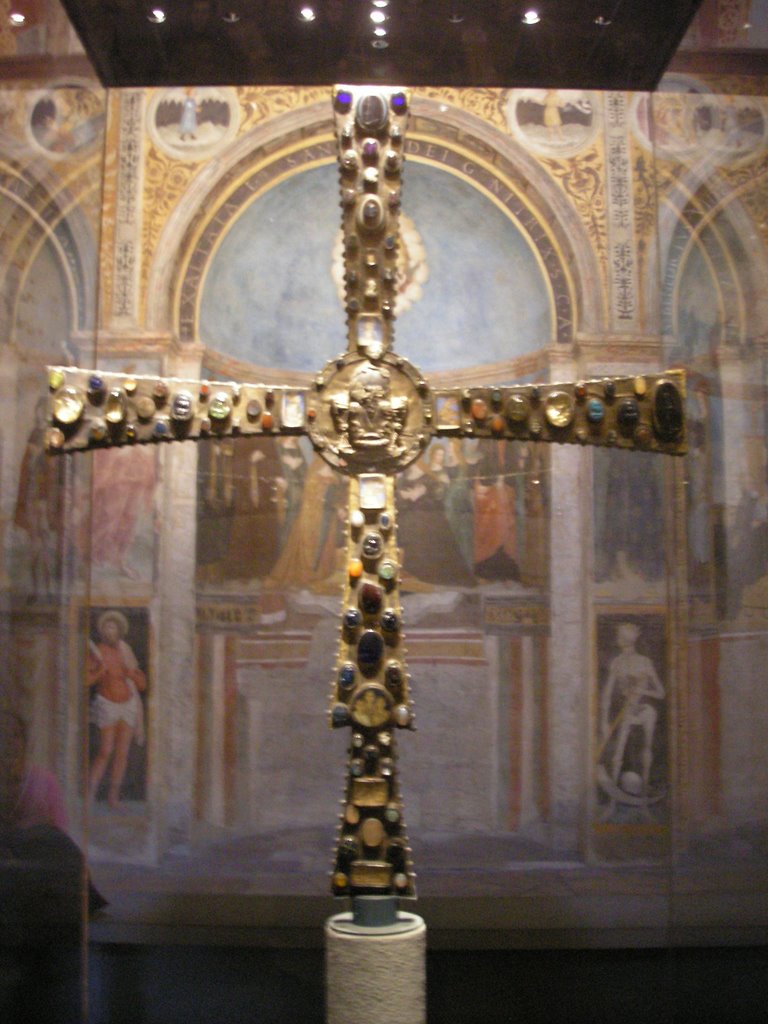
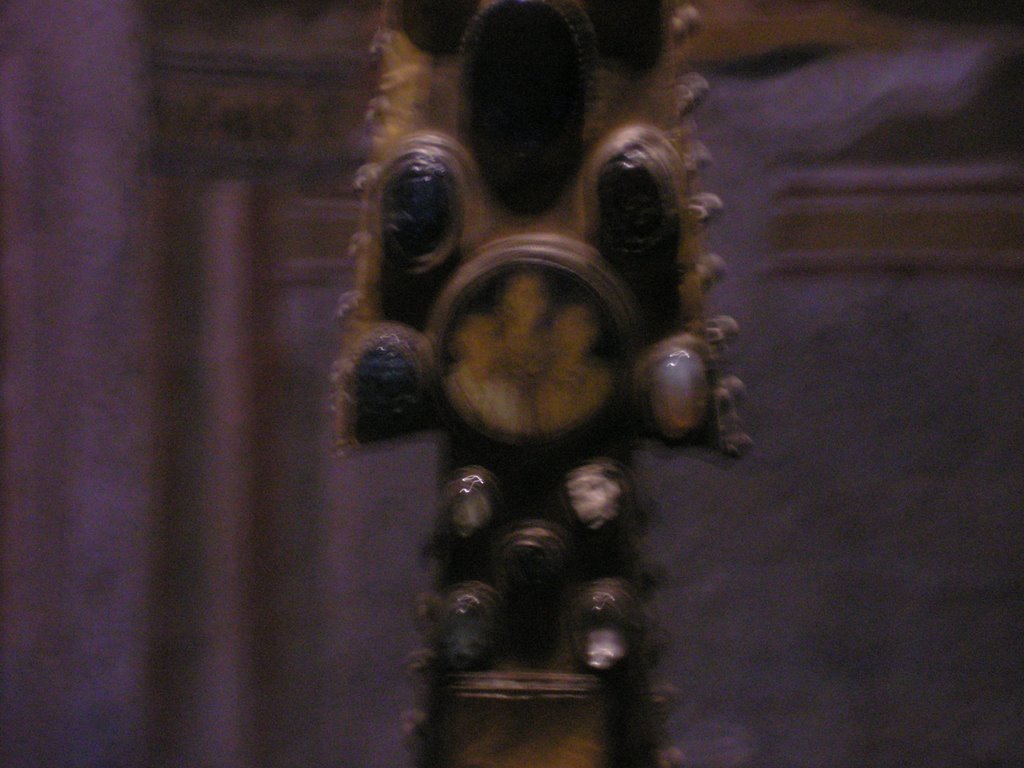
On the other itinerary at the museum, one finds an incredibly ornate jeweled cross, put together out of various pieces in the seventh century. One of those pieces, just over half-way down the lower arm of the cross, is a medallion from the Roman Empire (if you click on the photo to view it in a larger size in its own window, you might be able at least to make it out in general terms; my zoom-in shot is too blurry to see any details, though I’ve included it anyway).


Jas Elsner briefly discusses the object in the introduction to Imperial Rome and Christian Triumph: The Art of the Roman Empire AD 100-450 (Oxford, 1998). In his caption, he writes (p. 22), ‘Gold-glass medallion, perhaps from Alexandria, dated anywhere between the early third and the mid-fifth centuries AD. This family group of a mother, in a richly embroidered robe and jewels, with her son and daughter, bears the inscription BOUNNERI KERAMI. This may be an artist’s signature or the name of the family represented.’

In his remarks in the text, he states (p. 23):

...[T]here are...profound continuities between the visual productions of the pagan and Christian empires, as the following chapters will show. Take, for example, the beautiful gold-glass medallion from Brescia, which could have been made at any point in our period–its transfixing naturalism gestures towards the second century, while its technique is more typical of objects from the fourth. Perhaps from Alexandria, since its inscription is in the Alexandrian dialect of Greek, it probably found its way early to Italy–at any rate, it was incorporated there in the seventh century in a ceremonial, jewelled, cross. Whenever it was made, and for the duration of its use in antiquity, the imagery of this gem speaks of the continuity and values of family life, of the wealth and patronage of aristocratic elites, of the high value placed on exquisite workmanship from the second century to the fifth.

Tuesday, May 16, 2006

Santa Giulia (3)

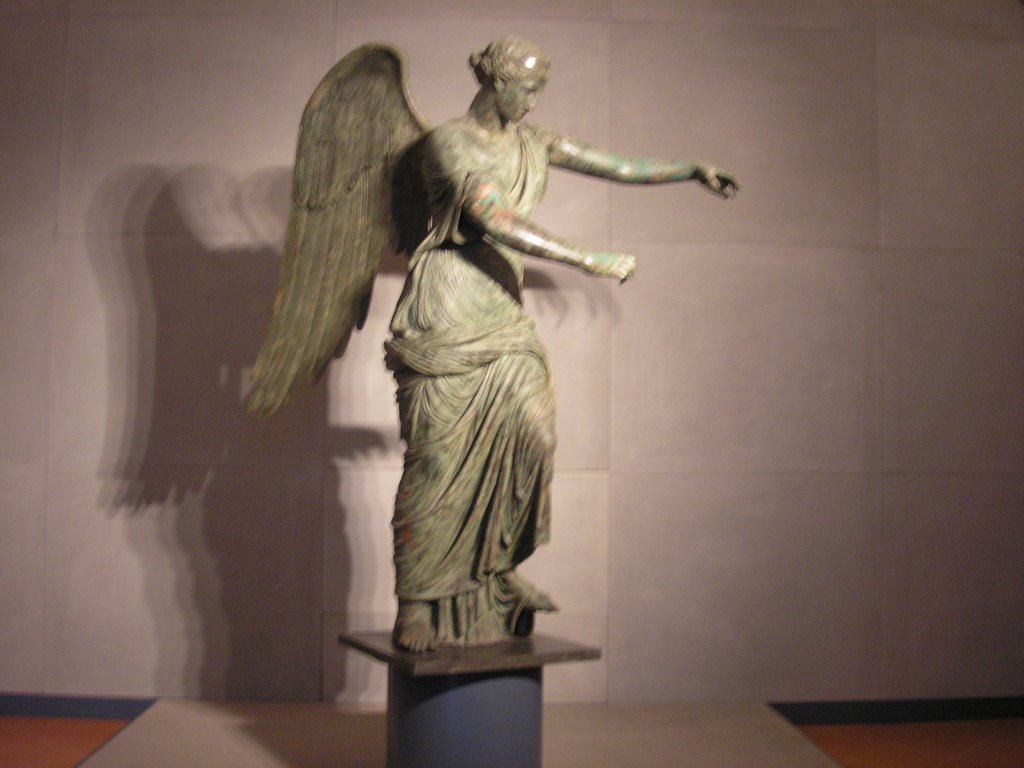
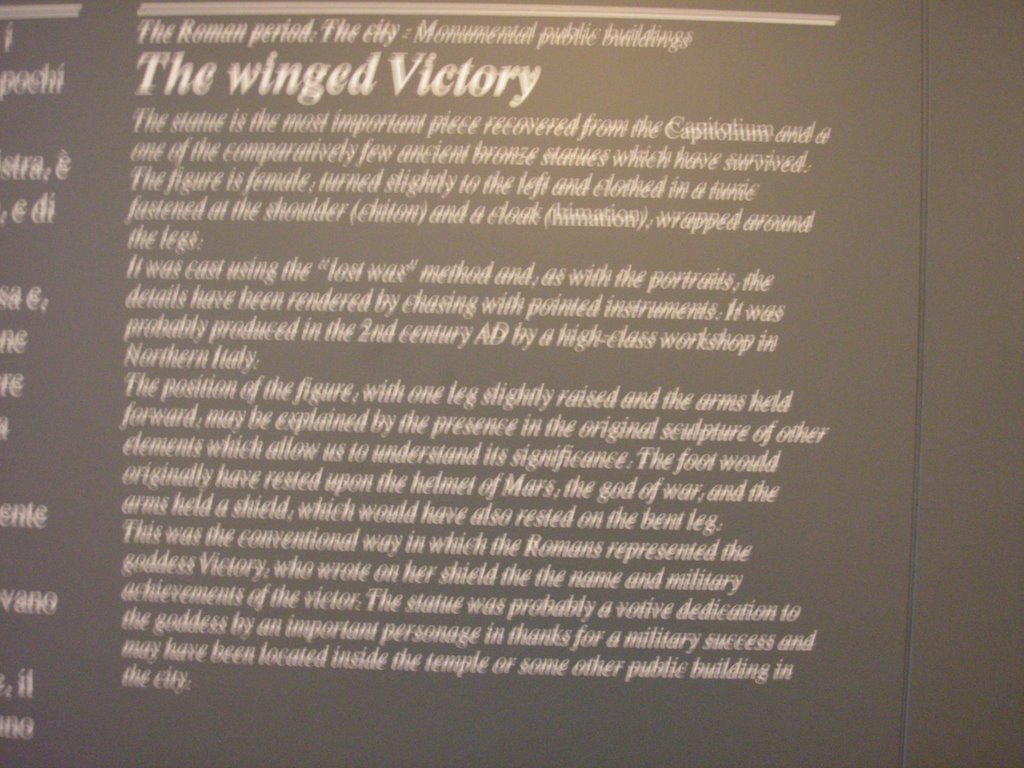
One of the surprising things to me about the museum was their impressive and substantial collection of antique bronze sculptures and ornamention. By far their most famous bronze is this incredible Winged Victory from the Capitolium.


Why Not Keep Talking about Hercules and the Merchant of Venice?

In Act III, Scene II, another suitor-scene in front of the caskets (as was the previous scene recently discussed on the Campus), Hercules comes up twice. The first is in a speech of Portia:

...Now he goes
With no less presence, but with much more love
Than young Alcides, when he did redeem
The virgin tribute, paid by howling Troy
To the sea-monster: I stand for sacrifice,
The rest aloof are the Dardanian wives,
With bleared visages come forth to view
The issue of th' exploit: go Hercules!
Live thou, I live--with much much more dismay,
I view the fight, than thou that mak'st the fray.

(53-62)

Shortly thereafter, as Bassanio is deliberating his choice and commenting on the deceptive attraction of outward ornament, he states:
How many cowards whose hearts are all as false
As stairs of sand, wear yet upon their chings
The beards of Hercules and frowning Mars,
Who inward search'd, have livers white as milk?--
And these assume but valour's excrement
To render them redoubted.

(83-8)

Book Buys

There was another sale at the library here today. Not tons of stuff that I was interested in, but I did get a couple of Classics-related things--Oliver Strunk's Antiquity and the Middle Ages from the 'Source Readings in Music History' series and a book by Edward W. Spofford called The Social Poetry of the Georgics. But the grand prize of the day was the Alfred Rahlfs' 1935 edition of the Septuagint, voll. 1 and 2.

Monday, May 15, 2006

Is nothing sacred?

A reader has e-mailed to ask about the correct Latin translation of the phrase 'is nothing sacred?', made famous in Wes Anderson's classic Rushmore as 'nihilo sanctum estne?'

The problem with that translation was discussed here previously, but I thought I'd post my reply to this latest question, which may be inadequate so feel free to add your two cents on the issue in the comments.

It's almost a philosophical question. You have to think about the meaning behind the idiom rather than the literal translation.

Nihilo sanctum estne is close to a literal translation, but it's grammatically incorrect. A literal translation might be "nihilne sanctum est?" The interrogative particle (-ne) attaches to the first word (which is why "estne" would be a question unto itself in the Rushmore version). The verb "est" isn't technically necessary, so: nihilne sanctum?

This could work, but it's not said anywhere in Latin literature, though similar statements exist, e.g., "dictitat ... nihil esse tam sanctum quod non violari ... possit," i.e., "he asserts that ... nothing is so sacred that it can not be violated" (Cicero, In Verrem I. 2). This same thought is expressed elsewhere in nearly identical terms.

So it's possible to use "nihil sanctum (est)" to say "nothing's sacred." But still, the question "is nothing sacred" isn't asked.

It can be difficult to pinpoint the essential meaning of an idiom and then to translate it into the idiom of another language in a way that would be culturally relevant. In the same context that an English speaker says "is nothing sacred?", a Roman might have said, "mehercule!", an exclamation like our "my god!" which originally meant "by Hercules!" It expresses disbelief, maybe even disgust. But then again, there are probably better Latin idioms that I can't think of that would suit in different contexts.

Saturday, May 13, 2006

the Merchant of Venice again

The earliest reference I can find to Hercules and Lichas occurs in Hesiod fr. 25, which mentions Lichas in the same context that Ovid does, i.e., Deianara 'having besmeared the tunic, gave it to the herald Lichas to bring" (21-22). This is, of course, treated in the Trachiniae, so both characters are present, but there are no dice games.

Shakespeare knew this story well because he used it in Antony and Cleopatra. Antony says the following after dismissing Cleopatra in anger (Act IV scene 8, 53-61):

... ‘Tis well th’art gone,
If it be well to live; but better ‘twere
Thou fell’st into my fury, for one death
Might have prevented many. Eros, ho!
The shirt of Nessus is upon me; teach me,
Alcides, thou mine ancestor, thy rage.
Let me lodge Lichas on the horns o’ th’ moon,
And with those hands that grasp’d the heaviest club
Subdue my worthiest self. The witch shall die.


I suspect that Shakespeare chose to have Hercules and Lichas play dice for two reasons. First is the surface meaning, as Morochus intends it, viz. to place the greatest of the Greek heroes against a lowly servant in a game not of skill, but chance, in which the superiority of Hercules has no bearing, just as the supposed natural superiority of Morochus is neutralized by the game here. Second, and I think more significant, Shakespeare may also have been prefiguring Morochus's lot, for when he makes his choice, the golden casket, his 'prize' is figurative death (answering the riddle 'Who chooseth me shall gain what many men desire'):

O hell! what have we here?
A carrion Death, within whose empty eye
There is a written scroll! I'll read the writing.

"All that glitters is not gold;
Often have you heard that told:
Many a man his life hath sold
But my outside to behold:
Gilded tombs do worms enfold.
Had you been as wise as bold,
Young in limbs, in judgment old,
Your answer had not been inscroll'd:
Fare you well; your suit is cold."


Morochus likened himself to Hercules in an imagined game with Lichas, but he ended up (figuratively, at least) as Hercules did in the familiar story.

Sunday, May 07, 2006

The Merchant of Venice and Hercules

In The Merchant of Venice today I read the following, spoken by Morocco (Act II, Scene I, 32-8):

If Hercules and Lichas play at dice
Which is the better man, the greater throw
May turn by fortune from the weaker hand:
So is Alcides beaten by his rage,
And so may I, blind Fortune leading me,
Miss that which one unworthier may attain,
And die with grieving.

In the 'Arden Shakespeare' edition of the play, edited by John Russell Brown, the note for 'Lichas' in line 32 reads:
'the attendant who brought Hercules the poisoned shirt of Nessus (see Ovid, Met., IX); no story of a game at dice is known [my emphasis].'

Is this correct? Has anyone ever come across an ancient reference to a game of dice?

Thursday, May 04, 2006

Continuing the Tour: Santa Giulia (2)

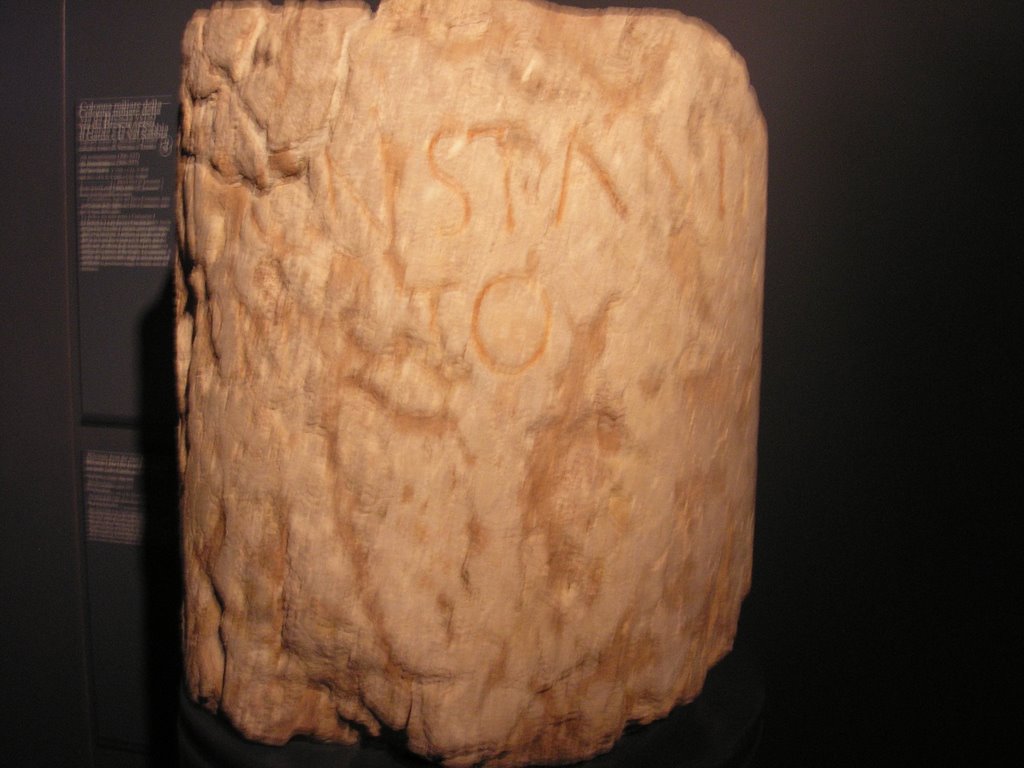
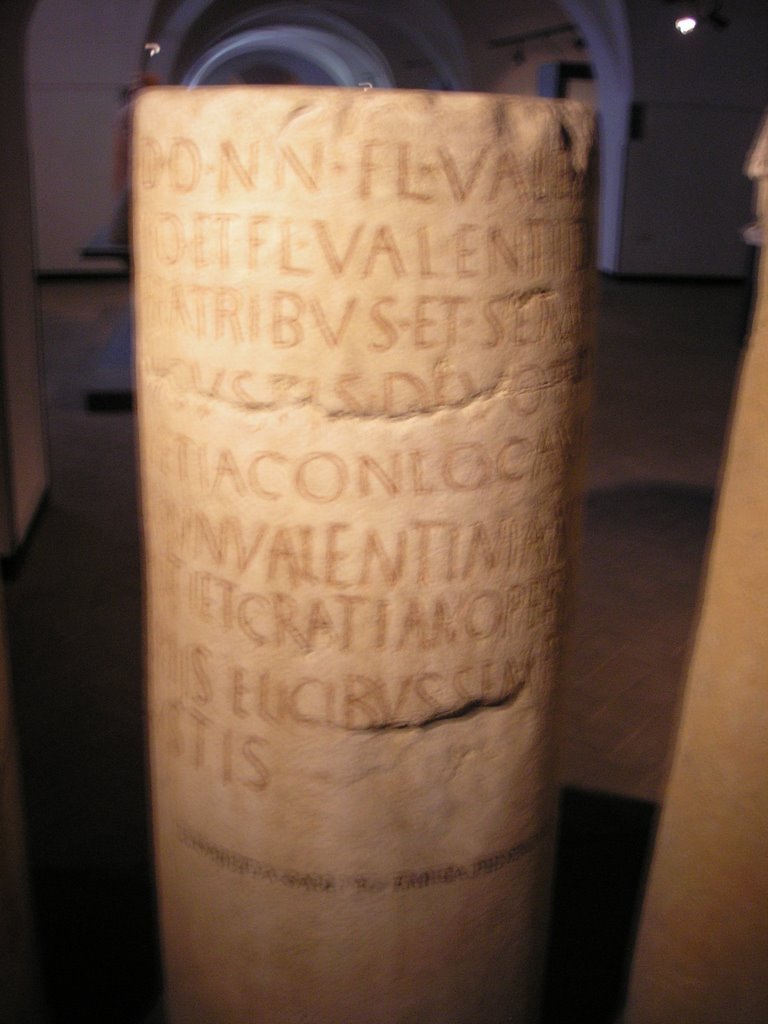
Two more late antique milestones:


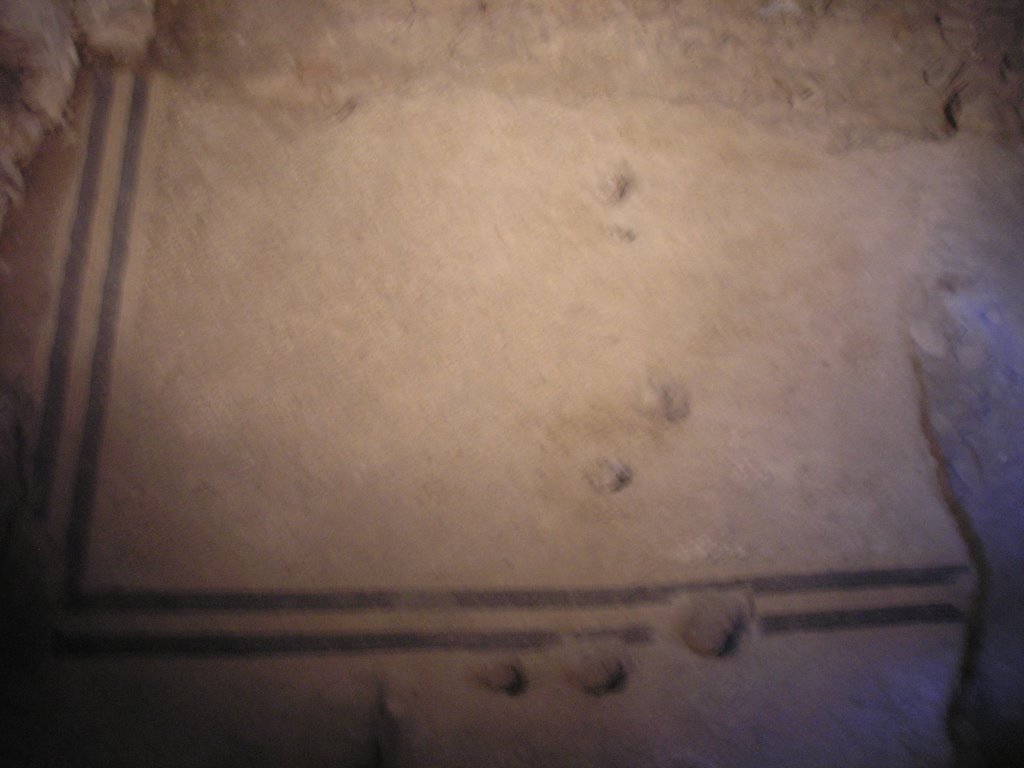
A mosaic floor from a Roman house discovered underneath the monastery--a site later reused by the Lombards to build their huts, as the post-holes cut into the mosaic indicate. I've included a shot (unfortunately blurry) of the didactic plaque:

Wednesday, May 03, 2006

Brescia/Santa Giulia Museo della Citta' (1)

This past weekend I visited the Museo della Citta' in Brescia (Northern Italy), and am convinced that it is one of Italy's best-kept secrets. The museum, housed in a former monastery and a couple of church buildings and located on a street that follows the path of the ancient Decumanus Maximus of the Roman city Brixia, is enormous. It has two itineraries: one which takes you through the history of the town and its surroundings from the prehistoric period all the way through the Venetian period. The other itinerary takes you through the history of the monastery. This post and the next (at least) will focus on some highlights of the first itinerary, and I'll try to do another post on the second. For interested parties, here are some links for the museum: one, two, three.

(Some of these photographs will be blurry, since parts of the museum were a little dark and the use of a flash is not allowed.)

The exhibit on the Roman period had several milestones from the area from the late antique period (Constantine, Valens, Valentinian, etc.). Here is one example:

They also had fragments of fresco from a Republican temple on display. I especially like the second with it's imitation of different types of marble veneer:


That's all I have time for at the moment, but I'll try to continue the series soon.

Archaeologists discover unusual network of burial chambers in Rome

This is the first I've heard about this...

By John Thavis
Catholic News Service

ROME (CNS) -- Archaeologists repairing a Roman catacomb have discovered an unusual network of underground burial chambers containing the elegantly dressed corpses of more than 1,000 people, a Rome official said.

The rooms appear to date back to the second century and are thought to be a place of early Christian burial. Because of the large number of bodies deposited over a relatively short period, experts believe a natural disaster or epidemic may have occurred at the time.

The corpses, dressed in fine clothes embroidered with gold thread, were carefully wrapped in sheets and covered in lime. Balsamic fragrances were also applied, according to Raffaella Giuliani, chief inspector of the Roman catacombs, who spoke with Vatican Radio May 1.

The discovery will be officially presented in June by the Pontifical Roman Academy of Archaeology, which excavated the site in collaboration with Rome's Ecole Francaise and the University of Bordeaux in France.

Giuliani said the burial chambers were found accidentally in 2003, when experts were repairing a cave-in located in the Catacomb of Sts. Peter and Marcellinus, one of Rome's lesser-known catacombs that is closed to the public.

The archaeologists discovered a large room behind one of the painted walls of the catacombs, then a series of similar rooms.

"These were not galleries or cubicles, but big rooms completely full of skeletons. We had to work very carefully to excavate them without destroying them," Giuliani said.

"We were amazed at the high number of individual corpses found in these rooms," she said. The rooms appear to predate the catacombs, which were built in the third century.

Giuliani said the experts believe they were Christian burial places, in part because Christians of that time dedicated great care to burial. Early Christians buried rich and poor with great dignity, in expectation of the resurrection of the dead -- a fact that helps explain the presence in Rome of more than 50 miles of underground catacombs.

UPDATE: Well, I see that the Rogueclassicist beat me to this one, but I'll leave it up in case anyone missed it!

Tuesday, April 25, 2006

Books!

Heck ... Eric just keeps on posting away and apologizing about no posting more often, and here I am keeping quiet.

Let's see what kinds of excuses I can come up with, but first I'll list some recent booksale acqusitions (recent meaning Sunday morning):


Macaulay's Lays of Ancient Rome.
A famous an influential imagining of the 'lost' ballads of the early Roman Republic by the great essayist and historian of England.
T.Z. Lavine's From Socrates to Sartre
A popular survey.
Lily Ross Taylor's Party Politics in the Age of Caesar
A classic on politics at the end of the Republic by a Bryn Mawr professor.
Harold Lamb's Alexander of Macedon
A biography apparently bordering on historical fiction.
G.E. Duckworth's The Nature of Roman Comedy: a Study in Popular Entertainment
Described by Sander M. Goldberg as "the single most comprehensive guide to Roman comedy." Dope.
John Summerson's The Classical Language of Architecture
Looks to be a very readable guide with essays, illustrations, and a nice glossary.
Will Durant's The Life of Greece
Volume 2 in the series 'The Story of Civilization.' It apparently sweeps through from 3500 to 146 BC, and is said to be enjoyable.
The Works of Geoffrey Chaucer from the Riverside Press, Cambridge
Complete text with notes and glossary.
A Conrad Argosy, edited by William McFee
A large, pretty anthology (Heart of Darkness, the Secret Sharer, ...) with woodcuts.
Justin Kaplan's Mr. Clemens and Mark Twain
Winner of the Pulitzer Prize and the National Book Award. And it's about Mark Twain!

That last book leads me to excuses. I've been obsessed with Mark Twain lately. While his works are classics, they're classics of a different sort. In the past week I've read The Adventures of Tom Sawyer, the Adventures of Huckleberry Finn, Tom Sawyer Abroad, Tom Sawyer Detective, and numerous short pieces, and have begun Life on the Mississippi.

There's that and my current job search. And being sick.

But here's hoping all turns out well in the end.

Good book buys always help, especially when you get all of the above for $16.

A Portrait of Vergil

Sorry for the lack of posts around here lately. In the meantime, here's an image of Vergil from the manuscript Vat. lat. 3867 (folio 14, recto).

Tuesday, April 18, 2006

Late Antique Opus Sectile

Not much survives from the decoration of the so-called Basilica of Junius Bassus on the Esquiline, but there are four panels located in two different museums in Rome: the Museo Nazionale Romano located in Palazzo Massimo alle Terme and the Palazzo dei Conservatori in the Capitoline Museums.


The Electa guide book for Palazzo Massimo gives us the following helpful information:

Two panels from the Basilica of Junius Bassus, consul in AD 331, show the extraordinary luxury that characterised the private residences of the artistocratic urban class of the 4th century AD. One panel represents the myth of Hylas abducted by the Nymphs and the other shows the beginning of a race at the circus. Along with two other panels which are now part of the collections at the Palazzo dei Conservatori, this panel belongs to the wall-decoration of a large hall which was a private baslica in a luxurious structure near the Esquiline. The existence of an inscription allows us to identify the hall as the property of the consul Junius Bassus, father of the Roman prefect of the same name. The latter, a Christian, died in AD 359.

After the hall was discovered in the 15th century it was destroyed, but all of the panels in opus sectile were seen and drawn by the well-known Renaissance artist Giuliano da Sangallo, who described them as a 'cosa meravigliosa' (thing of wonder).

Another Link

From Rogueclassicism I have gotten a link to a page of online dictionaries and language and paleography resources, which includes a Medieval Latin dictionary. Thanks to the Rogue for posting it. Enjoy!

Word of the Day for Dennis

I think Dennis should appreciate Merriam-Webster's 'Word of the Day' for 18 April, even though it doesn't actually mention Nicander:

theriac \THEER-ee-ak\ noun

1 : a mixture of many drugs and honey formerly held to be an antidote to poison
*2 : cure-all

Example sentence:
Garlic has been called the poor man's theriac.

Did you know?
There really is no such thing as a single remedy for all that ails us. But that hasn't kept English speakers from creating, not just a single word, but several words, that mean "cure-all" — "catholicon," "elixir," "nostrum," "panacea," and today's word, "theriac." When we first used "theriac," it meant "an antidote for poison" — for any and all poisons, that is. That's how our Roman and Greek forebears used their "theriaca" and "thēriakē," which derive ultimately from the Greek word for "wild animal." The first theriac was supposedly created by the first-century Greek physician Andromachus, whose concoction consisted of some 70 drugs pulverized with honey. Medieval physicians created even more elaborate theriacs to dose a plague-dreading populace, for whom the possibility of a cure-all didn't seem too wild a notion at all.

*Indicates the sense illustrated in the example sentence.

Monday, April 17, 2006

More Good Searches

Here is, in my opinion, the top recent search that brought someone to the Campus:

what's wrong with guys

Another interesting one is:
argosy grad school is bad

Two runners-up are:
"anyone owns a song"

And a personal favorite of mine:
"aaron kook"

And speaking of the Magister, where has he been lately, anyway?

Additionally, Dennis' post on 'bad movie latin' continues to attract a lot of hits.

Friday, April 14, 2006

A Christian Sarcophagus

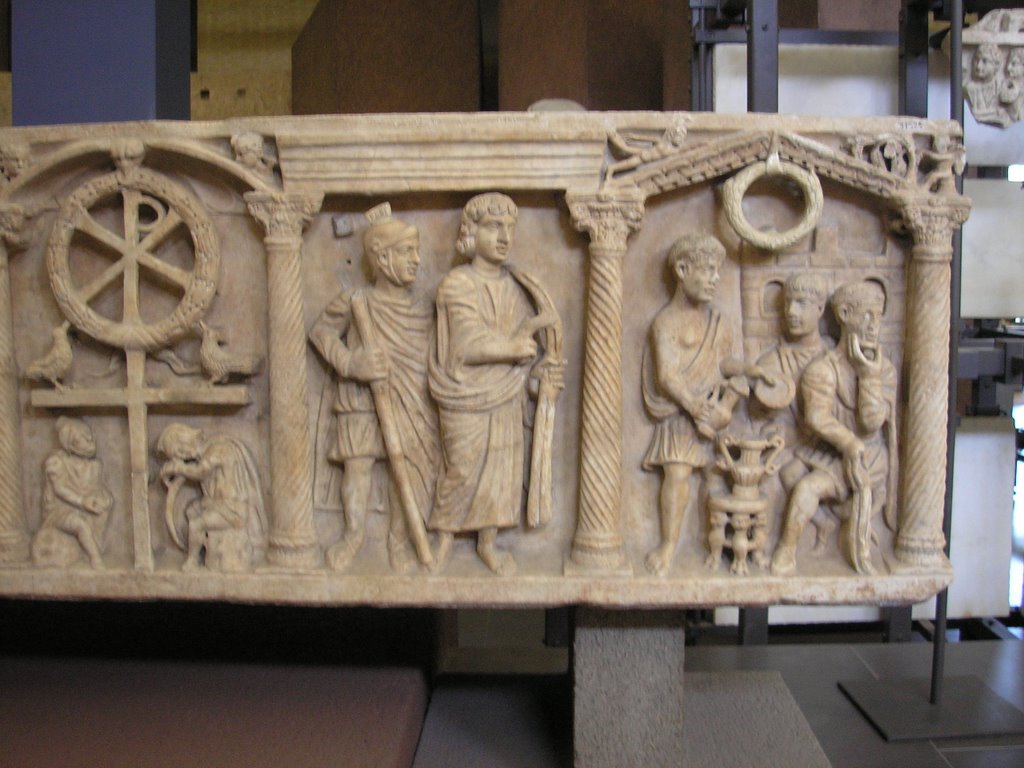
In honor of Good Friday/Easter, I thought I'd post a couple of photographs of a Christian sarcophagus currently on display in the Vatican Museums.


Regarding the type of symbolic centerpiece used in this sarcophagus, Andre Grabar writes the following:

'This first type of image of the Resurrection [i.e. the type he has been discussing in the foregoing paragraphs, not the type shown in the photographs here], which I call juridical and evangelical (because, like the Gospels, it evoked dogma by showing the story of the eyewitnesses of the Resurrection), was not the only one that the image-makers invented. It outweighed all the others, however, from about 400 until the eleventh century in the West and until modern times in the Byzantine world. But in the fourth century, probably in Rome, another image was invented, symbolic in its iconography, that had great success but was abandoned a hundred or a hundred and twenty years later, perhaps because its meaning had become obscure. It was a figuration inspired by the art of military triumphs of pagan Roman tradition, and as it became further removed from pagan times, it must have appeared less explicit. It is on Roman sarcophagi of the fourth century that we find almost all the examples. Here we see the military trophy, and in it the phoenix--symbol of the Resurrection--with seated or standing figures on either side. The origins of this iconography are recognizable in the reliefs of a pagan sarcophagus where the usual military trophy, displaying the arms of the vanquished, is represented, along with the barbarians beneath it who were conquered by the Romans. The Christian formula replaces the trophy by the Cross, on which is suspended a triumphal crown, and substitutes for the captured barbarians two armed but sleeping soldiers--in an allusion to the guardians of the tombe of Christ: their arms are as powerless to prevent the victorious Resurrection of Christ as the arms of the barbarians were powerless before those of the Imperial armies.'

--from Christian Iconography: A Study of its Origins (Princeton 1968), pp. 124-5

Thursday, April 13, 2006

Henry James and the Equestrian Marcus Aurelius

In the Michelangelo-designed piazza on the Capitoline hill is a giant bronze statue of Marcus Aurelius on horseback:

The above sculpture, however, is a copy. The real one has been moved inside the museum and is no longer exposed to the elements. It is now housed in the same room as the giant bronze of Constantine, a photo of which I posted the other day:

The sculpture, justifiably famous, has long provoked comment. Here are Henry James' thoughts, taken from his essay 'A Roman Holiday', which is collected in Italian Hours:

The legendary wolf of Rome has lately been accommodated with a little artificial grotto, among the cacti and the palms, in the fantastic triangular garden squeezed between the steps of the church and the ascent to the Capitol, where she holds a perpetual levee and "draws" apparently as powerfully as the Pope himself.
Above, in the piazzetta before the stuccoed palace which rises so jauntily on a basement of thrice its magnitude, are more loungers and knitters in the sun, seated round the massively inscribed base of the statue of Marcus Aurelius. Hawthorne has perfectly expressed the attitude of this admirable figure in saying that it
extends its arm with "a command which is in itself a benediction." I doubt if any statue of king or captain in the public places of the world has more to commend it to the general heart. Irrecoverable simplicity--residing so in irrecoverable
Style--has no sturdier representative. Here is an impression that the sculptors of the last three hundred years have been laboriously trying to reproduce; but contrasted with this mild old monarch their prancing horsemen suggest a succession of
riding-masters taking out young ladies' schools. The admirably human character of the figure survives the rusty decomposition of the bronze and the slight "debasement" of the art; and one may call it singular that in the capital of Christendom the portrait most suggestive of a Christian conscience is that of a pagan
emperor.

Wednesday, April 12, 2006

No 'Gold' and 'Silver' in the Middle Ages

'Instruction in grammar...comprised language and literature. The selection of authors studied in the medieval schools includes pagan and Christian writers. The Middle Ages makes no distinction between "gold" and "silver" Latinity. The concept "classical" is unknown to it. All authors are, as it were, authorities. Let us examine a number of medieval documents as to curriculum authors. When Walter of Speyer was in school about 975, he read Virgil, "Homer" (that is, the so-called Ilias Latina, a crude condensation of the Iliad in 1070 hexameters, of the first century A.D.), Martianus Capella, Horace, Persius, Juvenal, Boethius, Statius, Terence, Lucan. This is not a casual selection, it is a normative one. It recurs as the basis of later lists.'

--E.R. Curtius, from European Literature and the Latin Middle Ages, tr. Willard R. Trask, pp. 48-9

Two Useful Links Coming Your Way

The first (created, I believe, by Bryce Walker and Bret Mulligan) is the page for the Bi-College (i.e. Haverford College and Bryn Mawr College) 'ORALi-Tea', an event dedicated to the oral performance of ancient poetry. The page has some handy links to recordings of modern renditions of ancient lit by Stanley Lombardo and others and a nice bibliography on reading aloud and related topics.

The second will be especially useful if you live in the Philadelphia area or in relatively close proximity thereto. Bret Mulligan has put together a page listing all the Classics events going on in the area. From that page we learn that Carole Newlands will be speaking at Penn tomorrow (13 April). Her topic (as listed on Penn's page) appears to relate to a character mentioned just yesterday on the Campus: 'Problems of Violence in Ovid: Philomela and Marsyas'.

Kudos to the creators of these pages!

Truth and Virtue revisited

Recently I posted about the mystery of the Bryn Mawr College motto: is it VERITATEM DILEXI or VIRTVTEM DILEXI?

I showed that the inscription on Pembroke Arch, which is said to read 'veritatem,' actually reads 'virtutem.'

I'd heard from a faculty member that there were two explanations, described as apocryphal. One that a change occurred with the rise of feminism, what with virtus meaning 'manliness' and all (but would that have happened as early as 1908, when M. Carey Thomas quoted the motto in its modern form?). The other explanation wasn't mentioned, left off with a laugh that implied improbability or perhaps something unspeakable. I can't imagine what it might be, but it's probably more exciting to wonder.

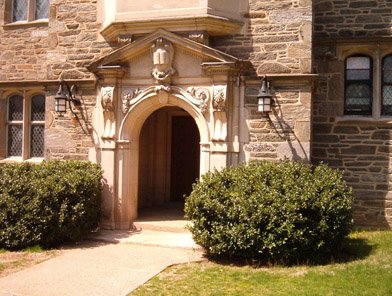
I happened by the entrance to the Quita Woodward wing of Thomas Hall the other day and found something interesting. Here's the entrance:


And here's the inscription above:


It looks like a much newer inscription to me (up close it looks as though the whole center section above the arch of the doorway is done in concrete newer than the rest -- if so, what might have been replaced?).

I reckon I ought to hunt up that second explanation.

Horace and Tyrtaeus

The other day, I posted one of Horace's Odes, and Dennis posted some Tyrtaeus of which he said my post had reminded him. While reading an article by Mario Citroni called 'Quintilian and the System of Poetic Genres' (from Flavian Poetry [Brill 2006], pp. 1-19), I came across a reference to Tyrtaeus and Horace's Ars Poetica in the context of a discussion regarding Quintilian's sources for his poetic canon. Here is Citroni:

'The other Greek poets mentioned by Quintilian, but not by Dionysius, are the epic poet Pisander, the authors of ancient comedy, and Tyrtaeus. As regards ancient comedy, Quintilian maintains the triad of Aristophanes, Eupolis and Cratinus, consecrated by Horace. As for Tyrtaeus, Quintilian quotes a verse from Horace's Ars Poetica as confirmation of his excellence. And it is certain that he was led by Horace, and not by a Greek source, to include Tyrtaeus in his survey, seeing that he does not place him among the elegiac poets, but among the epic writers, because, as he himself says, Horace had placed him beside Homer.' (p.8)

And here are Horace's words (Ars Poetica 400-7):
Sic honor et nomen diuinis uatibus atque 400
carminibus uenit. Post hos insignis Homerus
Tyrtaeusque mares animos in Martia bella
uersibus exacuit, dictae per carmina sortes,
et uitae monstrata uia est et gratia regum
Pieriis temptata modis ludusque repertus 405
et longorum operum finis: ne forte pudori
sit tibi Musa lyrae sollers et cantor Apollo.

Favorite Google Search Directing Someone to the Campus Today?

'i'm look the Angola basketball'.

Tuesday, April 11, 2006

A Post for Mr. Coke

Our largely reticent co-blogger mentioned in the title to this post is a great enthusiast of Plato and his caprine leading man Socrates. In Symposium 215a and following, we find Alcibiades comparing Socrates to Marsyas:

“The way I shall take, gentlemen, in my praise of Socrates, is by similitudes. Probably he will think I do this for derision; but I choose my similitude for the sake of truth, not of ridicule. For I say [215b] he is likest to the Silenus-figures that sit in the statuaries' shops; those, I mean, which our craftsmen make with pipes or flutes in their hands: when their two halves are pulled open, they are found to contain images of gods. And I further suggest that he resembles the satyr Marsyas. Now, as to your likeness, Socrates, to these in figure, I do not suppose even you yourself will dispute it; but I have next to tell you that you are like them in every other respect. You are a fleering fellow, eh? If you will not confess it, I have witnesses at hand. Are you not a piper? [215c] Why, yes, and a far more marvellous one than the satyr. His lips indeed had power to entrance mankind by means of instruments; a thing still possible today for anyone who can pipe his tunes: for the music of Olympus' flute belonged, I may tell you, to Marsyas his teacher. So that if anyone, whether a fine flute-player or paltry flute-girl, can but flute his tunes, they have no equal for exciting a ravishment, and will indicate by the divinity that is in them who are apt recipients of the deities and their sanctifications. You differ from him in one point only--that you produce the same effect with simple prose unaided by instruments. For example, when we hear any other person--[215d] quite an excellent orator, perhaps--pronouncing one of the usual discourses, no one, I venture to say, cares a jot; but so soon as we hear you, or your discourses in the mouth of another,--though such person be ever so poor a speaker, and whether the hearer be a woman or a man or a youngster--we are all astounded and entranced. As for myself, gentlemen, were it not that I might appear to be absolutely tipsy, I would have affirmed on oath all the strange effects I personally have felt from his words, and still feel even now. For when I hear him [215e] I am worse than any wild fanatic; I find my heart leaping and my tears gushing forth at the sound of his speech, and I see great numbers of other people having the same experience. When I listened to Pericles and other skilled orators I thought them eloquent, but I never felt anything like this; my spirit was not left in a tumult and had not to complain of my being in the condition of a common slave: whereas the influence of our Marsyas here has often thrown me into such a state [216a] that I thought my life not worth living on these terms. In all this, Socrates, there is nothing that you can call untrue. Even now I am still conscious that if I consented to lend him my ear, I could not resist him, but would have the same feeling again. For he compels me to admit that, sorely deficient as I am, I neglect myself while I attend to the affairs of Athens. So I withhold my ears perforce as from the Sirens, and make off as fast as I can, for fear I should go on sitting beside him till old age was upon me."

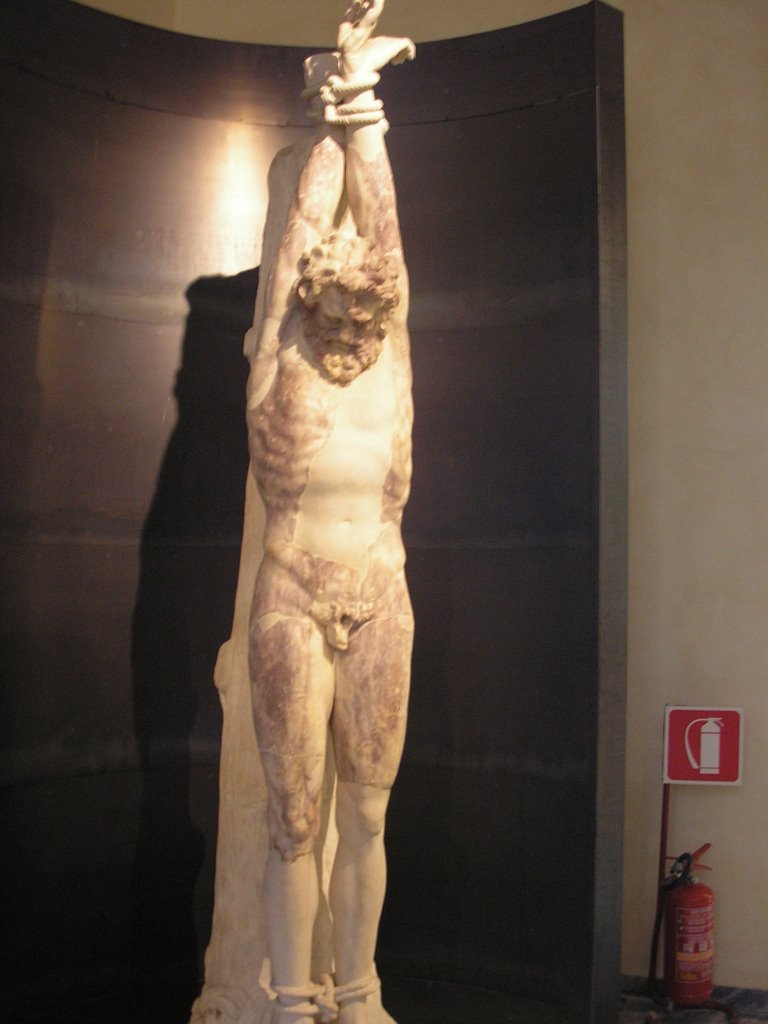
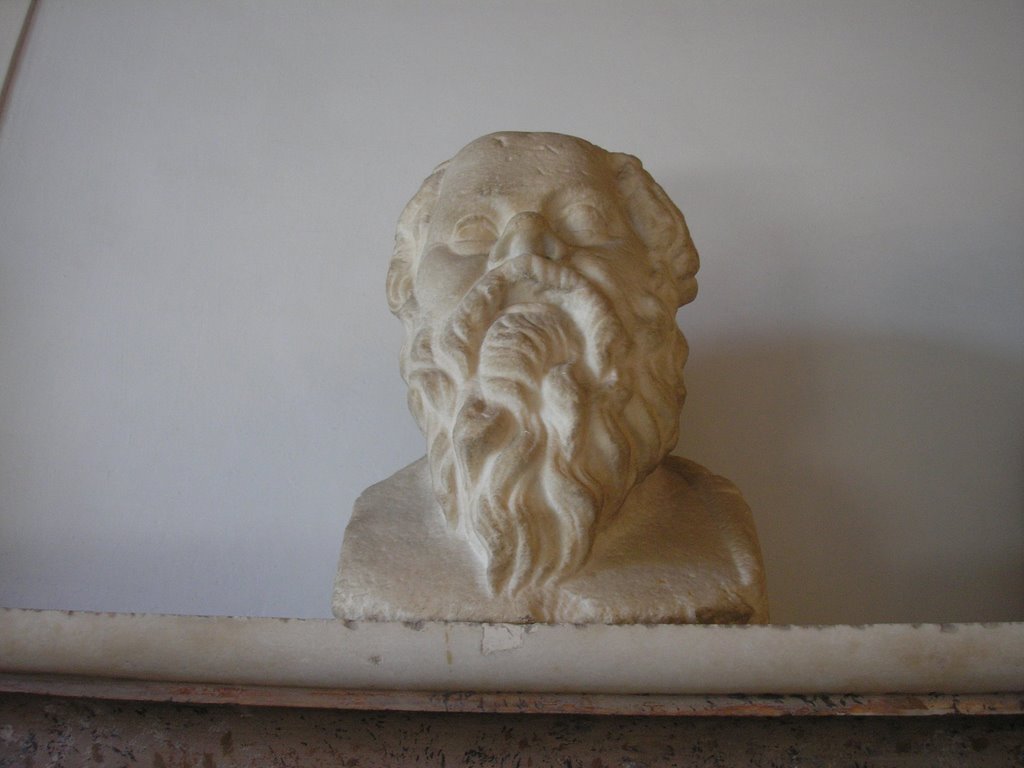
While at the Capitoline the other day, I got pictures of a sculpture of the flaying of Maryas and another of Socrates' head. Take a look at them and compare (sorry, I know the face of Marsyas is difficult to see at that angle). Is Alcibiades right? Does Socrates look like a satyr? Or is he telling a fib?

'So What Brings You to the Campus?'

Two recent (and blunt) answers to that question are, via Google search pages:

'cambridge latin course unit four cheat sheets' (triggered by remarks on the 'Cambridge Greek and Latin Classics Series' and the 'Grad School Cheat Sheet')

and
'catullus dirty poems' (triggered by Dennis' remarks on Catullus 50).

Monday, April 10, 2006

Constantinian Colossi

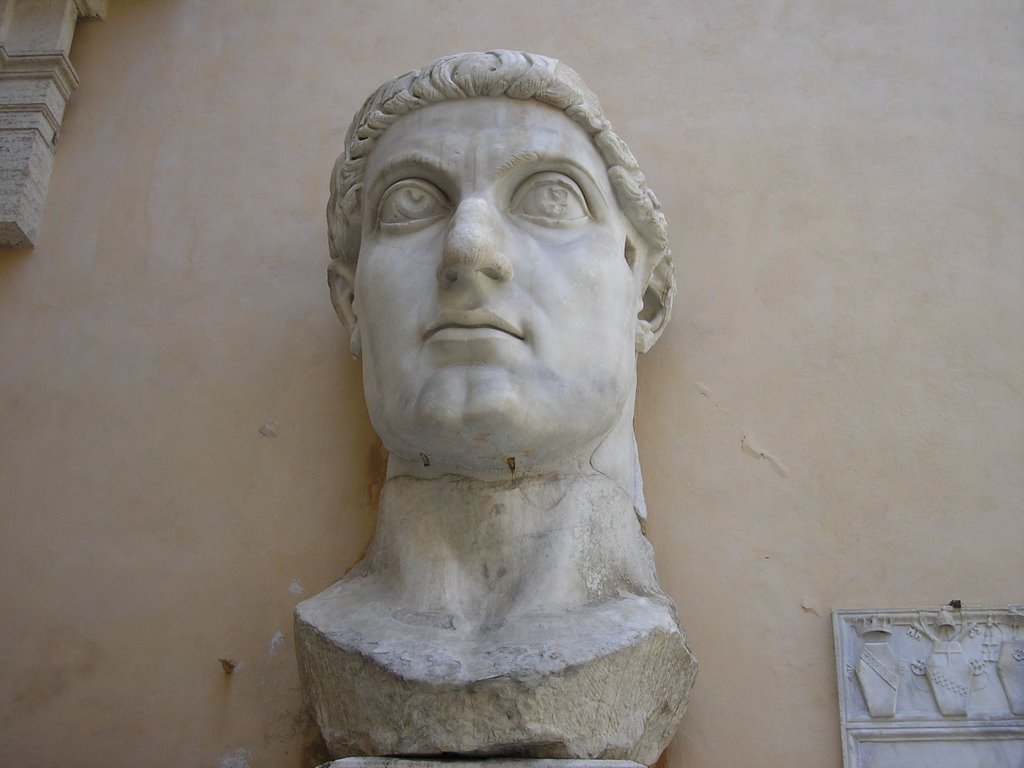
Last week was 'culture week' in Italy, so a lot of museums and sites were free. I tried to take advantage and save some euros and grabbed a bunch of photos along the way, and thought I'd post some that ancient enthusiasts might enjoy. Since Dennis remarked on the apparent popularity of Constantine, I decided to post a couple colossals of the big C from the Capitoline Museums. First, the head from the giant statue originally in the apse of the Basilica Nova:

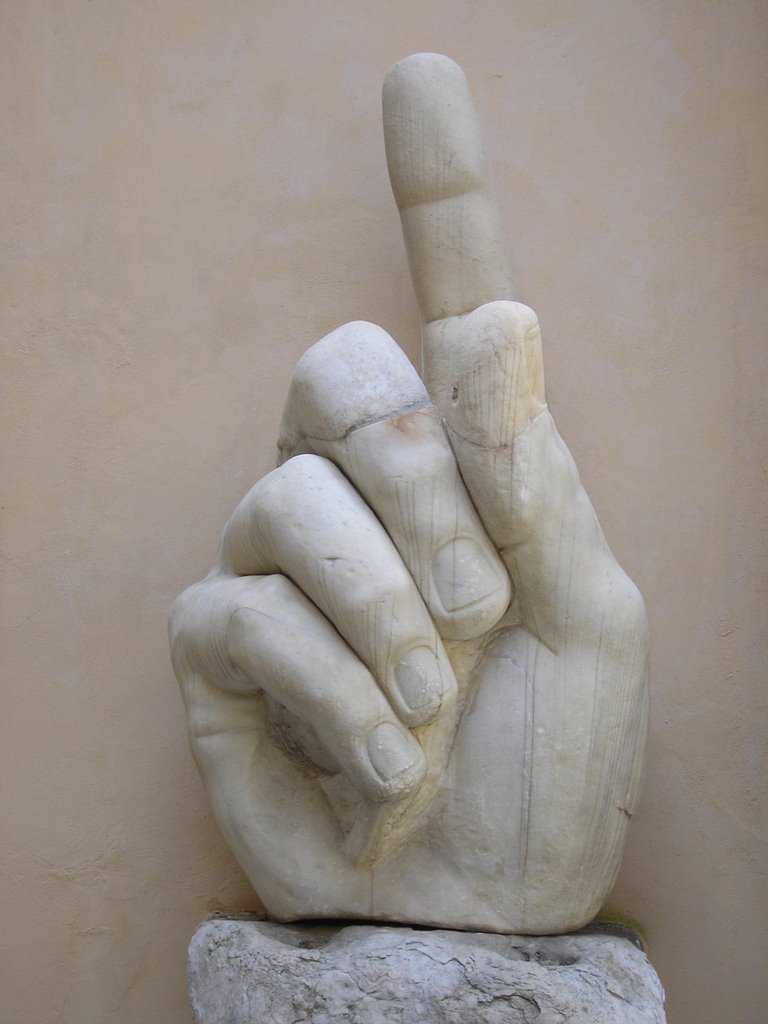
Next, possibly my favorite piece of ancient sculpture: the 'We're Number 1!' hand from the same statue.

Finally, an incredible bronze head, hand, and globe of Constantine. My museum guide says the following about it: 'Beginning in the mediaeval period, the precious remains of the sculpture depicting the first Christian emperor--the head, hand, and globe--were part of the patrimony of the patriarch's Lateran residence. In 1471, they went to the Capitoline Hill, as part of Sixtus IV's donation to the People of Rome. The large head, a masterpiece of antique bronze statuary, impressive both in the colossal scale and the intensity of the features, has been associated with portraits of Constantine during the last period of his life. The hand, intended to hold up a globe, symbol of the power over the world, is securely attributable to the statue.'

Boeckh's Use of the Term 'Encylopaedia'

'Boeckh's use of the term "encyclopaedia" also requires a gloss. He would have the student learn by careful study one or preferably several areas of learning before he is introduced to the survey of learning. He would, for example, introduce one to literature through intensive study of an author's work until he has attained to thorough knowledge of that body of writing. Only after repeated experiences of such a sort would he expose the student to the survey. Careful study in several fields provides a number of points from which the entire circle may be constructed. He who starts from a survey of the whole, which can be presented only in outlines, stands at the mercy of the surveyor and cannot attain to exact knowledge for himself. And yet the student cannot rest in minute knowledge of the several areas he has mastered. Such a one becomes arrogantly biased in his knowledge; and since no part of study is an island, study of single areas remains incomplete without their being fitted into the total ciruict of knowledge. By "encyclopaedia," Boeckh means the comprehensive view of all that is known. Obviously we have here another idea unattainable since probably the time of Dante. Boeckh envisages a scholar well acquainted with several areas whose experience in them enables him to fill out the less nearly complete areas presented in the encyclopaedic survey. He can thus contemplate competently the whole circle of knowledge much more inclusively than if he had not looked at the whole with a mind trained by previous intensive study.

'Methodology is not in Boeckh's view an actual part of philology itself, but is consideration of the means and tools for philological study. Its value for philology lies largely in the fact that it enables the instructed scholar to enter with equal detail as far as he may need to go into whatever area of knowledge the encyclopaedic study has presented to him.'

--John Paul Pritchard, from the preface to his abridged translation of August Boeckh's Encyclopaedie und Methodologie der philologischen Wissenschaften. The title of the translation is On Interpretation and Criticism (University of Oklahoma Press, 1968)

Back on Track (?)

Apologies for my lack of posts 'round here lately. I hope to start getting a few things up of perhaps at least marginal interest.

I thought Merriam-Webster's word-of-the-day for yesterday was intriguing. Here it is:

catchpole \KATCH-poal\ noun

: a sheriff's deputy; especially : one who makes arrests for failure to pay a debt

Example sentence:
David knew that it must be the catchpole knocking at his door, so he quickly threw on his shoes and coat and snuck out the back.

Did you know?
Imagine chasing a chicken around the barnyard. Catching it would be no mean feat. And chasing down someone who owes you money is pretty challenging too. It's no surprise then that these two taxing tasks come together in "catchpole," which derives from a word that literally means "chicken chaser" — Anglo-French "cachepole." Before it referred to the debt police, "catchpole" was used more generally for any tax collector. That's the sense demonstrated in a 12th-century homily about the apostle Matthew: "Matheus thet wes cachepol thene he iwende to god-spellere" ("Matthew who was a catchpole until he turned into a writer of the Gospel").

*Indicates the sense illustrated in the example sentence.

Friday, April 07, 2006

On Philology and Philosophy

'Philology and philosophy are treated as reciprocal. They exist on equal footing, and neither functions satisfactorily without the other. Their methods, as Boeckh views them, are opposite; philology attains to knowledge through induction, whereas philosophy starts from a concept. To formulate his concepts soundly, the philosopher needs an adequate fund of knowledge or data; too many philosophers, Boeckh charges, lack a basis in knowledge or tradition. The insights or intuitions of the well-based philosopher are more trustworthy than are those of the man not thus firmly based. On the other hand, the philologist who attempts to work without some order concept in his view gathers a mere aggregate of facts, cannot digest his data into a system. Philosophy is, as the etymology of the word indicates, the love of wisdom; philology, seeking Newman's "twofold logos," is the love of expression in words and of what that expression conveys. The followers of each strive after an unattainable idea. Boeckh would undoubtedly be exceedingly wary of the tendency apparent in some recent literary interpreters to treat philology as almost subservient to philosophy. In the study of literature, philology must be master and philosophy the servant.'

--John Paul Pritchard, from the preface to his abridged translation of August Boeckh's Encyclopaedie und Methodologie der philologischen Wissenschaften. The title of the translation is On Interpretation and Criticism (University of Oklahoma Press, 1968)

Thursday, April 06, 2006

Modern Hieroglyphics

Or should that be beeroglyphics?

Maybe this is the wrong place for this, but I'm stumped. Lionshead beer, a cheap but eminently drinkable Pennsylvania pilsner, has puzzles under the bottle cap. Maybe I'm just dense, but I can't solve this one:


I'm hoping that some of our vast and learned readership can help restore this bit of lost knowledge, exercising some of the skills they've acquired in the pursuit of Altertumswissenschaft.

UPDATE: I think the good professor solved the problem (see comment below): Count to 10.

And while I'm grateful, I feel a little like Ralphie in A Christmas Story, whose high hopes were dashed by the crass commercialism of the secret message he'd deciphered with the aid of his long-awaited and hard won Little Orphan Annie decoder ring: "Drink more Ovaltine."

Here the commercialism has been replaced by banality.

No, this will not do. We shall adopt the lectio difficilior, viz. bull ain't whistlin', evidently a colloquialism whose precise meaning is unrecoverable.

That's more like it.

Wednesday, April 05, 2006

Uncle Sam wants a piece of Nicander

I'm always interested to know how people find the campus, so I check the site meter pretty regularly. Our (mostly) silent partner, Magister Coke, brings in a lot of his students, but the big one has got to be Constantine's Vision.

Must be a hot topic these days.

I'm most puzzled, however, by this: it seems the IRS is auditing some very old books.

Someone found the Campus by googling Nicander's Alexipharmaca.

This isn't the first time someone's found us by searching for this most misunderstood and disliked Hellenistic poet. I should do him the honor of posting something more substantial than the post everyone stumbles upon.

In the meantime, go easy on the lad. His books don't sell well, and I doubt he's holding out on the feds.

Then again, maybe the IRS is concerned with incurring the wrath of those whom they audit. Antidotes might come in handy.

Monday, April 03, 2006

Stand your ground and bite your lip

I've never been much of a Latinist -- don't get me wrong. It's just that Greek poetry has always interested me more, even when it seems so straight forward and, by modern standards, jingoistic. Consequently I haven't read much Horace beyond the Sermones. I'm familiar with the famous 'dulce et decorum est,' but Eric's post which referred to it reminded of Tyrtaeus (7th c. BC). I would imagine that everyone who's written on either poem has noted the connection, but I thought it'd be nice to post the text for comparison:

τεθνάμεναι γὰρ καλὸν ἐνὶ προμάχοισι πεσόντα
ἄνδρ’ ἀγαθὸν περὶ ἧι πατρίδι μαρνάμενον·
τὴν δ’ αὐτοῦ προλιπόντα πόλιν καὶ πίονας ἀγροὺς
πτωχεύειν πάντων ἔστ’ ἀνιηρότατον,
πλαζόμενον σὺν μητρὶ φίληι καὶ πατρὶ γέροντι (5)
παισί τε σὺν μικροῖς κουριδίηι τ’ ἀλόχωι.
ἐχθρὸς μὲν γὰρ τοῖσι μετέσσεται οὕς κεν ἵκηται,
χρησμοσύνηι τ’ εἴκων καὶ στυγερῆι πενίηι,
αἰσχύνει τε γένος, κατὰ δ’ ἀγλαὸν εἶδος ἐλέγχει,
πᾶσα δ’ ἀτιμίη καὶ κακότης ἕπεται. (10)
†εἶθ’ οὕτως ἀνδρός τοι ἀλωμένου οὐδεμί’ ὤρη
γίνεται οὔτ’ αἰδὼς οὔτ’ ὀπίσω γένεος.
θυμῶι γῆς πέρι τῆσδε μαχώμεθα καὶ περὶ παίδων
θνήσκωμεν ψυχ<4έω>4ν μηκέτι φειδόμενοι.
ὦ νέοι, ἀλλὰ μάχεσθε παρ’ ἀλλήλοισι μένοντες, (15)
μηδὲ φυγῆς αἰσχρῆς ἄρχετε μηδὲ φόβου,
ἀλλὰ μέγαν ποιεῖτε καὶ ἄλκιμον ἐν φρεσὶ θυμόν,
μηδὲ φιλοψυχεῖτ’ ἀνδράσι μαρνάμενοι·
τοὺς δὲ παλαιοτέρους, ὧν οὐκέτι γούνατ’ ἐλαφρά,
μὴ καταλείποντες φεύγετε, τοὺς γεραιούς. (20)
αἰσχρὸν γὰρ δὴ τοῦτο, μετὰ προμάχοισι πεσόντα
κεῖσθαι πρόσθε νέων ἄνδρα παλαιότερον,
ἤδη λευκὸν ἔχοντα κάρη πολιόν τε γένειον,
θυμὸν ἀποπνείοντ’ ἄλκιμον ἐν κονίηι,
αἱματόεντ’ αἰδοῖα φίλαις ἐν χερσὶν ἔχοντα— (25)
αἰσχρὰ τά γ’ ὀφθαλμοῖς καὶ νεμεσητὸν ἰδεῖν,
καὶ χρόα γυμνωθέντα· νέοισι δὲ πάντ’ ἐπέοικεν,
ὄφρ’ ἐρατῆς ἥβης ἀγλαὸν ἄνθος ἔχηι,
ἀνδράσι μὲν θηητὸς ἰδεῖν, ἐρατὸς δὲ γυναιξὶ
ζωὸς ἐών, καλὸς δ’ ἐν προμάχοισι πεσών. (30)
ἀλλά τις εὖ διαβὰς μενέτω ποσὶν ἀμφοτέροισι
στηριχθεὶς ἐπὶ γῆς, χεῖλος ὀδοῦσι δακών.


Text: fr. 10 from M.L. West. Iambi et elegi Graeci, Oxford.