Monday, March 06, 2006

New books

The folks at Edgar Kent, a Canadian publishing house (apparently partnered with the University of Toronto Press), have asked me to forward the following to scholars who might be interested. The first, on Greek warfare, was written by a Marine who became a classicist, which intrigues me as a classicist whose father was a Marine. The second is by Frank Frost on Athenian historiography, which was lauded in the BMCR.

I guess there's no harm in giving them a little free publicity:

please find below details of our latest titles in Classics. We would appreciate if you would take the time to review these titles and forward this email to any scholars who may be interested in our books.


THE ATHLETES OF WAR

AN EVALUATION OF THE AGONISTIC ELEMENTS IN GREEK

WARFARE

by John C. Dayton


In this dramatically revisionist account of Greek warfare, John Dayton challenges the modern views that Greek warfare was more an aspect of the Greek spirit of competition than a desire to inflict drastic harm on an enemy. He examines all the ancient evidence bearing on the actual conduct of war and combat among the Greeks themselves and in struggles of Greeks with barbarians from the archaic period to the fourth century, and draws on Polybius for the evidence Roman warfare bears on the conduct of battles. A thorough analysis of casualty statistics shows that Greeks suffered heavily from warfare, and that there was no “tournament-like” limitation on the harm that one party might inflict on another. He places the scholarly analyses of Greek warfare in the context of the ideologies prevalent at the time modern historians study the question, and he uses the evidence of casualty figures suffered in modern conflicts to show that the damage Greek armies inflicted on one another is comparable to the losses suffered in modern “total war.”


The conception that Greek warfare was more an aspect of the Greek spirit of competition than a desire to inflict drastic harm on an enemy is a modern myth. The notion still exerts great cultural influence, and persists precisely because it is a myth, a durable belief in principled and ceremonial wars between Greeks that shares some elements with the belief in the peaceable savage who fights only for his own honor or in his own defense. Examining all the ancient sources that provide information on the nature and ideology of combat in the Greek world, John Dayton shows that this modern conception is thoroughly disprovable by any objective criteria. His presentation of the data also provides a basic source of information about Greek warfare and history for all studies in the future. This is a study essential to any understanding of Greek history, of which war was a constant feature.


Contents


Introduction • 1: The History of Agonism • 2: The Archaic Evidence •

3: The Fifth Century • 4: The Casualties • 5: The Fourth Century •

6: Polybius and the Roman Connection • Conclusion • Bibliography • Index


John Dayton combines military experience with classical training to provide an understanding of Greek attitudes towards war. Born in Michigan in 1966, he served with the U.S. Marine Corps from 1987 to 1991. He studied classics at Princeton and the University of Kansas, and received his doctorate from Brown University in 2003. He was the Heinrich Schliemann Fellow at the American School of Classical Studies in Athens in 2000-01, and subsequently has taught at the College of the Holy Cross in Worchester, Massachusetts and the University of Indiana. He is currently a member of the classics faculty of the University of Calgary.


Hardcover Edition

ISBN 0-88866-651-9 • $82.50 • 200 Pages


Order From:

University of Toronto Press

Phone: (416) 667-7791 or toll-free 1-800-565-9523 in North America.
Fax: (416) 667-7832 or toll-free 1-800-221-9985 in North America.
E-mail: publishing@utpress.utoronto.ca

Mail U.S.
2250 Military Road
Tonawanda, New York 14150

Mail Canada
5201 Dufferin Street
Toronto, On M3H 5T6

United Kingdom and Continental Europe
NBN International,
Phone 44 (0) 1752 202301,
Fax 44 (0) 1752 202333
E-mail: orders@nbninternational.com


--------------------------------------------------------------------------------


POLITICS AND THE ATHENIANS

ESSAYS ON ATHENIAN HISTORY AND HISTORIOGRAPHY


by Frank J. Frost


From the Foreword by Erich Gruen, Gladys Rehard Wood Professor of History and Classics, University of California, Berkeley


“Frank Frost has been among the leading historians of archaic and classical Greece for the past four decades and more.… The articles assembled here…put on exhibit the coherence and continuity of his writing over the years on the political history of Athens in its most dramatic and productive time, the sixth and fifth centuries B.C., on the tangled historiography treating that era, and on the severe limitations as well as the exciting challenge of reconstructing it.…. One thinks particularly of ‘Pericles,’… a compelling deconstruction of Plutarch’s simplistic dichotomy of aristocrats vs. democrats which had misled more than a generation of scholars. [and] his “Themistocles’ Place in Athenian Politics.” These seminal articles exhibit Frank’s great strength in the dissection of historiographical traditions and the extraction of reliable evidence to rebuild the picture.… He argues for the circumstances in which stories were concocted, traces the tortuous paths that they followed, and exposes plausible reasons for their alteration and manipulation that shed as much light on the motives of the tellers as on the meaning of the tales.


“One finds this form of scrupulous scrutiny again and again in his essays… alive to the vast lacunae in our testimony but also to the potential of discovery and the value of weaving together the diverse strands that survive.… He both sobers and stimulates his readers.


Contents


Foreword • Author’s Preface • Attic Literacy and the Solonian Seisachtheia • Aspects of Early Athenian Citizenship • The Rural Demes of Attica • Solon Pornoboskos and Aphrodite Pandemos • Solon and Salamis, Peisistratos and Nisaia • Plutarch and Theseus • Toward a History of Peisistratid Athens • The “Ominous” Birth of Peisistratos • Peisistratos, the Cults, and the Unification of Attica • Faith, Authority, and History in Early Athens • Politics in Early Athens • Tribal Politics and the Civic State • The Athenian Military before Cleisthenes • The Dubious Origins of the “Marathon” • Themistocles’ Place in Athenian Politics • Themistocles and Mnesiphilus • Troizen and the Persian War • A Note on Xerxes at Salamis • Thucydides I. 137.2 • Some Documents in Plutarch’s Lives • Aristodemos • Phylarchus, Fragment 76 • Pericles and Dracontides • Pericles, Thucydides, Son of Melesias, and Athenian Politics before the War • A Frank Frost Bibliography


“Frank Frost has been one of the most penetrating researchers into the social and political structure of archaic Athens.…His work has always been marked by a careful evaluation of the sources and an awareness of the contemporary context… This is a valuable book. It not only brings together a group of papers important for the study of Athenian history, but it also allows us to appreciate the achievement of an important American historian of ancient Greece. Let us hope for more in the future..” J.A.S. Evans in Bryn Mawr Classical Review


Hardcover Edition

ISBN 0-88866-650-0 • $82.50 • 299 Pages


Order From:

University of Toronto Press

Phone: (416) 667-7791 or toll-free 1-800-565-9523 in North America.
Fax: (416) 667-7832 or toll-free 1-800-221-9985 in North America.
E-mail: publishing@utpress.utoronto.ca

Mail U.S.
2250 Military Road
Tonawanda, New York 14150

Mail Canada
5201 Dufferin Street
Toronto, On M3H 5T6

United Kingdom and Continental Europe
NBN International,
Phone 44 (0) 1752 202301,
Fax 44 (0) 1752 202333
E-mail: orders@nbninternational.com


*Please quote the title and ISBN when ordering your books.

The Cameleopard

As a great fan of the 'liger' dialogue in Napoleon Dynamite, I had to post this section on the 'cameleopard' which I just came across in Pliny the Elder while looking for something else. Both texts are copied from Perseus (Latin ed. K.F.T. Mayhoff), and I've included the notes from Perseus' English translation (ed. John Bostock and H.T. Riley).

XXXI.

harum aliqua similitudo in duo transfertur animalia. nabun aethiopes vocant collo similem equo, pedibus et cruribus bovi, camelo capite, albis maculis rutilum colorem distinguentibus, unde appellata camelopardalis, dictatoris caesaris circensibus ludis primum visa romae. ex eo subinde cernitur, aspectu magis quam feritate conspicua, quare etiam ovis ferae nomen invenit.

CHAP. 27.--THE CAMELEOPARD; WHEN IT WAS FIRST SEEN AT ROME.
There are two others[1] animals, which have some resemblance to the camel. One of these is called, by the Æthiopians, the nabun.[2] It has a neck like that of the horse, feet and legs like those of the ox, a head like that of the camel, and is covered with white spots upon a red ground; from which peculiarities it has been called the cameleopard.[3] It was first seen at Rome in the Circensian games held by Cæsar, the Dictator.[4] Since that time too, it has been occasionally seen. It is more remarkable for the singularity of its appearance than for its fierceness; for which reason it has obtained the name of the wild sheep.[5]

1 He speaks here of only one of the animals which resemble the camel; the giraffe, namely. The other, which he for the present omits, is the ostrich.

2 The description of the giraffe, here given, is sufficiently correct, but we have a more minute account of it by Dion Cassius, B. xliii. In the time of the Emperor Gordian, ten of these animals were exhibited at Rome at once; a remarkable fact, when we bear in mind that so few have been imported into Europe for many centuries past. The giraffe is figured in the mosaic at Præneste, and under it is inscribed its name, nabi.--B. It has been found that it is unable to bear the winters of Europe.

3 Its form being like that of the camel, while its spots resemble those of the leopard. Horace refers to it, when speaking of an object calculated to excite the vulgar gaze; "Diversum confusa genus panthera camelo"-- "The race of the panther mingled with the camel," Ep. B. ii.; Ep. i. 1. 195.

4 According to Dion Cassius, B. xliii., these games were celebrated A.U.C. 708.--B.

5 This comparison can only be employed to indicate the mild nature of the giraffe.--B.

"hoc opus, hic labor est"

'I conclude, therefore, that he excelleth history, not only in furnishing the mind with knowledge, but in setting it forward to that which deserves to be called and accounted good: which setting forward, and moving to well-doing, indeed, setteth the laurel crown upon the poets as victorious; not only of the historian, but over the philosopher, howsoever, in teaching, it may be questionable. For suppose it be granted, that which I suppose, with great reason, may be denied, that the philosopher, in respect of his methodical proceeding, teach more perfectly than the poet, yet do I think, that no man is so much philophilosophos, as to compare the philosopher in moving with the poet. And that moving is of a higher degree than teaching, it may by this appear, that it is well nigh both the cause and effect of teaching; for who will be taught, if he be not moved with desire to be taught? And what so much good doth that teaching bring forth (I speak still of moral doctrine) as that it moveth one to do that which it doth teach. For, as Aristotle saith, it is not gnwsis but praxis must be the fruit: and how praxis can be, without being moved to practise, it is no hard matter to consider. The philosopher showeth you the way, he informeth you of the particularities, as well of the tediousness of the way and of the pleasant lodging you shall have when your journey is ended, as of the many by-turnings that may divert you from your way; but this is to no man, but to him that will read him, and read him with attentive, studious painfulness; which constant desire whosoever hath in him, hath already passed half the hardness of the way, and therefore is beholden to the philosopher but for the other half. Nay, truly, learned men have learnedly thought, that where once reason hath so much overmastered passion, as that the mind hath a free desire to do well, the inward light each mind hath in itself is as good as a philosopher's book: since in nature we know it is well to do well, and what is well and what is evil, although not in the words of art which philosophers bestow upon us; for out of natural conceit the philosophers drew it; but to be moved to do that which we know, or to be moved with desire to know, "hoc opus, hic labor est."'

--Sir Philip Sydney, from The Defence of Poesy

Sunday, March 05, 2006

Question

Does anyone know how I can convert digital pictures of the pages of a book into PDFs?

Friday, March 03, 2006

The Epic Successors of Virgil

'This is a short book on some very long poems written in the first 130 years of the Roman empire: Ovid's Metamorphoses, Lucan's Bellum Civile, Statius' Thebaid, Valerius Flaccus' Argonautica, and Silius Italicus' Punica. My aim above all is to throw light on the dynamics of a tradition. Tradition is often felt negatively as a dead weight; I shall have succeeded if I encourage in my reader a sense that these monstrous poems are possessed of a restless and fertile energy and that close to the surface of their hides there is stretched an intricately sensitive nerve-system.

'In literary terms the source of this dynamism is Virgil's Aeneid. One of the greatnesses of this apparently definitive Roman epic is its ability to spawn a vigorous progeny. The successors to Virgil, at once respectful and rebellious, constructed a space for themselves through a 'creative imitation' that exploited the energies and tensions called up but not finally expended or resolved in the Aeneid.'

--Philip Hardie, The Epic Successors of Virgil (Cambridge University Press 1993), p. 1

Thursday, March 02, 2006

Michael Choniates, a reader of Nicander

Michael Choniates was Metropolitan of Athens in the early 13th century, a learned man who loved the ancient world and wrote with sadness about the barbarous conditions to which Athens had fallen in his time. I found him through a letter he'd written which in part praised the work another man had done in making Nicander accessible to others. In the following poem (number 6) the opening is unmistakably--though metaphorically--Nicandrean:

Δράκοντι δηχθεὶς καὶ νοητοῖς σκορπίοις,
θνήσκων τε μικροῦ καὶ τὰ λοίσθια πνέων
ἀναθεωρῶ τὸν κρεμασθέντα ξύλῳ,
ὡς καὶ θανών πως ἀναβιῴην πάλιν.
'Having been bitten by a dragon and by mental scorpions, close to death and breathing my last, I reconsider the one hanging on the wood, how even having died I might somehow return to life.'

The poem continues (with two more Nicandrean images), but I'll leave it for now since I really should be getting ready for the German exam. There are a few things I have questions about (ζωὴ μόνος?), but for the most part it's clear: a prayer for everlasting life.

Ἀνάστασις γάρ ἐστι καὶ ζωὴ μόνος, (5)
ὡς ἀμνὸς αἴρων κοσμικὴν ἁμαρτίαν.
Εἰ χάλκεος γὰρ καὶ τυπικός τις ὄφις
ἑρπυστικῶν δήγμασι θανατουμένους
ἐζωοποίει προςδεδορκότας μόνον,
πῶς οὐκ ἂν αὐτὸς ἐξαναστήσεις, ἄναξ, (10)
κέντρῳ πεπληγότα με τῆς ἁμαρτίας
καὶ κείμενον δείλαιον ὡς τεθνηκότα
καὶ βλέμμ’ ἀνατείνοντα πρὸς σὲ καὶ μόνον;
Ἀλλ’, ὦ πρὸς ὕψος ἀναβὰς θεοῦ λόγε,
ὡς πάντας ἄρδην πρὸς σεαυτὸν ἑλκύσαις, (15)
ὡς αἰχμαλωτεύσειας αἰχμαλωσίαν,
ὡς αὐτὸς εἶπας καὶ Δαυὶδ ψάλλων ᾄδει,
ἕλκυσον, ἀπάλλαξον αἰχμαλωσίας
καὶ προςλαβοῦ με τὸν κακοῖς ἀπωσμένον
χερσὶ ταθείσαις σταυρικῇ διατάσει, (20)
καὶ ζωοποιῷ σῷ τριταίῳ θανάτῳ
ἔμπνευσον ἐμπνεύσαντι παλινζωίαν
ὡς πνεύματι ζῶ σήν τε νέκρωσιν φέρω
καὶ συμμετάσχω, σῶτερ, ἀειζωίας.

Naked Philosophers

I just came across the following in a section of Prudentius' Hamartigenia in which he is expounding on the wickedness of fallen man. I'm fairly certain I've never seen the italicized word before or, if I have, I don't recall it.

Inde canina foro latrat facundia toto;
hinc gerit Herculeam vilis sapientia clavam
ostentatque suos vicatim gymnosofistas,
incerat lapides fumosos idololatrix
religio et surdis pallens advolvuitur aris. (401-5)


Guess I may have to go to Pliny 7.2.2 to check it out.

Sunday, February 26, 2006

Horace Manuscript Tradition

A little while ago, I put up a couple of posts on the transmission of classical texts and the Carolingian Renaissance. Recently I needed to look at Horace's second Epode and had recourse to David Mankin's commentary in the 'Cambridge Greek and Latin Classics' series. In section 7 of the introduction, he has the following to say about Horatian manuscripts:

It appears that after their publication in the late first century BC Horace's works went in and out of fashion but never ceased to be read in parts, if not the whole, of the Roman world. Nevertheless, the earlies manuscripts (MSS) containing them date only to the ninth century AD, when there may have been a kind of 'Horatian revival' at the court of Charlemagne. These MSS seem to be the ancestors of the countless others from later centuries, and are the only ones that modern scholars draw on for composition of the text.

Monday, February 20, 2006

Mirabile Dictu, Juvencus!

In Book 4, immediately after Christ has been betrayed by Judas and one of the disciples has cut off the servant's ear, Christ addresses his captors. He mentions that no one seized Him while he was teaching in the middle of the Temple itself, and closes with these words (534-5):

'...nec talia quisquam
in solum tantis circumlatrantibus ausus.'

Circumlatrantibus, weighing in with a hefty six syllables, strikes me as a very vivid word and one which gives a good sense of the enraged crowd that now seeks His blood--'not...having dared with so great a throng of barkers-around'. The savage animal tendencies point back nicely to the tone of rage and madness which Juvencus has been building and will continue to build (cf. ferocis, 511; furentis, 514; ferox, 526, furori, 545; frendens furiis, 550; furiis, 561).

Reading Lots, Thinking Little

From a lesson in my Italian textbook:

Vantasi molto il professor Clemente
Del leggere che fa continuamente
E a lui Corrado: E' ver, tanto leggete
Che tempo di pensar mai non avete.

--Gaetano Puccianti

vantasi = si vanta (vantarsi di to boast about)
mai non avete = non avete mai (non...mai never)

Late Antique Poetry and the So-called Decretum Gelasianum

The Decretum Gelasianum, after discussing God and the books that should form the Biblical Canon, goes on to discuss the Church Fathers and other extra-canonical writings that should be read for edification. Section IV begins as follows:

Et quamvis 'aliud fundamentum nullus possit ponere praeter id quod positum est, Christus Iesus', tamen ad aedificationem sancta idem Romana ecclesia post illas veteris velo novi testamenti quas regulariter superius enumeravimus etiam has suscipi non prohibet scripturas:

After a list that includes some of the big boys such as Augustine and Ambrose, we find, at the very end, some poetry. First, Sedulius:
item venerabilis viri Sedulii opus paschale, quod heroicis descripsit versibus, insigni laude praeferimus.

And then, Juvencus:
item Iuvenci nihilominus laboriosum opus non spernimus sed miramur.

I love that last bit: non spernimus sed miramur--they were amazed at him!

Some other works mentioned previously in these pages do not, however, make the cut and are accordingly blacklisted in section V:
Cetera quae ab hereticis sive scismaticis conscripta vel praedicata sunt, nullatenus recipit catholica et apostolica Romana ecclesia; e quibus pauca, quae ad memoriam venerunt et a catholicis vitanda sunt, credidimus esse subdenda:

Among these is a reference to a cento that can only refer, I think, to Proba's poem:
Centonem de Christo virgilianis conpaginatum versibus.

The writer of this decree, then, must have agreed with Jerome's assessment in Ep. 53 to Paulinus.

Referring to this letter reminds me that, from my brief scan of the decree, nothing is mentioned about Paulinus of Nola, either for or agin'. Curious.

Anyway, I'm now off to read some Juvencus. Non sperno sed miror!

*An English translation of the Decretum Gelasianum can be found here.

Saturday, February 18, 2006

Juvencus Texts

For anyone interested in Juvencus, there are at least two critical texts available. The first is by C. Marold (Teubner, 1886) and the second is by J. Huemer (CSEL 24, 1891). In my opinion the Huemer text is much superior, if for no other reason than that his critical apparatus dwarfs that of the Marold text, and one must frequently consult the apparatus when reading Juvencus.

Do We Really Have to Distinguish Sharply Between the Narrative Persona of an Ancient Work and its Real-life Author of the Same Name?

'...[Y]ou can use personal experience in your work without necessarily having it pour out in profuse strains of unpremeditated art. And contrariwise, a poet who is a careful and conscious artist in the Callimachean tradition can still be exercising that art of material which has been lived and not just imagined. I repeat: if he uses his own name for the protagonist in the drama, and if his readers--innocent of our type of theory--take it as the report of his own experience, then I think the onus of proof is on those who say it can't be.

'That conclusion no doubt makes me an empirico-positivist. So be it, but it is no help to me: like Erridge [a character in Anthony Powell's Dance to the Music of Time], I would not know one of those from an anarcho-syndicalist.'

--T.P. Wiseman, in 'Erridge's Answer: Response to James Zetzel' (p. 64), from The Interpretation of Roman Poetry: Empiricism or Hermeneutics?, pp. 58-64. The rest of the brief essay is worth reading in tandem with Zetzel's 'Roman Romanticism and Other Fables', pp. 41-57.

Thursday, February 16, 2006

The evolution of myth

The folks over at HomestarRunner.com have a new Strong Bad e-mail about myth that even includes stuff about constellations.

The mythical creature in Strongbadia? A bear holding a shark.

I don't think it's very far off.

Wednesday, February 15, 2006

Scholarship is hard!

Our colleagues in English are whining about the loss of original materials:

"Melville scholarship is hampered by the lack of primary evidence," Mr. Olsen-Smith laments. "So many manuscripts have been lost or destroyed, so many letters are unrecovered."
I can really relate to that because our first Nicander manuscripts date from the 13th century, a mere 1500-1600 years after the poet's floruit. If only we had his autograph and some letters to leading Hellenistic lights discussing his motivation and poetic aims.

But somehow we make do.

It is neat, though, that they're able to read the marginalia written by Melville that others later erased. Still, it's hardly a technological breakthrough (as the article suggests). We have the advantage with what's being done with charred papyri.

On the Superiority of Poetry to Philosophy and History

Sorry--this one is kind of long, but is well worth the read.

'....So that the ending end of all earthly learning being virtuous
action, those skills that most serve to bring forth that have a most
just title to be princes over all the rest; wherein, if we can show
it rightly, the poet is worthy to have it before any other
competitors. {26}

Among {27} whom principally to challenge it, step forth the moral
philosophers; whom, methinks, I see coming toward me with a sullen
gravity (as though they could not abide vice by daylight), rudely
clothed, for to witness outwardly their contempt of outward things,
with books in their hands against glory, whereto they set their
names; sophistically speaking against subtlety, and angry with any
man in whom they see the foul fault of anger. These men, casting
largesses as they go, of definitions, divisions, and distinctions,
with a scornful interrogative do soberly ask: Whether it be
possible to find any path so ready to lead a man to virtue, as that
which teacheth what virtue is; and teacheth it not only by
delivering forth his very being, his causes and effects; but also by
making known his enemy, vice, which must be destroyed; and his
cumbersome servant, passion, which must be mastered, by showing the
generalities that contain it, and the specialities that are derived
from it; lastly, by plain setting down how it extends itself out of
the limits of a man's own little world, to the government of
families, and maintaining of public societies?

The historian {28} scarcely gives leisure to the moralist to say so
much, but that he (laden with old mouse-eaten records, authorizing
{29} himself, for the most part, upon other histories, whose
greatest authorities are built upon the notable foundation of
hearsay, having much ado to accord differing writers, and to pick
truth out of partiality; better acquainted with a thousand years ago
than with the present age, and yet better knowing how this world
goes than how his own wit runs; curious for antiquities, and
inquisitive of novelties, a wonder to young folks, and a tyrant in
table-talk) denieth, in a great chafe, that any man for teaching of
virtue and virtuous actions, is comparable to him. I am "Testis
temporum, lux veritatis, vita memoriae, magistra vitae, nuncia
vetustatis." {30} The philosopher, saith he, teacheth a disputative
virtue, but I do an active; his virtue is excellent in the
dangerless academy of Plato, but mine showeth forth her honourable
face in the battles of Marathon, Pharsalia, Poictiers, and
Agincourt: he teacheth virtue by certain abstract considerations;
but I only bid you follow the footing of them that have gone before
you: old-aged experience goeth beyond the fine-witted philosopher;
but I give the experience of many ages. Lastly, if he make the song
book, I put the learner's hand to the lute; and if he be the guide,
I am the light. Then would he allege you innumerable examples,
confirming story by stories, how much the wisest senators and
princes have been directed by the credit of history, as Brutus,
Alphonsus of Aragon (and who not? if need be). At length, the long
line of their disputation makes a point in this, that the one giveth
the precept, and the other the example.

Now {31} whom shall we find, since the question standeth for the
highest form in the school of learning, to be moderator? Truly, as
me seemeth, the poet; and if not a moderator, even the man that
ought to carry the title from them both, and much more from all
other serving sciences. Therefore compare we the poet with the
historian, and with the moral philosopher; and if he go beyond them
both, no other human skill can match him; for as for the Divine,
with all reverence, he is ever to be excepted, not only for having
his scope as far beyond any of these, as eternity exceedeth a
moment, but even for passing each of these in themselves; and for
the lawyer, though "Jus" be the daughter of Justice, the chief of
virtues, yet because he seeks to make men good rather "formidine
poenae" than "virtutis amore," or, to say righter, doth not
endeavour to make men good, but that their evil hurt not others,
having no care, so he be a good citizen, how bad a man he be:
therefore, as our wickedness maketh him necessary, and necessity
maketh him honourable, so is he not in the deepest truth to stand in
rank with these, who all endeavour to take naughtiness away, and
plant goodness even in the secretest cabinet of our souls. And
these four are all that any way deal in the consideration of men's
manners, which being the supreme knowledge, they that best breed it
deserve the best commendation.

The philosopher, therefore, and the historian are they which would
win the goal, the one by precept, the other by example; but both,
not having both, do both halt. For the philosopher, setting down
with thorny arguments the bare rule, is so hard of utterance, and so
misty to be conceived, that one that hath no other guide but him
shall wade in him until he be old, before he shall find sufficient
cause to be honest. For his knowledge standeth so upon the abstract
and general, that happy is that man who may understand him, and more
happy that can apply what he doth understand. On the other side the
historian, wanting the precept, is so tied, not to what should be,
but to what is; to the particular truth of things, and not to the
general reason of things; that his example draweth no necessary
consequence, and therefore a less fruitful doctrine.

Now {32} doth the peerless poet perform both; for whatsoever the
philosopher saith should be done, he giveth a perfect picture of it,
by some one by whom he pre-supposeth it was done, so as he coupleth
the general notion with the particular example. A perfect picture,
I say; for he yieldeth to the powers of the mind an image of that
whereof the philosopher bestoweth but a wordish description, which
doth neither strike, pierce, nor possess the sight of the soul, so
much as that other doth. For as, in outward things, to a man that
had never seen an elephant, or a rhinoceros, who should tell him
most exquisitely all their shape, colour, bigness, and particular
marks? or of a gorgeous palace, an architect, who, declaring the
full beauties, might well make the hearer able to repeat, as it
were, by rote, all he had heard, yet should never satisfy his inward
conceit, with being witness to itself of a true living knowledge;
but the same man, as soon as he might see those beasts well painted,
or that house well in model, should straightway grow, without need
of any description, to a judicial comprehending of them; so, no
doubt, the philosopher, with his learned definitions, be it of
virtue or vices, matters of public policy or private government,
replenisheth the memory with many infallible grounds of wisdom,
which, notwithstanding, lie dark before the imaginative and judging
power, if they be not illuminated or figured forth by the speaking
picture of poesy.'

From Sir Philip Sidney, The Defence of Poesy

On the Priority of Poetry in Language and Learning

'Let learned Greece, in any of her manifold sciences, be able to show me one book before Musaeus, Homer, and Hesiod, all three nothing else but poets. Nay, let any history he brought that can say any writers were there before them, if they were not men of the same skill, as Orpheus, Linus, and some others are named, who having been the first of that country that made pens deliverers of their knowledge to posterity, may justly challenge to be called their fathers in learning. For not only in time they had this priority (although in itself antiquity be venerable) but went before them as causes to draw with their charming sweetness the wild untamed wits to an admiration of knowledge. So as Amphion was said to move stones with his poetry to build Thebes, and Orpheus to be listened to by beasts, indeed, stony and beastly people, so among the Romans were Livius Andronicus, and Ennius; so in the Italian language, the first that made it to aspire to be a treasure-house of science, were the poets Dante, Boccace, and Petrarch; so in our English were Gower and Chaucer; after whom, encouraged and delighted with their excellent foregoing, others have followed to beautify our mother tongue, as well in the same kind as other arts.'

From Sir Philip Sidney, The Defence of Poesy

Monday, February 13, 2006

Another Jonah-swallowing Monster...

...but this time not a cetus! In this instance Juvencus instead uses belua. This one occurs in a speech of Christ to the Pharisees and Sadducees (3.224-35). Here are the relevant lines (3.233-5):

"...Sed vobis signa dabuntur,
quae maris immenso quondam venere profundo,
belua cum tenuit ventris sub carcere vatem."

Monumenta Germaniae Historica

I forgot to mention this the other day: I've learned from Bread and Circuses that one can access the Monumenta Germaniae Historica online. Read away!

Saturday, February 11, 2006

Everything Old is New Again*

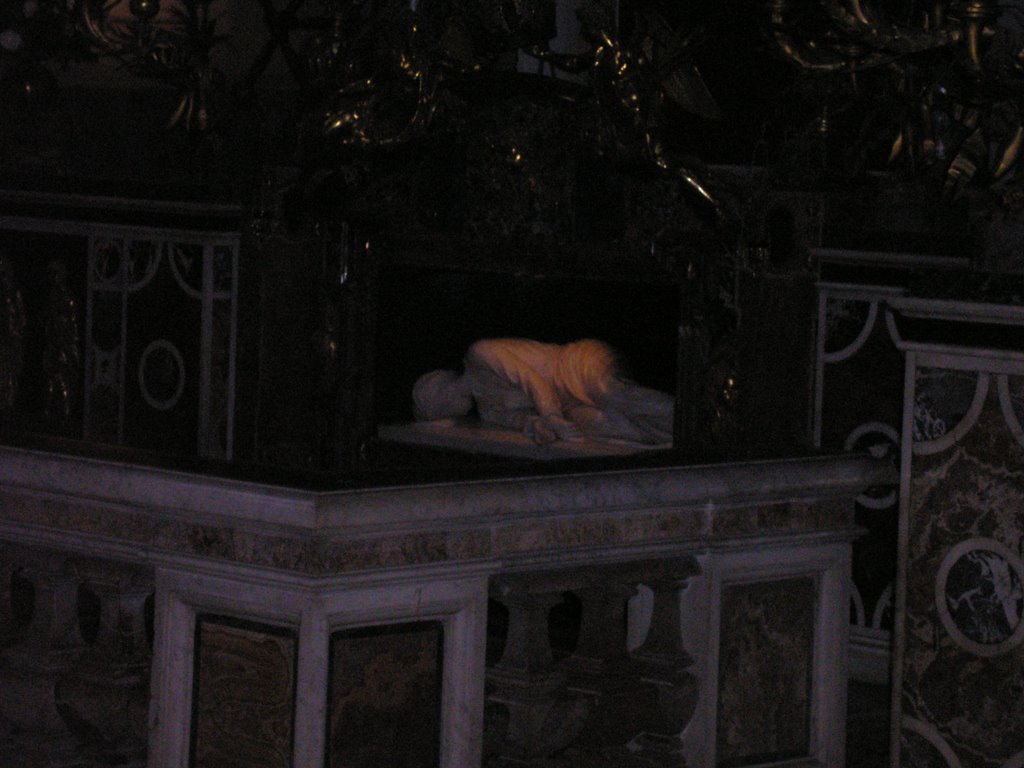
I mentioned Proba and her Cento in these pages recently; her poem, made up of bits of Vergil reorganized to tell the story of Christ, is a fascinating example of Late Antique Christian adaptation and appropriation of the classical past. I think that the statue pictured below demonstrates a similar phenomenon in the visual arts, though this adaptation did not, as far as I know, occur in Late Antiquity–I do not know when it was remade, but I assume that it was perhaps in the Renaissance. The statue sits in the Roman basilica of Santa Croce in Gerusalemme (other names are Basilica Eleniana or Basilica Sessoriana, which claims to preserve fragments of the True Cross as relics brought back from Jerusalem by Constantine’s mother Helena, along with some earth from Calvary. The basilica sits on the grounds of a 3rd-century imperial villa begun by Septimius Severus and completed by Heliogabalus, which served as Helena’s private residence. She is thought to have dedicated a room of the building for Christian worship and, perhaps around a decade later, an atrium of the building was turned into a Christian basilica.

Anyway, back to the statue. This work, found at Ostia, was originally a statue of Juno and was then transformed into a figure of Helena by replacing the head and arms and adding a cross.

*Information for this post was taken from the Blue Guide for Rome, the Guida d’Italia: Roma, and the Eyewitness Travel Guide for Rome.

Friday, February 10, 2006

Sea-monsters Again!

Rogueclassicism may be on to something, as I have come across yet another use of cetus. This is somewhat funny to me, as I haven't been seeking them out and, as I mentioned before, I don't recall seeing the word incredibly often in the past. This use, this time a Latin genitive, is also in reference to Jonah and is found in a speech of Christ in Book 2 of Juvencus. Here are lines 697-9:

Namque propheta cavo quantum sub pectore ceti
temporis absumpsit, terrae in penetralibus altis
progenies hominis tantum demersa manebit.

Thursday, February 09, 2006

Sermones Germanici ... Latine!

My girlfriend is reading Roman satire right now, which currently gets lots of comparisons to hip-hop, thanks largely to Ralph Rosen who I think first made the comparison between iambic poetry and hip-hop.

I like the idea of using Horace's 'sermones' (referring to his satires, especially, but also to his epistles) to translate 'rap' because both words refer to informal speech or compositions which affect informal speech. There's often the pretense that the composition is off the cuff or at least not 'inauthentic,' however that's defined.

There's never a 100% correspondence, but it can be instructive.

Anyway, David Meadows at rogueclassicism linked to a story about some people in Germany who rap in Latin. The story he linked to, and other stories I found on the net, failed to link to the band's site, and with a name like Ista they proved difficult to find.

But here it is, for your amusement: www.ista-latina.de/.

Sound and Sense in Juvencus

In Book 2, lines 433-508, of his Libri Evangeliorum Quattuor, Juvencus places a long discourse of Christ in which he gives His disciples their instructions. Line 462, in a passage in which Christ tells the disciples that they will be persecuted and punished for His sake, includes an excellent example of sound corresponding to sense. The subject matter of the passage is harsh, as Christ mentions specific torments they will suffer, and the ugly sound of the line reflects this well. Here is the couplet 462-3:

Vos flagris vinclisque feris durisque tyrranis
frendens urgebit pro me violentia saecli.

Both lines have a rather heavy feel. The first scans -----^^---^^-x, while the second scans -------^^-^^-x. In 462, every word ends with an 's'-sound (if we discount the copulative -que endings), and the second through sixth words all end in long -is. Moreover, in flagris and feris, the pulse and ictus clash, so that the -is sounds receive a special sort of emphasis (I'm assuming that pulse and accent coincide for vinclisque and durisque due to an accent shift to the penultimate caused by non-elided -que--which reminds me: in Golden Latin Artistry Wilkinson states, I believe, that the question of whether accent shifts in a word containing an elided -que is undecided. That book was pubished in 1963; does anyone know what the current status of that question is?).

Perhaps I'm being fanciful, but I also detect in these slithering 's'-sounds a hint of the serpent, popular since the Garden of Eden as a figure for Satan and an appropriate one to evoke here in the context of the evil punishment of the disciples for the sake of the righteous Christ. If this hint is present, another interesting layer of meaning is added as well by the fact that only four lines earlier Christ had instructed His disciples to be as cunning as serpents (458):
sed vos arguto serpentum corde vigete...

On the Intentional 'Fallacy'

Some comments from James Zetzel, discussing whether Catullus 34 was written as a hymn for performance at an actual religious festival (he thinks it wasn't):

....Even if Catullus 34 were found in an ancient equivalent of "Hymns Ancient and Modern" that would not mean that its religious aspect was primary in its author's intention.

I realize that I am here committing the intentional fallacy, and I am doing so intentionally, because I do not believe that it is a serious critical problem. In any case, given the assumption--and it is an assumption--of poetic intelligence and control of the text, and given the assumption that we are ultimately interested in the poetry and its composition rather than in using it as evidence for something else, a critic must deal not only with what the historical circumstances are, but how the poet uses them; not with the reconstruction of the psychology and emotions of the poet, but with the depiction of them in the poem; not with what the generic conventions are, but how the poet manipulates them.

From 'Roman Romanticism and Other Fables', p. 50, in The Interpretation of Roman Poetry: Empiricism or Hermeneutics? (entire article pp. 41-57)

Wednesday, February 08, 2006

How not to read Latin

I found myself sorely bothered today by technology in classics, but before you write me off as a curmudgeon or a snob hear me out. It won't take long.

I was reading about a program that purports to help you read classical Latin by parsing words, highlighting syntactic units, offering speech bubbles filled with grammatical information pointing to words and clauses -- in short, reading the Latin for you.

I know there's always been a drive to keep up with the Joneses, where the Joneses are other academic disciplines, particularly in the sciences. It's been going on longer than I've been alive. (I remember seeing an old movie as a kid and being puzzled about the conflict faced by the humanities professor whose son had turned to the dark side of math, i.e., science, with which his impractical discipline was ever at odds.)

Anyway, that's no reason to dispense with the time-honored tradition of actually learning how to read Latin. I can hear you saying, 'but this software will help students to learn grammar better and to read sooner!' But it won't.

As it is we're already too dependent upon commentaries. This indicates that we produce translators of Greek and Latin rather than readers. And they're not even passable translators. Why would a person fully capable of walking with a little effort choose to rely on so many crutches?

Teach grammar properly and your students won't require linguistic calculators.

On a related note I've been annoyed lately by the number of teachers who write to a certain mailing list with the most inane questions easily answered by reaching for a grammar or a dictionary. These posts are invariably followed up by a half dozen or so well-intentioned guesses by other teachers who haven't thought to look it up elsewhere than thei Dick and Jane textbook of choice.

Of course I'm being unfair, and of course a lot of meaningful discussion takes place. And of course some people do post references to good grammars.

But the numbers are against them, and teachers who've learned Latin poorly will continue to teach it poorly and will fail to impart to their students any deep familiarity with the tools at their disposal.

They'll just keep on sneaking peeks at translations when their commentaries, cd-roms, and pocket dictionaries fail them.

Tuesday, February 07, 2006

The Sleeping Jonah (Before His Wake-up Call)

In the brief entry in Schanz/Hosius on the anonymous poem De Jona, the author of the poem is praised for his 'originality' and 'blooming imagination' in his description of the storm at sea. Schanz/Hosius then comments that the rest of the narrative is in accordance with the Biblical account: 'Die weitere Erzaehlung schliesst sich an den biblischen Bericht an' (p. 189). This is not entirely correct, however, in one interesting respect. The anonymous poet states that Jonah goes to sleep in the interior of the boat, just as the Biblical account does (et Iona descendit ad interiora navis et dormiebat sopore gravi, Jonah 1:5, Vulg.), but he adds the humanizing and somewhat comic detail that he is snoring through his swollen or puffed up nose:

Nescius haec reus ipse cavo sub fornice puppis
stertens inflata resonabat nare soporem. (53-4)

I also wonder whether there is a play on a double-meaning of inflata here, since the word can also mean 'haughty' or 'proud', which describes fairly well the attitude of Jonah in not wanting the Ninevites to come to repentance (cf. Jonah 3:10-4:2 (NASB): 'When God saw their deeds, that they turned from their wicked way, then God relented concerning the calamity which He had declared He would bring upon them. And He did not do it. But it greatly displeased Jonah and he became angry. He prayed to the LORD and said, "Please LORD, was not this what I said while I was still in my own country? Therefore in order to forestall this I fled to Tarshish, for I knew that You are a gracious and compassionate God, slow to anger and abundant in lovingkindness, and one who relents concerning calamity.').

Monday, February 06, 2006

More on Sea-monsters

Earlier, I inquired about the frequency of the use of cete, which I had come across in Proba's Cento. Bret Mulligan commented that one often finds it in Late Antique exegesis, especially of the Book of Jonah. Today I was reading the anonymous Late Antique poem De Iona Propheta and came across the word again, this time in the singular and spelled with an ending in the Latinized -us instead of Greek -os (interestingly, Lewis' Elementary Latin Dictionary enters the word as cetos, while Lewis & Short uses cetus and puts in parentheses afterwards 'acc. to the Gr. cētŏs).

The anonymous author of De Iona Propheta then uses another word transliterated from Greek in the following line. Here are the two lines in question (85-6):

Iamque illic imo exoriens de gurgite cetus,
squamosum et conchis evolvens corporis agmen...

Wednesday, February 01, 2006

A Few Notes on Hilary of Poitiers

On pp. 204-6 of vol. VIII.4.1 of Schanz/Hosius there is a brief but helpful summary of the poetic work of Hilary of Poitiers, from which the following notes are taken.

Hilary was a writer of hymns--the oldest hymn-poet in the Latin church--yet, for a long time, his actual poetry was unknown. This changed when Gamurrini discovered, in a manuscript of Arezzo, three mutilated hymns attributed to Hilary. None of the three remains in entirety: the first is missing its last four strophes; the second is missing the first five strophes; for the last, the ending is lost, whose length is therefore unable to be determined.

While the first two have in common their abecedarian composition, no two of the three are alike in meter. The first is in Second Asclepiads, the second in iambic senarii, and the third in trochaic tetrameters.

In the second and third hymns the verse-ictus and the accent fall together almost always. The first, however, abides by a different principle, in which Hilary takes great license with quantities: short syllables become long on the beat and long syllables become short on the off-beat (in der Senkung--abatement, countersink, descent, fall).

Tuesday, January 31, 2006

Numerological Redemption?

In his article 'Theory and Practice in the Vergilian Cento' (ICS 9, pp. 79-90), David F. Bright points out (p. 83 and n. 20) that, when the prologue is subtracted, Proba's cento (in which Vergil is Christianized) has exactly 666 lines. I had not noticed this fact; Bright remarks on it because it has bearing on his statistical analysis (the 29-line prologue is only partly centonic). This number, of course, has obvious Christian significance. Here is the Vulgate version of Revelation 13:18 (not the version Proba would have known, but it will at least give us some Latin):

hic sapientia est qui habet intellectum conputet numerum bestiae numerus enim hominis est et numerus eius est sescenti sexaginta sex

It is odd that the fully Vergilian part of the poem is exactly coterminous with the Number of the Beast. Coincidence? Or is Proba here attempting a poetic neutralization, appropration, and 'redemption' of more than just Vergil?

Monday, January 30, 2006

The Survival of Classical Texts (2)

Previously, we noted the importance of Carolingian strongholds in the revival of the copying of ancient texts. But what of England’s part? Reynolds observes that, due to wars and invasions, England had lost most of its collection of literature even as such collections were starting to grow on the Continent.. When England began to rebuild her libraries in the 10th century, it is a sign of the extent of the Continental revival that connoisseurs were aided by texts that had migrated across the water, probably as a result of the influx of Europeans caused by the invasions :

'But crossing the English Channel is always something of a bore, and the gradual restocking of English libraries is one indication of the vigour and success with which classical learning was able to expand its orbit’ (xxxi-xxxii).

Evidence indicates that much more ancient poetry than prose was acquired at this time. Moreover, classical learning continued to pick up steam and rapidly expanded in the century following the Norman Conquest (xxxiv).

As one moves into the 11th century, German and Italian contributions overshadow those of France (xxxii). This trend is especially noteworthy at the Italian monastery of Montecassino:

‘The most remarkable phenomenon is of course the copying at Montecassino within the course of a few decades [of the eleventh century] of a whole clutch of hitherto totally unknown texts’ (xxxiii).

The trend of the revival (though one must take some ups and downs into account) continued upward, especially as another sort of renaissance began in the 12th century. During this time, one may observe a great increase in the amount of books circulating (xxxv). France now again moves (probably) into a position of dominance, ‘though there is strenuous competition from the monasteries of Bavaria and Austria....The Cistercians were a vigorous order and their scriptoria were particularly busy’ (xxxv). The increased volume, however, brought problems of its own: textual corruption. Reynolds points out that

‘[e]ditors do not necessarily look upon the manuscripts of the later Middle Ages with any great enthusiasm. In the case of some authors they will have had a long copying tradition behind them, with its inevitable accumulation and compounding of error and conjecture, and there is now a marked propensity towards arbitrary alteration’ (xxxv).

And, remembering the Norman Conquest, one must not forget the increased activity in England. Reynolds illustrates this point by referring to ‘the breadth of reading of such a writer as William of Malmesbury, who was totally dependent on the books which he could obtain in England’ (xxxvi).

Naturally, such revivals gave birth to an increase in literacy, previously the province, for the most part, of clergy and the powerful (xxxvii). Reynolds states that

‘[t]he putting into circulation of newly discovered works of Latin literature could have a wider impact on taste and culture now that books were coming withing the reach of a reading public’ (xxxvii).

Finally, there are a couple of more things worth remarking upon in the run-up to the capital-r Renaissance. The first is the development of the convenient florilegium, which made a greater amount of Latin literature available in circulation; this occurred at the same time as Latin translations from Greek and Arabic gave access to Aristotelian philosophy and science (xxxvii-xxxviii).

Secondly, the importance of the development of printing cannot be overstated:

‘Although the change was gradual–some of our late manuscripts are copies of printed editions–most Latin authors were available in print by the end of the fifteenth century’ (xlii-xliii).

Sunday, January 29, 2006

Public Finance in 4th century Athens

We've received a request from a reader named George in the UK who is looking for some help with bibliography in the subject above. He would appreciate any help, and I'll direct him to any comments left here.

I can't say that I know a lot (or anything) about the subject, but I imagine a good place to start would be Robin Osborne & Simon Hornblower's Ritual, Finance, Politics: Athenian Democratic Accounts (OUP 1994).

I've recently run across a few articles and things that discuss public finance in 3rd century Delphi under the Aetolian league, and such things seem very specialized. I'd recommend doing some creative searches with L'Année philologique, which your university or (hopefully) one nearby will allow you to access. Off the top of my head I'd guess that BCH (Bulletin de correspondance hellénique) will end up being a good source for inscriptional evidence.

Good luck!

Numismatics again.

Guess what? This post isn't about coins. It's about someone who sells coins spamming our site with ads. I wanted you to know that I'll be deleting all of your disingenuous comments and that they will lead no one to your site. It's really pathetic that you'd take the time to post so many comments with security features in place.

I'll also be enabling comment moderation and promise to stay on top of it so that comments are not delayed.

Saturday, January 28, 2006

Delayed Resolution for the New Year

I resolve to read the other classics blogs with more regularity, starting with David Meadows's rogueclassicism.

And if that means I keep myself from posting what's already been discussed elsewhere, maybe I'll be forced to try harder.

Gow's Housman

Before Saranike and I head out to do a little book hunting I thought I'd recommend A.S.F. Gow's A.E. Housman: a sketch together with a list of his writing and indexes to his classical papers.

Why that long and odd subtitle? Because one condition of Housman's will was that no one ever collect his published papers into a single volume. He evidently didn't want his early work to stand beside what he considered his life's achievments (Manilius, for one).

Gow's sketch is brief (57 pages with the remainder taken by the bibliography and indexes), charming, and allows Housman to speak humbly about himself often. That would appear to some to be a paradox of his character, but it is perfectly reasonable that someone so well-known for his attacks on the intellectual failings and dishonesty of others would appraise himself as a pedant who counted only as one fourth a Bentley or roughly a Porson.

The harshest critic of other was his own harshest critic.

Next on my list is, appropriately, C.O. Brink's English Classical Scholarship: historical reflections on Bentley, Porson, and Housman. Stay tuned.

Our Retired Explorer (Dines With Michel Foucault In Paris, 1961)

Those with a bent toward 'theory' or, alternatively, toward 'interrogating its discourse' (to borrow a few terms) should check out the song by the Weakerthans mentioned in the subject line. Here are the lyrics:

Just one more drink and then I should be on my way home
I'm not enterely sure what your talking about
I've had a really nice time but my dogs need to be fed
I must say that in the right light you look like Shackleton
Comment allez-vous ce soir? Je suis comme ci comme ça
Yes, a penguin taught me French back in Antarctica
Oh, I could show you the way shadows colonize snow
Ice breaking up on the bay off the Lassiter coast
Light failing over the pole as every longitude leads
up to your frost bitten feet oh, you're very sweet
thank you for the flowers and the book by Derrida
But I must be getting back to dear Antarctica
Say, do you have a ship and a dozen able men
That maybe you could lend me?

Oh Antarctica
Oh Antarctica
Oh Antarctica
Oh Antarctica

The lyrics alone without the poppy music don't really do it justice, and maybe others won't find it as amusing as I do, but it does make me chuckle to think of a frost-bitten, earthy, hardened old explorer chatting with Foucault about Derrida and icebergs until he has to go home to let his dogs out.

Typhoid Melanippe?

One of our field agents who goes by the name 'the Hawk' tipped us off to this Scientific American story about DNA used to identify the plague at Athens during the Peloponnesian War as Typhoid Fever:

More than 2,000 years ago, a plague gripped the Greek city of Athens. Ultimately, as much as a third of the population succumbed and the devastation, which helped Sparta gain the upper hand in the nearly 30-year-long war between the city-states. That much Thucydides--an ancient historian, general in the war and plague victim who recovered--conveys in his History of the Peloponnesian War. But he did not leave a precise enough description to decide definitively whether the disease was bubonic plague, smallpox or a host of other ailments. Now DNA collected from teeth in an ancient burial pit points to typhoid fever.


Typhus has been identified in the past as a top contender, as it has been on Indiana's Asclepion page, dedicated to the study of ancient medicine. Be on the look out for new articles supporting or refuting the findings in your favorite journals. And who knows ... maybe today we'll even see it in blogs.

Tuesday, January 24, 2006

The Survival of Classical Texts

In the introduction to Texts and Transmission, L.D. Reynolds helpfully illustrates the contraction and expansion of classical texts from antiquity through the Dark Ages and into the Middle Ages with the figure of the hourglass, in which the slender middle represents the almost total disappearance of classical culture from the intellectual scene during the period running from roughly 550-750 A.D. The lack of activity with respect to texts of Vergil illustrates this point. Reynolds notes that

‘[o]f the 16 manuscripts of Rome’s national poet to have survived from late Antiquity and the early Middle Ages, 6 are attributed to the fourth century, 5 to the fifth, 3 to c.500; then we have nothing until the late eighth century’ (xvi).

Antique and Late Antique laborers were responsible for other tasks, too, which would aid in the resurgence of classical learning in the wake of the Dark Ages, since their craftsmen developed the techniques widely used for book-making:
‘By the fifth century the roll had given way to the codex, a form of book which has never been superseded. Although the change of format had by now yielded to parchment, which was much more durable and not subject to the monopoly of the Middle East; it could be manufactured wherever there were cows and sheep and goats. The beautiful uncial script was firmly established, as was the first minuscule book-hand, half-uncial. All the arts essential to the making of books as the Middle Ages knew them were fully developed’ (xv).

For the Carolingian revival to be possible, of course, texts were needed. Reynolds conjectures that Italy was probably most responsible for the influx of texts in the north. As he states,
‘If we turn to Italy, the results are much more positive; the movement of books northwards over the Alps can be amply documented. It began long before the Carolingian period, as books were attracted to the powerful monastic foundations of northern Europe....When we come to the Carolingian period and manuscript traditions begin to blossom forth in profusion, the chances are that many of their archetypes were books imported from Italy. This is of course often impossible to prove; but it is not unreasonable to assume that many of the texts had indeed travelled by the prevailing wind’ (xxi-xxii)

The most important city for this could well have been Ravenna, since it had remained a political and cultural power into the sixth century (xxiii).

The Caronlingian revival, the first such major revival of interest in classical literature to occur in the Middle Ages, lasted for approximately 100 years, spanning the ninth century. Its major achievement was one of consolidation, and the court and monasteries played the major role (xxv):
‘The fundamental function of the Carolingian revival in the transmission of our texts was to gather in what could be found of the literature and learning of the past and generate from it the new medieval traditions which would carry the classics through the centuries’ (xxiv)

By the end of the ninth century, in fact, most of what we now possess of classical literature 'had...been copied and was enjoying some degree of circulation, however limited, localized, or precarious it may in some cases have been’ (xxvii-xxviii).

An important factor in the success of the promulgation of these texts was the development of a clear and readable script, the Carolingian minuscule. Indeed, regions of the Empire that did not use this script were not nearly as influential as those that did:
‘The comparative illegibility of ‘national’ hands might help to account for the relatively modest contribution of Ireland and Spain and the slowness with which texts written in Beneventan percolated from their base in the south of Italy...’ (xxviii).

In the years following the Carolingian reflorescence, copying activity likely began to be concentrated in the south and west. Reynolds remarks that
‘Two-thirds of the ninth-century manuscripts mentioned in this book were written in what we now know as France....[A]mid all this flux and reflux it is perhaps not too fanciful to sense a general drift towards the south and west, as the deposits of texts built up at the Carolingian court and in the abbeys of western Germany and north-eastern France were carried to other regions, where, sooner or later, they would help to stimulate fresh revivals of classical learning’ (xxix).

Monday, January 23, 2006

On Theoretical Jargon

'Modern American theorists are products of the U.S. educational system: rarely do they master a foreign language. Perhaps that is why they have invented their own.'

--Karl Galinsky, in 'Introduction: The Current State of the Interpretation of Roman Poetry and the Contemporary Critical Scene' (p. 24) (from The Interpretation of Roman Poetry: Empiricism or Hermeneutics?, K. Galinsky, ed.)

Thursday, January 19, 2006

An Uncommon Word?

While I was reading Proba's Cento today, I came across the half-line

facies inmania cete,


which is from Aeneid 5.22. I had to look cete up--it's a neuter plural from the noun cetos (the 'e' is long) and is a direct transliteration of the Greek noun khtos (with 'h' representing eta--sorry, no Greek font), and means 'a sea-monster'. I only have Lewis' Elementary Latin Dictionary in front of me right now, and Vergil is the only classical author cited as having used this noun, which is where Proba got it from, as I mentioned above. Does anyone recall seeing this noun used elsewhere by classical or late antique authors?

Saturday, January 14, 2006

Golden Latin Artistry

I decided recently to read through L.P. Wilkinson's book Golden Latin Artistry straight through to get an idea of the book as a whole and to re-introduce myself, as it were, to Latin verse and prose.

As it turned out, some aspects of the book were not even re-introductions for me, but introductions, and I especially include here the extensive and helpful discussions of prose rhythm. In this section, as in the others, Wilkinson demonstrates a remarkable knack for synthesizing ancient evidence from Aristotle, Cicero, and sundry grammarians, along with modern discussions representing a potpourri of languages and spanning the long range of scholarship from the 18th century to his own contemporary day.

The three parts of the book are: 'Sounds', subdivided into 'Pronunciation', 'Verbal Music', and 'Expressiveness'; 'Rhythms', subdivided into 'Verse Rhythm' and 'Prose Rhythm'; and 'Structure', subdivided into 'Periodic Prose' and 'Architectonics of Verse'. He closes with two appendices, 'Rival Theories to the Pulse-Accent Theory of Latin Dactylic Verse' and 'Some Modern Theories of Latin Prose Rhythm'.

The concerns of the book are largely formal, and often touch on topics which lend themselves to subjectivity. Throughout, however, Wilkinson displays an admirable level-headedness and restraint in presenting his views. His baseline standard with which to make judgments seems to be what he calls 'aesthetic principles'. Sometimes these principles could be better defined, but most of the time, I think, the reader has a fairly good idea of what he is referring to.

In addition to his survey of prose rhythm, probably most helpful was his discussion of the 'Pulse-Accent theory' of dactylic verse. Though I don't know much about this outside of what I read in this book, I found it rather convincing.

It is my observation that this book should be required reading for every student of Latin literature. The discussions are lucid, accessible, well-stocked with examples, and give a very solid introduction to the formal features one should look for when reading the Latin classics. His style is warm and engaging, and the broad scope of the book combined with its thorough discussion will continue to give Golden Latin Artistry a great deal of staying power. For these reasons, I must disagree with J.P. Elder, who states in his heartily endorsing review that Golden Latin Artistry is not an important book, but is a very good one. Because of its usefulness and clarity, GLA strikes me as indispensable both for Latin literary pedagogy and, more generally, for Latin literary appreciation.

I close with a passage from 'Appendix 1' on hexameter caesuras that demonstrates Wilkinson's enjoyable style:

Lucian Mueller opined that the 'strong' (2 1/2) caesura, as in

Bella per Emathios//plus quam civilia campos,

was preferred by the Romans because it came as nearly as possible in the middle of the line (yet the 2 3/4 caesure is still nearer, and was preferred by many of the Greeks; and 3, which would be exactly in the middle, is avoided by all); also because the first member (if dactylic) would, if repeated, make a pentameter, 'second only among the pure jewels that compose the crown of Greek metres'; for example,

Bella per Emathios bella per Emathios;

and thirdly, because the second resultant memeber was in itself a metrical line, the paroemiac, 'which shines with an elegance of its own'; for example,

plus quam civilia campos.

He might just as well have said that he did not know the reason.

Thursday, January 12, 2006

Spit and polish

I got tired of Athena so the Campus has undergone a very slight renovation.

As far as genuine content to add to the site, well, there really should be some, shouldn't there? We can chalk our lack of posts up to diligence in the execution of our scholarly obligations, but those activities should spawn posts, not prevent them.

I used a Borders gift which I'd gotten for Christmas to order C.O. Brink's English Classical Scholarship. This appears to argue that 19th century German philologists were following a British tradition which grew out of the Renaissance, but that, after a period of stagnation, came home again in the work of A.E. Housman. I haven't read it yet, but I'll post about it when I do. In addition to my thesis and tutoring I've been reading a number of things in and outside of classics, including the Iliad in Greek, Bonfire of the Humanities, some novels by the late Saul Bellow, Maurois's biography of Disraeli, and lots of Mark Twain.

For my thesis I've been reading on everything from ancient medicine to the history of Byzantine scholarship.

So I'll try to have something substantive to contribute here soon.

Wednesday, January 04, 2006

Items of Interest

A couple of things of note from Ross Holloway's article in the most recent newsletter of the Classical Society of the American Academy in Rome:

[A]cross the remains of medieval and later Rome brought to light in the recent excavations in the Forum of Trajan, there is even more recent news, the discovery of an over-life-size marble head of the Emperor Constantine in the main sewer under the Forum. In making announcement of the find the mayor of Rome, Walter Veltroni, remarked that the sculpture was not in the sewer by chance but had been put there deliberately. Damnatio memoriae or even crimen maiestatis, if Constantine were alive when the head was decapitated from the statue it once adorned and flushed? Walter Veltroni goes for the second explanation, recalling Constantine's unhappy return to Rome in 326 when, according to Zozimus, he had to retreat from the city followed by hoots and cat calls. I'm with him (for more on the subject see Orizzonti IV, 2004). The sculpture could have had a pracical use in the sewer...as a heavy mop dragged through the sewer to assist in cleaning it, but this possibility begs the question of how an imperial image came to be relegated to the sewer in the first place.

[...]

But of all archaeological work in Rome filled with a sense of anticipation perhaps the most fascinating is the investigations being carried out at the basilica of S. Paolo Fuori le Mura by archaeologists from the Vatican Museums under the direction of Dr. Giorgio Filippi. Below the high altar of the basilica and the stone with the inscription "Paolo Apostolo Mart" this work has revealed an intact sarcophagus. Its cover has a small opening creating a cataract through which strips of cloth could have been lowered to touch the saintly remains within. It appears more than likely that the remains venerated as those of the Apostle in the fourth century A.D. will indeed be brought to light. The sarcophagus is not in the position that it would have occupied in the Constantinian basilica because the building was thoroughly remade after his time, but it has evidently occupied its current position since the time of Theodosius the Great.

Tuesday, December 27, 2005

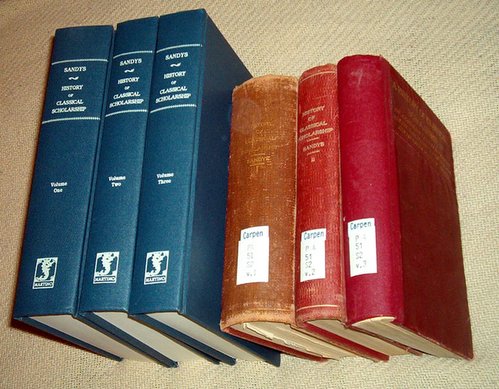
Sandys's History of Classical Scholarship


LEFT: My brand spanking new copy. RIGHT: the library's old copy, which is yellowed and falling apart.

This is what I asked of my parents for Christmas this year: a facsimile edition of John Edwin Sandys's A History of Classical Scholarship. I opted for the facsimile because it's printed on better paper and is more durably bound. This set was done by Martino Publishing in partnership with Krown and Spellman, booksellers. Krown & Spellman sell it for $165 + $5 per book shipping USPS. The edition which Martino offers on their site, apparently not in connection with Krown & Spellman, is listed at $195.

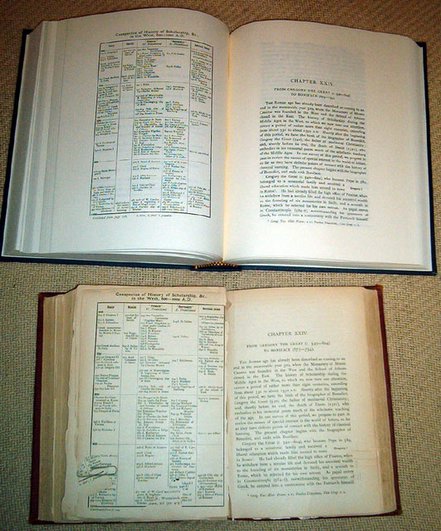
The only weakness of the facsimile is the quality of the illustrations, mostly portraits of classical scholars. The differences from the original did not photograph well, but it's something like a very good photocopy: no gray tones, some loss of detail, but nothing to cry about. Posted by Picasa

Here are some more comparisons:
 
 Posted by Picasa

 
 Posted by Picasa

Saturday, December 10, 2005

Plato's Motto

A question was sent out to a Latin teacher's list about Plato's motto, which a sender's colleague in math wanted to put above his door. Michael Hendry of Curculio remembered the first word of the Greek and replied with the quote and the citation as given in the LSJ.

I was intrigued and did a little reading via TLG, responding with what follows, though without the Greek, as e-mail still tends to revert to 7-bit ASCII, even in the 21st century. (The translations are mine):


The scholiast on Aelius Aristides 125.14 (Dindorf, Vol. 3) says the following:
ἐπεγέγραπτο ἔμπροσθεν τῆς διατριβῆς τοῦ Πλάτωνος ὅτι ἀγεωμέτρητος μηδεὶς εἰσίτω· ἀντὶ τοῦ ἄνισος καὶ ἄδικος. ἡ γὰρ γεωμετρία τὴν ἰσότητα καὶ τὴν δικαιοσύνην τηρεῖ.
'In front of Plato's school had been inscribed, "Let noone enter un-geometried" rather than "unequal" or "unjust," for geometry maintains equality and justness.'
I assume geometry was among the lower mathematical pursuits required for the study of philosophy, and it seems plausible that Plato would have framed its usefullness in terms of qualities of the soul.

At any rate, Pseudo-Galen (post 2 A.D.?) quotes the phrase at the beginning of 'On the divisions of philosophy,' and makes geometry a preliminary to theology:
ὁ μὲν οὖν Πλάτων εἰς φυσιολογικὸν καὶ θεολογικὸν αὐτὸ διαιρεῖ· τὸ γὰρ μαθηματικὸν οὐκ ἠβούλετο εἶναι μέρος τῆς φιλοσοφίας, ἀλλὰ προγύμνασμά τι ὥσπερ ἡ γραμματικὴ καὶ ἡ ῥητορική· ὅθεν καὶ πρὸ τοῦ ἀκροατηρίου τοῦ οἰκείου ἐπέγραψεν ‘ἀγεωμέτρητος μηδεὶς εἰσίτω’. τοῦτο δὲ ὁ Πλάτων ἐπέγραφεν, ἐπειδὴ εἰς τὰ πολλὰ θεολογεῖ καὶ περὶ θεολογίαν καταγίνεται· συμβάλλεται δὲ εἰς εἴδησιν τῆς θεολογίας τὸ μαθηματικόν, οὗτινός ἐστιν ἡ γεωμετρία.
'Plato divided it (theoretical philosophy) into physiology and theology. In fact, he did not want mathematics to be a part of philosophy, but a sort of progymnasma like grammar and rhetoric. That's why, before his private lecture-room, he inscribed "Let no one enter un-geometried." He inscribed this since he discoursed on theology in all matters and dwelt on theology, and included mathematics, of which geometry is a part, into theology's forms of knowledge.'

I like the notion that it wasn't the school but rather Plato's personal lecture space, and that the teacher wants to hang it above the door to his own classroom.

As one of my old humanities professors used to say in his booming baritone, 'mathematics is gymnastics for the mind!'

Tuesday, December 06, 2005

A note on translation

I have the utmost respect for the work of A.S.F. Gow and A.F. Scholfield, but I always find myself feeling that their translation does a grave disservice to Nicander, especially for those who don't have the Greek or the time (or the inclination) to work through the Greek.

Here's just one example, and not the most egregious, of a style of translation that aims at 'meaning' (which is subjective) while ignoring the manner of expression. It's the introduction to Nicander's extensive catalogue of snakes, following the recipes for various repellents including incense and balms for the skin (Theriaca 115-120):

Εἰ δέ που ἐν δακέεσσιν ἀφαρμάκτῳ χροῒ κύρσῃς
ἄκμηνος σίτων, ὅτε δὴ κακὸν ἄνδρας ἰάπτει,
αἶψά κεν ἡμετέρῃσιν ἐρωήσειας ἐφετμαῖς.
τῶν ἤτοι θήλεια παλίγκοτος ἀντομένοισι
δάχματι, πλειοτέρη δὲ καὶ ὁλκαίην ἐπὶ σειρήν·
τοὔνεκα καὶ θανάτοιο θοώτερος ἵξεται αἶσα.


Gow-Scholfield:
But if you should chance to come upon biting creatures when your skin is unmedicated and you are fasting--that is the time when disaster strikes a man--you may readily save yourself by our precepts. It is the Female Snake that attacks with its bite those who encounter it; besides, it is thicker right down to the trailing tail, and for that reason the doom of death will come more swiftly.


But this is what it says:

But if by chance, with flesh unanointed, you meet with noxious beasts, having gone long without food (that's when evil harms men!), forthwith could you rush forth by our commands.

Now, of these the female is doubly wrathful to those who meet with her bite, and she is more full even in her trailing cord (i.e., tail). And for this reason destiny shall come as a rather swift sort of death.


One of the keys to Nicander's poetic imagery is readily evident: going without food. Most everyone takes this to mean 'fasting.' Jean-Marie Jacques in his Budé edition makes an effort to explain why it's worse to be bitten on an empty stomach, but even if this is a legitimate point it ignores the poetic function. Compare Iliad 19.163 with the same phrase in the same sedes (with gen. sg.; N. has pl.). Odysseus is beseeching Achilles to allow the Achaeans to eat before battle, and argues that no man, no matter how up to the fight, has the strength to go on at the end of the day without food.

The image is then one of battle, and Nicander wants us to read the lines in this way, with the addressee as the weary soldier at the behest of his commander. He's too weak on his own, but there's hope for a fighting chance in the special knowledge which Nicander has to impart. The imagery is maintained (e.g., ἄντομαι is common of meeting in battle).

The problem with the Gow-Scholfield translation is that it obscures what's poetic in Nicander in pursuit of clarifying what is supposed to be 'scientific' or 'substantive.'

Another problem, though, is that inattentiveness to the stylistic effects has also obscured some interesting stuff in the syntax. Among these is the masculine adjective θοώτερος seemingly agreeing with αἶσα. Jacques explains this as syllepsis because θανάτοιο αἶσα = θάνατος. But cf. also Smyth 1050 where a predicate adjective in the superlative often agrees with a dependent genitive. It's a small step to the comparative.

I don't pretend to have given an elegant translation. It was was written on the spot for the purpose of this post. But I think it's important to retain the imagery and spirit of verse, and to use the vocabulary of verse, which is a different thing from that of prose though the lines are often blurred today. I think in reading the two my version seems more lively and stylized, has the feeling of interested instruction and genuine threat. At the very least it seems more like the Greek to me than the other.

But now I must needs eat some pasta lest I fall upon a nest of vipers undernourished!

Friday, December 02, 2005

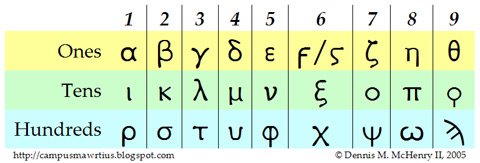
Greek Numerals - Easy as AIR

I'm still trying to get the hang of posting images with Google's Hello, but after seven attempts here's a little jpeg I made to demonstrate Greek numerals. (I came up with this while covering a study hall as a sub.)


Greek Numerals Posted by Picasa

The system incorporates 27 characters from the archaic alphabet, which means the inclusion of digamma (or sometimes stigma), koppa, and sampi. You'll notice that digamma (based on semitic wau) looks similar to and occupies the same position as Latin f. Likewise, koppa with Latin q.

Using this chart is fairly simple. The mnemonic AIR (alpha, iota, rho : αιρ) will help you to remember that these three character represent one, ten, and one hundred. Since there are 27 charαcters, or 9 each for ones, tens, and hundreds, the system allows for numbers as high as 999 (sampi koppa theta).

Numerals are normally marked by a stroke to the upper right (α' = 1), but multiples of 1000 are marked by a stroke to the lower left (,α = 1000).

Remember that these are all multiples: iota is 1 times 10 (10), kappa is 2 times 10 (20). 11 would be iota alpha (ια'), and 12 would be iota beta (ιβ').

Who knew it was that easy?

Browsing at the New Acquisitions Table

As the title states, I was just browsing at the new acquisitions table in the library. I noticed that they had the Bude addition of the Theriaka. Dennis: I'm assuming you have that available to you, but if not, let me know and I can copy any relevant sections for you. I also saw a fairly recent (2002) book by W. Clausen on the Aeneid with which I'm not familiar and whose subtitle is 'Decorum, Allusion, and Ideology'. Has anyone read any of it? Thoughts? For any Bryn Mawr readers in the Aeneid seminar: have you come across this book?

A couple other things of interest to me were a book on the 3rd century persecutions of Decius and Valerian and another collection called Early Christian Families in Context.

Monday, November 28, 2005

And Speaking of Solidi...

...Sarah brings us a link to a pucker-faced Honorius solidus, worth reproducing here:

Friday, November 25, 2005

No Direction Home

I saw one of the best correctives I've come across in a while to academic extravagance in mountain-out-of-a-molehill-making (often in evidence in my own papers) while watching part two of Scorsese's recent Bob Dylan bio-pic No Direction Home. During the footage of a 1965 press conference in San Francisco, a reporter tries to inquire into the 'significance' of the Triumph Motorcycle t-shirt he is wearing on the cover of Highway 61 Revisited, telling him that there is a 'philosophy' embedded in it. Dylan's response is to laugh and tell the reporter he hasn't really spent a lot of time looking at it (the reporter says he has spent a lot of time looking at it) and says it was just a picture somebody took one day while he was sitting on the steps.

Not one to give up, the reporter asks if he can talk about the meaning of the motorcycle image in his song-writing. Dylan's only response to this is, 'Well, we all like motorcycles, don't we?', or something to that effect.

The moral of this story is: sometimes a t-shirt is just a t-shirt. I have to remind myself of that sometimes, when puzzling over individual words in a poem and attempting to make an entire interpretation hang on what, to the author, might have been a rather insignificant detail. That doesn't mean these details are always insignificant, but it seems good at least to pause over them, to take a step back and ask the more general questions: does this interpretation I'm gleaning from this one word make sense in the broader scope of the poem? How does it fit in with the whole body of data I'm working with? Would the author have used the word in this way and with this significance? What is his normal practice? How does he mark what is important and what is not in his poem, if at all? Am I foisting my own intent on the author, trying to make a square poem fit in a round hole, as it were? Or does it cohere with the rest of the work?

Ok. I'm done babbling. But it is always nice to find a reminder in a surprising place which causes some reflection on the pitfalls of interpretation--one which pulls me for a moment from the hermetically-sealed bubble in which I often attempt to work with ancient texts out into the wider world.

M-W's Word of the Day for All Y'all Late Antique and Numismatic Types

solidus \SAH-luh-dus\ noun

1 : an ancient Roman gold coin introduced by Constantine and used to the fall of the Byzantine Empire
*2 : a mark / used typically to denote "or" (as in and/or), "and or" (as in straggler/deserter), or "per" (as in feet/second)

Example sentence:
In her latest thriller, the author manipulates her readers into believing there are two killers until the final page, where she connects their two names with a solidus.

Did you know?
Call it a solidus, or call it a slash/diagonal/slant/virgule — whatever you call it, you are bound to run into this useful mark with some regularity. These days, one place the mark is commonly seen is in Internet addresses (http://www.merriam-webster.com/cgi-bin/mwwod.pl, for example), but the history of the word "solidus" takes us back to a time well before computers. The ancient Roman emperor Constantine the Great borrowed the Latin term for "solid" ("solidus") for the gold coin that was the successor to the aureus. And in Medieval Latin, "solidus" designated the shilling. Before the introduction of decimal coinage, abbreviations of the shilling ("s," "sh," or "shil") were used. Eventually, the abbreviations were replaced with the simple symbol "/," which became known as a solidus.

*Indicates the sense illustrated in the example sentence.

I never knew that the mark '/' was called a solidus. So perhaps now we should begin saying things such as 'The web address is aitch tee tee pee colon solidus solidus...'?

Thursday, November 24, 2005

Milton as a Reader of Nicander

In Milton's essay Of Education we learn that if only we should teach children, in addition to the usual arts and sciences, 'the helpful experience of hunters, fowlers, fisherman, shepherds, gardners, apothecaries,' then 'those poets which are now counted most hard will be both facile and pleasant: Orpheus, Hesiod, Theocritus, Aratus, Nicander, Oppian, Dionysius, and in Latin, Lucretius, Manilius, and the rural part of Virgil.'

It comes as no surprise then when we find Nicander creeping up in book X of Paradise Lost. Satan has returned triumphantly to Hell and makes a self-congratulatory speech which doesn't go over quite so well. Note, particularly, the list of snakes, which even includes a scorpion, from verses 524-529:

504    So having said, awhile he stood expecting
505    Their universal shout and high applause
506    To fill his ear; when, contrary, he hears
507    On all sides from innumerable tongues
508    A dismal universal hiss, the sound
509    Of public scorn. He wonder'd, but not long
510    Had leisure, wond'ring at himself now more:
511    His visage drawn he felt to sharp and spare,
512    His arms clung to his ribs, his legs entwining
513    Each other till, supplanted, down he fell
514    A monstrous serpent on his belly prone,
515    Reluctant but in vain: a greater power
516    Now rul'd him, punish'd in the shape he sinn'd,
517    According to his doom. He would have spoke,
518    But hiss for hiss return'd with forked tongue
519    To forked tongue; for now were all transform'd
520    Alike, to serpents all, as accessories
521    To his bold riot. Dreadful was the din
522    Of hissing through the hall, thick-swarming now
523    With complicated monsters, head and tail:
524    Scorpion and asp and amphisbaena dire,
525    Cerastes horn'd, hydrus, and ellops drear,
526    And dipsas (not so thick swarm'd once the soil
527    Bedropp'd with blood of Gorgon, or the isle
528    Ophiusa); but still greatest he, the midst,
529    Now dragon grown, larger than whom the sun
530    Engender'd in the Pythian vale on slime,
531    Huge Python; and his power no less he seem'd
532    Above the rest still to retain. They all
533    Him follow'd, issuing forth to th' open field,
534    Where all yet left of that revolted rout,
535    Heav'n-fall'n, in station stood or just array,
536    Sublime with expectation when to see
537    In triumph issuing forth their glorious Chief.
538    They saw, but other sight instead--a crowd
539    Of ugly serpents. Horror on them fell,
540    And horrid sympathy; for what they saw
541    They felt themselves now changing. Down their arms,
542    Down fell both spear and shield, down they as fast;
543    And the dire hiss renew'd, and the dire form
544    Catch'd by contagion, like in punishment
545    As in their crime. Thus was th' applause they meant
546    Turn'd to exploding hiss, triumph to shame
547    Cast on themselves from their own mouths. There stood
548    A grove hard by, sprung up with this their change
549    (His will who reigns above) to aggravate
550    Their penance, laden with fair fruit, like that
551    Which grew in Paradise, the bait of Eve
552    Us'd by the Tempter. ...

Milton has clearly read Apollonius, Nicander, and Lucan.

If only more of us had been educated in his manner, we'd more easily see the allusion.

Wednesday, November 23, 2005

D gets in on the book action

Here are all (I think all) of my book finds for the past month:

  • 101 Puzzles in Thought and Logic (Math & Logic Puzzles), C. R. Wylie
  • ABC of atoms, Bertrand Russell
  • American Heritage dictionary of idioms, Christine Ammer
  • Anthology of Latin poetry, Robert Yelverston Tyrell
  • Brideshead revisited, Evelyn Waugh
  • Byzantium and Europe, Speros Vryonis
  • Cassell's Italian dictionary,
  • The Charioteer, Mary Renault
  • The Cherry orchard a comedy, Anton Pavlovich Chekhov
  • Christmas holiday, W. Somerset Maugham
  • Classical hand-list;, John Arbuthnot Nairn
  • The classical heritage and its beneficiaries, R. R. Bolgar
  • A clerk of Oxenford; essays on literature and life, Gilbert Highet
  • The crown the Philippics and ten other orations, Demosthenes
  • Das Nibelungenlied,
  • De l'Institution des Enfants, Essais, liv. I, chap. xxv, Michel de Montaigne
  • Dean's December, Saul Bellow
  • Deutscher lehrgang, Eduard Prokosch
  • A dictionary of economics, John Black
  • Dictionary of historical terms, Chris Cook
  • A dictionary of linguistics, Mario Pei
  • Did you ever see a dream walking? American conservative thought in the twentieth century, William F. Buckley
  • Dutch vocabulary, B. C. Donaldson
  • The education of Henry Adams, Henry Adams
  • The eleven comedies, Aristophanes
  • The empire of reason : how Europe imagined and America realized the enlightenment, Henry Steele Commager
  • End of History and the Last Man, Francis Fukuyama
  • The end of racism : principles for a multiracial society, Dinesh D'Souza
  • English stress; its form, its growth, and its role in verse, Morris Halle
  • The essays of Michel de Montaigne, Michel de Montaigne
  • Framley parsonage, Anthony Trollope
  • Frankenstein, Mary Shelley
  • French Revolution: a history, Thomas Carlyle
  • Goethe, J.-F. Angelloz
  • Golden lion of Granpere, Anthony Trollope
  • Graphically speaking : an illustrated guide to the working language of design and printing, Mark Beach
  • Greek: A Complete Course for Beginners (Teach Yourself Books), Aristarhos Matsukus
  • A handbook of Greek mythology including its extension to Rome, H. J. Rose
  • Henderson, the rain king, Saul Bellow
  • Herzog, Saul Bellow
  • Histoire de l'eloquence latine depuis l'origine de Rome jusqu'à Ciceron, Victor Cucheval
  • Histoire de l'éloquence romaine depuis la mort de Cicéron jusqu'à l'avènement de l'emper, Victor. [from old catalog] Cucheval
  • Histoire des oracles Du bonheur. Essai sur l'histoire. Dialogues des morts, Fontenelle, M. de
  • Historians' fallacies; toward a logic of historical thought, David Hackett Fischer
  • A history of Greece to the death of Alexander the Great, J. B. Bury
  • A history of private life, (vols. 1 & 2)
  • The house of intellect, Jacques Barzun
  • Humboldt's gift, Saul Bellow
  • An introduction to linguistic science, Edgar H. Sturtevant
  • An introduction to Roman history, literature, and antiquities, Alexander Petrie
  • Johnson's London; selected source materials for freshman research papers, Roland Bartel
  • La guerre civile la pharsale . tome 1, livres I-V, texte établi par a. bourgery., Lucain
  • Langenscheidt's new college German dictionary,
  • Latter-day pamphlets, Thomas Carlyle
  • Le Symbolisme dans la mythologie grecque, Paul Diel
  • Learning to look; a handbook for the visual arts, Joshua Charles Taylor
  • Les Phéniciens et l'Odyssée, Victor Bérard
  • Liberal education (Beacon paperback no. 86), Mark Van Doren
  • The life and strange surprising adventures of Robinson Crusoe, Daniel Defoe
  • Linguaphone; introduction to Russian grammar,
  • Lucky Jim, Kingsley Amis
  • Man's unconquerable mind; studies of English writers, Raymond Wilson Chambers
  • Method of philological study of the English language, Francis Andrew March
  • Michelet oeuvres choisies, Gaillard H.
  • The natural, Bernard Malamud
  • A new introduction to Greek, Alston Hurd Chase
  • A new Russian grammar in two parts, Anna Hering Semeonoff
  • Nieuw volledig Engelsch-Nederlandsch en Nederlandsch-Engelsch woordenboek, I. M. Calisch
  • Notre-Dame de Paris, Victor Hugo
  • Oeuvres, François Rabelais
  • Official Scrabble Players Dictionary,
  • On heroes, hero-worship, and the heroic in history, Thomas Carlyle
  • Patriotic gore; studies in the literature of the American Civil War, Edmund Wilson
  • Pensées de Pascal, Blaise Pascal
  • Point Counter Point, Aldous Huxley
  • The rights of woman, Mary Wollstonecraft
  • Samuel Johnson, John Wain
  • Say It In French: Phrase Book for Travelers, Leon J. Cohen
  • The small house at Allington, Anthony Trollope
  • Songwriting : a complete guide to the craft, Stephen Citron
  • Source readings in music history from classical antiquity through the romantic era, W. Oliver Strunk
  • The story of Apollonius, King of Tyre : a study of its Greek origin and an edition of the two oldest Latin recensions, G. A. A. Kortekaas
  • The story of philosophy; the lives and opinions of the greater philosophers, Will Durant
  • The synonym finder, J. I. Rodale
  • Thomas Mann: profile and perspectives with two unpublished letters and a chronological list of important events, André Von Gronicka
  • Three comedies: The circle, Our betters, The constant wife, W. Somerset Maugham
  • To Jerusalem and back a personal account, Saul Bellow
  • The voyage of the Beagle, Charles Darwin
  • The way of all flesh, Samuel Butler
  • Winnie ille Pu, A. A. Milne

Wow ... an even 90. And I paid about $30 for the lot.

MORE: Eric ... do you think the W. Oliver Strunk who wrote Source readings in music history from classical antiquity through the romantic era is your Oliver Strunk?

More on 'd.d.'

Caelestis suggests below that the abbreviation stands for 'donum dat/dedit'. I was looking through the epigraphy book mentioned below and have found some confirming evidence. In it is reproduced an inscription from an obelisk in Rome:

IMP.CAESAR.DIVI.F
AVGVSTVS
PONTIFEX.MAXIMUS
IMP.XII.COS.XI.TRIB.POT.XIV
AEGVPTO.INPOTESTATEM
POPVLI.ROMANI.REDACTA
SOLI.DONVM.DEDIT
And here are a few more abbreviations (the second of which lends support to Dennis' suggestion 'dedit') listed in chapter 7 employing the letter 'D':
D: dat
D, D.D: dedit
D, DED, DD: dedicavit
D.D.D: dedit idemque dedicavit
D.D: dono dedit (is dono some sort of predicative dative here? Or is this a parallel construction to one in which we would find the accusative of the person and the ablative of the thing (cf. Allen & Greenough 225d)?)

Book Buys 2

Ok, so today I returned to the book sale and stuck more to the task at hand (which is not to say that I still didn't have a few divergences). Thankfully there were still some items of interest that I hadn't noticed yesterday, and some that I had, but put off getting.

Bloch, Raymon. L'epigraphie latine (in the 'que sais-je?' series).
Brueder Grimm. Kinder- und Hausmaerchen.
Christ, W., and M. Paranakis. Anthologia Graeca Carminum Christianorum (Hildesheim 1963).
Dickens, Charles. The Life of Our Lord (the title of the work in the original manuscript written for his own children is The History of Our Saviour Jesus Christ).
Dolan, John P., ed. and trans. The Essential Erasmus.
Fraser, W.H., and J. Square. Heath's Practical French Grammar.
Friend, A.M., Jr. The Portraits of the Evangelists in Greek and Latin Manuscripts (reprinted from Art Studies: 1927).
Lateinische Gedichte Deutscher Humanisten (Lateinisch/Deutsch).
Lawall, Gilbert. Theocritus' Coan Pastorals: A Poetry Book.
Langenscheidt's German-English/English-German Dictionary.
Lesky, Albin. Die Tragische Dichtung Der Hellenen (paperback).
Porphyry. Peri Apochhs Empsuchwn (De l'abstinence), tome 1, livre 1 in the Bude series, edited with French translation by Jean Bouffartigue.
Waugh, Evelyn. Black Mischief.

Ok, so maybe I went a little overboard. But I was given the advice previously to build the library (Field of Dreams style?...Well, maybe not).

Tuesday, November 22, 2005

St. Cecilia

Rogueclassicism tells us that today is the anniversary of the martyrdom of St. Cecilia, patron saint of music. Here is a shot of the facade of S. Cecilia in Trastevere, Rome, thought (I think) to be on the site of her house and martyrdom:

When her tomb was opened in the late 1599, supposedly her body was found in tact and undecayed, and the sculptor Stefano Maderno, present at the opening, was able to depict it:


There are some excavations underneath the church of Roman remains which I haven't visited yet, but would like to. If and when I do, I'll try to get some pics up from them.

UPDATE: I had a feeling that some of the information I read on the catholic-forum.com site conflicted with something I had read before. Here is what the Blue Guide for Rome says (whence some of the above information also comes):

[The church of Santa Cecilia in Trastevere is] on the site of the house of St. Cecilia and her husband St. Valerian, whome she converted to Christianity. This building was adapted to Christian use probably in the 5C, and the body of St. Cecilia was transferred here and a basilica erected by Paschal I (817-24). The church, radically altered from the 16C onwards, was partly restored to its original form in 1899-1901. The slightly leaning campanile dates from 1120.

St. Cecilia, a patrician lady of the gens Cornelia, was martyred in 230, during the reign of Alexander Severus. She was shut up in the calidarium of her own baths, to be scalded to death. Emerging unscathed, she was beheaded in her own house, but the executioner did such a bad job that she lived for three days afterwards. She was buried in the Catacombs of St. Calixtus, where her body remained until its reinterment in her church in 820. As the inventor of the organ, she is the patron saint of music. On 22 November churches hold musical services in her honour.