The evolution of myth
The folks over at HomestarRunner.com have a new Strong Bad e-mail about myth that even includes stuff about constellations.
The mythical creature in Strongbadia? A bear holding a shark.
I don't think it's very far off.

Male Graduate Students:
un-serious in terms of studies since 1931.
The folks over at HomestarRunner.com have a new Strong Bad e-mail about myth that even includes stuff about constellations.
The mythical creature in Strongbadia? A bear holding a shark.
I don't think it's very far off.
Our colleagues in English are whining about the loss of original materials:
"Melville scholarship is hampered by the lack of primary evidence," Mr. Olsen-Smith laments. "So many manuscripts have been lost or destroyed, so many letters are unrecovered."I can really relate to that because our first Nicander manuscripts date from the 13th century, a mere 1500-1600 years after the poet's floruit. If only we had his autograph and some letters to leading Hellenistic lights discussing his motivation and poetic aims.
Sorry--this one is kind of long, but is well worth the read.
'....So that the ending end of all earthly learning being virtuous
action, those skills that most serve to bring forth that have a most
just title to be princes over all the rest; wherein, if we can show
it rightly, the poet is worthy to have it before any other
competitors. {26}
Among {27} whom principally to challenge it, step forth the moral
philosophers; whom, methinks, I see coming toward me with a sullen
gravity (as though they could not abide vice by daylight), rudely
clothed, for to witness outwardly their contempt of outward things,
with books in their hands against glory, whereto they set their
names; sophistically speaking against subtlety, and angry with any
man in whom they see the foul fault of anger. These men, casting
largesses as they go, of definitions, divisions, and distinctions,
with a scornful interrogative do soberly ask: Whether it be
possible to find any path so ready to lead a man to virtue, as that
which teacheth what virtue is; and teacheth it not only by
delivering forth his very being, his causes and effects; but also by
making known his enemy, vice, which must be destroyed; and his
cumbersome servant, passion, which must be mastered, by showing the
generalities that contain it, and the specialities that are derived
from it; lastly, by plain setting down how it extends itself out of
the limits of a man's own little world, to the government of
families, and maintaining of public societies?
The historian {28} scarcely gives leisure to the moralist to say so
much, but that he (laden with old mouse-eaten records, authorizing
{29} himself, for the most part, upon other histories, whose
greatest authorities are built upon the notable foundation of
hearsay, having much ado to accord differing writers, and to pick
truth out of partiality; better acquainted with a thousand years ago
than with the present age, and yet better knowing how this world
goes than how his own wit runs; curious for antiquities, and
inquisitive of novelties, a wonder to young folks, and a tyrant in
table-talk) denieth, in a great chafe, that any man for teaching of
virtue and virtuous actions, is comparable to him. I am "Testis
temporum, lux veritatis, vita memoriae, magistra vitae, nuncia
vetustatis." {30} The philosopher, saith he, teacheth a disputative
virtue, but I do an active; his virtue is excellent in the
dangerless academy of Plato, but mine showeth forth her honourable
face in the battles of Marathon, Pharsalia, Poictiers, and
Agincourt: he teacheth virtue by certain abstract considerations;
but I only bid you follow the footing of them that have gone before
you: old-aged experience goeth beyond the fine-witted philosopher;
but I give the experience of many ages. Lastly, if he make the song
book, I put the learner's hand to the lute; and if he be the guide,
I am the light. Then would he allege you innumerable examples,
confirming story by stories, how much the wisest senators and
princes have been directed by the credit of history, as Brutus,
Alphonsus of Aragon (and who not? if need be). At length, the long
line of their disputation makes a point in this, that the one giveth
the precept, and the other the example.
Now {31} whom shall we find, since the question standeth for the
highest form in the school of learning, to be moderator? Truly, as
me seemeth, the poet; and if not a moderator, even the man that
ought to carry the title from them both, and much more from all
other serving sciences. Therefore compare we the poet with the
historian, and with the moral philosopher; and if he go beyond them
both, no other human skill can match him; for as for the Divine,
with all reverence, he is ever to be excepted, not only for having
his scope as far beyond any of these, as eternity exceedeth a
moment, but even for passing each of these in themselves; and for
the lawyer, though "Jus" be the daughter of Justice, the chief of
virtues, yet because he seeks to make men good rather "formidine
poenae" than "virtutis amore," or, to say righter, doth not
endeavour to make men good, but that their evil hurt not others,
having no care, so he be a good citizen, how bad a man he be:
therefore, as our wickedness maketh him necessary, and necessity
maketh him honourable, so is he not in the deepest truth to stand in
rank with these, who all endeavour to take naughtiness away, and
plant goodness even in the secretest cabinet of our souls. And
these four are all that any way deal in the consideration of men's
manners, which being the supreme knowledge, they that best breed it
deserve the best commendation.
The philosopher, therefore, and the historian are they which would
win the goal, the one by precept, the other by example; but both,
not having both, do both halt. For the philosopher, setting down
with thorny arguments the bare rule, is so hard of utterance, and so
misty to be conceived, that one that hath no other guide but him
shall wade in him until he be old, before he shall find sufficient
cause to be honest. For his knowledge standeth so upon the abstract
and general, that happy is that man who may understand him, and more
happy that can apply what he doth understand. On the other side the
historian, wanting the precept, is so tied, not to what should be,
but to what is; to the particular truth of things, and not to the
general reason of things; that his example draweth no necessary
consequence, and therefore a less fruitful doctrine.
Now {32} doth the peerless poet perform both; for whatsoever the
philosopher saith should be done, he giveth a perfect picture of it,
by some one by whom he pre-supposeth it was done, so as he coupleth
the general notion with the particular example. A perfect picture,
I say; for he yieldeth to the powers of the mind an image of that
whereof the philosopher bestoweth but a wordish description, which
doth neither strike, pierce, nor possess the sight of the soul, so
much as that other doth. For as, in outward things, to a man that
had never seen an elephant, or a rhinoceros, who should tell him
most exquisitely all their shape, colour, bigness, and particular
marks? or of a gorgeous palace, an architect, who, declaring the
full beauties, might well make the hearer able to repeat, as it
were, by rote, all he had heard, yet should never satisfy his inward
conceit, with being witness to itself of a true living knowledge;
but the same man, as soon as he might see those beasts well painted,
or that house well in model, should straightway grow, without need
of any description, to a judicial comprehending of them; so, no
doubt, the philosopher, with his learned definitions, be it of
virtue or vices, matters of public policy or private government,
replenisheth the memory with many infallible grounds of wisdom,
which, notwithstanding, lie dark before the imaginative and judging
power, if they be not illuminated or figured forth by the speaking
picture of poesy.'
From Sir Philip Sidney, The Defence of Poesy
'Let learned Greece, in any of her manifold sciences, be able to show me one book before Musaeus, Homer, and Hesiod, all three nothing else but poets. Nay, let any history he brought that can say any writers were there before them, if they were not men of the same skill, as Orpheus, Linus, and some others are named, who having been the first of that country that made pens deliverers of their knowledge to posterity, may justly challenge to be called their fathers in learning. For not only in time they had this priority (although in itself antiquity be venerable) but went before them as causes to draw with their charming sweetness the wild untamed wits to an admiration of knowledge. So as Amphion was said to move stones with his poetry to build Thebes, and Orpheus to be listened to by beasts, indeed, stony and beastly people, so among the Romans were Livius Andronicus, and Ennius; so in the Italian language, the first that made it to aspire to be a treasure-house of science, were the poets Dante, Boccace, and Petrarch; so in our English were Gower and Chaucer; after whom, encouraged and delighted with their excellent foregoing, others have followed to beautify our mother tongue, as well in the same kind as other arts.'
From Sir Philip Sidney, The Defence of Poesy
...but this time not a cetus! In this instance Juvencus instead uses belua. This one occurs in a speech of Christ to the Pharisees and Sadducees (3.224-35). Here are the relevant lines (3.233-5):
"...Sed vobis signa dabuntur,
quae maris immenso quondam venere profundo,
belua cum tenuit ventris sub carcere vatem."
I forgot to mention this the other day: I've learned from Bread and Circuses that one can access the Monumenta Germaniae Historica online. Read away!
I mentioned Proba and her Cento in these pages recently; her poem, made up of bits of Vergil reorganized to tell the story of Christ, is a fascinating example of Late Antique Christian adaptation and appropriation of the classical past. I think that the statue pictured below demonstrates a similar phenomenon in the visual arts, though this adaptation did not, as far as I know, occur in Late Antiquity–I do not know when it was remade, but I assume that it was perhaps in the Renaissance. The statue sits in the Roman basilica of Santa Croce in Gerusalemme (other names are Basilica Eleniana or Basilica Sessoriana, which claims to preserve fragments of the True Cross as relics brought back from Jerusalem by Constantine’s mother Helena, along with some earth from Calvary. The basilica sits on the grounds of a 3rd-century imperial villa begun by Septimius Severus and completed by Heliogabalus, which served as Helena’s private residence. She is thought to have dedicated a room of the building for Christian worship and, perhaps around a decade later, an atrium of the building was turned into a Christian basilica.
Anyway, back to the statue. This work, found at Ostia, was originally a statue of Juno and was then transformed into a figure of Helena by replacing the head and arms and adding a cross.
*Information for this post was taken from the Blue Guide for Rome, the Guida d’Italia: Roma, and the Eyewitness Travel Guide for Rome.
Rogueclassicism may be on to something, as I have come across yet another use of cetus. This is somewhat funny to me, as I haven't been seeking them out and, as I mentioned before, I don't recall seeing the word incredibly often in the past. This use, this time a Latin genitive, is also in reference to Jonah and is found in a speech of Christ in Book 2 of Juvencus. Here are lines 697-9:
Namque propheta cavo quantum sub pectore ceti
temporis absumpsit, terrae in penetralibus altis
progenies hominis tantum demersa manebit.
My girlfriend is reading Roman satire right now, which currently gets lots of comparisons to hip-hop, thanks largely to Ralph Rosen who I think first made the comparison between iambic poetry and hip-hop.
I like the idea of using Horace's 'sermones' (referring to his satires, especially, but also to his epistles) to translate 'rap' because both words refer to informal speech or compositions which affect informal speech. There's often the pretense that the composition is off the cuff or at least not 'inauthentic,' however that's defined.
There's never a 100% correspondence, but it can be instructive.
Anyway, David Meadows at rogueclassicism linked to a story about some people in Germany who rap in Latin. The story he linked to, and other stories I found on the net, failed to link to the band's site, and with a name like Ista they proved difficult to find.
But here it is, for your amusement: www.ista-latina.de/.
In Book 2, lines 433-508, of his Libri Evangeliorum Quattuor, Juvencus places a long discourse of Christ in which he gives His disciples their instructions. Line 462, in a passage in which Christ tells the disciples that they will be persecuted and punished for His sake, includes an excellent example of sound corresponding to sense. The subject matter of the passage is harsh, as Christ mentions specific torments they will suffer, and the ugly sound of the line reflects this well. Here is the couplet 462-3:
Vos flagris vinclisque feris durisque tyrranis
frendens urgebit pro me violentia saecli.
sed vos arguto serpentum corde vigete...
Some comments from James Zetzel, discussing whether Catullus 34 was written as a hymn for performance at an actual religious festival (he thinks it wasn't):
....Even if Catullus 34 were found in an ancient equivalent of "Hymns Ancient and Modern" that would not mean that its religious aspect was primary in its author's intention.
I realize that I am here committing the intentional fallacy, and I am doing so intentionally, because I do not believe that it is a serious critical problem. In any case, given the assumption--and it is an assumption--of poetic intelligence and control of the text, and given the assumption that we are ultimately interested in the poetry and its composition rather than in using it as evidence for something else, a critic must deal not only with what the historical circumstances are, but how the poet uses them; not with the reconstruction of the psychology and emotions of the poet, but with the depiction of them in the poem; not with what the generic conventions are, but how the poet manipulates them.
From 'Roman Romanticism and Other Fables', p. 50, in The Interpretation of Roman Poetry: Empiricism or Hermeneutics? (entire article pp. 41-57)
I found myself sorely bothered today by technology in classics, but before you write me off as a curmudgeon or a snob hear me out. It won't take long.
I was reading about a program that purports to help you read classical Latin by parsing words, highlighting syntactic units, offering speech bubbles filled with grammatical information pointing to words and clauses -- in short, reading the Latin for you.
I know there's always been a drive to keep up with the Joneses, where the Joneses are other academic disciplines, particularly in the sciences. It's been going on longer than I've been alive. (I remember seeing an old movie as a kid and being puzzled about the conflict faced by the humanities professor whose son had turned to the dark side of math, i.e., science, with which his impractical discipline was ever at odds.)
Anyway, that's no reason to dispense with the time-honored tradition of actually learning how to read Latin. I can hear you saying, 'but this software will help students to learn grammar better and to read sooner!' But it won't.
As it is we're already too dependent upon commentaries. This indicates that we produce translators of Greek and Latin rather than readers. And they're not even passable translators. Why would a person fully capable of walking with a little effort choose to rely on so many crutches?
Teach grammar properly and your students won't require linguistic calculators.
On a related note I've been annoyed lately by the number of teachers who write to a certain mailing list with the most inane questions easily answered by reaching for a grammar or a dictionary. These posts are invariably followed up by a half dozen or so well-intentioned guesses by other teachers who haven't thought to look it up elsewhere than thei Dick and Jane textbook of choice.
Of course I'm being unfair, and of course a lot of meaningful discussion takes place. And of course some people do post references to good grammars.
But the numbers are against them, and teachers who've learned Latin poorly will continue to teach it poorly and will fail to impart to their students any deep familiarity with the tools at their disposal.
They'll just keep on sneaking peeks at translations when their commentaries, cd-roms, and pocket dictionaries fail them.
In the brief entry in Schanz/Hosius on the anonymous poem De Jona, the author of the poem is praised for his 'originality' and 'blooming imagination' in his description of the storm at sea. Schanz/Hosius then comments that the rest of the narrative is in accordance with the Biblical account: 'Die weitere Erzaehlung schliesst sich an den biblischen Bericht an' (p. 189). This is not entirely correct, however, in one interesting respect. The anonymous poet states that Jonah goes to sleep in the interior of the boat, just as the Biblical account does (et Iona descendit ad interiora navis et dormiebat sopore gravi, Jonah 1:5, Vulg.), but he adds the humanizing and somewhat comic detail that he is snoring through his swollen or puffed up nose:
Nescius haec reus ipse cavo sub fornice puppis
stertens inflata resonabat nare soporem. (53-4)
Earlier, I inquired about the frequency of the use of cete, which I had come across in Proba's Cento. Bret Mulligan commented that one often finds it in Late Antique exegesis, especially of the Book of Jonah. Today I was reading the anonymous Late Antique poem De Iona Propheta and came across the word again, this time in the singular and spelled with an ending in the Latinized -us instead of Greek -os (interestingly, Lewis' Elementary Latin Dictionary enters the word as cetos, while Lewis & Short uses cetus and puts in parentheses afterwards 'acc. to the Gr. cētŏs).
The anonymous author of De Iona Propheta then uses another word transliterated from Greek in the following line. Here are the two lines in question (85-6):
Iamque illic imo exoriens de gurgite cetus,
squamosum et conchis evolvens corporis agmen...
On pp. 204-6 of vol. VIII.4.1 of Schanz/Hosius there is a brief but helpful summary of the poetic work of Hilary of Poitiers, from which the following notes are taken.
Hilary was a writer of hymns--the oldest hymn-poet in the Latin church--yet, for a long time, his actual poetry was unknown. This changed when Gamurrini discovered, in a manuscript of Arezzo, three mutilated hymns attributed to Hilary. None of the three remains in entirety: the first is missing its last four strophes; the second is missing the first five strophes; for the last, the ending is lost, whose length is therefore unable to be determined.
While the first two have in common their abecedarian composition, no two of the three are alike in meter. The first is in Second Asclepiads, the second in iambic senarii, and the third in trochaic tetrameters.
In the second and third hymns the verse-ictus and the accent fall together almost always. The first, however, abides by a different principle, in which Hilary takes great license with quantities: short syllables become long on the beat and long syllables become short on the off-beat (in der Senkung--abatement, countersink, descent, fall).
In his article 'Theory and Practice in the Vergilian Cento' (ICS 9, pp. 79-90), David F. Bright points out (p. 83 and n. 20) that, when the prologue is subtracted, Proba's cento (in which Vergil is Christianized) has exactly 666 lines. I had not noticed this fact; Bright remarks on it because it has bearing on his statistical analysis (the 29-line prologue is only partly centonic). This number, of course, has obvious Christian significance. Here is the Vulgate version of Revelation 13:18 (not the version Proba would have known, but it will at least give us some Latin):
hic sapientia est qui habet intellectum conputet numerum bestiae numerus enim hominis est et numerus eius est sescenti sexaginta sex
Previously, we noted the importance of Carolingian strongholds in the revival of the copying of ancient texts. But what of England’s part? Reynolds observes that, due to wars and invasions, England had lost most of its collection of literature even as such collections were starting to grow on the Continent.. When England began to rebuild her libraries in the 10th century, it is a sign of the extent of the Continental revival that connoisseurs were aided by texts that had migrated across the water, probably as a result of the influx of Europeans caused by the invasions :
'But crossing the English Channel is always something of a bore, and the gradual restocking of English libraries is one indication of the vigour and success with which classical learning was able to expand its orbit’ (xxxi-xxxii).
‘The most remarkable phenomenon is of course the copying at Montecassino within the course of a few decades [of the eleventh century] of a whole clutch of hitherto totally unknown texts’ (xxxiii).
‘[e]ditors do not necessarily look upon the manuscripts of the later Middle Ages with any great enthusiasm. In the case of some authors they will have had a long copying tradition behind them, with its inevitable accumulation and compounding of error and conjecture, and there is now a marked propensity towards arbitrary alteration’ (xxxv).
‘[t]he putting into circulation of newly discovered works of Latin literature could have a wider impact on taste and culture now that books were coming withing the reach of a reading public’ (xxxvii).
‘Although the change was gradual–some of our late manuscripts are copies of printed editions–most Latin authors were available in print by the end of the fifteenth century’ (xlii-xliii).
We've received a request from a reader named George in the UK who is looking for some help with bibliography in the subject above. He would appreciate any help, and I'll direct him to any comments left here.
I can't say that I know a lot (or anything) about the subject, but I imagine a good place to start would be Robin Osborne & Simon Hornblower's Ritual, Finance, Politics: Athenian Democratic Accounts (OUP 1994).
I've recently run across a few articles and things that discuss public finance in 3rd century Delphi under the Aetolian league, and such things seem very specialized. I'd recommend doing some creative searches with L'Année philologique, which your university or (hopefully) one nearby will allow you to access. Off the top of my head I'd guess that BCH (Bulletin de correspondance hellénique) will end up being a good source for inscriptional evidence.
Good luck!
Guess what? This post isn't about coins. It's about someone who sells coins spamming our site with ads. I wanted you to know that I'll be deleting all of your disingenuous comments and that they will lead no one to your site. It's really pathetic that you'd take the time to post so many comments with security features in place.
I'll also be enabling comment moderation and promise to stay on top of it so that comments are not delayed.
I resolve to read the other classics blogs with more regularity, starting with David Meadows's rogueclassicism.
And if that means I keep myself from posting what's already been discussed elsewhere, maybe I'll be forced to try harder.
Before Saranike and I head out to do a little book hunting I thought I'd recommend A.S.F. Gow's A.E. Housman: a sketch together with a list of his writing and indexes to his classical papers.
Why that long and odd subtitle? Because one condition of Housman's will was that no one ever collect his published papers into a single volume. He evidently didn't want his early work to stand beside what he considered his life's achievments (Manilius, for one).
Gow's sketch is brief (57 pages with the remainder taken by the bibliography and indexes), charming, and allows Housman to speak humbly about himself often. That would appear to some to be a paradox of his character, but it is perfectly reasonable that someone so well-known for his attacks on the intellectual failings and dishonesty of others would appraise himself as a pedant who counted only as one fourth a Bentley or roughly a Porson.
The harshest critic of other was his own harshest critic.
Next on my list is, appropriately, C.O. Brink's English Classical Scholarship: historical reflections on Bentley, Porson, and Housman. Stay tuned.
Those with a bent toward 'theory' or, alternatively, toward 'interrogating its discourse' (to borrow a few terms) should check out the song by the Weakerthans mentioned in the subject line. Here are the lyrics:
Just one more drink and then I should be on my way home
I'm not enterely sure what your talking about
I've had a really nice time but my dogs need to be fed
I must say that in the right light you look like Shackleton
Comment allez-vous ce soir? Je suis comme ci comme ça
Yes, a penguin taught me French back in Antarctica
Oh, I could show you the way shadows colonize snow
Ice breaking up on the bay off the Lassiter coast
Light failing over the pole as every longitude leads
up to your frost bitten feet oh, you're very sweet
thank you for the flowers and the book by Derrida
But I must be getting back to dear Antarctica
Say, do you have a ship and a dozen able men
That maybe you could lend me?
Oh Antarctica
Oh Antarctica
Oh Antarctica
Oh Antarctica
One of our field agents who goes by the name 'the Hawk' tipped us off to this Scientific American story about DNA used to identify the plague at Athens during the Peloponnesian War as Typhoid Fever:
More than 2,000 years ago, a plague gripped the Greek city of Athens. Ultimately, as much as a third of the population succumbed and the devastation, which helped Sparta gain the upper hand in the nearly 30-year-long war between the city-states. That much Thucydides--an ancient historian, general in the war and plague victim who recovered--conveys in his History of the Peloponnesian War. But he did not leave a precise enough description to decide definitively whether the disease was bubonic plague, smallpox or a host of other ailments. Now DNA collected from teeth in an ancient burial pit points to typhoid fever.
In the introduction to Texts and Transmission, L.D. Reynolds helpfully illustrates the contraction and expansion of classical texts from antiquity through the Dark Ages and into the Middle Ages with the figure of the hourglass, in which the slender middle represents the almost total disappearance of classical culture from the intellectual scene during the period running from roughly 550-750 A.D. The lack of activity with respect to texts of Vergil illustrates this point. Reynolds notes that
‘[o]f the 16 manuscripts of Rome’s national poet to have survived from late Antiquity and the early Middle Ages, 6 are attributed to the fourth century, 5 to the fifth, 3 to c.500; then we have nothing until the late eighth century’ (xvi).
‘By the fifth century the roll had given way to the codex, a form of book which has never been superseded. Although the change of format had by now yielded to parchment, which was much more durable and not subject to the monopoly of the Middle East; it could be manufactured wherever there were cows and sheep and goats. The beautiful uncial script was firmly established, as was the first minuscule book-hand, half-uncial. All the arts essential to the making of books as the Middle Ages knew them were fully developed’ (xv).
‘If we turn to Italy, the results are much more positive; the movement of books northwards over the Alps can be amply documented. It began long before the Carolingian period, as books were attracted to the powerful monastic foundations of northern Europe....When we come to the Carolingian period and manuscript traditions begin to blossom forth in profusion, the chances are that many of their archetypes were books imported from Italy. This is of course often impossible to prove; but it is not unreasonable to assume that many of the texts had indeed travelled by the prevailing wind’ (xxi-xxii)
‘The fundamental function of the Carolingian revival in the transmission of our texts was to gather in what could be found of the literature and learning of the past and generate from it the new medieval traditions which would carry the classics through the centuries’ (xxiv)
‘The comparative illegibility of ‘national’ hands might help to account for the relatively modest contribution of Ireland and Spain and the slowness with which texts written in Beneventan percolated from their base in the south of Italy...’ (xxviii).
‘Two-thirds of the ninth-century manuscripts mentioned in this book were written in what we now know as France....[A]mid all this flux and reflux it is perhaps not too fanciful to sense a general drift towards the south and west, as the deposits of texts built up at the Carolingian court and in the abbeys of western Germany and north-eastern France were carried to other regions, where, sooner or later, they would help to stimulate fresh revivals of classical learning’ (xxix).
'Modern American theorists are products of the U.S. educational system: rarely do they master a foreign language. Perhaps that is why they have invented their own.'
--Karl Galinsky, in 'Introduction: The Current State of the Interpretation of Roman Poetry and the Contemporary Critical Scene' (p. 24) (from The Interpretation of Roman Poetry: Empiricism or Hermeneutics?, K. Galinsky, ed.)
While I was reading Proba's Cento today, I came across the half-line
facies inmania cete,
I decided recently to read through L.P. Wilkinson's book Golden Latin Artistry straight through to get an idea of the book as a whole and to re-introduce myself, as it were, to Latin verse and prose.
As it turned out, some aspects of the book were not even re-introductions for me, but introductions, and I especially include here the extensive and helpful discussions of prose rhythm. In this section, as in the others, Wilkinson demonstrates a remarkable knack for synthesizing ancient evidence from Aristotle, Cicero, and sundry grammarians, along with modern discussions representing a potpourri of languages and spanning the long range of scholarship from the 18th century to his own contemporary day.
The three parts of the book are: 'Sounds', subdivided into 'Pronunciation', 'Verbal Music', and 'Expressiveness'; 'Rhythms', subdivided into 'Verse Rhythm' and 'Prose Rhythm'; and 'Structure', subdivided into 'Periodic Prose' and 'Architectonics of Verse'. He closes with two appendices, 'Rival Theories to the Pulse-Accent Theory of Latin Dactylic Verse' and 'Some Modern Theories of Latin Prose Rhythm'.
The concerns of the book are largely formal, and often touch on topics which lend themselves to subjectivity. Throughout, however, Wilkinson displays an admirable level-headedness and restraint in presenting his views. His baseline standard with which to make judgments seems to be what he calls 'aesthetic principles'. Sometimes these principles could be better defined, but most of the time, I think, the reader has a fairly good idea of what he is referring to.
In addition to his survey of prose rhythm, probably most helpful was his discussion of the 'Pulse-Accent theory' of dactylic verse. Though I don't know much about this outside of what I read in this book, I found it rather convincing.
It is my observation that this book should be required reading for every student of Latin literature. The discussions are lucid, accessible, well-stocked with examples, and give a very solid introduction to the formal features one should look for when reading the Latin classics. His style is warm and engaging, and the broad scope of the book combined with its thorough discussion will continue to give Golden Latin Artistry a great deal of staying power. For these reasons, I must disagree with J.P. Elder, who states in his heartily endorsing review that Golden Latin Artistry is not an important book, but is a very good one. Because of its usefulness and clarity, GLA strikes me as indispensable both for Latin literary pedagogy and, more generally, for Latin literary appreciation.
I close with a passage from 'Appendix 1' on hexameter caesuras that demonstrates Wilkinson's enjoyable style:
Lucian Mueller opined that the 'strong' (2 1/2) caesura, as in
Bella per Emathios//plus quam civilia campos,
was preferred by the Romans because it came as nearly as possible in the middle of the line (yet the 2 3/4 caesure is still nearer, and was preferred by many of the Greeks; and 3, which would be exactly in the middle, is avoided by all); also because the first member (if dactylic) would, if repeated, make a pentameter, 'second only among the pure jewels that compose the crown of Greek metres'; for example,
Bella per Emathios bella per Emathios;
and thirdly, because the second resultant memeber was in itself a metrical line, the paroemiac, 'which shines with an elegance of its own'; for example,
plus quam civilia campos.
He might just as well have said that he did not know the reason.
I got tired of Athena so the Campus has undergone a very slight renovation.
As far as genuine content to add to the site, well, there really should be some, shouldn't there? We can chalk our lack of posts up to diligence in the execution of our scholarly obligations, but those activities should spawn posts, not prevent them.
I used a Borders gift which I'd gotten for Christmas to order C.O. Brink's English Classical Scholarship. This appears to argue that 19th century German philologists were following a British tradition which grew out of the Renaissance, but that, after a period of stagnation, came home again in the work of A.E. Housman. I haven't read it yet, but I'll post about it when I do. In addition to my thesis and tutoring I've been reading a number of things in and outside of classics, including the Iliad in Greek, Bonfire of the Humanities, some novels by the late Saul Bellow, Maurois's biography of Disraeli, and lots of Mark Twain.
For my thesis I've been reading on everything from ancient medicine to the history of Byzantine scholarship.
So I'll try to have something substantive to contribute here soon.
A couple of things of note from Ross Holloway's article in the most recent newsletter of the Classical Society of the American Academy in Rome:
[A]cross the remains of medieval and later Rome brought to light in the recent excavations in the Forum of Trajan, there is even more recent news, the discovery of an over-life-size marble head of the Emperor Constantine in the main sewer under the Forum. In making announcement of the find the mayor of Rome, Walter Veltroni, remarked that the sculpture was not in the sewer by chance but had been put there deliberately. Damnatio memoriae or even crimen maiestatis, if Constantine were alive when the head was decapitated from the statue it once adorned and flushed? Walter Veltroni goes for the second explanation, recalling Constantine's unhappy return to Rome in 326 when, according to Zozimus, he had to retreat from the city followed by hoots and cat calls. I'm with him (for more on the subject see Orizzonti IV, 2004). The sculpture could have had a pracical use in the sewer...as a heavy mop dragged through the sewer to assist in cleaning it, but this possibility begs the question of how an imperial image came to be relegated to the sewer in the first place.
[...]
But of all archaeological work in Rome filled with a sense of anticipation perhaps the most fascinating is the investigations being carried out at the basilica of S. Paolo Fuori le Mura by archaeologists from the Vatican Museums under the direction of Dr. Giorgio Filippi. Below the high altar of the basilica and the stone with the inscription "Paolo Apostolo Mart" this work has revealed an intact sarcophagus. Its cover has a small opening creating a cataract through which strips of cloth could have been lowered to touch the saintly remains within. It appears more than likely that the remains venerated as those of the Apostle in the fourth century A.D. will indeed be brought to light. The sarcophagus is not in the position that it would have occupied in the Constantinian basilica because the building was thoroughly remade after his time, but it has evidently occupied its current position since the time of Theodosius the Great.
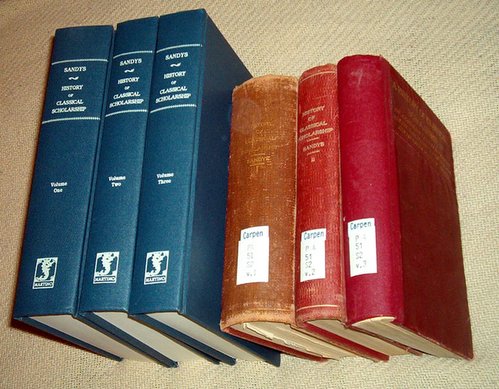
LEFT: My brand spanking new copy. RIGHT: the library's old copy, which is yellowed and falling apart.
This is what I asked of my parents for Christmas this year: a facsimile edition of John Edwin Sandys's A History of Classical Scholarship. I opted for the facsimile because it's printed on better paper and is more durably bound. This set was done by Martino Publishing in partnership with Krown and Spellman, booksellers. Krown & Spellman sell it for $165 + $5 per book shipping USPS. The edition which Martino offers on their site, apparently not in connection with Krown & Spellman, is listed at $195.
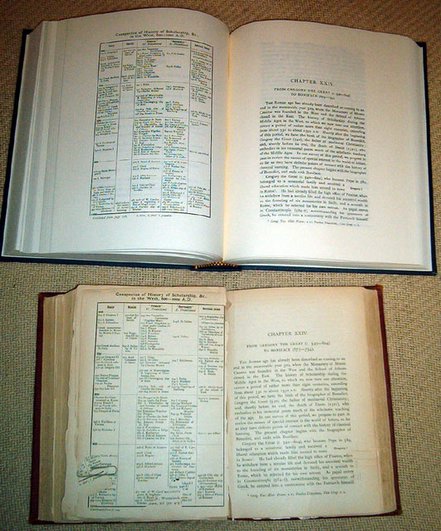
The only weakness of the facsimile is the quality of the illustrations, mostly portraits of classical scholars. The differences from the original did not photograph well, but it's something like a very good photocopy: no gray tones, some loss of detail, but nothing to cry about. 
Here are some more comparisons:
A question was sent out to a Latin teacher's list about Plato's motto, which a sender's colleague in math wanted to put above his door. Michael Hendry of Curculio remembered the first word of the Greek and replied with the quote and the citation as given in the LSJ.
I was intrigued and did a little reading via TLG, responding with what follows, though without the Greek, as e-mail still tends to revert to 7-bit ASCII, even in the 21st century. (The translations are mine):
ἐπεγέγραπτο ἔμπροσθεν τῆς διατριβῆς τοῦ Πλάτωνος ὅτι ἀγεωμέτρητος μηδεὶς εἰσίτω· ἀντὶ τοῦ ἄνισος καὶ ἄδικος. ἡ γὰρ γεωμετρία τὴν ἰσότητα καὶ τὴν δικαιοσύνην τηρεῖ.
'In front of Plato's school had been inscribed, "Let noone enter un-geometried" rather than "unequal" or "unjust," for geometry maintains equality and justness.'I assume geometry was among the lower mathematical pursuits required for the study of philosophy, and it seems plausible that Plato would have framed its usefullness in terms of qualities of the soul.
ὁ μὲν οὖν Πλάτων εἰς φυσιολογικὸν καὶ θεολογικὸν αὐτὸ διαιρεῖ· τὸ γὰρ μαθηματικὸν οὐκ ἠβούλετο εἶναι μέρος τῆς φιλοσοφίας, ἀλλὰ προγύμνασμά τι ὥσπερ ἡ γραμματικὴ καὶ ἡ ῥητορική· ὅθεν καὶ πρὸ τοῦ ἀκροατηρίου τοῦ οἰκείου ἐπέγραψεν ‘ἀγεωμέτρητος μηδεὶς εἰσίτω’. τοῦτο δὲ ὁ Πλάτων ἐπέγραφεν, ἐπειδὴ εἰς τὰ πολλὰ θεολογεῖ καὶ περὶ θεολογίαν καταγίνεται· συμβάλλεται δὲ εἰς εἴδησιν τῆς θεολογίας τὸ μαθηματικόν, οὗτινός ἐστιν ἡ γεωμετρία.
'Plato divided it (theoretical philosophy) into physiology and theology. In fact, he did not want mathematics to be a part of philosophy, but a sort of progymnasma like grammar and rhetoric. That's why, before his private lecture-room, he inscribed "Let no one enter un-geometried." He inscribed this since he discoursed on theology in all matters and dwelt on theology, and included mathematics, of which geometry is a part, into theology's forms of knowledge.'
I have the utmost respect for the work of A.S.F. Gow and A.F. Scholfield, but I always find myself feeling that their translation does a grave disservice to Nicander, especially for those who don't have the Greek or the time (or the inclination) to work through the Greek.
Here's just one example, and not the most egregious, of a style of translation that aims at 'meaning' (which is subjective) while ignoring the manner of expression. It's the introduction to Nicander's extensive catalogue of snakes, following the recipes for various repellents including incense and balms for the skin (Theriaca 115-120):
Εἰ δέ που ἐν δακέεσσιν ἀφαρμάκτῳ χροῒ κύρσῃς
ἄκμηνος σίτων, ὅτε δὴ κακὸν ἄνδρας ἰάπτει,
αἶψά κεν ἡμετέρῃσιν ἐρωήσειας ἐφετμαῖς.
τῶν ἤτοι θήλεια παλίγκοτος ἀντομένοισι
δάχματι, πλειοτέρη δὲ καὶ ὁλκαίην ἐπὶ σειρήν·
τοὔνεκα καὶ θανάτοιο θοώτερος ἵξεται αἶσα.
But if you should chance to come upon biting creatures when your skin is unmedicated and you are fasting--that is the time when disaster strikes a man--you may readily save yourself by our precepts. It is the Female Snake that attacks with its bite those who encounter it; besides, it is thicker right down to the trailing tail, and for that reason the doom of death will come more swiftly.
But if by chance, with flesh unanointed, you meet with noxious beasts, having gone long without food (that's when evil harms men!), forthwith could you rush forth by our commands.
Now, of these the female is doubly wrathful to those who meet with her bite, and she is more full even in her trailing cord (i.e., tail). And for this reason destiny shall come as a rather swift sort of death.
I'm still trying to get the hang of posting images with Google's Hello, but after seven attempts here's a little jpeg I made to demonstrate Greek numerals. (I came up with this while covering a study hall as a sub.)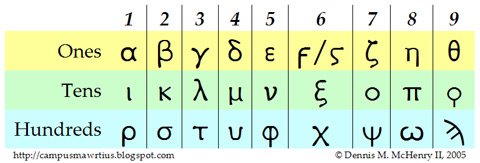
Greek Numerals
The system incorporates 27 characters from the archaic alphabet, which means the inclusion of digamma (or sometimes stigma), koppa, and sampi. You'll notice that digamma (based on semitic wau) looks similar to and occupies the same position as Latin f. Likewise, koppa with Latin q.
Using this chart is fairly simple. The mnemonic AIR (alpha, iota, rho : αιρ) will help you to remember that these three character represent one, ten, and one hundred. Since there are 27 charαcters, or 9 each for ones, tens, and hundreds, the system allows for numbers as high as 999 (sampi koppa theta).
Numerals are normally marked by a stroke to the upper right (α' = 1), but multiples of 1000 are marked by a stroke to the lower left (,α = 1000).
Remember that these are all multiples: iota is 1 times 10 (10), kappa is 2 times 10 (20). 11 would be iota alpha (ια'), and 12 would be iota beta (ιβ').
Who knew it was that easy?
As the title states, I was just browsing at the new acquisitions table in the library. I noticed that they had the Bude addition of the Theriaka. Dennis: I'm assuming you have that available to you, but if not, let me know and I can copy any relevant sections for you. I also saw a fairly recent (2002) book by W. Clausen on the Aeneid with which I'm not familiar and whose subtitle is 'Decorum, Allusion, and Ideology'. Has anyone read any of it? Thoughts? For any Bryn Mawr readers in the Aeneid seminar: have you come across this book?
A couple other things of interest to me were a book on the 3rd century persecutions of Decius and Valerian and another collection called Early Christian Families in Context.
...Sarah brings us a link to a pucker-faced Honorius solidus, worth reproducing here:
I saw one of the best correctives I've come across in a while to academic extravagance in mountain-out-of-a-molehill-making (often in evidence in my own papers) while watching part two of Scorsese's recent Bob Dylan bio-pic No Direction Home. During the footage of a 1965 press conference in San Francisco, a reporter tries to inquire into the 'significance' of the Triumph Motorcycle t-shirt he is wearing on the cover of Highway 61 Revisited, telling him that there is a 'philosophy' embedded in it. Dylan's response is to laugh and tell the reporter he hasn't really spent a lot of time looking at it (the reporter says he has spent a lot of time looking at it) and says it was just a picture somebody took one day while he was sitting on the steps.
Not one to give up, the reporter asks if he can talk about the meaning of the motorcycle image in his song-writing. Dylan's only response to this is, 'Well, we all like motorcycles, don't we?', or something to that effect.
The moral of this story is: sometimes a t-shirt is just a t-shirt. I have to remind myself of that sometimes, when puzzling over individual words in a poem and attempting to make an entire interpretation hang on what, to the author, might have been a rather insignificant detail. That doesn't mean these details are always insignificant, but it seems good at least to pause over them, to take a step back and ask the more general questions: does this interpretation I'm gleaning from this one word make sense in the broader scope of the poem? How does it fit in with the whole body of data I'm working with? Would the author have used the word in this way and with this significance? What is his normal practice? How does he mark what is important and what is not in his poem, if at all? Am I foisting my own intent on the author, trying to make a square poem fit in a round hole, as it were? Or does it cohere with the rest of the work?
Ok. I'm done babbling. But it is always nice to find a reminder in a surprising place which causes some reflection on the pitfalls of interpretation--one which pulls me for a moment from the hermetically-sealed bubble in which I often attempt to work with ancient texts out into the wider world.
solidus \SAH-luh-dus\ noun
1 : an ancient Roman gold coin introduced by Constantine and used to the fall of the Byzantine Empire
*2 : a mark / used typically to denote "or" (as in and/or), "and or" (as in straggler/deserter), or "per" (as in feet/second)
Example sentence:
In her latest thriller, the author manipulates her readers into believing there are two killers until the final page, where she connects their two names with a solidus.
Did you know?
Call it a solidus, or call it a slash/diagonal/slant/virgule — whatever you call it, you are bound to run into this useful mark with some regularity. These days, one place the mark is commonly seen is in Internet addresses (http://www.merriam-webster.com/cgi-bin/mwwod.pl, for example), but the history of the word "solidus" takes us back to a time well before computers. The ancient Roman emperor Constantine the Great borrowed the Latin term for "solid" ("solidus") for the gold coin that was the successor to the aureus. And in Medieval Latin, "solidus" designated the shilling. Before the introduction of decimal coinage, abbreviations of the shilling ("s," "sh," or "shil") were used. Eventually, the abbreviations were replaced with the simple symbol "/," which became known as a solidus.
*Indicates the sense illustrated in the example sentence.
In Milton's essay Of Education we learn that if only we should teach children, in addition to the usual arts and sciences, 'the helpful experience of hunters, fowlers, fisherman, shepherds, gardners, apothecaries,' then 'those poets which are now counted most hard will be both facile and pleasant: Orpheus, Hesiod, Theocritus, Aratus, Nicander, Oppian, Dionysius, and in Latin, Lucretius, Manilius, and the rural part of Virgil.'
It comes as no surprise then when we find Nicander creeping up in book X of Paradise Lost. Satan has returned triumphantly to Hell and makes a self-congratulatory speech which doesn't go over quite so well. Note, particularly, the list of snakes, which even includes a scorpion, from verses 524-529:
504 So having said, awhile he stood expecting
505 Their universal shout and high applause
506 To fill his ear; when, contrary, he hears
507 On all sides from innumerable tongues
508 A dismal universal hiss, the sound
509 Of public scorn. He wonder'd, but not long
510 Had leisure, wond'ring at himself now more:
511 His visage drawn he felt to sharp and spare,
512 His arms clung to his ribs, his legs entwining
513 Each other till, supplanted, down he fell
514 A monstrous serpent on his belly prone,
515 Reluctant but in vain: a greater power
516 Now rul'd him, punish'd in the shape he sinn'd,
517 According to his doom. He would have spoke,
518 But hiss for hiss return'd with forked tongue
519 To forked tongue; for now were all transform'd
520 Alike, to serpents all, as accessories
521 To his bold riot. Dreadful was the din
522 Of hissing through the hall, thick-swarming now
523 With complicated monsters, head and tail:
524 Scorpion and asp and amphisbaena dire,
525 Cerastes horn'd, hydrus, and ellops drear,
526 And dipsas (not so thick swarm'd once the soil
527 Bedropp'd with blood of Gorgon, or the isle
528 Ophiusa); but still greatest he, the midst,
529 Now dragon grown, larger than whom the sun
530 Engender'd in the Pythian vale on slime,
531 Huge Python; and his power no less he seem'd
532 Above the rest still to retain. They all
533 Him follow'd, issuing forth to th' open field,
534 Where all yet left of that revolted rout,
535 Heav'n-fall'n, in station stood or just array,
536 Sublime with expectation when to see
537 In triumph issuing forth their glorious Chief.
538 They saw, but other sight instead--a crowd
539 Of ugly serpents. Horror on them fell,
540 And horrid sympathy; for what they saw
541 They felt themselves now changing. Down their arms,
542 Down fell both spear and shield, down they as fast;
543 And the dire hiss renew'd, and the dire form
544 Catch'd by contagion, like in punishment
545 As in their crime. Thus was th' applause they meant
546 Turn'd to exploding hiss, triumph to shame
547 Cast on themselves from their own mouths. There stood
548 A grove hard by, sprung up with this their change
549 (His will who reigns above) to aggravate
550 Their penance, laden with fair fruit, like that
551 Which grew in Paradise, the bait of Eve
552 Us'd by the Tempter. ...
Here are all (I think all) of my book finds for the past month:
Caelestis suggests below that the abbreviation stands for 'donum dat/dedit'. I was looking through the epigraphy book mentioned below and have found some confirming evidence. In it is reproduced an inscription from an obelisk in Rome:
IMP.CAESAR.DIVI.FAnd here are a few more abbreviations (the second of which lends support to Dennis' suggestion 'dedit') listed in chapter 7 employing the letter 'D':
AVGVSTVS
PONTIFEX.MAXIMUS
IMP.XII.COS.XI.TRIB.POT.XIV
AEGVPTO.INPOTESTATEM
POPVLI.ROMANI.REDACTA
SOLI.DONVM.DEDIT
D: dat
D, D.D: dedit
D, DED, DD: dedicavit
D.D.D: dedit idemque dedicavit
D.D: dono dedit (is dono some sort of predicative dative here? Or is this a parallel construction to one in which we would find the accusative of the person and the ablative of the thing (cf. Allen & Greenough 225d)?)
Ok, so today I returned to the book sale and stuck more to the task at hand (which is not to say that I still didn't have a few divergences). Thankfully there were still some items of interest that I hadn't noticed yesterday, and some that I had, but put off getting.
Bloch, Raymon. L'epigraphie latine (in the 'que sais-je?' series).
Brueder Grimm. Kinder- und Hausmaerchen.
Christ, W., and M. Paranakis. Anthologia Graeca Carminum Christianorum (Hildesheim 1963).
Dickens, Charles. The Life of Our Lord (the title of the work in the original manuscript written for his own children is The History of Our Saviour Jesus Christ).
Dolan, John P., ed. and trans. The Essential Erasmus.
Fraser, W.H., and J. Square. Heath's Practical French Grammar.
Friend, A.M., Jr. The Portraits of the Evangelists in Greek and Latin Manuscripts (reprinted from Art Studies: 1927).
Lateinische Gedichte Deutscher Humanisten (Lateinisch/Deutsch).
Lawall, Gilbert. Theocritus' Coan Pastorals: A Poetry Book.
Langenscheidt's German-English/English-German Dictionary.
Lesky, Albin. Die Tragische Dichtung Der Hellenen (paperback).
Porphyry. Peri Apochhs Empsuchwn (De l'abstinence), tome 1, livre 1 in the Bude series, edited with French translation by Jean Bouffartigue.
Waugh, Evelyn. Black Mischief.
Rogueclassicism tells us that today is the anniversary of the martyrdom of St. Cecilia, patron saint of music. Here is a shot of the facade of S. Cecilia in Trastevere, Rome, thought (I think) to be on the site of her house and martyrdom:
When her tomb was opened in the late 1599, supposedly her body was found in tact and undecayed, and the sculptor Stefano Maderno, present at the opening, was able to depict it: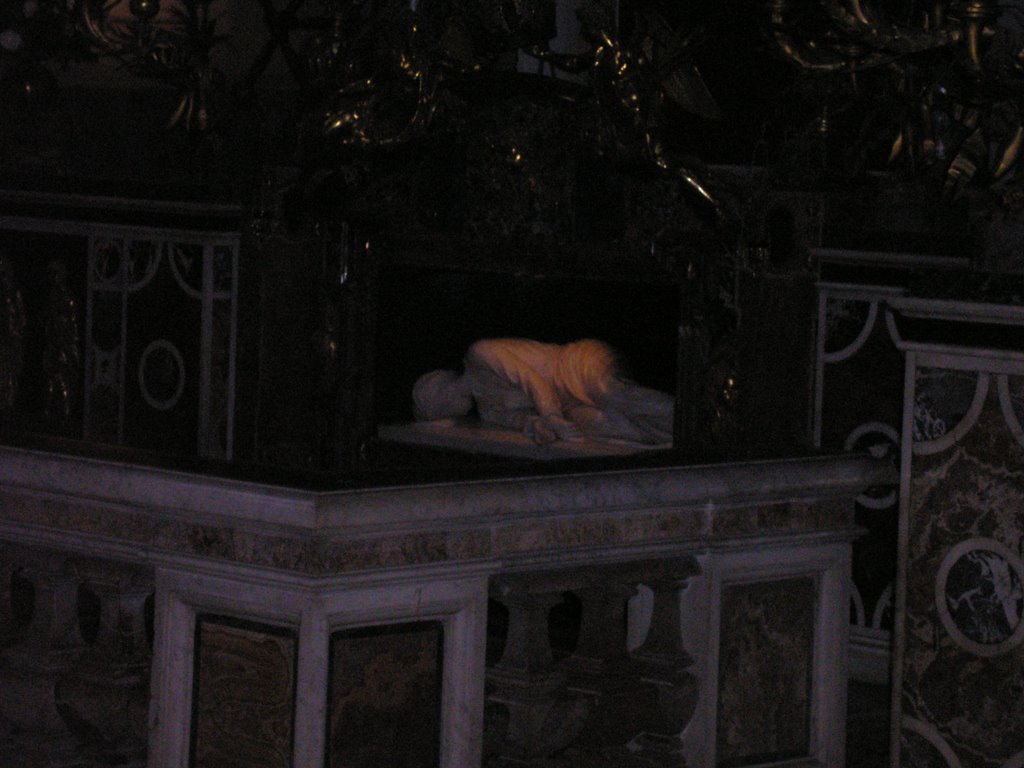
There are some excavations underneath the church of Roman remains which I haven't visited yet, but would like to. If and when I do, I'll try to get some pics up from them.
UPDATE: I had a feeling that some of the information I read on the catholic-forum.com site conflicted with something I had read before. Here is what the Blue Guide for Rome says (whence some of the above information also comes):
[The church of Santa Cecilia in Trastevere is] on the site of the house of St. Cecilia and her husband St. Valerian, whome she converted to Christianity. This building was adapted to Christian use probably in the 5C, and the body of St. Cecilia was transferred here and a basilica erected by Paschal I (817-24). The church, radically altered from the 16C onwards, was partly restored to its original form in 1899-1901. The slightly leaning campanile dates from 1120.St. Cecilia, a patrician lady of the gens Cornelia, was martyred in 230, during the reign of Alexander Severus. She was shut up in the calidarium of her own baths, to be scalded to death. Emerging unscathed, she was beheaded in her own house, but the executioner did such a bad job that she lived for three days afterwards. She was buried in the Catacombs of St. Calixtus, where her body remained until its reinterment in her church in 820. As the inventor of the organ, she is the patron saint of music. On 22 November churches hold musical services in her honour.
The library had a book sale today, and I picked up a few things:
Berg, William. Early Virgil.
Bunyan, John. The Pilgrim's Progress.
Die Bibel (Luther's German translation)
Cassell's New French Dictionary. (I actually like Harper/Collins/Robert, but I wanted to get a copy of this as well.)
James, Henry. Italian Hours.
Kierkegaard, Soren. Either/Or (translation).
Pascal, Blaise. Pensees (translation by W.F. Trotter with an introduction by T.S. Eliot).
Septuaginta X (ed. A Rahlfs): Psalmi cum Odis (the 'Odes' are Novem Odae ecclesiae graecae). Handwritten in the front is, I believe, the name of William Strunk's (of 'Strunk and White' fame) son Oliver. Perhaps someone can tell me what this inscription means. It reads: 'O. Strunk d.d. J. Raasted, Sept. '63'. Does anyone know what the 'd.d.' stands for?
As you can tell, I didn't do a very good job of sticking to classics books, but I am very glad to have gotten a copy of Berg; there's a lot I enjoy in that book. There were some others in the classics field I wanted to get, but I was getting outside of what I thought I should spend. The one I'm most disappointed to have passed up was John Jones' On Aristotle and Greek Tragedy, my personal favorite as far as works on the Poetics and Greek Tragedy go. I also passed on a Cassell's Latin Dictionary, which I don't actually own. There was a pristine copy of the Appolonius Rhodius Loeb as well, and Merrill's Catullus. In addition, they had the first part of an edition of the Catalepton, with Latin, English, and Latin commentary. Finally, I had to pass on A.P. Burnett's The Art of Bacchylides.
Dennis: they had a very nice edition of Victor Bers' Greek Poetic Syntax in the Classical Age. I think it was about EUR 8 ($10 or $12). Let me know if you want it and I could try to pick it up if it's still there.
UPDATE: I have a hunch 'd.d.' could stand for dedicavit. Can anyone confirm or deny?
UPDATE 2: I was just poking around at the book sale again and came across Charles Segal's copy of Anne Lebeck's Studies in Aeschylus. They seem to have had several tragedy books that I missed the first time around, as I saw someone absconding with Winnington-Ingram's Studies in Aeschylus. Ah, well.
First a bit of business: apologies to anyone who posted a comment recently only to find it no appear. We don't know how comment moderation was enabled (perhaps all of that numismatic wine Eric's been drinking?) but it wasn't intentional, it's been turned off, and all such comments have been indiscriminately approved and posted.
But back to that wine, I said in the comments that I'd link to Sarah's blog if she posted about the coin we identified the other day, and sure enough she has. So here it is: a Cilician coin from Tarsus featuring the emperor Gallus Trebonianus (Gaius Vibius) with interesting translations and transliterations from Latin into Greek.
The epigraph in L.P. Wilkinson's Golden Latin Artistry is too good not to share:
Gaius Lucilius...used to say that he wished to be read neither by the very unlearned nor by the very learned; for the former would understand nothing, the latter perhaps more than himself. (Cicero, De Oratore, II, 25)
All right, I have another wine-bottle numismatics question for you. This picture's a lot blurrier than the last one, but it purports to be a coin of one of the Marcus Porcius Catos (or 'Porky', as I like to call them). I'm assuming it must be Cato the Elder, since he was from Tusculum. I say this because Tusculum is south-east of Rome, and this particular wine, Frascati, comes from the region south-east of Rome. (Cato the Younger, on the other hand, was born in Rome.) I suppose the photo might be too blurry even to ask, but can anyone make this out well enough to know if it's real, as Sarah proved the last one to be? 
The last post should still have been in draft mode, but I'll let it stand since people have presumably read it, and it makes sense as it goes.
The basic argument, I think, is sound: the meters of Greek and Latin poetry are a tricky business, still rife with controversy and theories and still a fertile field for further study.
A lot of good and important books were left out of the last post. The Sounds of Greek by W.B. Stanford comes to mind, though it isn't really about meter. That gives you a clue that meter alone isn't much of a study. Even when prosody is given its due attention (cf. the work of Devine & Stephens) the work is inadequate. When you talk about 'the prosody of Greek speech' which Greeks in which era speaking which dialect do you mean, and how does that impact, say, the analysis of the metrical practices of a Hellenistic poet mimicking those of an archaic model?
It's for reasons like these that I'll always remain a positivist, however dirty a word it has become in the academy. Imagine the sort of synchronistic analysis found in this area applied to numismatics: we take coins of all periods, because, afterall, COINAGE is our concern, and extrapolate a set of rules and laws, then publish countless articles about how individual coins break the rules.
The kind of rudimentary diachronic work that West did in his Greek Metre is a step in the right direction, but what's really needed is for students to look at the individual texts of individual poets.
Having done that with Nicander I learned more about meter in general than I ever had by reading manuals, but I also learned that the statistics published in every relevant source--e.g., Lingenberg's dissertation and it's followers (Kroll's RE entry, West in GM) and J.-M. Jacques--are demonstrably incorrect and that it's not accurate to classify Nicander as 'very Callimachean' as everyone does.
This isn't going anywhere ... just another rambling post.
(This was going to be a comment to Eric's latest post, but it seems too long for that.)
As for meter, it's a tough and tricky business to get involved in. You need to read a number of things very actively, but most importantly you need to actively read verse aloud. Not only do the various meters have their own rhythms, but so do individual poets. I first noticed this reading Roman satire. When we moved from Horace to Persius to Juvenal I found myself stumbling at first. But familiarity with Juvenal's rhythms led me to mark a few lines as spurious in the margin only to find later that Edward Courtney doubted the very same lines, I think on different grounds.
You should begin with poetry that you enjoy, preferably that you care about, and you should let the verse tell you what it's doing without trying to impose rules gleaned from handbooks (many supposed laws are nothing more than tendencies, and are often tendencies of only specific, usually late writers). Remember that Greek meter apparently grew out of music, out of rhythm, which is measured in time as perceived aurally. You must then read the verse so that you can hear it, and must try to read it not only as linguists have restored the sounds for us, but also so that you can hear the differences between different sounds (this means pronouncing eta differently from epsilon iota, etc., or in Latin pronouncing classical verse classically, and not in the manner of the Church).
Halporn, Ostwald, and Rosenmeyer can be a valuable guide at this stage, but it, and all of the other handbooks, will be largely useless if you can't hear the verse.
Here's a quick take on some of the more prominent books:
Halporn, Ostwald, and Rosenmeyer (a translation of H. & O.'s Lateinische Metrik with R.'s liberal adaptation of Bruno Snell's Griechische Metrik) is great for what it is but so much that students will want to know is omitted, presumably because they should be able to ask their teachers. But teachers increasingly know less and less (or nothing) about it. For those who can read French I'd recommend W.J.W. Koster Traité de métrique grecque. It's not the same kind of reference, but it's more useful as you advance.
In fact, Koster recommends Masqueray's book of the same name which is very old and hard to come by, but I've found it to be very useful for all sorts of odd questions (like the placement of the caesura when dealing with enclitics, which may seem obvious, but which doubtless plagues students).
I actually think you should read Thomas Dwight Goodell's Chapters on Greek Metric at some point, preferably early. A lot of it is dated, but it'll put a number of things into context, and Goodell duly appreciates the ancient tradition which is too often referred to obliquely or simply discounted.
In addition I would read two essays by Hardie in Lectures on Classical Subjects: The Language of Poetry, and the Metrical Form of Poetry.
Paul Maas's Greichische Metrik is important and in some ways idiosyncratic (in some ways that's a good thing, as when he clarifies the nature of the 'bucolic diaeresis' by reference to a corresponding 'bucolic bridge' and illustrates the significance of the phenomenon by Theocritus' use). If you get Hugh Lloyd Jones's translation you'll want to make a number of corrections (as I've done with our library's copy) from L.P.E. Parker's review (JHS 84, 1964, 173-5).
M.L. West's Greek Metre is good but I think not very useful to students, with the possible exception of his initial treatment of the hexameter in which he follows Haslam's lead: hemiepes + paroemiac (cf. Haslam, 'The Versification of the New Stesichorus' GRBS 19, 1978, 29-57). West is something to read when you've done a fair amount of work with meter and can check his statistics against your own and understand where he agrees or diverges from tradition.
Avoid Raven's books on meter at all costs. I don't have the strength to attack them here. Just save yourself the agony.
I still haven't been able to give C.M.J. Sicking's Griechische Verslehre (Handbuch der Altertumswissenschaft 2.4, 1993) a proper inspection, mainly because my German is only strong enough to handle what I absolutely need to read for my thesis, but it looks good, is clearly the most up-to-date of all the handbooks, and has a very attractive and detailed approach to diagramming the schemata.
Eventually you have to read A.M. Dale's The Lyric Meters of Greek Drama as well as her Collected Papers. There are a number of good individual works.
Previously, I asked for suggestions for an essential reading list of secondary sources on the ancient world. Here's what we've got so far:
Bing, Peter. The Well-Read Muse.
Buck, Carl Darling. The Greek Dialects.
Burkert, Walter. Greek Religion.
Dill, Samuel. Roman Society from Nero to Marcus Aurelius.
Dodds, E.R. The Greeks and the Irrational.
Finley, M.I. The Ancient Economy.
Frazer, James. The Golden Bough.
Gibbon, Edward. The Decline and Fall of the Roman Empire.
Guthrie, W.K.C. A History of Greek Philosophy.
Harrison, Jane Ellison. Prolegomena to the Study of Greek Religion.
Heinze, Richard. Virgil's Epic Technique.
Jaeger, Werner. Paideia.
Lord, A.B. The Singer of Tales.
Meiggs, R., and D. Lewis, A selection of Greek historical inscriptions to the end of the fifth century B.C.
Nagy, Gregory. The Best of the Achaeans.
Pickard-Cambridge, A.W. Dithyramb, Tragedy And Comedy (the original of 1927, not T.B.L. Webster's 1962 update).
Pickard-Cambridge, A.W. Dramatic Festivals of Athens.
Sandys, John Edwin. A History of Classical Scholarship.
Snell, Bruno. The Discovery of the Mind.
Syme, Ronald. The Roman Revolution.
Vermeule, Emily. Greece in the Bronze Age.
Wilamowitz. History of Classical Scholarship (tr. Hugh Lloyd-Jones).
Wilkinson, L.P. Golden Latin Artistry.
Williams, Bernard. Shame and Necessity.
I went on a little tour of the 'Protestant' Cemetery today down by the Pyramid/Tomb of Cestius and under the shade of the Aurelian Walls. Here is a picture of the Pyramid, which supposedly took around 330 days to build, if I'm remembering correctly.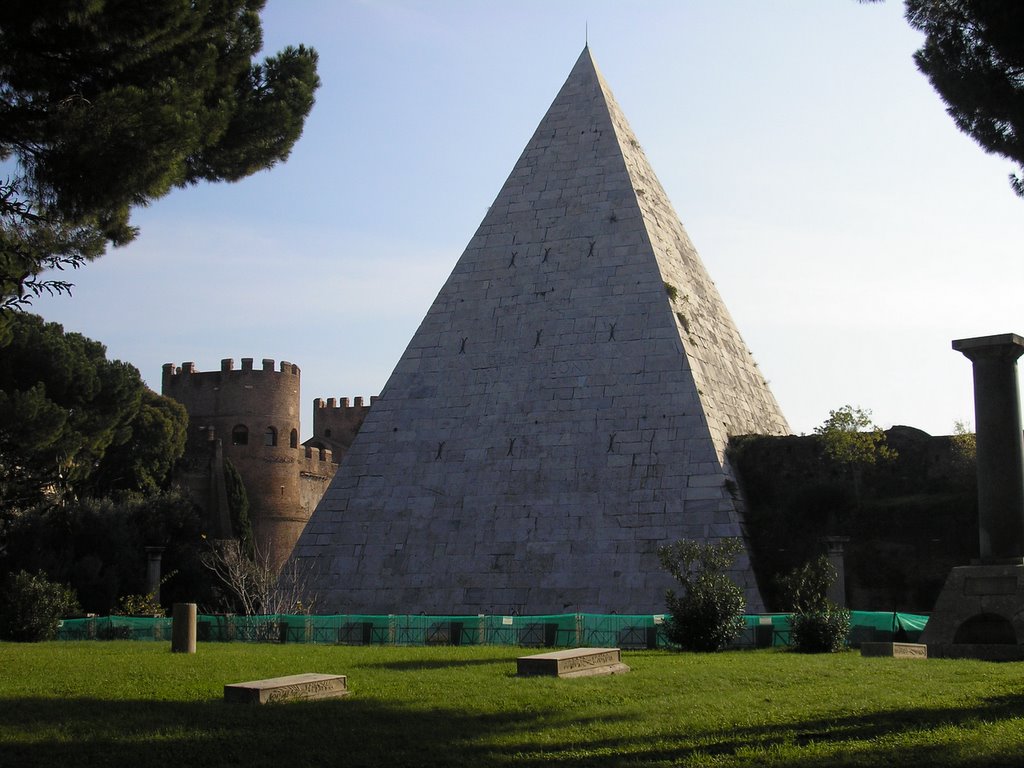
For all you Late Antique/Early and Medieval Christian Art and Architecture types, here is a picture of the grave of Richard Krautheimer, a civis Romanus.
And for all you Bryn Mawr types, here is a picture of the grave of Charles Densmore Curtis.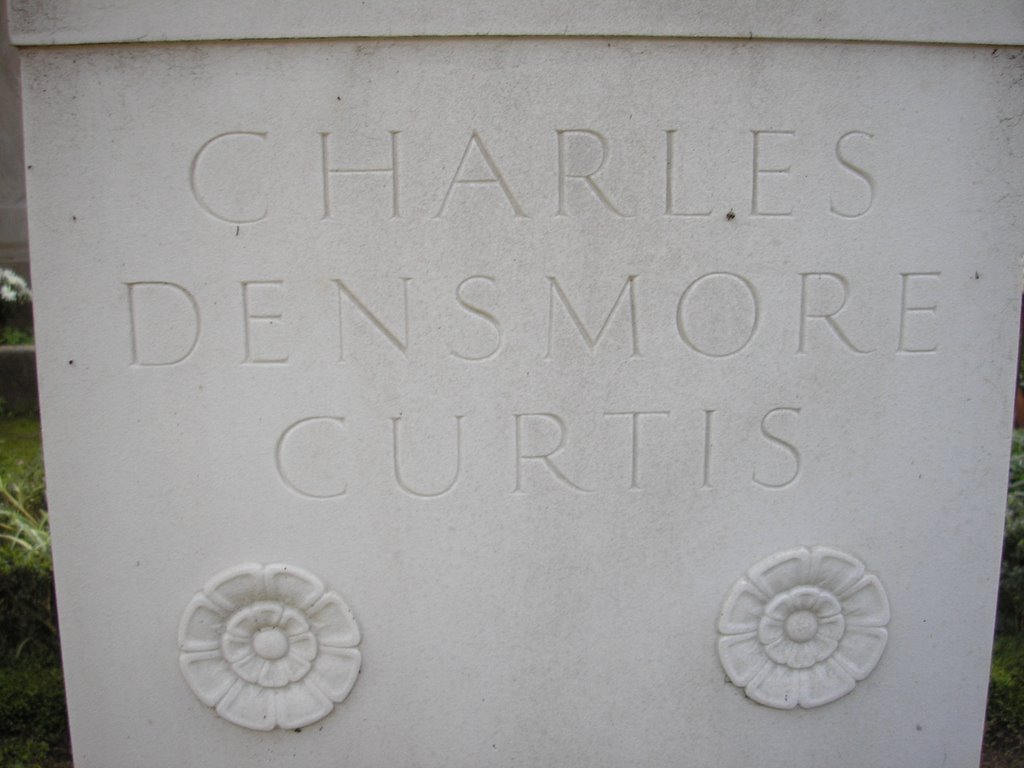
UPDATE: I also have some non-classical photos from the cemetery here.
Here is Merriam-Webster's word for today, of Latin heritage.
vulnerary \VUL-nuh-rair-ee\ adjective
: used for or useful in healing wounds
Example sentence:
Native Americans prized the herb echinacea for its vulnerary properties, using it to treat burns and snakebite as well as arrow wounds.
Did you know?
"Vulnus," in Latin means "wound." You might think, then, that the English adjective "vulnerary" would mean "wounding, causing a wound." And, indeed, "vulnerary" has been used that way, along with two obsolete adjectives, "vulnerative" and "vulnific." But for the lasting and current use of "vulnerary," we took our cue from the Roman scholar Pliny the Elder. In his Natural History, he used the Latin adjective "vulnerarius" to describe a plaster, or dressing, for healing wounds. And that's fine — the suffix "-ary" merely indicates that there is a connection, which, in this case, is to wounds. (As you may have already suspected, "vulnerable" is related; it comes from the Latin verb "vulnerare," which means "to wound.")
*Indicates the sense illustrated in the example sentence.
One more thing from rogueclassicism: there are a couple of confusing stories floating around about a wall collapsing in the Forum and the Colosseum being closed. I was a little surprise that I hadn't heard anything about this, so my wife went down to investigate this afternoon. She reports that everything appears to be open today, including the Colosseum; this doesn't mean that there wasn't a wall-collapse, but only that (so far, at least) it doesn't seem to have had a significant impact on site-accessibility. I'll update this as and when I come across any other information.
In reference to Magister Coke's teaching of AP Vergil, he might find the latest installment of Father Foster worth sharing with his class, in which the esteemed Latinist says a couple of times that Vergil is overdone, and that he prefers Horace. In fact, I think he even says at one point that there are 10,000 other Latin authors as good as Vergil (but I may be remembering incorrectly). I listened to it last night, and it was quite entertaining. Here is the link to rogueclassicism, from which you can click on a link to download the mp3 file.
And speaking of Vergil and Horace, I also learn from the rogue that today is the anniversary of Maecenas' death.
Maecenas atauis edite regibus,
o et praesidium et dulce decus meum,
sunt quos curriculo puluerem Olympicum
collegisse iuuat metaque feruidis
euitata rotis palmaque nobilis 5
terrarum dominos euehit ad deos;
hunc, si mobilium turba Quiritium
certat tergeminis tollere honoribus;
illum, si proprio condidit horreo
quicquid de Libycis uerritur areis. 10
Gaudentem patrios findere sarculo
agros Attalicis condicionibus
numquam demoueas, ut trabe Cypria
Myrtoum pauidus nauta secet mare.
Luctantem Icariis fluctibus Africum 15
mercator metuens otium et oppidi
laudat rura sui; mox reficit rates
quassas, indocilis pauperiem pati.
Est qui nec ueteris pocula Massici
nec partem solido demere de die 20
spernit, nunc uiridi membra sub arbuto
stratus, nunc ad aquae lene caput sacrae.
Multos castra iuuant et lituo tubae
permixtus sonitus bellaque matribus
detestata. Manet sub Ioue frigido 25
uenator tenerae coniugis inmemor,
seu uisa est catulis cerua fidelibus,
seu rupit teretis Marsus aper plagas.
Me doctarum hederae praemia frontium
dis miscent superis, me gelidum nemus 30
Nympharumque leues cum Satyris chori
secernunt populo, si neque tibias
Euterpe cohibet nec Polyhymnia
Lesboum refugit tendere barbiton.
Quod si me lyricis uatibus inseres, 35
sublimi feriam sidera uertice.


