And Speaking of Solidi...
...Sarah brings us a link to a pucker-faced Honorius solidus, worth reproducing here:

Male Graduate Students:
un-serious in terms of studies since 1931.
...Sarah brings us a link to a pucker-faced Honorius solidus, worth reproducing here:
I saw one of the best correctives I've come across in a while to academic extravagance in mountain-out-of-a-molehill-making (often in evidence in my own papers) while watching part two of Scorsese's recent Bob Dylan bio-pic No Direction Home. During the footage of a 1965 press conference in San Francisco, a reporter tries to inquire into the 'significance' of the Triumph Motorcycle t-shirt he is wearing on the cover of Highway 61 Revisited, telling him that there is a 'philosophy' embedded in it. Dylan's response is to laugh and tell the reporter he hasn't really spent a lot of time looking at it (the reporter says he has spent a lot of time looking at it) and says it was just a picture somebody took one day while he was sitting on the steps.
Not one to give up, the reporter asks if he can talk about the meaning of the motorcycle image in his song-writing. Dylan's only response to this is, 'Well, we all like motorcycles, don't we?', or something to that effect.
The moral of this story is: sometimes a t-shirt is just a t-shirt. I have to remind myself of that sometimes, when puzzling over individual words in a poem and attempting to make an entire interpretation hang on what, to the author, might have been a rather insignificant detail. That doesn't mean these details are always insignificant, but it seems good at least to pause over them, to take a step back and ask the more general questions: does this interpretation I'm gleaning from this one word make sense in the broader scope of the poem? How does it fit in with the whole body of data I'm working with? Would the author have used the word in this way and with this significance? What is his normal practice? How does he mark what is important and what is not in his poem, if at all? Am I foisting my own intent on the author, trying to make a square poem fit in a round hole, as it were? Or does it cohere with the rest of the work?
Ok. I'm done babbling. But it is always nice to find a reminder in a surprising place which causes some reflection on the pitfalls of interpretation--one which pulls me for a moment from the hermetically-sealed bubble in which I often attempt to work with ancient texts out into the wider world.
solidus \SAH-luh-dus\ noun
1 : an ancient Roman gold coin introduced by Constantine and used to the fall of the Byzantine Empire
*2 : a mark / used typically to denote "or" (as in and/or), "and or" (as in straggler/deserter), or "per" (as in feet/second)
Example sentence:
In her latest thriller, the author manipulates her readers into believing there are two killers until the final page, where she connects their two names with a solidus.
Did you know?
Call it a solidus, or call it a slash/diagonal/slant/virgule — whatever you call it, you are bound to run into this useful mark with some regularity. These days, one place the mark is commonly seen is in Internet addresses (http://www.merriam-webster.com/cgi-bin/mwwod.pl, for example), but the history of the word "solidus" takes us back to a time well before computers. The ancient Roman emperor Constantine the Great borrowed the Latin term for "solid" ("solidus") for the gold coin that was the successor to the aureus. And in Medieval Latin, "solidus" designated the shilling. Before the introduction of decimal coinage, abbreviations of the shilling ("s," "sh," or "shil") were used. Eventually, the abbreviations were replaced with the simple symbol "/," which became known as a solidus.
*Indicates the sense illustrated in the example sentence.
In Milton's essay Of Education we learn that if only we should teach children, in addition to the usual arts and sciences, 'the helpful experience of hunters, fowlers, fisherman, shepherds, gardners, apothecaries,' then 'those poets which are now counted most hard will be both facile and pleasant: Orpheus, Hesiod, Theocritus, Aratus, Nicander, Oppian, Dionysius, and in Latin, Lucretius, Manilius, and the rural part of Virgil.'
It comes as no surprise then when we find Nicander creeping up in book X of Paradise Lost. Satan has returned triumphantly to Hell and makes a self-congratulatory speech which doesn't go over quite so well. Note, particularly, the list of snakes, which even includes a scorpion, from verses 524-529:
504 So having said, awhile he stood expecting
505 Their universal shout and high applause
506 To fill his ear; when, contrary, he hears
507 On all sides from innumerable tongues
508 A dismal universal hiss, the sound
509 Of public scorn. He wonder'd, but not long
510 Had leisure, wond'ring at himself now more:
511 His visage drawn he felt to sharp and spare,
512 His arms clung to his ribs, his legs entwining
513 Each other till, supplanted, down he fell
514 A monstrous serpent on his belly prone,
515 Reluctant but in vain: a greater power
516 Now rul'd him, punish'd in the shape he sinn'd,
517 According to his doom. He would have spoke,
518 But hiss for hiss return'd with forked tongue
519 To forked tongue; for now were all transform'd
520 Alike, to serpents all, as accessories
521 To his bold riot. Dreadful was the din
522 Of hissing through the hall, thick-swarming now
523 With complicated monsters, head and tail:
524 Scorpion and asp and amphisbaena dire,
525 Cerastes horn'd, hydrus, and ellops drear,
526 And dipsas (not so thick swarm'd once the soil
527 Bedropp'd with blood of Gorgon, or the isle
528 Ophiusa); but still greatest he, the midst,
529 Now dragon grown, larger than whom the sun
530 Engender'd in the Pythian vale on slime,
531 Huge Python; and his power no less he seem'd
532 Above the rest still to retain. They all
533 Him follow'd, issuing forth to th' open field,
534 Where all yet left of that revolted rout,
535 Heav'n-fall'n, in station stood or just array,
536 Sublime with expectation when to see
537 In triumph issuing forth their glorious Chief.
538 They saw, but other sight instead--a crowd
539 Of ugly serpents. Horror on them fell,
540 And horrid sympathy; for what they saw
541 They felt themselves now changing. Down their arms,
542 Down fell both spear and shield, down they as fast;
543 And the dire hiss renew'd, and the dire form
544 Catch'd by contagion, like in punishment
545 As in their crime. Thus was th' applause they meant
546 Turn'd to exploding hiss, triumph to shame
547 Cast on themselves from their own mouths. There stood
548 A grove hard by, sprung up with this their change
549 (His will who reigns above) to aggravate
550 Their penance, laden with fair fruit, like that
551 Which grew in Paradise, the bait of Eve
552 Us'd by the Tempter. ...
Here are all (I think all) of my book finds for the past month:
Caelestis suggests below that the abbreviation stands for 'donum dat/dedit'. I was looking through the epigraphy book mentioned below and have found some confirming evidence. In it is reproduced an inscription from an obelisk in Rome:
IMP.CAESAR.DIVI.FAnd here are a few more abbreviations (the second of which lends support to Dennis' suggestion 'dedit') listed in chapter 7 employing the letter 'D':
AVGVSTVS
PONTIFEX.MAXIMUS
IMP.XII.COS.XI.TRIB.POT.XIV
AEGVPTO.INPOTESTATEM
POPVLI.ROMANI.REDACTA
SOLI.DONVM.DEDIT
D: dat
D, D.D: dedit
D, DED, DD: dedicavit
D.D.D: dedit idemque dedicavit
D.D: dono dedit (is dono some sort of predicative dative here? Or is this a parallel construction to one in which we would find the accusative of the person and the ablative of the thing (cf. Allen & Greenough 225d)?)
Ok, so today I returned to the book sale and stuck more to the task at hand (which is not to say that I still didn't have a few divergences). Thankfully there were still some items of interest that I hadn't noticed yesterday, and some that I had, but put off getting.
Bloch, Raymon. L'epigraphie latine (in the 'que sais-je?' series).
Brueder Grimm. Kinder- und Hausmaerchen.
Christ, W., and M. Paranakis. Anthologia Graeca Carminum Christianorum (Hildesheim 1963).
Dickens, Charles. The Life of Our Lord (the title of the work in the original manuscript written for his own children is The History of Our Saviour Jesus Christ).
Dolan, John P., ed. and trans. The Essential Erasmus.
Fraser, W.H., and J. Square. Heath's Practical French Grammar.
Friend, A.M., Jr. The Portraits of the Evangelists in Greek and Latin Manuscripts (reprinted from Art Studies: 1927).
Lateinische Gedichte Deutscher Humanisten (Lateinisch/Deutsch).
Lawall, Gilbert. Theocritus' Coan Pastorals: A Poetry Book.
Langenscheidt's German-English/English-German Dictionary.
Lesky, Albin. Die Tragische Dichtung Der Hellenen (paperback).
Porphyry. Peri Apochhs Empsuchwn (De l'abstinence), tome 1, livre 1 in the Bude series, edited with French translation by Jean Bouffartigue.
Waugh, Evelyn. Black Mischief.
Rogueclassicism tells us that today is the anniversary of the martyrdom of St. Cecilia, patron saint of music. Here is a shot of the facade of S. Cecilia in Trastevere, Rome, thought (I think) to be on the site of her house and martyrdom:
When her tomb was opened in the late 1599, supposedly her body was found in tact and undecayed, and the sculptor Stefano Maderno, present at the opening, was able to depict it: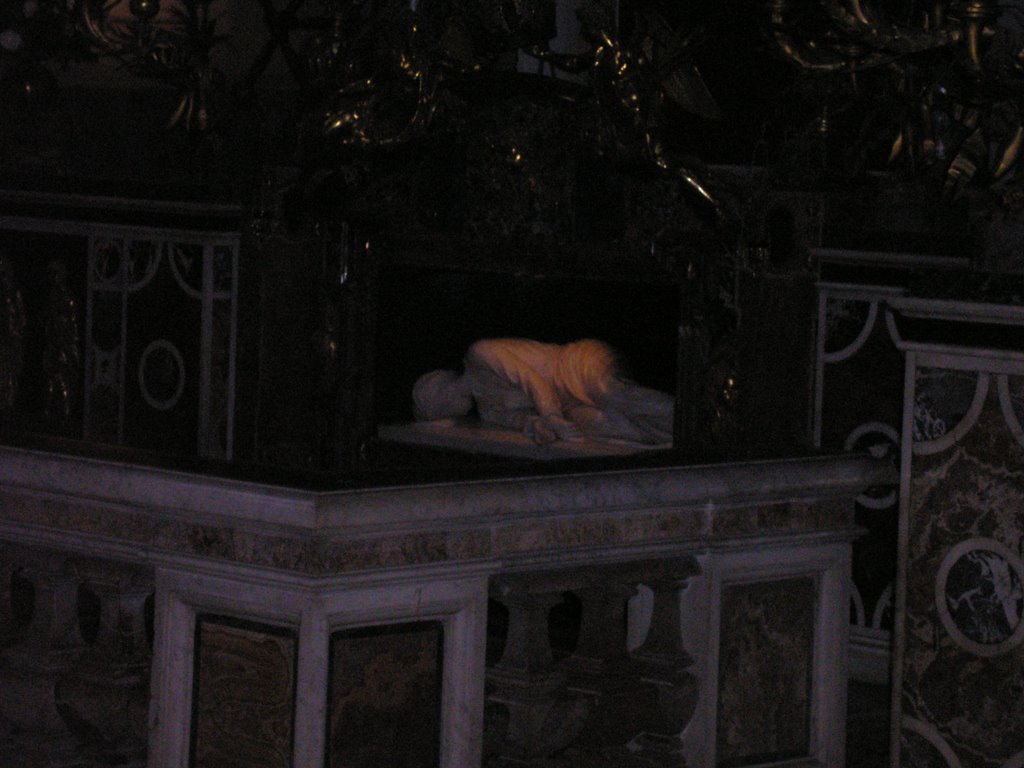
There are some excavations underneath the church of Roman remains which I haven't visited yet, but would like to. If and when I do, I'll try to get some pics up from them.
UPDATE: I had a feeling that some of the information I read on the catholic-forum.com site conflicted with something I had read before. Here is what the Blue Guide for Rome says (whence some of the above information also comes):
[The church of Santa Cecilia in Trastevere is] on the site of the house of St. Cecilia and her husband St. Valerian, whome she converted to Christianity. This building was adapted to Christian use probably in the 5C, and the body of St. Cecilia was transferred here and a basilica erected by Paschal I (817-24). The church, radically altered from the 16C onwards, was partly restored to its original form in 1899-1901. The slightly leaning campanile dates from 1120.St. Cecilia, a patrician lady of the gens Cornelia, was martyred in 230, during the reign of Alexander Severus. She was shut up in the calidarium of her own baths, to be scalded to death. Emerging unscathed, she was beheaded in her own house, but the executioner did such a bad job that she lived for three days afterwards. She was buried in the Catacombs of St. Calixtus, where her body remained until its reinterment in her church in 820. As the inventor of the organ, she is the patron saint of music. On 22 November churches hold musical services in her honour.
The library had a book sale today, and I picked up a few things:
Berg, William. Early Virgil.
Bunyan, John. The Pilgrim's Progress.
Die Bibel (Luther's German translation)
Cassell's New French Dictionary. (I actually like Harper/Collins/Robert, but I wanted to get a copy of this as well.)
James, Henry. Italian Hours.
Kierkegaard, Soren. Either/Or (translation).
Pascal, Blaise. Pensees (translation by W.F. Trotter with an introduction by T.S. Eliot).
Septuaginta X (ed. A Rahlfs): Psalmi cum Odis (the 'Odes' are Novem Odae ecclesiae graecae). Handwritten in the front is, I believe, the name of William Strunk's (of 'Strunk and White' fame) son Oliver. Perhaps someone can tell me what this inscription means. It reads: 'O. Strunk d.d. J. Raasted, Sept. '63'. Does anyone know what the 'd.d.' stands for?
As you can tell, I didn't do a very good job of sticking to classics books, but I am very glad to have gotten a copy of Berg; there's a lot I enjoy in that book. There were some others in the classics field I wanted to get, but I was getting outside of what I thought I should spend. The one I'm most disappointed to have passed up was John Jones' On Aristotle and Greek Tragedy, my personal favorite as far as works on the Poetics and Greek Tragedy go. I also passed on a Cassell's Latin Dictionary, which I don't actually own. There was a pristine copy of the Appolonius Rhodius Loeb as well, and Merrill's Catullus. In addition, they had the first part of an edition of the Catalepton, with Latin, English, and Latin commentary. Finally, I had to pass on A.P. Burnett's The Art of Bacchylides.
Dennis: they had a very nice edition of Victor Bers' Greek Poetic Syntax in the Classical Age. I think it was about EUR 8 ($10 or $12). Let me know if you want it and I could try to pick it up if it's still there.
UPDATE: I have a hunch 'd.d.' could stand for dedicavit. Can anyone confirm or deny?
UPDATE 2: I was just poking around at the book sale again and came across Charles Segal's copy of Anne Lebeck's Studies in Aeschylus. They seem to have had several tragedy books that I missed the first time around, as I saw someone absconding with Winnington-Ingram's Studies in Aeschylus. Ah, well.
First a bit of business: apologies to anyone who posted a comment recently only to find it no appear. We don't know how comment moderation was enabled (perhaps all of that numismatic wine Eric's been drinking?) but it wasn't intentional, it's been turned off, and all such comments have been indiscriminately approved and posted.
But back to that wine, I said in the comments that I'd link to Sarah's blog if she posted about the coin we identified the other day, and sure enough she has. So here it is: a Cilician coin from Tarsus featuring the emperor Gallus Trebonianus (Gaius Vibius) with interesting translations and transliterations from Latin into Greek.
The epigraph in L.P. Wilkinson's Golden Latin Artistry is too good not to share:
Gaius Lucilius...used to say that he wished to be read neither by the very unlearned nor by the very learned; for the former would understand nothing, the latter perhaps more than himself. (Cicero, De Oratore, II, 25)
All right, I have another wine-bottle numismatics question for you. This picture's a lot blurrier than the last one, but it purports to be a coin of one of the Marcus Porcius Catos (or 'Porky', as I like to call them). I'm assuming it must be Cato the Elder, since he was from Tusculum. I say this because Tusculum is south-east of Rome, and this particular wine, Frascati, comes from the region south-east of Rome. (Cato the Younger, on the other hand, was born in Rome.) I suppose the photo might be too blurry even to ask, but can anyone make this out well enough to know if it's real, as Sarah proved the last one to be? 
The last post should still have been in draft mode, but I'll let it stand since people have presumably read it, and it makes sense as it goes.
The basic argument, I think, is sound: the meters of Greek and Latin poetry are a tricky business, still rife with controversy and theories and still a fertile field for further study.
A lot of good and important books were left out of the last post. The Sounds of Greek by W.B. Stanford comes to mind, though it isn't really about meter. That gives you a clue that meter alone isn't much of a study. Even when prosody is given its due attention (cf. the work of Devine & Stephens) the work is inadequate. When you talk about 'the prosody of Greek speech' which Greeks in which era speaking which dialect do you mean, and how does that impact, say, the analysis of the metrical practices of a Hellenistic poet mimicking those of an archaic model?
It's for reasons like these that I'll always remain a positivist, however dirty a word it has become in the academy. Imagine the sort of synchronistic analysis found in this area applied to numismatics: we take coins of all periods, because, afterall, COINAGE is our concern, and extrapolate a set of rules and laws, then publish countless articles about how individual coins break the rules.
The kind of rudimentary diachronic work that West did in his Greek Metre is a step in the right direction, but what's really needed is for students to look at the individual texts of individual poets.
Having done that with Nicander I learned more about meter in general than I ever had by reading manuals, but I also learned that the statistics published in every relevant source--e.g., Lingenberg's dissertation and it's followers (Kroll's RE entry, West in GM) and J.-M. Jacques--are demonstrably incorrect and that it's not accurate to classify Nicander as 'very Callimachean' as everyone does.
This isn't going anywhere ... just another rambling post.
(This was going to be a comment to Eric's latest post, but it seems too long for that.)
As for meter, it's a tough and tricky business to get involved in. You need to read a number of things very actively, but most importantly you need to actively read verse aloud. Not only do the various meters have their own rhythms, but so do individual poets. I first noticed this reading Roman satire. When we moved from Horace to Persius to Juvenal I found myself stumbling at first. But familiarity with Juvenal's rhythms led me to mark a few lines as spurious in the margin only to find later that Edward Courtney doubted the very same lines, I think on different grounds.
You should begin with poetry that you enjoy, preferably that you care about, and you should let the verse tell you what it's doing without trying to impose rules gleaned from handbooks (many supposed laws are nothing more than tendencies, and are often tendencies of only specific, usually late writers). Remember that Greek meter apparently grew out of music, out of rhythm, which is measured in time as perceived aurally. You must then read the verse so that you can hear it, and must try to read it not only as linguists have restored the sounds for us, but also so that you can hear the differences between different sounds (this means pronouncing eta differently from epsilon iota, etc., or in Latin pronouncing classical verse classically, and not in the manner of the Church).
Halporn, Ostwald, and Rosenmeyer can be a valuable guide at this stage, but it, and all of the other handbooks, will be largely useless if you can't hear the verse.
Here's a quick take on some of the more prominent books:
Halporn, Ostwald, and Rosenmeyer (a translation of H. & O.'s Lateinische Metrik with R.'s liberal adaptation of Bruno Snell's Griechische Metrik) is great for what it is but so much that students will want to know is omitted, presumably because they should be able to ask their teachers. But teachers increasingly know less and less (or nothing) about it. For those who can read French I'd recommend W.J.W. Koster Traité de métrique grecque. It's not the same kind of reference, but it's more useful as you advance.
In fact, Koster recommends Masqueray's book of the same name which is very old and hard to come by, but I've found it to be very useful for all sorts of odd questions (like the placement of the caesura when dealing with enclitics, which may seem obvious, but which doubtless plagues students).
I actually think you should read Thomas Dwight Goodell's Chapters on Greek Metric at some point, preferably early. A lot of it is dated, but it'll put a number of things into context, and Goodell duly appreciates the ancient tradition which is too often referred to obliquely or simply discounted.
In addition I would read two essays by Hardie in Lectures on Classical Subjects: The Language of Poetry, and the Metrical Form of Poetry.
Paul Maas's Greichische Metrik is important and in some ways idiosyncratic (in some ways that's a good thing, as when he clarifies the nature of the 'bucolic diaeresis' by reference to a corresponding 'bucolic bridge' and illustrates the significance of the phenomenon by Theocritus' use). If you get Hugh Lloyd Jones's translation you'll want to make a number of corrections (as I've done with our library's copy) from L.P.E. Parker's review (JHS 84, 1964, 173-5).
M.L. West's Greek Metre is good but I think not very useful to students, with the possible exception of his initial treatment of the hexameter in which he follows Haslam's lead: hemiepes + paroemiac (cf. Haslam, 'The Versification of the New Stesichorus' GRBS 19, 1978, 29-57). West is something to read when you've done a fair amount of work with meter and can check his statistics against your own and understand where he agrees or diverges from tradition.
Avoid Raven's books on meter at all costs. I don't have the strength to attack them here. Just save yourself the agony.
I still haven't been able to give C.M.J. Sicking's Griechische Verslehre (Handbuch der Altertumswissenschaft 2.4, 1993) a proper inspection, mainly because my German is only strong enough to handle what I absolutely need to read for my thesis, but it looks good, is clearly the most up-to-date of all the handbooks, and has a very attractive and detailed approach to diagramming the schemata.
Eventually you have to read A.M. Dale's The Lyric Meters of Greek Drama as well as her Collected Papers. There are a number of good individual works.
Previously, I asked for suggestions for an essential reading list of secondary sources on the ancient world. Here's what we've got so far:
Bing, Peter. The Well-Read Muse.
Buck, Carl Darling. The Greek Dialects.
Burkert, Walter. Greek Religion.
Dill, Samuel. Roman Society from Nero to Marcus Aurelius.
Dodds, E.R. The Greeks and the Irrational.
Finley, M.I. The Ancient Economy.
Frazer, James. The Golden Bough.
Gibbon, Edward. The Decline and Fall of the Roman Empire.
Guthrie, W.K.C. A History of Greek Philosophy.
Harrison, Jane Ellison. Prolegomena to the Study of Greek Religion.
Heinze, Richard. Virgil's Epic Technique.
Jaeger, Werner. Paideia.
Lord, A.B. The Singer of Tales.
Meiggs, R., and D. Lewis, A selection of Greek historical inscriptions to the end of the fifth century B.C.
Nagy, Gregory. The Best of the Achaeans.
Pickard-Cambridge, A.W. Dithyramb, Tragedy And Comedy (the original of 1927, not T.B.L. Webster's 1962 update).
Pickard-Cambridge, A.W. Dramatic Festivals of Athens.
Sandys, John Edwin. A History of Classical Scholarship.
Snell, Bruno. The Discovery of the Mind.
Syme, Ronald. The Roman Revolution.
Vermeule, Emily. Greece in the Bronze Age.
Wilamowitz. History of Classical Scholarship (tr. Hugh Lloyd-Jones).
Wilkinson, L.P. Golden Latin Artistry.
Williams, Bernard. Shame and Necessity.
I went on a little tour of the 'Protestant' Cemetery today down by the Pyramid/Tomb of Cestius and under the shade of the Aurelian Walls. Here is a picture of the Pyramid, which supposedly took around 330 days to build, if I'm remembering correctly.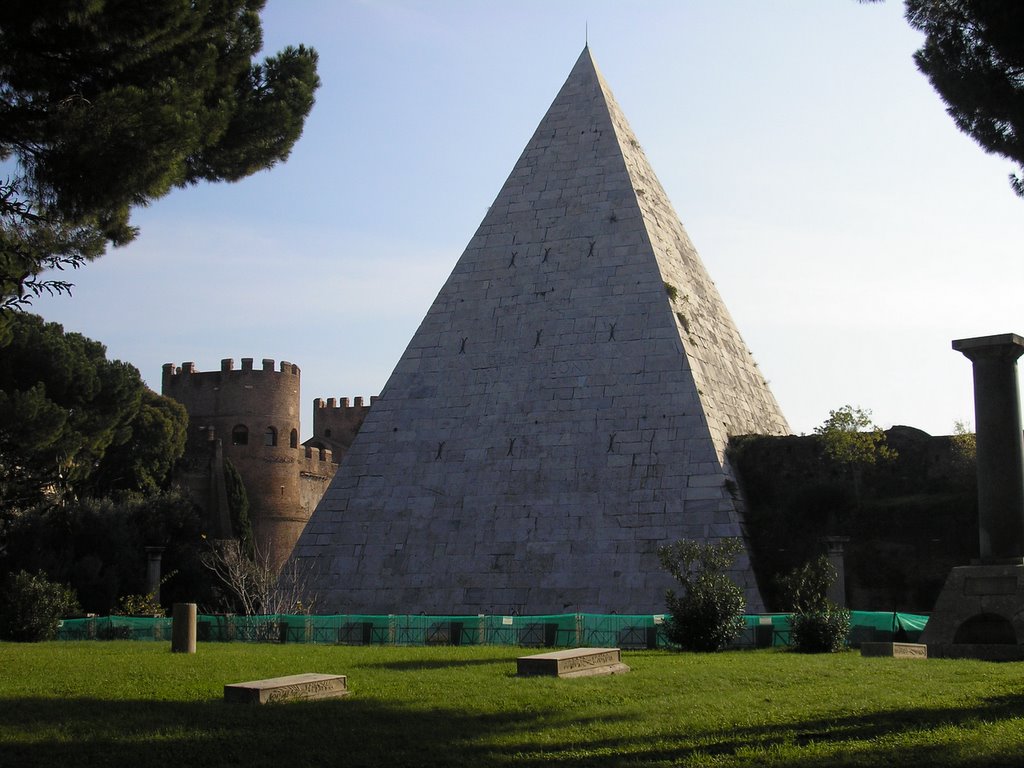
For all you Late Antique/Early and Medieval Christian Art and Architecture types, here is a picture of the grave of Richard Krautheimer, a civis Romanus.
And for all you Bryn Mawr types, here is a picture of the grave of Charles Densmore Curtis.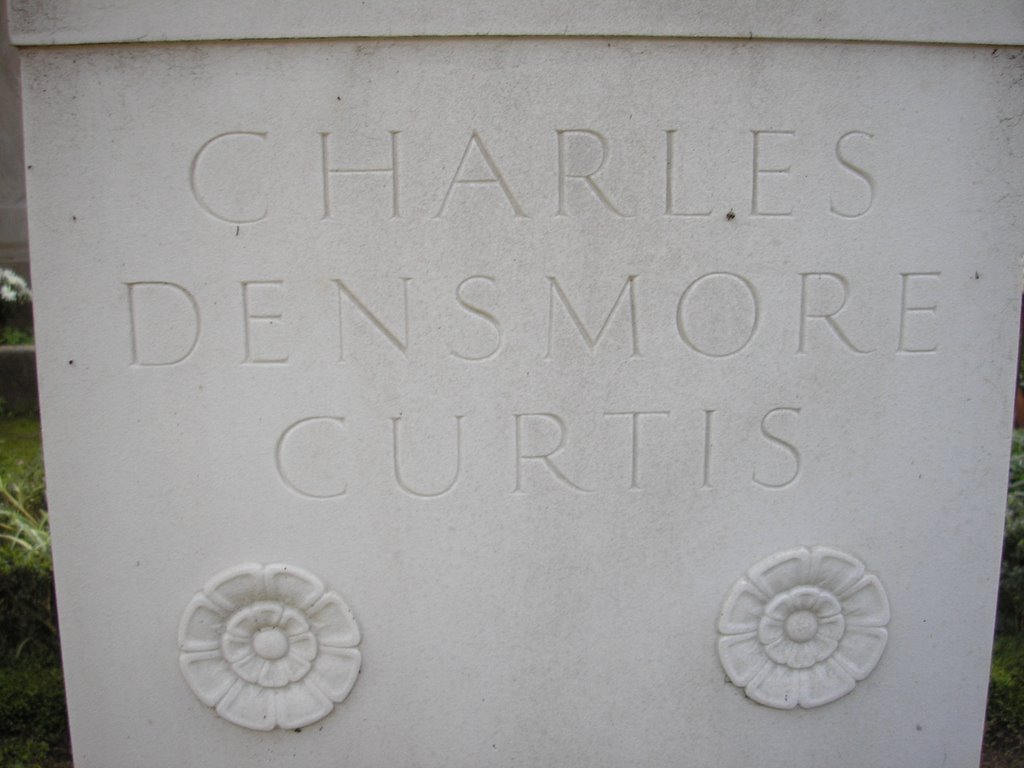
UPDATE: I also have some non-classical photos from the cemetery here.
Here is Merriam-Webster's word for today, of Latin heritage.
vulnerary \VUL-nuh-rair-ee\ adjective
: used for or useful in healing wounds
Example sentence:
Native Americans prized the herb echinacea for its vulnerary properties, using it to treat burns and snakebite as well as arrow wounds.
Did you know?
"Vulnus," in Latin means "wound." You might think, then, that the English adjective "vulnerary" would mean "wounding, causing a wound." And, indeed, "vulnerary" has been used that way, along with two obsolete adjectives, "vulnerative" and "vulnific." But for the lasting and current use of "vulnerary," we took our cue from the Roman scholar Pliny the Elder. In his Natural History, he used the Latin adjective "vulnerarius" to describe a plaster, or dressing, for healing wounds. And that's fine — the suffix "-ary" merely indicates that there is a connection, which, in this case, is to wounds. (As you may have already suspected, "vulnerable" is related; it comes from the Latin verb "vulnerare," which means "to wound.")
*Indicates the sense illustrated in the example sentence.
One more thing from rogueclassicism: there are a couple of confusing stories floating around about a wall collapsing in the Forum and the Colosseum being closed. I was a little surprise that I hadn't heard anything about this, so my wife went down to investigate this afternoon. She reports that everything appears to be open today, including the Colosseum; this doesn't mean that there wasn't a wall-collapse, but only that (so far, at least) it doesn't seem to have had a significant impact on site-accessibility. I'll update this as and when I come across any other information.
In reference to Magister Coke's teaching of AP Vergil, he might find the latest installment of Father Foster worth sharing with his class, in which the esteemed Latinist says a couple of times that Vergil is overdone, and that he prefers Horace. In fact, I think he even says at one point that there are 10,000 other Latin authors as good as Vergil (but I may be remembering incorrectly). I listened to it last night, and it was quite entertaining. Here is the link to rogueclassicism, from which you can click on a link to download the mp3 file.
And speaking of Vergil and Horace, I also learn from the rogue that today is the anniversary of Maecenas' death.
Maecenas atauis edite regibus,
o et praesidium et dulce decus meum,
sunt quos curriculo puluerem Olympicum
collegisse iuuat metaque feruidis
euitata rotis palmaque nobilis 5
terrarum dominos euehit ad deos;
hunc, si mobilium turba Quiritium
certat tergeminis tollere honoribus;
illum, si proprio condidit horreo
quicquid de Libycis uerritur areis. 10
Gaudentem patrios findere sarculo
agros Attalicis condicionibus
numquam demoueas, ut trabe Cypria
Myrtoum pauidus nauta secet mare.
Luctantem Icariis fluctibus Africum 15
mercator metuens otium et oppidi
laudat rura sui; mox reficit rates
quassas, indocilis pauperiem pati.
Est qui nec ueteris pocula Massici
nec partem solido demere de die 20
spernit, nunc uiridi membra sub arbuto
stratus, nunc ad aquae lene caput sacrae.
Multos castra iuuant et lituo tubae
permixtus sonitus bellaque matribus
detestata. Manet sub Ioue frigido 25
uenator tenerae coniugis inmemor,
seu uisa est catulis cerua fidelibus,
seu rupit teretis Marsus aper plagas.
Me doctarum hederae praemia frontium
dis miscent superis, me gelidum nemus 30
Nympharumque leues cum Satyris chori
secernunt populo, si neque tibias
Euterpe cohibet nec Polyhymnia
Lesboum refugit tendere barbiton.
Quod si me lyricis uatibus inseres, 35
sublimi feriam sidera uertice.
I am teaching AP Vergil this year, and I have a student who is trying to write in meter. I check his work, show him his mistakes, and he comes back with more mistakes than before. He is a rather smart guy, and he does not give up easily. I like to see his efforts, but I feel that somehow, his time might be spent better in other Latinic pursuits. I want to encourage him to pursue communication through other means until his vocabulary and his awareness of meter are more consolidated. So, I wrote a little poem for him in dactyllic hexameter. His latin name is Tertullus. I need some feedback.
Tu, Tertulle, loqui nunc visne aut scribere metro?
non facile est mihi simpliciter fandum vacuumque
verbum adipisci, verum est insanum modulate.
How's my meter? Have I missed anything? I am concerned about the use of "metro" and "modulate." Does the poem make sense to you? Any suggestions for word choice? Thanks!
Magister Coke

Illuminated manuscripts, because they are handmade and often contain miniature masterpieces of painting on paper, seem to belong more to the art museum than to a public library.
But a hundred of them are on display in the library's dimly lit D. Samuel and Jeane H. Gottesman Exhibition Hall on the first floor of the stately building at 42nd Street and Fifth Avenue. This is the cream of the library's 300 or so illuminated books. It includes Bibles, prayer books, atlases, scientific texts and romances, dating from the 10th to the 16th centuries.
Magister: Last night as I was walking down Fratelli Bonnet I saw Father Foster through the back window of a bus. I know it was him; the briefcase and clean-shorn head are unmistakable. I thought about trying to track him down to say hello on your behalf, but ultimately did not. Apologies.
On a somewhat unrelated note: last night I also watched an old episode of Seinfeld called 'The Cafe'. Toward the beginning of the episode, she keeps repeating the phrase casus belli because she had just read it in a book and wanted to say it. George persists in asking what it means, and she replies, 'It's just a Latin phrase, George; it doesn't mean anything'--and this right before she boasts of her 145 IQ!
... and in this case death:
A UNIVERSITY student died after being hurled 100ft through the air by a medieval-style "trebuchet" catapult, an inquest heard yesterday.
Kostydin Yankov, 19, an Oxford University student, suffered multiple injuries and serious spinal damage when he fell short of the safety net.
. . . . . . . . . .
The device is based on the trebuchets used in medieval times to hurl rocks and dead animals over castle walls during sieges. It uses a tonne of lead weight to give a see-saw effect and propel volunteers hundreds of feet into the air.
I've come across the abbreviation a.O. in a German article and I think it must mean the same thing as a.a.O, 'am angeführten Orte,' which is essentially ad loc.
Does anyone know for certain? Reference works have been absolutely no help.
This specimen, so far as I know, is the oldest extant bit of opus reticulatum in the city of Rome. It formed part of the structure of Rome's first permanent theater, the Theater of Pompey. It now forms part of the basement of a restaurant.
This same restaurant has a nice model reconstruction of the theater:
The Campus should reach 10,000 hits today, and that's no small feat.
I attribute it to things like this: someone found us yesterday by searching Yahoo for 'funniest aminals.' (Yes, aminals ... not animals.)
And you know what? We came up as number 9.
(See the previous posts in the sidebar if you're not sure how that happened.)
'Saranike' takes an entertaining and idiosyncratic trip through the OCLC's list of the top 1000 books. And she even mentions me at the end.
She pointed me toward the Reference list, so let's see what I own:
#4 -- MLA Handbook for Writers of Research Papers, Joseph Gibaldi
#5 -- History of Art, H. W. Janson
#7 -- Elements of Style, William Strunk
#10 -- Oxford Companion to American Literature, James David Hart
#11 -- Art through the Ages, Helen Gardner
#27 -- Oxford Companion to English Literature, Margaret Drabble
(n.b.: I don't have this edition, 'updated' by Margaret drabble, but rather the original by Sir Paul Harvey)
#30 -- Dictionary of Modern English Usage, H. W. Fowler
#34 -- Outline of History, H. G. Wells
Looking over the list, I don't want anything I haven't got, and I think I'm better with the other stuff I have than most of what pass for libraries today.
This could become a meme: which books do you own from which lists. I see the banned books list being particularly popular.
Mary Beard has a good, readable review of a number of books which rework classical myth. One of them, Margaret Atwood's Penelopiad (which she actually enjoyed), led her to lash out at a weak 'feminist' reading, and then at Robert Graves, whom she blames:
The only blot on this brilliant book is a chapter entitled "An Anthropology Lecture". This insists, through the mouth of the murdered maids, that deep beneath the story of Penelope lies the cult of the Mother Goddess, and that anyone who does not accept the matriarchal substrate of Greek myth has not learned the lessons of feminism. This is complete rubbish (most feminists I know think that matriarchy is itself a myth invented by patriarchal culture). But I suspect that Robert Graves has a lot to answer for here.
Graves was one of the few people who believed Butler's claims about the authoress of the Odyssey, and his bonkers White Goddess is a founding tract of New Age matriarchy. More influential, though, is his Greek Myths, which has been the standard reference work for half a century now (and is acknowledged by Atwood as a "crucial" source). The success of this book is a mystery; it is dry and dense, with almost as much footnote as text over its 800 pages. It is hard not to suspect that most buyers, attracted by the combination of famous author and authoritative title, do not get very far in actually reading it. But you need to skim only a few pages of the introduction to get the clear message that the Great Mother is the key to most of what will follow.
Can anyone recommend a good standard reference for poetic hymn- and prayer-form (classical/non-Christian)? I realize that individual writers make a lot of modifications to the forms; I'm just looking for something very basic that lays out the components.
That's what's finally happened to Sanskrit, anyway: it's now officially a classical language in India, joining the ranks of Tamil.
Hard to believe it's taken this long (if I read one more article/preface/etc. that opens, 'In 1786 Sir William Jones declared to the Asiatick Society of Calcutta ...' I don't know what I'll do).
maGgalavAdin!
Peter Bing opened The Well-Read Muse with the following inscription taken from the opening soliloquy of Plautus' Pseudolus, Act I Scene 4:
sed quasi poeta, tabulas quom cepit sibi,
quaerit quod nusquamst gentium, reperit tamen,
facit illud veri simile, quod mendacium est,
nunc ego poeta fiam
Robert H. Johnston, whose work in the digital restoration of archaeological finds resulted in ways to read ancient degraded texts such as the Dead Sea Scrolls, died Oct. 19 at his suburban Rochester home. He was 77.
"His influential body of work has had an indelible impact on the history of medieval science, and the depth and clarity of his scholarship has enlightened our understanding of subject areas as diverse as medieval physics and Egyptology," Peter Goddard, the institute's director said in a statement.
One more thing: my wife called me a 'big dork' today because I ran upstairs excited that the new edition of the Cambridge Ancient History vol. XII, covering the years 193-337 AD, was spotted by yours truly this morning on the new acquisitions table of the library. Maybe I AM a big dork (maybe? Come on, who am I kidding?), but I was nonetheless enthused to find it now available--I really would have like to have gotten my hands on it a couple of months ago in preparation for exams and all that, but alas, it was not to be.
Anyway, I skimmed through the contents and it looks like there might be some good stuff in there, especially for the Late Antique crowd. If anyone comes across a review of the book, please bring it to my attention.
My wife and I opened a bottle of a wine called 'Merlot Sangiovese Rubicone' tonight that has a rather interesting label. I reproduce it for you here: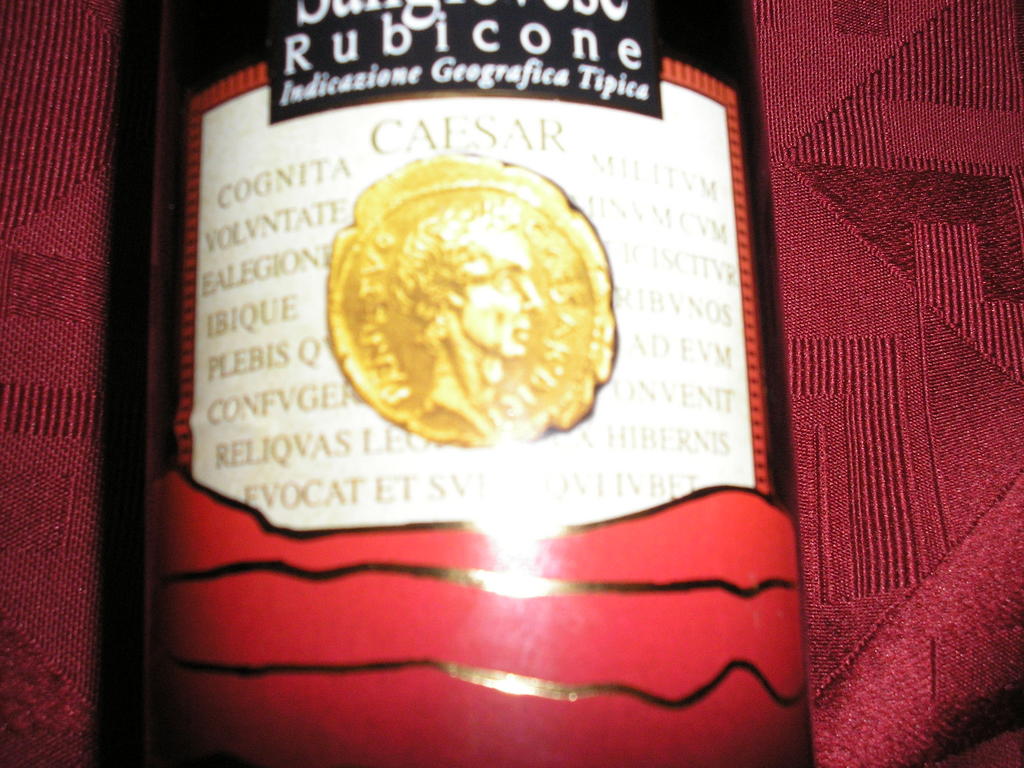
There's a little bit of a glare on the picture, but you can probably see the word 'Caesar' at the top above a Caesarean coin, surrounded by Latin. Here is how the broken Latin reads:
COGNITA MILITVM VOLVNTATE [...]MINVM CVM EALEGIONE [...]FICISCITVR IBIQUE [...]RIBVNOS PLEBIS QV[...] AD EVM CONFVGER[...] CONVENIT RELIQVAS LEG[...] EX HIBERNIS EVOCAT ET SVBSEQVI IVBET
Tonight on Jeopardy we learned that the Latin for the old Charlie Rich song 'Behind Closed Doors' would be 'januis clausis.'
Not 'post januas clausas' or even 'pone januas clausas.'
My response? 'What is "with the doors being closed, ..."?'
I haven't been keeping as close an eye on this as I should, but my alma mater, UMass, maintains an online database of Etruscan texts and other resources.
The project is headed by Prof. Rex E. Wallace, with whom I had the honor of studying Faliscan, Oscan, Umbrian, and yes Etruscan (along with a bit of Cisalpine Gaulish).
(After that class we had a department shirt emblazoned with a refrain from the purifications in the Iguvine Tables: 'place the testicles on the tray.' This was, of course, in the original Umbrian.)
The site promises a new version in development, but it's well worth checking out in its current incarnation.
Here's a shot I grabbed today of the Roman Forum. On the left, you can see the Temple of Antoninus and Faustina and the Column of Phocas, in the middle the Temple of Vesta and the Arch of Titus in the distance, and on the right the Temple of Castor and the Basilica Julia. I hope to have some more detailed posts soon on specific structures, but at present sleep is beginning to call enchantingly from her window.
As a side note, thanks to everyone who has been contributing ideas for the list. Keep 'em coming!
A bit of sense.
Many of the British Museum's claims are either unfounded, or have now become obsolete.
"We own the Marbles because Lord Elgin fairly bought and paid for them" - but he did not. "More people see the sculptures in London than in Athens" - no longer true. "The Greeks would not look after the sculptures properly" - this one is a case of "people living in glass houses..." What happened to the London sculptures in 1938, when they were attacked with chisels and abrasives to make them look whiter, has no counterpart with the Athens pieces, as was shown particularly in 2004 when the West Frieze of the Parthenon, which Elgin had left in place, was first exhibited (after a long process of conservation) on the Acropolis.
Teaching has been great so far. I don't mind the extra cash (which will soon enough cease to be extra and will have, somehow, to pay the rent). But my favorite part is when I can bring something to a lesson unplanned, moments when I can spontaneously bring to the students things from my experience with real Latin that has relavance for what they're learning and which actually catches their interest. I like to tell the girls about derivatives, word formation, or the relationship between Latin idiom and the romance languages. For example, the 8th graders were surprised to learn that egregius literally describes someone as standing apart from the flock, and the 10th graders should remember the impersonal use of placet with the dative now that they know it survives even today in French (s'il vous plaît, from si vobis placet).
Just yesterday I started tutoring a local high schooler who's already taking Latin and French and studying Italian and German on his own. He had been begging his father for some time to find him a tutor in Greek. I've started him on Chase and Phillips, and after the first session he's doing lessons 3 and 4. When I showed him the conjugation of eimi he recognized the formation from the cognate forms in Sanskrit.
This is going to be fun.
I've started trying to come up with a list of secondary works on the ancient world that I've never read, or never read in toto, and would like to and that seem in some sense to be seminal ('scuse the alliteration). Here's the list so far, in no particular order except perhaps that of the alphabet:
Buck, Carl Darling. The Greek Dialects.
Dodds, E.R. The Greeks and the Irrational.
Finley, M.I. The Ancient Economy.
Frazer, James. The Golden Bough.
Gibbon, Edward. The Decline and Fall of the Roman Empire.
Guthrie, W.K.C. A History of Greek Philosophy.
Harrison, Jane Ellison. Prolegomena to the Study of Greek Religion.
Heinze, Richard. Virgil's Epic Technique.
Jaeger, Werner. Paideia.
Sandys, John Edwin. A History of Classical Scholarship.
Syme, Ronald. The Roman Revolution.
Williams, Bernard. Shame and Necessity.
Via rogueclassicism, I have learned that a book from 1764 by Robert Adam called Ruins of the palace of the Emperor Diocletian at Spalatro in Dalmatia is now entirely available online. I've only had a chance to glance at it so far, but it's pretty interesting, especially for those with a penchant for Late Antiquity.
I've started reading the first volume of Bob Dylan's autobiography and came across this paragraph, in which I thought those interested in the ancient world might be, well, interested. It comes as he is standing in a library in someone's apartment, after a paragraph about he pop culture of his day.
Standing in this room you could take it all for a joke. There were all types of things in here, books on topography, epigraphy, philosophy, political ideologies. The stuff that could make you bug-eyed. Books like Fox's Book of Martyrs, The Twelve Caesars, Tacitus lectures and letters to Brutus. Pericles' Ideal State of Democracy, Thucydides' The Athenian General--a narrative which would give you chills. It was written four hundres years before Christ and it talks about how human nature is always the enemy of anything superior. Thucydides writes about how words in his time have changed from their ordinary meaning, how actions and opinions can be altered in the blink of an eye. It's like nothing has changed from his time to mine.
(Chronicles: Volume One, p. 36)
I read some of The Sound and the Fury, didn't quite get it, but Faulkner was powerful. I read some of the Albertus Magnus book...the guy who mixed up scientific theories with theology. It was lightweight compared to Thucydides.
There was a book there on Joseph Smith, the authentic American prophet who identifies himself with Enoch in the Bible and says that Adam was the first man-god. This stuff pales in comparison to Thucydides, too.
Well, in answer to Coke's query, teaching didn't go bad at all on Friday. But I suspect it's part of the reason I haven't posted anything in a few days.
I came away from the experience with a nasty cold or flu or something which I might have picked up from my girlfriend, but I think the collective germs a few hundred middle and high school students added to the soup and aggravated what my immune system had been holding at bay.
That said, the day was largely a success. Only one piece of paper was thrown my way, and it missed. Most of the students were so polite that they actually thanked me for being there. But the one thing that really surprised me was how different two classes in the same grade level could be so different. When the tests were finished, one class sat and drew pictures quietly, another erupted into a party, and the third passed notes and cast sly glances my way as if they were up to something but nothing came of it.
I'll let you guess which class threw the paper.
I was a little disappointed in how I handled one class, but I think some of that had to do with the assignment. Not that I'm second-guessing the teacher. I'm sure it works for her. Students were put into groups of 2 and asked to translate 2-3 sentences of a short mythic narrative. The problem was that the students were only concerned with the sentences they had been assigned and made a number of mistakes that they wouldn't have made had they known the context. When I went through the text with them it was clear that those who hadn't gone yet were so focused on re-reading their sentences that they took nothing away from what came before. When I had occasion to correct mistakes and explain why they were mistaken I was very often met with confusion or absolute disbelief, as when students insisted that a third declension dative was a genitive because it didn't end in -o.
Again, it may have had a lot to do with the fact that I wasn't their regular teacher. They know that I'm not coming back tomorrow, that I'm not giving them a grade. They can slack off for a day when the teacher's away, and maybe their teacher has a way of pulling this stuff out of them that I don't.
But I felt that if I were given a class of my own day in and day out I could make some real progress. It wasn't at all terrifying, so I've passed that test.
Another crazy thing is going back to middle school or high school and realizing just how young these kids are. I seemed so much older to myself when I was their age. It reminds me of my youth, and those memories are downright comical now.
I have a few more days lined up already and will be on call if anyone needs a sick day. The department head has offered to help me find a job in the area if I'm interested, and if that turns into anything I already have ideas.
Coke was talking about bringing in real Latin and I think I would like to try the Colloquia of Erasmus among other things.
But that's a long way away.
Since I recently posted a review of VDH's most recent book, I might as well post his recent review of two books in The New Criterion, The Long March: Xenophon and the Ten Thousand, edited by Robin Lane Fox; and “The Sea! The Sea!”: The Shout of the Ten Thousand in the Modern Imagination, by Tim Rood. The review can be found here (registration required).
For anyone who's interested, William Grimes in the New York Times has a review of Victor Davis Hanson's latest book, A War Like No Other: How the Athenians and Spartans Fought the Peloponnesian War.
(Lvrogueclassicism.)
Ok, here's the second batch.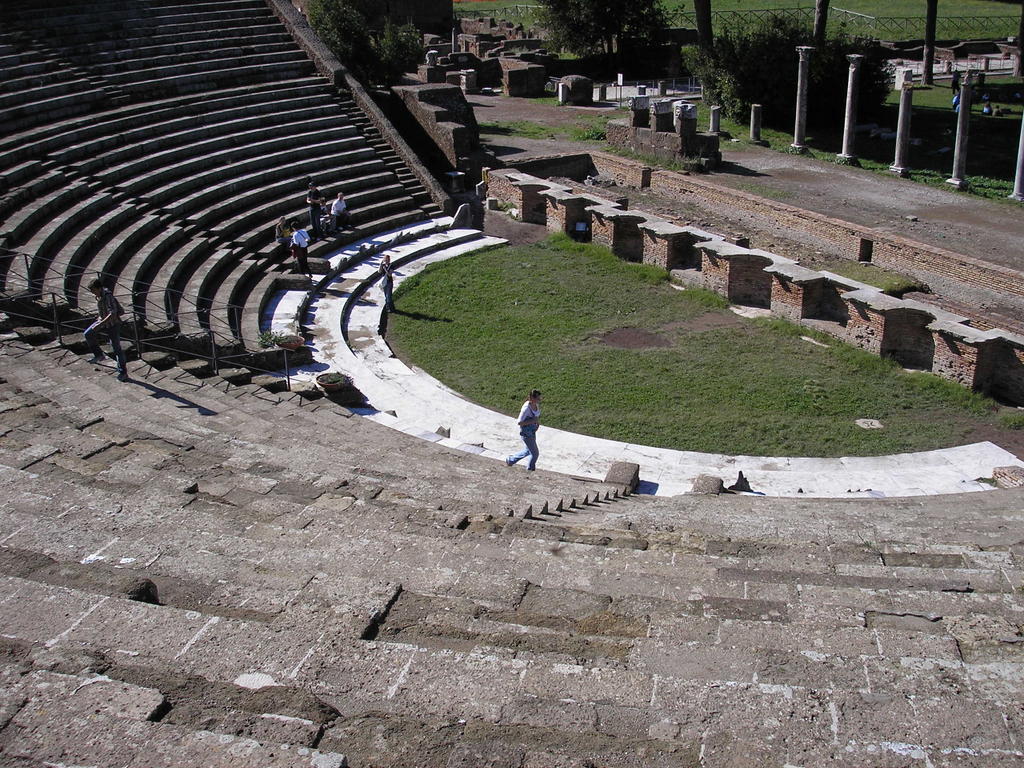 Another shot of the theater, which originally had 3 tiers of seating divided into five cunei (wedges) and a seating capacity of around 2,700; two of the tiers survive
 Theater masks
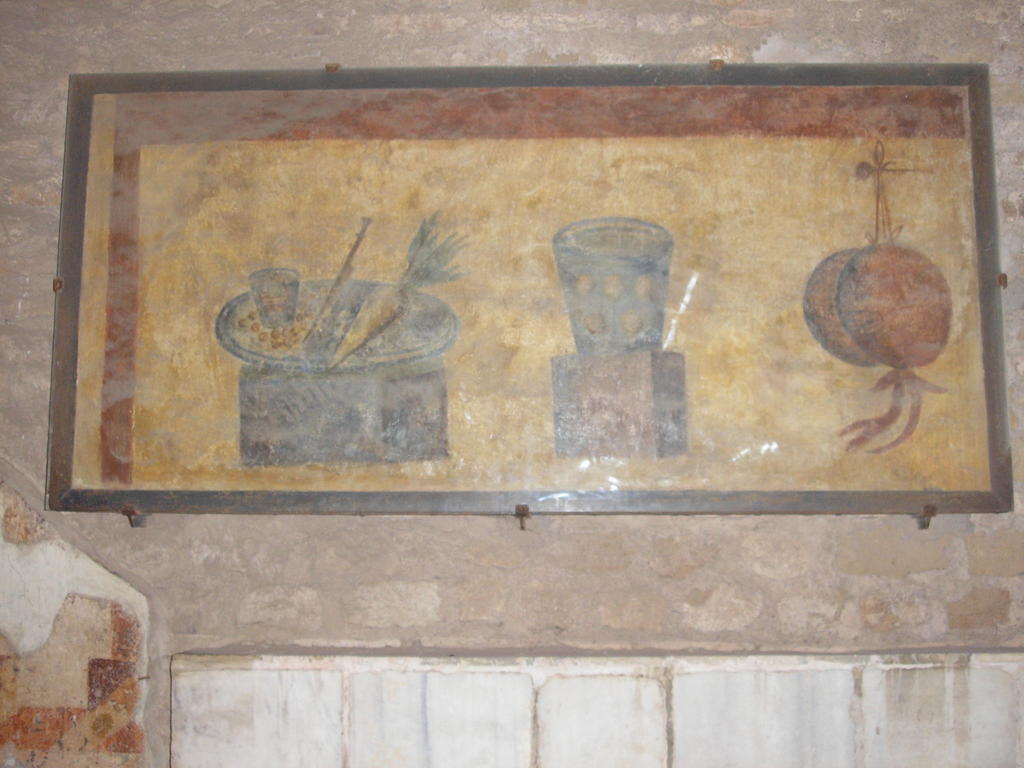 A painting of fruits and vegetables from a Thermopolium, which is very well preserved. The marble countertops are in excellent shape, and two seats flanking the door also survive
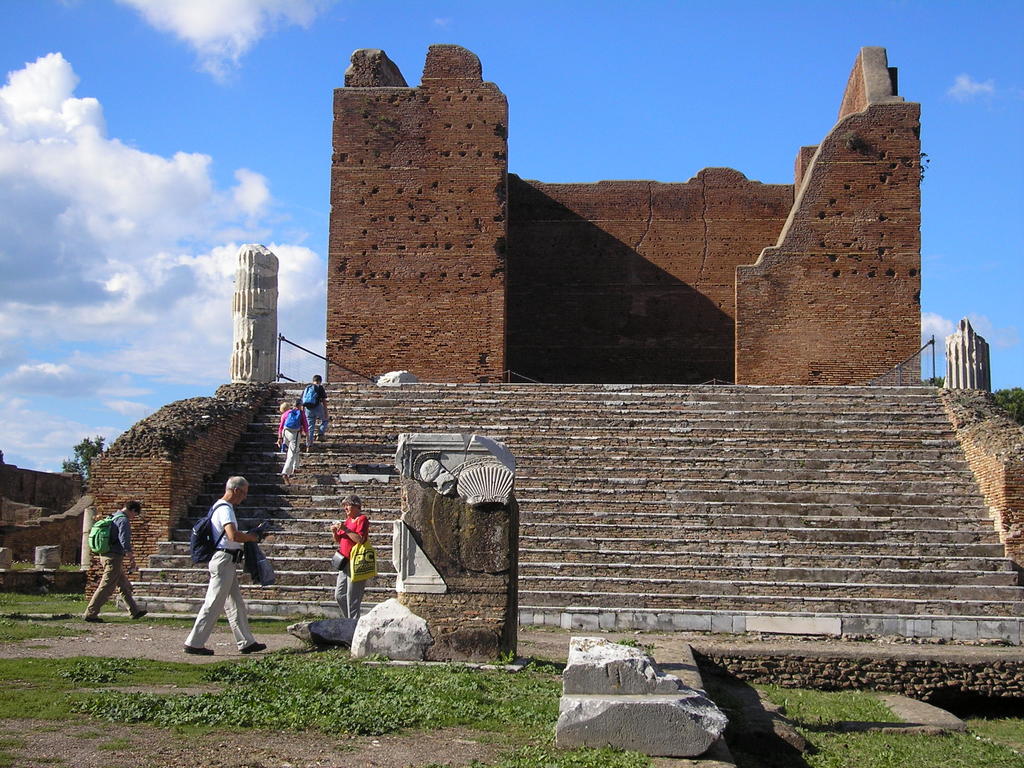 The Capitolium in the Forum. The temple was dedicated to the Capitoline triad (Jupiter, Juno, and Minerva)
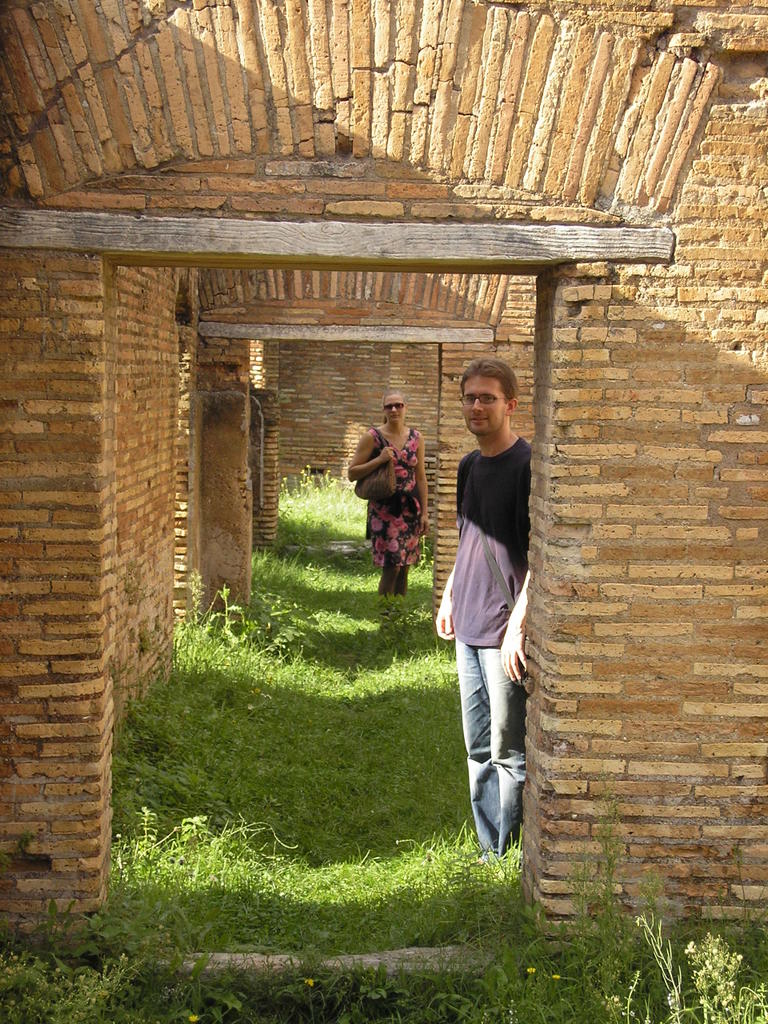 My wife Allison and brother Ryan in the doorways of some buildings on one of Ostia's side streets
If anyone is interested in other pictures of Rome that are not necessarily classical, my wife and I have been posting some at another website.
Dennis: how did the teaching go?
Ok, I'm back. My brother, wife, and I visited the ancient Roman port town of Ostia today and I just wanted to post some pictures for y'all. I have a few more pics to post, but blogger won't let me put them all in this one, so see above. 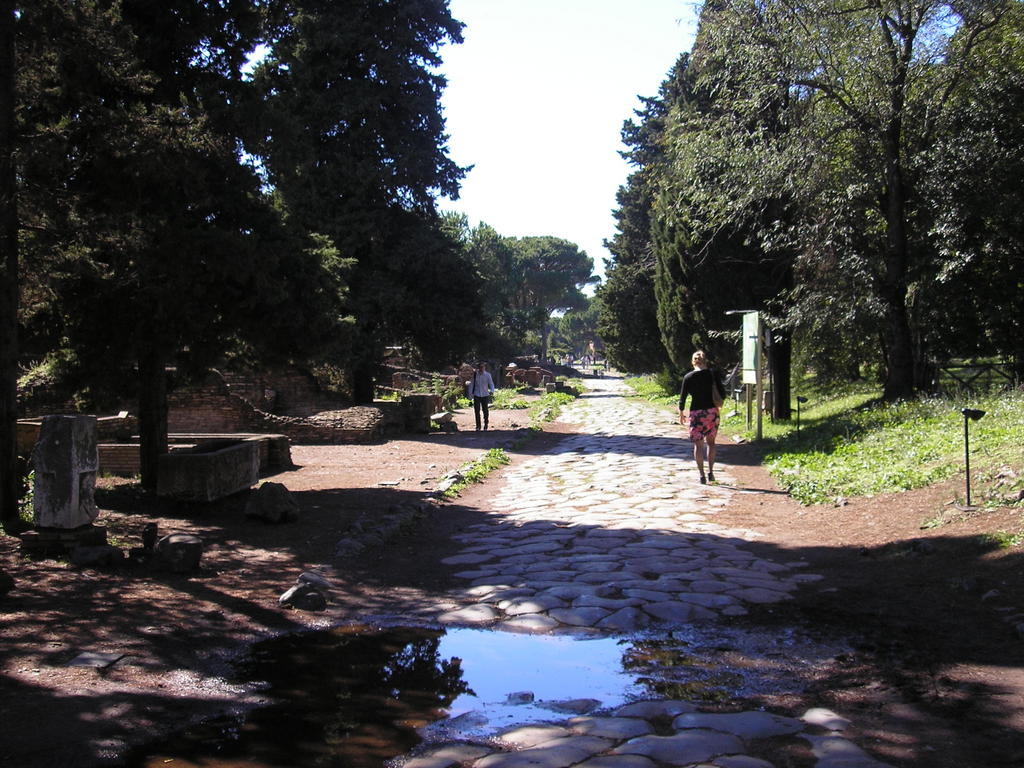 Via Ostiense
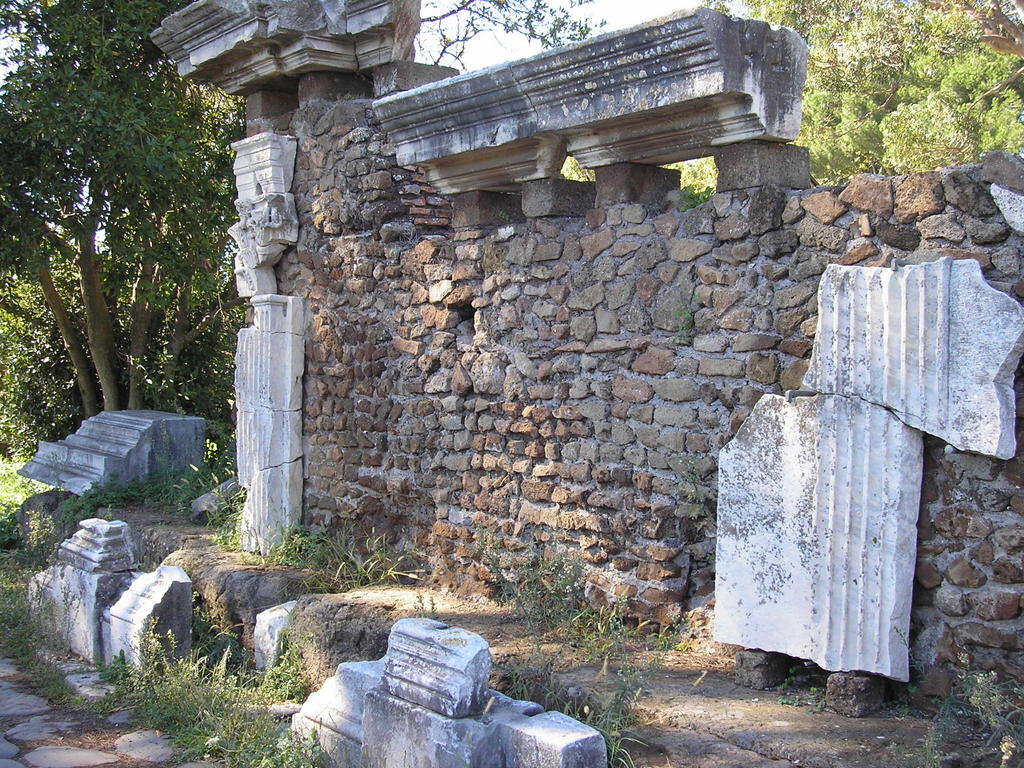 Porta Romana
 Fragments of the inscription once adorning Porta Romana. Notice 'P. Clodius...', and I believe the 'M' may be from Marcus Tullius Cicero
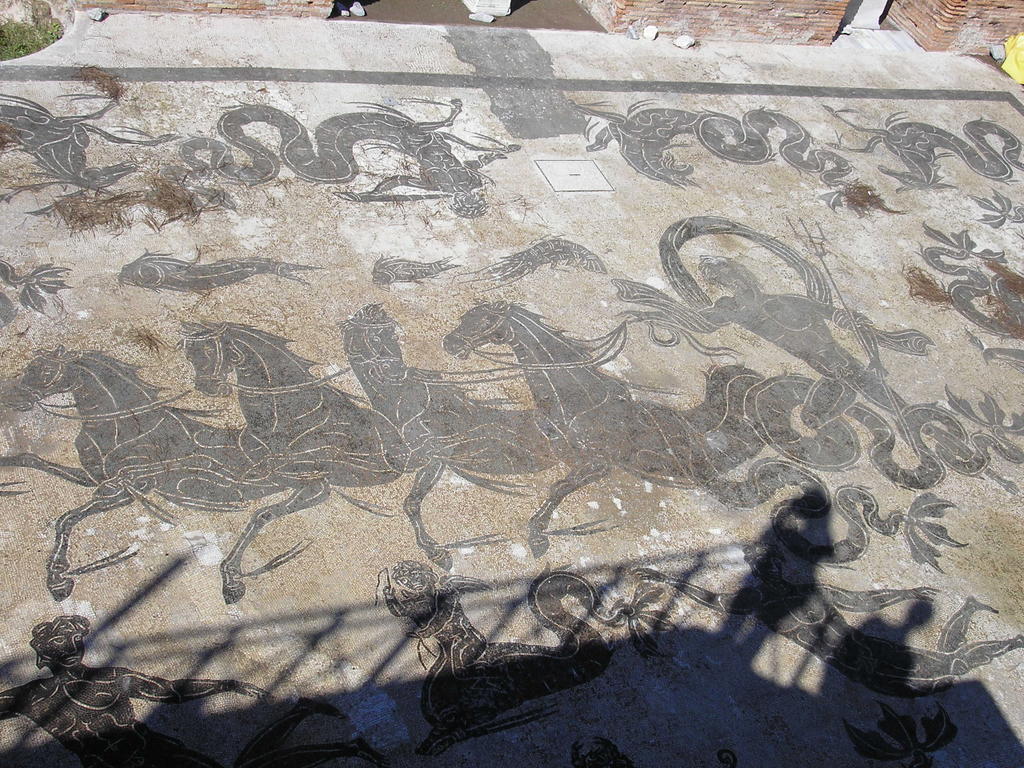 Neptune mosaic from baths
 Theater
I have a lot to say, so let me get started by giving Dennis the virtual high five for entering the classroom. I have to say that my life has never before made more sense than it does at the present time. I love being in that classroom and I hope that even as tomorrow strikes you, you will have some ember of an appreciation for the magic of being a GOOD teacher. As for the little snots (shites is a great term, too), let them sit in the bathroom for as long as they like. Let them smoke weed in the stalls, let them smoke crack; as long as they will be sure to OD before coming back into my ROOM. I want them out of my class! Don't waste my precious time! I advise you generally not to smile much at ALL, if you are able, since you are a sub. Try not to listen to their murderously sub-neanderthal conversations (if you are in study hall duty). Youths have to be trained to have decent conversations and no one is training these kids. Oh, but you are proctoring tests! Keep an eye on them as they do those tests. They know the system and they know where to put a little index card (right between their legs) with all the 3rd principle parts written in the tiniest letters you've ever seen. I love them, but they are who they are.
I will check out those websites. I am right now generally looking for Latin texts that are REAL, on the internet, can be read by students of lower levels (with some degree of support), and show the language being used artfully. I found this one fantastic set of readings (gesta Romanorum) and I also like to try Publilius (that's what they call him on the Latin Library.com, but I thought his name was Publius) Syrus. We also do Vulgate Latin and Thomas Aquinas because generally, it's just easier stuff. I hunger for material that has less passive constructions and less subjunctives. It's basically impossible to find that kind of stuff, bu I am finding ways to help my students along in passages with Latin constructions they've never seen before. The truly unfortunate thing about Latin textbook series overall is that they do not vary the word order in the readings enough for it to make sense for the students to memorize proficiently those noun endings. Furthermore, the style of the textbook writers is just simply atrocious, because quite obviously they have no CONCEPT of style. But students do, and the book (Oxford Latin) is a bore for them. These are students with a whole IPOD full of artists expressing complex emotions and ideas. Do you think they want to read about Scintilla and Flaccus going to market? These textbook series, I believe, are seriously crippling the progress of student interest in Latin in the country. When I work with the word order and the students use their dictionaries on a daily basis (from the very first year), suddenly the language is extremely FUN for them. It's like another world suddenly. Suddenly, suddenly.
I wrote Reggie a small note a few weeks ago, saying something like:
Dear Reggie,
I am teaching Latin by your method as best I can. I taught last year using those textbooks you used to rage about in class. I see now what is wrong with them. I am teaching Latin your way, and I am really DYING for the language. I don't sleep anymore. You sent me out as Father Zosima sent out Alyosha. I miss you a lot. I hope your health is better and that the surgery went well. If you need money for photocopies or anything else, please let me know.
Aaron.
This is what he wrote back on a postcard (I just got it tonight...) in four different colors of ink:
Pridie Kalendas Octobres m m v.
AARONI SUO
REGINALDUS
SALUTEM.
TUA MIHI SALUTATIO SIMULQUE
LAMENTATIO PLURIMUM SANE
ADTULIT IUCUNDITATIS ET CONSOLA-
TIONIS. I am happy you are sharing
with others in the classroom and are
on fire with Latin. The time has passed
and after our 20th "AESTIVA" and vacation (aestiva is the summer program)
in Wisconsin, I am back waiting for the
pope to do something AND preparing also
for a full year of 5 experiences at the (experiences are the levels of Latin -
University in a few weeks. My health he teaches five preps.)
is fine, as my legs and feet have by
nature healed. I am better = worse than
ever, and have energy and ideas for a
long time to come. The no-Latin crisis
in the Catholic church will grow, and I
do not know what THEY will do about it.
I always speak about more interest-study
of Ltin outside than inside. SO you must
continue your zealous no-sleep efforts.
TIBI FAVENTES ADSUMUS PECUNIA NON EGENTES.
-Reginaldus
The only thing that bothered me about the letter was that he put a macron over the A in PECUNIA. Did I seem that stupid in his class?
But otherwise, the letter took me to the third level of Nirvana. When I got the letter, my heart was pounding. I am actually going to stay up tonight and finish grading my homework assignments, just as I know that Reggie does. The whole night. I am pulling an all-nighter as a teacher. Well, unfortunately, my workaholic habits have done more than made me lose sleep. I have lost 15 pounds in the last three months. I work like a raving madman. I am actually dying for the Latin language. I don't really care, because I actually feel happy. I think I won't mind dying like this. When I tried to DIE for graduate school, I was always miserable. Perhaps I have found my true home...
Anyway, either I will die or something beautiful will come out of all of this. I am betting on the second of the two. I guess I better get started grading now.
AARON EIUS
Sarah and I took a nice walk around campus this afternoon, and though I'm in my third year here (!) I saw lots of things I hadn't seen before.
Like the pond. Where did that thing come from?
I imagine a lot of people haven't seen them because they're off the paths, but they're the most beautiful and interesting angles and bits architectural oddities.
I'm going to bring a camera soon and share some of this stuff.
I think I may also locate the fabled Latin inscriptions left by former students, such as the one that apparently translates 'death to squirrels.'
But for now it's back to work.
If you haven't already heard (and where have you been, I might ask), be sure to check Library Thing, brought to you by Tim Spalding, whose other sites, Isadore of Seville and the Ancient Library, have been discussed here before.
It's an easy-to-use online database of your books. Now you don't have to invite people to the apartment to show off your book collection. That means more beer and food for you.
On an unrelated note, I'm looking at a copy of Graham Zanker's Realism in Alexandrian Poetry, and it makes me wonder if there's anything realistic in my hope to re-read all the Greek epic I can get my hands on this week (and by epic I don't mean just 'heroic' epic).
And on another unrelated note, I have my first teaching duties this Friday, filling in at a local private school. I'll mainly be proctoring tests, thanks to the kindness and planning of the usual teacher, but I'll have my hands full with one eighth grade class dealing with the 3rd and 4th conjugations.
That I can handle. But do you have any encouraging words for a guy stepping in front a class of kids for the first time?
Magister Coke?
A few weeks ago Michael Hendry was wondering about certain orthographical conventions (adscript iota and the like) and was surprised to find that 'siculate sigmas' hadn't caught on.
I tried to post a comment asking for more information, but it doesn't seem to have taken (apologies if it does, and this is redundant), so I thought I'd ask our readers for input.
Does anyone know what a siculate sigma is?
The way I see it there are three possibilities:
1) A sigma which resembles a Sicilian girl (from Siculus, -a, -um)
2) A sigma which resembles a small curved dagger, with handle (final sigma, ς)
3) A sigma which resembles a small curved dagger, sans handle (lunate sigma, ϲ)
Little help? I know others (such as Caelestis at Sauvage Noble) have been wondering.
Statues of Athena and Hera have found at Gortyn in Crete:
The works, representing the goddesses Athena and Hera, date to between the 2nd and 4th centuries AD – a period of Roman rule in Greece – and originally decorated the Roman theatre in the town of Gortyn, archeologist Anna Micheli from the Italian School of Archaeology told the Associated Press.
“They are in very good condition,” she said, adding that the statue of Athena, goddess of wisdom, was complete, while Hera – long-suffering wife of Zeus, the philandering king of gods – is missing her head.
Here's the full citation for the article on the excavations of the mask and the tripods & cauldrons at Ithaka:
Benton, Sylvia. BSA (The Annual of the British School at Athens) 35 (1934-1935): 45-73.
(It was actually published in 1938 by Macmillan & Co., and 1934-1935 marks the session, but it should be catalogued under the latter.)
The description of the mask is on page 54, with a plate on 55 showing a black and white photograph and a line drawing.
The top of the mask reads horizontally
ΕΥΧΗΝ Ο
ΔΥΣΣΕΙ
while the lower portion, of which the surface is completely gone, yields only Η and Ν at the ends of two vertical lines.
Based on this the following was proposed:
εὐχὴν Ὀδυσσεῖ, [ὁ δεῖνα ἀνέθ]η[κε]ν.
i.e., 'Votive offering to Odysseus, so and so dedicated it.'
It seems to me a poor translation. If the reconstruction is at all correct it should say, '(so-and-so) set (this object) up (as) a vow to Odysseus.'
Anyone with anything to contribute? An updated bibliography? Thoughts on the controversy?
Roger Cox at Scotsman.com writes about the new book by businessman Robert Bittlestone, (written with the aid of geologist John Underhill and Euripides scholar James Diggle, who doesn't appear to have a decent on-line bio).
Essentially they argue that the western peninsula of Kefalonia was once an island, now joined to its neighbor by rockfalls and deposits, and that it better accords with Homer's description in book 9 than does the island now called Ithaka:
In book nine of The Odyssey, Ithaca is described as "low-lying" and "furthest towards dusk [i.e. west]" of all the nearby islands. However, the island now known as Ithaca is mountainous, and lies to the east of its neighbours.
αὐτὴ δὲ χθαμαλὴ πανυπερτάτη εἰν ἁλὶ κεῖται (25)
πρὸς ζόφον, αἱ δέ τ’ ἄνευθε πρὸς ἠῶ τ’ ἠέλιόν τε,
τρηχεῖ’, ἀλλ’ ἀγαθὴ κουροτρόφος·
In Book 8 of the Odyssey, Homer tells how Odysseus receives gifts from King Alkinoos of Phaeacia before he sails back to Ithaca. The gifts were from "12 noble lords ... and I myself the 13th", says the king. What were the gifts? Later in Book 13 we read: "Come let each of us man by man give him a large tripod and cauldron..."
So 13 men gave Odysseus gifts, and the finds in the 1870s and 1930s add up to 13 cauldrons. When dated, they are proved to be from before Homer.
I've added a number of blogs to the sidebar (each of which links here):
Por las tierras de los Banu Qasi, en Español. This blog appears to cover an interesting range which includes Mongolian history, Linux, and fiction.
hobbyblog, for all you numismatists.
AVE, by a self-described 'Ancient Roman history geek' in Vancouver.
Netlex News, with posts divided among 46 categories, covers art and music among many, many other things.
Memento Vivere, which I've linked to before, now makes the sidebar: 'Classicism for the 21st Century.'
The Hellenophile, where a commercial property examiner from Ohio--with degrees in classics and history--shares his love of Greece. (Seems dormant, but blogs go that way now and then.)
Frequent Citations, 'musings and misadventures of a would-be lawyer' who must have a background in Classics if she bothers with this here blog.
That's it for now. There's no hierarchy there -- just listed in the order I found them.
Also, our e-mail address has changed: it's now campusmawrtius@gmail.
Bring on the spam!
p.s. I was too lazy to put the addresses here in the post, so you'll just have to use the sidebar. Sorry.
Who says scholarship doesn't have any impact on the real world?
Israel unveiled an underground archaeological site near a disputed Jerusalem holy shrine on Tuesday, nearly a decade after the opening of an exhibit in the same area sparked widespread Palestinian rioting.
The latest discovery included a ritual bath from the period of the second Jewish Temple, destroyed in 70 A.D., and a wall that archaeologists said dates to the first Jewish Temple, destroyed in 586 B.C. The findings strengthen Jewish ties to the shrine also claimed by Muslims.
I am doing it! I am following Reggie's methods! They said it could not be done! All of his students would say, "The old man's impractical. You can't teach Latin like THAT to a bunch of highschoolers!" That's because they were all idiots. It is working well, and for the first time, my job seems to MAKE SENSE. My students LIKE LATIN and they understand why the cases are important. We look at the real Latin stuff and my students LOVE IT. Okay not all of them. Some kids are only pleased by stupid video games and chocolate.
quodcunque ostendas eis, increduli oderunt. Verum universa non est turba ac iam eas auras mentes vidi meis cum oculis
vita mea nunc vivit.
Hey Dennis, am I allowed to write in Latin on this blog as much as I like? Is it annoying to the readers? I like to write in Latin, and most certainly my Latin is not the best, but where else would I find an audience to critique my work or give me suggestions on word usage and finer points of grammar?
We've been inundated with comment spam recently, and I just noticed that Blogger has word verification to ensure that real people and not robots are entering comments.
So I apologize for the inconvenience but it's better than reading (and deleting) unwanted advertisements.
James Le Fanu at the Telegraph has a column on something called the Ulysses syndrome which might have interest for classicists and which reminded me of a scene from my favorite show, House:
Medicine is full of classical allusions, a faint echo from the days when doctors knew more of the world than just the narrow horizons of science.
So, famously, we have the Achilles tendon, after the young warrior was dipped in the river Styx by his mother to ensure his immortality, while the atlas, the first of the vertebrae at the top of the spine, like its namesake, balances a globe - the skull - on the shoulders. There is the iris, after the Greek goddess of the rainbow, and the hymen, in honour of Apollo's son, so beautiful he was thought to be a girl.
More recently, the paediatrician Charles Essex, writing in the British Medical Journal, has drawn attention to the Ulysses syndrome, a reference to the Greek hero's 10-year odyssey following the Trojan war, with its many dangerous and occasionally pleasurable adventures - before he eventually returned to his point of departure. Similarly, those with the Ulysses syndrome, though healthy enough at the start, undertake a long journey with many disagreeable adventures on the way - before ending up where they started.
Researchers at Cornell have used x-ray fluorescence to recover a number of illegible inscriptions, and apparently Draco's laws are among them.
The article is found in ZPE 152 (2005): 221–227, 'X-ray Fluorescence Recovers Writing from Ancient Inscriptions.'
Unfortunately our copy is currently in 'labelling' which means I may never see it. I'll have to make do with short-on-content articles that feel the need to translate the names of publications.
(Zeitschrift fuer Papyrologie und Epigraphik is translated--Journal for Papyrology and Epigraphy--and given with no further citation other than 'the August issue,' so that lots of people who might want to read the article--and not the article about the article-- might have a hard time finding it.)
Here's something that might actually get me out of the Philly area for a day: the Edwin Smith papyrus:
What researchers call the world's oldest known medical treatise, an Egyptian papyrus offering 4,000-year-old wisdom, has long dwelled in the rare books vault at the New York Academy of Medicine.
It is an extraordinary remnant of a culture that was already ancient when Rome was new and Athens was a backwater - Egypt's stone monuments endure, but the scrolls made of pulped reeds have mostly been lost. One expert, James H. Breasted, who translated the papyrus in the 1920's, called it "the oldest nucleus of really scientific knowledge in the world." Yet relatively few people know of it, and fewer have seen it.
It is about to become much better known. After a short trip down Fifth (insert down-the-Nile metaphor here) to the Metropolitan Museum of Art, the papyrus will go on public display, probably for the first time, on Tuesday, as part of the Met's exhibition "The Art of Medicine in Ancient Egypt." The show will also include items like a CAT scan of a mummy, surgical needles and other medical artifacts.
Today Eric completed the oral examination for his PhD prelims and will be heading off to Rome next week to begin work on his dissertation as the first Marti Fellow to the American Academy.
As Professor Scott told us today over champagne following Eric's exam, Berthe Marti was partial to three institutions: Bryn Mawr College, UNC Chapel Hill, and the American Academy. Her dream was to send one Bryn Mawr and one UNC graduate to the Academy each year on a fellowship, a dream which the changing times and financial constraints have forced to compromise.
All of us here know that Eric will do everyone proud.
Here's a biographical sketch of Berthe Marti written by Bryn Mawr alumn Eleanor Dickey (A.B./M.A. 1989) while still an undergraduate:
Berthe Marti, a graduate of the University of Lausanne, came to Bryn Mawr as a graduate student in 1925, wrote her dissertation with Lily Ross Taylor, and received her Ph.D. in 1934. She began teaching in 1930 and remained at Bryn Mawr until 1963. Although most famous as a medievalist, she also taught classical Latin and sometimes French.
I am thoroughly enjoying (very occasionally) browsing through Briggs and Calder's Classical Scholarship: A Biographical Encyclopedia (and I do take Rusten's caution to heart, especially since I noted a few glaring omissions myself).
You can read about former Bryn Mawr professors Paul Shorey, Tenney Frank, and Lily Ross Taylor. I see via the department's site that Briggs's Biographical Dictionary of North American Classicists contains entries on Paul Shorey, Herbert Weir Smyth, Gonzalez Lodge, Arthur Leslie Wheeler, Tenney Frank, Lily Ross Taylor, Louise Adams Holland, and T. Robert S. Broughton.
But the reason I started this post was simply to say that I envy the old-timers who knew these languages better than many of us ever will. I've just gotten my hands on J.G. Schneider's edition of the Theriaca of Nicander (1816) which has been highly praised by those in the know (one modern scholar once called it the only useful edition, a direct slap to Otto Schneider's edition of 1856 and an acknowledgment of the limitations of Gow-Scholfield). I haven't time to do much with it yet, but the most promising thing is J.G. Schneider's prose: his Latin is the clearest academic Latin prose I've come across.
That's high praise.
The following story has relevance for those interested in classical civilization and archaeology, as well as the internet (hat tip to Sarah):
A computer programmer looking at Google Earth satellite images has reportedly discovered the remains of an ancient Roman villa near Sorbelo, Italy.
Luca Mori of Sorbelo was looking at a satellite image of his area, located near Parma, when he noticed unusual shading near his home, the London Telegraph reported Wednesday.
He said the area had an oval shaded form more than 500 yards long, with some unusual rectangular shadows nearby.
Archaeologists subsequently determined the rectangular lines were, most likely, a buried structure and the oval area was likely the course of an ancient river.
Mori contacted the National Archaeological Museum of Parma, which investigated.
"At first they thought the site might be Bronze Age, but a closer inspection turned up ceramic and stone pieces that showed it was a Roman villa built some time just before the birth of Christ," he told the newspaper.
Mori said he was happy with his discovery. "I have managed to get people talking about the Internet because of something interesting rather than pedophiles and viruses," he told the Telegraph.
This will probably seem silly to anyone who actually knows German, but I've been working on my reading competence and I'm finding it much easier to deal with compound verbs by thinking of a hierarchy of compositional elements.
The second position in the sentence of course takes the finite verb, and the other parts get kicked back to the end of the sentence.
The rank goes like this:
(1) Futurity (2) Perfectivity (3) Passivity (4) Verbal idea
Their ordering goes like this:
... A ... (D,C)B
It's that final position which moves right to left that seems tricky at first.
In English we have the same hierarchy but for the fact that ours reads from left to right.
Compare the following:
G. ... wird ... gesagt worden sein.
E. ... will have been said ....
If you remove any element, the hierarchy requires that the other elements take their proper place. If you wanted to remove the passivity, worden and been would both be dropped and their place would be taken up by gesagt and said, and the auxiliary of sagen (haben) rather than of werden (sein) would take final position:
G. ... wird ... gesagt haben.
E. ... will have said ....
In neither language is there any flexibility in the position of each element. If any of them is present it will take its place in the hierarchy.
Again,
German, ... A ... (D,C,B)
English, ... A (B,C,D) ...
Then again, I'm just a classicist struggling through this language. Go ahead and trash and/or correct me in the comments.
I've been working on a new edition of an old Greek textbook, as some of you know, and I've made my share of contributions--mostly of the negative variety, like successfully lobbying to delete unsound linguistic arguments.
But yesterday I was greeted with the note 'NEED EXAMPLE' on the accusative absolute.
I wrote:
(e.g., δέον ἡμῖν ἀπιέναι, ‘it being necessary for us to depart’ ; δέον is the neuter accusative participle of the impersonal verb δεῖ. Compare the genitive absolute ἀπερχομένων ἡμῶν, ‘with us departing’).
Let's see what's on the agenda here at the Campus ...