Wednesday, September 06, 2006

Today's Quintilian: 8.6.26

XXVI. huius enim sunt generis cum "ab Hannibale" caesa [et apud tragicos aegialeo] apud Cannas sexaginta milia dicimus, et carmina Vergili "Vergilium", "venisse" commeatus qui adferantur, "sacrilegium" deprehensum, non sacrilegum, "armorum" scientiam habere, non artis.

26. We adopt it when we say that "sixty thousand were killed by Hannibal at Cannae"; when we say "Virgil" for Virgil's poetry; when we say that "provisions," which have been brought, "have come"; that a "sacrilege has been found out" instead of the person who committed it; and that "a soldier has a knowledge of arms" instead of a knowledge of the military art.

Tuesday, September 05, 2006

Today's Quintilian: 8.6.24-25

XXIV. Quod fit retrorsum durius. Refert autem in quantum hic tropos oratorem sequatur. Nam ut "Vulcanum" pro igne vulgo audimus et "vario Marte pugnatum" eruditus est sermo et "Venerem" quam coitum dixisse magis decet, ita "Liberum et Cererem" pro vino et pane licentius quam ut fori severitas ferat. Sicut ex eo quod continet id quod continetur: usus recipit "bene moratas urbes" et "poculum epotum" et "saeculum felix", at id quod contra est raro audeat nisi poeta: XXV. "iam proximus ardet Vcalegon". Nisi forte hoc potius est a possessore quod possidetur, ut "hominem devorari", cuius patrimonium consumatur: quo modo fiunt innumerabiles species.

The reverse would be offensive.

24. It is of great importance, however, to consider how far the use of the trope is permitted to the orator, for though we daily hear "Vulcan" used for fire, though it is elegant to say vario Marte pugnatum for "the fortune of the battle was various," and though it is more becoming to say "Venus" than coitus, yet to use "Bacchus" and "Ceres" for wine and bread would be more venturesome than the severity of the forum would allow. Thus, too, custom permits us to signify that which is contained from that which contains it, as "well-mannered cities," "a cup was drunk," "a happy age." But the opposite mode of expression scarcely any one would use but a poet, as Proximus ardet Ucalegon, "Ucalegon burns next." 25. It may perhaps be more allowable, however, to signify from the possessor that which is possessed, such as "a man is eaten up" when his estate is squandered. But there are numberless forms of metonymy of this sort.

Monday, September 04, 2006

Today's Quintilian: 8.6.23

XXIII. Nec procul ab hoc genere discedit metonymia, quae est nominis pro nomine positio, [cuius vis est pro eo quod dicitur causam propter quam dicitur ponere] sed, ut ait Cicero, hypallagen rhetores dicunt. Haec inventas ab inventore et subiectas res ab optinentibus significat, ut "Cererem corruptam undis", et "receptus terra Neptunus classes aquilonibus arcet".

23. From synecdoche, metonymy is not very different. It is the substitution of one word for another, and the Greek rhetoricians, as Cicero observes, call it ὑπαλλαγή (hypallage). It indicates an invention, by the inventor, or a thing possessed, by the possessor. Thus Virgil says,

Cererem, corruptam undis,

Ceres by water damaged,
and Horace,

receptus
Terra Neptunus classes Aquilonibus arcet,

Neptune, received
Within the land, from north winds shields the fleets.

Jargon

This is just a note to ask if any teachers out there feel that 'professionalism' obscures a lot of common sense. I'm just starting out, but so much of the jargon reminds me of the sort of thing I abhorred in journals in graduate school, where the adoption of a hip vocabulary allows anyone to sound like a technically proficient specialist. Often, theorese (the language of theory) can be broken down in simple, almost laughably common ideas that are made to seem larger than life, and just as often the proponents of a given theory pretend that talking about the same old things with new terms is a revolution.

I don't think educationese (I thought I'd just coined that!) goes that far--i.e., I don't think it's consciously elitist, just consciously 'professional'--, but it is obscure.

For example, I've been reading in teacher's manuals and in lesson plan guidelines that I need to be sure I build 'formative and summative assessment' into each lesson.

I diligently sought out the precise meaning of this precise phrase that gets bandied about in education circles. It must be very important to have been codified and to be constantly repeated, I thought.

But it turns out that this is just a fancy way of saying something I had already planned to do: pay attention to how the lesson's going, then try to get some feedback at the end to see that it worked. The former is encoded as 'formative assessment' and the latter as 'summative.'

Did I need to be told to do that, and did I need to be told in cold, lifeless jargon?

I'm reminded now of Richard A. Lanham's little book, Revising Prose. He called this 'the Official Style.' I don't think it's even suited to the office.

Lepide!

Eh. Not so fast.

What the *bleep* is this?

That'll really get my students (and their parents) excited about Latin.

And I haven't even mentioned the one that asks, 'Hey! Where's my toilet paper?' What else could it mean?

Browse around and you'll see that some Latinists like dancing, while others are just crazy about ointment.

I would like to take this opportunity to tell my fellow Latin teachers that if your students seem amused by this kind of stuff, they are, but not in the way you think.

They think you're a dork. Those who don't, however, are themselves dorks. It is our civic duty to make Latin cool by not trying to make it 'cool'.

Saturday, September 02, 2006

Classics Watch

In today's Philadelphia Inquirer there are at least two Classics references. The first is from a letter to the editor:

It's quite a commentary on the state of America today that a major network feels a race-baiting reality show is good for prime time and a newspaper's Editorial Board tells its readers they "shouldn't be reluctant to watch" it.

The real question is: Why is such a blatant prime-time racial provocation any worse than much of the garbage American TV viewers already support with their viewing and consumer habits? The Romans had gladiator matches as part of the "bread and circus" that kept the Roman citizenry from asking too many questions about what was really going on. Survivor and other TV reality competitions may not be as violent as Roman gladiator games, but they seem to serve the same purpose.

Maybe it's only a matter of time before the impresarios of wrestling link up with the impresarios of reality TV to meld into a modern gladiator show as in the days of old, featuring strapping representatives of all the races beating the hell out of each other.

As the nation heads for its destiny - avoiding engagement with its tremendous indebtedness, its addiction to oil and its militaristic hubris - let the games begin!

The second is in the crossword puzzle, where the answer for the clue 'Roman magistrates' is 'praetors', except they make you spell it 'pretors'.

The Classical Tradition Lives On in Modern Greece

This is from an article about Greece tearing up the U.S. in the current basketball world tournament. Notice Baby Shaq's first name:

The Greeks don't have an NBA player on their roster, although guard Vassilis Spanoulis is headed for the Houston Rockets. Spanoulis led Greece with 22 points, Mihalis Kakiouzis added 15 and 6-foot-10 Sofoklis Schortsianitis -- nicknamed "Baby Shaq" -- bulled his way to 14 on 6-of-7 shooting.

Thursday, August 31, 2006

The Cost of Sea Travel in Ancient Greece

Near the end of the Gorgias, in the midst of his effort to convince Callicles of the relative unimportance of oratory, Socrates makes the following interesting remark about the price of ferry tickets (511, trans. Walter Hamilton):

Navigation is a modest art that knows her place; she does not put on airs or make out that she has performed some brilliant feat, even though she achieves as much as forensic oratory; she brings a man safe from Aegina for no more than two obols, I believe, and even if he comes from Egypt or Pontus or ever so far away the utmost she charges for this great service, for conveying in safety, as I said, a man and his children and property and womenfolk, is two drachmae when he disembarks at the Piraeus; and the man who possesses this skill and has accomplished all this lands and walks about on the shore beside his ship in a quite unassuming way.

Today's Quintilian: 8.6.21-22

XXI. Quod genus non orationis modo ornatus sed etiam cotidiani sermonis usus recipit. Quidam synecdochen vocant et cum id in contextu sermonis quod tacetur accipimus: verbum enim ex verbis intellegi, quod inter vitia ellipsis vocatur: "Arcades ad portas ruere". Mihi hanc figuram esse magis placet, illic ergo reddetur. XXII. Aliud etiam intellegitur ex alio: "aspice, aratra iugo referunt suspensa iuvenci", unde apparet noctem adpropinquare. Id nescio an oratori conveniat nisi in argumentando, cum rei signum est: sed hoc ab elocutionis ratione distat.

21. This mode of expression not only adorns oratorical speeches, but finds its place even in common conservation [this must be a typo for 'conversation']. Some say that synecdoche is also used when we understand something that is not actually expressed in the words employed, as one word is then discovered from another. But this is sometimes numbered among defects in style under the name of ellipsis, as,

Arcades ad portas ruere;

The Arcadians to the gates began to rush;
22. I consider it rather a figure, and among figures it shall be noticed. But from a thing actually expressed another may be understood, as,

Aspice aratra jugo referunt suspensa juvenci,

Behold the oxen homeward, bring their ploughs
Suspended from the yoke,
whence it appears that night is approaching. I do not know whether this mode of expression is allowable to an orator, unless in argumentation, when one thing is shown to indicate another. But this has nothing to do with elocution.

Wednesday, August 30, 2006

Today's Quintilian: 8.6.19-20

XIX. Quod [aliquando] paene iam magis de synecdoche dicam. Nam tralatio permovendis animis plerumque et signandis rebus ac sub oculos subiciendis reperta est: haec variare sermonem potest, ut ex uno pluris intellegamus, parte totum, specie genus, praecedentibus sequentia, vel omnia haec contra, liberior poetis quam oratoribus. XX. Nam prorsa, ut "mucronem" pro gladio et "tectum" pro domo recipiet, ita non "puppem" pro navi nec "abietem" pro tabellis, et rursus, ut pro gladio "ferrum", ita non pro equo "quadrupedem". Maxime autem in orando valebit numerorum illa libertas. Nam et Livius saepe sic dicit: "Romanus proelio victor", cum Romanos vicisse significat, et contra Cicero ad Brutum "populo" inquit "imposuimus et oratores visi sumus", cum de se tantum loqueretur.

19. What I say of metaphor may be applied, perhaps with more force, to synecdoche, for metaphor has been invented for the purpose of exciting the mind, giving a character to things, and setting them before the eye. Synecdoche is adapted to give variety to language by letting us understand the plural from the singular, the whole from a part, a genus from the species, something following from something preceding, and vice versa, but it is more freely allowed to poets than to orators. 20. For prose, though it may admit mucro, "a point" for a sword, and tectum, "a roof" for a house, will not let us say puppis, "a stern" for a ship, or quadrupes, "a quadruped" for a horse. But it is liberty with regard to number that is most admissible in prose. Thus Livy often says, Romanus praelio victor, "The Roman was victorious in the battle," when he means the Romans. Cicero, on the other hand, writes to Brutus, Populo imposuimus et oratores visi sumus, "We have imposed on the people and made ourselves be thought orators," when he speaks only of himself.

Tuesday, August 29, 2006

Today's Quintilian: 8.6.17-18

XVII. sunt et durae, id est a longinqua similitudine ductae, ut "capitis nives" et "Iuppiter hibernas cana nive conspuit Alpes". In illo vero plurimum erroris, quod ea quae poetis, qui et omnia ad voluptatem referunt et plurima vertere etiam ipsa metri necessitate coguntur, permissa sunt convenire quidam etiam prorsae putant. XVIII. At ego in agendo nec "pastorem populi" auctore Homero dixerim nec volucres per a‰ra "nare", licet hoc Vergilius in apibus ac Daedalo speciosissime sit usus. Metaphora enim aut vacantem locum occupare debet aut, si in alienum venit, plus valere eo quod expellit.

17. Some are harsh, that is, based on a resemblance not sufficiently close, as "The snows of the head," and,

Jupiter hibernas canâ nive conspuit Alpes,

Jove over the Alps spits forth the wintry snows.
But the greatest source of error in regard to this subject is that some speakers think whatever is allowed to poets (who make it their sole object to please and are obliged by the necessity of the meter to adopt many metaphorical expressions) is permissible also to those who express their thoughts in prose. 18. But I, in pleading, would never say the "shepherd of the people" on the authority of Homer, nor speak of "birds rowing with their wings," though Virgil, in writing of bees and of Daedalus, has used that phrase with great happiness. For a metaphor ought either to occupy a place that is vacant, or, if it takes possession of the place of something else, to appear to more advantage in it than that which it excludes.

Monday, August 28, 2006

Today's Quintilian: 8.6.14-16

XIV. Vt modicus autem atque oportunus eius usus inlustrat orationem, ita frequens et obscurat et taedio complet, continuus vero in allegorian et aenigmata exit. sunt etiam quaedam et humiles tralationes, ut id de quo modo dixi,"saxea est verruca", et sordidae. XV. Non enim, si Cicero recte "sentinam rei publicae" dixit, foeditatem hominum significans, idcirco probem illud quoque veteris oratoris: "persecuisti rei publicae vomicas". Optimeque Cicero demonstrat cavendum ne sit deformis tralatio, qualis est (nam ipsis eius utar exemplis): "castratam morte Africani rem publicam", et "stercus curiae Glauciam": XVI. ne nimio maior aut, quod saepius accidit, minor, ne dissimilis. Quorum exempla nimium frequenter deprendet qui scierit haec vitia esse. Sed copia quoque modum egressa vitiosa est, praecipue in eadem specie.

14. But as a moderate and judicious use of metaphors adorns language, so a too frequent introduction of them obscures it and renders the perusal of it fatiguing, while a continuous series of them runs into allegory and enigma. Some metaphors, too, are mean, as that which I recently mentioned, "There is a wart of stone, etc." 15. Some are repulsive, for though Cicero uses the _expression sentina rei publicae, "sink of the commonwealth," with great happiness, to signify a herd of bad characters, yet I cannot for that reason approve of the saying of an old orator, Persecuists rei publicae vomicas, "You have lanced the ulcers of the commonwealth." Cicero himself excellently shows that we must take care that a metaphor be not offensive, as in his own examples that "the republic was castrated by the death of Africanus," or that "Glaucia was the excrement of the senate"; 16. that it be not too great, or, as more frequently happens, too little for the subject; and that it be not inapplicable. He who knows that they are faults will find numerous such examples. But an excess of even good metaphors is vicious, especially if they are of the same kind.

Sunday, August 27, 2006

Today's Quintilian: 8.6.11-13

XI. Praecipueque ex his oritur mira sublimitas quae audaci et proxime periculum tralatione tolluntur, cum rebus sensu carentibus actum quendam et animos damus, qualis est "pontem indignatus Araxes" et illa Ciceronis: XII. "Quid enim tuus ille, tubero, destrictus in acie Pharsalica gladius agebat? cuius latus ille mucro petebat? Qui sensus erat armorum tuorum"? duplicatur interim haec virtus, ut apud Vergilium: "ferrumque armare veneno", nam et "veneno armare" et "ferrum armare" tralatio est. XIII. Secantur haec in pluris partis, ut a rationali ad rationale et idem de inrationalibus et haec invicem, quibus similis ratio est et a toto et a partibus. Sed iam non pueris praecipimus, ut accepto genere species intellegere non possint.

11. From the last kind of metaphor, when inanimate things are exalted by a bold and daring figure, and when we give energy and feeling as it were to objects that are without them, extraordinary sublimity is produced, as in Virgil,

Pontem indignatus Araxes,

Araxes that disdained a bridge;
12. in Cicero, "What was your drawn sword, Tubero, doing in the field of Pharsalia? At whose body did its point direct itself? What was the meaning of your arms?" Sometimes this beauty is doubled, as in Virgil,

Ferrumque armare veneno,

To arm the steel with poison,
for to arm with poison and to arm steel are both metaphors. 13. These four might be distinguished into more species, as a word may be taken from one sort of rational animal and applied metaphorically to another, and the same may be done with regard to irrational animals. In like manner, we may apply a metaphor from the rational to the irrational, or from the irrational to the rational, and from the whole of a thing to a part, or from the part to the whole. But I am not now giving directions to boys, or supposing that my readers, when they understand the genus, cannot master the species.

Gleek Ranguage

That title doesn't make a whole lot of sense, but I saw this on a t-shirt at Sears today and it reminded me of Engrish.com:

Friday, August 25, 2006

Today's Quintilian: 8.6.8-10

VIII. Quaedam etiam parum speciosa dictu per hanc explicantur: "hoc faciunt nimio ne luxu obtunsior usus sit genitali arvo et sulcos oblimet inertes". In totum autem metaphora brevior est similitudo, eoque distat quod illa comparatur rei quam volumus exprimere, haec pro ipsa re dicitur. IX. Comparatio est cum dico fecisse quid hominem "ut leonem", tralatio cum dico de homine "leo est". huius vis omnis quadruplex maxime videtur: cum in rebus animalibus aliud pro alio ponitur, ut de agitatore "gubernator magna contorsit equum vi", aut [ut Livius Scipionem a Catone "adlatrari" solitum refert] inanima pro aliis generis eiusdem sumuntur, ut "classique inmittit habenas", aut pro rebus animalibus inanima: X. "ferron an fato moerus Argivom occidit"? aut contra: "sedet inscius alto accipiens sonitum saxi de vertice pastor".

8. Some things also, which are unfit to be expressed plainly, are intimated metaphorically, as,

Hoc faciunt, nimio ne luxu obtusior usus
Sit genitalis arvo, et sulcos oblimet inertes;

This they do, lest by too much indulgence
the action of the genital field should grow
too unenergetic and obstruct the inert furrows.
On the whole, the metaphor is a short comparison, differing from the comparison in this respect, that, in the one, an object is compared with the thing which we wish to illustrate. In the other, the object is put instead of the thing itself. 9. It is a comparison, when I say that a man has done something like a lion; it is a metaphor, when I say of a man that he is a lion.

Of metaphors in general there seem to be four kinds: the first, when one sort of living thing is put for another, as, in speaking of a driver of horses,

Gubernator magnâ contorsit equum vi,

The steersman turn'd his horse with mighty force;
or as Livy says that Scipio used to be barked at by Cato. 10. The second, when one inanimate thing is put for another, as,

Classique inmittit habenas,

He gives his fleet the reins.
The third, when inanimate things are put for things having life, as,

Ferro, non fato, maerus Argivum occidit,

By steel, not fate, the wall of Greece fell down;
and the fourth, when things having life are put for things inanimate,

Sedet insicius alto
Accipiens sonitum saxi de vertice pastor,

The shepherd sits amazed,
Listening the sound from the high mountain's head.

Thursday, August 24, 2006

Today's Quintilian: 8.6.6-7

VI. Id facimus aut quia necesse est aut quia significantius est aut, ut dixi, quia decentius. Vbi nihil horum praestabit quod transferetur, inproprium erit. Necessitate rustici "gemmam" in vitibus (quid enim dicerent aliud?) et "sitire segetes" et "fructus laborare", necessitate nos "durum hominem" aut "asperum": non enim proprium erat quod daremus his adfectibus nomen. VII. Iam "incensum ira" et "inflammatum cupiditate" et "lapsum errore" significandi gratia: nihil enim horum suis verbis quam his arcessitis magis proprium erit. Illa ad ornatum, "lumen orationis" et "generis claritatem" et "contionum procellas" et "eloquentiae fulmina", ut Cicero pro Milone Clodium "fontem gloriae eius" vocat et alio loco "segetem ac materiem".

6. This change we make, either because it is necessary, or because it adds to significance, or, as I said, because it is more ornamental. Where the transference produces no one of these effects, it will be vicious. From necessity the rustics speak of the gemma, "bud," of the vines (for how else could they express themselves?) and say that the corn thirsts and that the crops suffer. From necessity we say that a man is hard or rough because there is no proper term for us to give to these dispositions of the mind. 7. But we say that a man is inflamed with anger, burning with desire, and has fallen into error, with a view to significance or force of expression, for none of these phrases would be more significant in its own words than in those adopted metaphorically. The expressions, luminousness of language, illustrious birth, storms of public assemblies, thunderbolts of eloquence, are used merely for ornament; and it is thus that Cicero calls Clodius in one place a source, and in another a harvest and foundation, of glory to Milo.

Wednesday, August 23, 2006

Today's Quintilian: 8.6.4-5

IV. Incipiamus igitur ab eo qui cum frequentissimus est tum longe pulcherrimus, tralatione dico, quae metaphora Graece vocatur. Quae quidem cum ita est ab ipsa nobis concessa natura ut indocti quoque ac non sentientes ea frequenter utantur, tum ita iucunda atque nitida ut in oratione quamlibet clara proprio tamen lumine eluceat. V. Neque enim vulgaris esse neque humilis nec insuavis haec recte modo adscita potest. Copiam quoque sermonis auget permutando aut mutuando quae non habet, quodque est difficillimum, praestat ne ulli rei nomen deesse videatur. Transfertur ergo nomen aut verbum ex eo loco in quo proprium est in eum in quo aut proprium deest aut tralatum proprio melius est.

4. Let us commence, however, with that species of trope, which is both the most common and by far the most beautiful, I mean that which consists in what we call translatio, and the Greeks μεταφορά (metaphora). Metaphor is not only so natural to us, that the illiterate and others often use it unconsciously, but is so pleasing and ornamental, that, in any composition, however brilliant, it will always make itself apparent by its own luster. 5. If it be but rightly managed, it can never be either vulgar, mean, or disagreeable. It increases the copiousness of a language by allowing it to borrow what it does not naturally possess; and, what is its greatest achievement, it prevents an appellation from being wanting for anything whatever. A noun or a verb is accordingly transferred, as it were, from that place in the language to which it properly belongs, to one in which there is either no proper word, or in which the metaphorical word is preferable to the proper.

Tuesday, August 22, 2006

Today's Quintilian: 8.6.1-3

[6] I. Tropos est verbi vel sermonis a propria significatione in aliam cum virtute mutatio. Circa quem inexplicabilis et grammaticis inter ipsos et philosophis pugna est quae sint genera, quae species, qui numerus, quis cuique subiciatur. II. Nos, omissis quae nihil ad instruendum oratorem pertinent cavillationibus, necessarios maxime atque in usum receptos exsequemur, haec modo in his adnotasse contenti, quosdam gratia significationis, quosdam decoris adsumi, et esse alios in verbis propriis, alios in tralatis, vertique formas non verborum modo sed et sensuum et compositionis. III. Quare mihi videntur errasse qui non alios crediderunt tropos quam in quibus verbum pro verbo poneretur. Neque illud ignoro, in isdem fere qui significandi gratia adhibentur esse et ornatum, sed non idem accidet contra, eruntque quidam tantum ad speciem accommodati.

1. A trope is the conversion of a word or phrase, from its proper signification to another, in order to increase its force. Concerning tropes grammarians have carried on interminable disputes among themselves and with the philosophers; disputes as to what genera there are of them, what species, what number, and which are subordinate to others. 2. For myself omitting all such subtilties as useless to form an orator, I shall speak only of those tropes which are most important and most in use; and in regard to these, too, I shall content myself with observing, that some are adopted for the purpose of adding to significance, others for the sake of ornament; that some take place in words used properly, and others in words used metaphorically; and that tropes occur, not only in single words, but also in thoughts, and in the structure of composition. 3. Those, therefore, appear to me to have been in error, who thought that there were no tropes but when one word is put for another; nor am I insensible, that in the tropes which are used with a view to significance, there is also embellishment; but the reverse is not the case, as, there are some that are intended for embellishment only.

New Feature/Quintilian on Figures and Tropes

Anyone interested in classical literature can always use more work on figures and tropes, so I'm hoping to blog through the parts of Quintilian's Institutio Oratoria relevant to this, beginning at 8.6. I am hoping to post one passage each day (we'll see whether that actually happens or not) in Latin and English. I'll take the Latin text from here and the English translation from here.

So, as soon as I hit 'publish' for this post I'll get to work posting our first segment--and, as always, feel free to discuss the passages in the comment sections, especially if you have additional bibliographical references that supplement what the big Q is talking about.

At Your Servius

Perhaps this has been up for a while, but I just noticed it for the first time--Servius' commentary on the Aeneid is available at Perseus.

QB, ed., ...

And you thought Warren Moon was just a Hall of Fame quarterback.

MORE: And you thought Pete Rose was just the all-time hits leader, banned from the Hall of Fame.

Sedulian Influence on the Roman Liturgy

Salve, sancta parens, enixa puerpera regem,
Qui caelum terramque tenet per saecula, cuius
Nomen et aeterno conplectens omnia gyro
Imperium sine fine manet; quae uentre beato
Gaudia matris habens cum uirginitatis honore
Nec primam similem uisa es nec habere sequentem:
Sola sine exemplo placuisti femina Christo.
(Sedulius, Paschale Carmen 2. 63-9)

In commenting on the above passage about Mary in his book The Gospel as Epic in Late Antiquity: The Paschale Carmen of Sedulius (Brill 1988), Carl P.E. Springer points out the ecclesiastical influence that this passage was to have. In addition to the incorporation of Salve, sancta parens into the Roman liturgy, '[l]ines 63-4 were adapted with a few small changes as the Introit for the Common feasts of Mary. Lines 67-8 became part of the second antiphon of Christmas Lauds and line 69 was used in the Magnificat antiphon on the feast of the Presentation of Mary' (p. 91). And Vergil aficionados will note the allusion in line 66 (imperium sine fine manet) to Aen.1.279 (imperium sine fine dedi), which comes shortly after the prophecy of a miraculous birth:
Hic iam ter centum totos regnabitur annos
gente sub Hectorea, donec regina sacerdos,
Marte gravis, geminam partu dabit Ilia prolem.
Inde lupae fulvo nutricis tegmine laetus
Romulus excipiet gentem, et Mavortia condet
moenia, Romanosque suo de nomine dicet.
His ego nec metas rerum nec tempora pono;
imperium sine fine dedi.
(Aen.1.272-9)

For What It's Worth

I was watching the Phillies/Cubs game tonight, and I noticed that the Cubs have a player named Angel Pagan. I thought this a rather odd juxtaposition.

Monday, August 21, 2006

Here's Something I Just Learned

In his recent review of Monte Johnson's Aristotle on Teleology, Thornton Lockwood points out that the word 'teleology' is an 18th century coinage--one which seems to have been minted by the German philosopher Christian Wolff.

Saturday, August 19, 2006

A War Like No Other

Perhaps folks have already seen this, but I just noticed (via ALDaily again!) that E. Christian Kopff has a review of Victor Davis Hanson's book A War Like No Other: How the Athenians and Spartans Fought the Peloponnesian War in the Claremont Review of Books.

Scholarly Smackdown

That's what S. Douglas Olson just laid down on Jean-Fabrice Nardelli in the BMCR.

It was wholly deserved, and I almost blogged about the offending incident when it arrived in my mailbox, but I was too busy to blog that day. Nardelli issued an oddly acerbic and unsupported attack on Olson for the 'style' of his reviews, but specifically in response to his review of Bernabé's Poetae Epici Graeci, which was apparently the straw that broke the camel's back and prompted this from Nardelli:

It behooves every author to acknowledge mistakes and accept criticism; now there is not a single one piece of his in this journal that does not reek of venom and is not bitter in the extreme -- a true pain to the reader, who is certainly not subscribing to BMCR for such dubious pleasures.
Nardelli alluded to Olson's supposedly venomous and reckless approach by vague references and paraphrases taken out of context. When I went back to read Olson's reviews I was struck by just how wrong Nardelli was. What Nardelli had done was a careful hatchet job. He hacked away at the facts until something very different and very ugly was left.

Skim through a few of Olson's entries for yourself and you'll find nothing that Nardelli claims to find, but rather a series of consistent, fair, helpful, and sufficiently critical reviews. (Scroll down to find Olson.)

I was still thinking of blogging on the matter when David Konstan joined the fray and felt the same way many of BMCR's readers must have felt:
This is wholly unjust. Olson writes: "Bernabé's wide learning and devotion to his subject are apparent on every page of this volume, which seems destined to become the standard edition of this odd and fascinating material for a generation or more." This is hardly venomous. Olson goes on to note, and to document carefully, some inconvenient features in the presentation, and a rather large number of typographical errors, erroneous citations, and the like. The purpose of this list, which certainly cost Olson plenty of time, is to facilitate corrections in a future edition, which Olson hopes to see published in the near future. This is just what a responsible reviewer should do; were Olson to correct me in this way, I should be grateful -- not resentful.
Finally Olson himself has responded, and you owe it to yourself to read every word, though I'll offer a small part:
On this matter, I refer him to the APA's Statement on Professional Ethics, which notes specifically (Section III, first paragraph) that classicists are ethically obliged to offer "accurate citations to help readers assess evidence." It would serve no purpose for me to respond to Nardelli's other remarks, except to say that I imagine he now regrets them -- and the alacrity with which they were published in BMCR. Instead, I would like to reflect briefly on why we as scholars disown ad hominem argumentation, and on the obligation of editors to refuse to publish such material when it is presented to them.
Accordingly, he takes on not only Nardelli, but the editors of the BMCR for 'a serious abdication of their professional responsibility, which deserves to be publicly described as such.'

Ouch.

Friday, August 18, 2006

Simon Blackburn on Plato's Republic

The Guardian (August 5, 2006) has an extract from Simon Blackburn's recent book Plato's Republic: A Biography, which can be found here. Needless to say, he doesn't seem to be a big fan of the Plato (or Socrates) presented therein, and Plato is said to have 'utterly betrayed his teacher' in the dialogue.

Anyway, check it out if interested.

(Link via ALDaily.)

Thursday, August 10, 2006

A (Two-Thirds) Campus Reunion

I thought I'd peek out from under the covers for a moment to comment on an enjoyable Campus reunion this evening with Dennis and his ladyfriend Sarah at Roache's (in Haverford, PA), which happens to have the best burgers in the word, in my humble opinion. When my wife and I entered, Dennis, studious as always, was reading M.I. Finley's The World of Odysseus. The biggest news of the night was the announcement of Dennis' great new teaching job, scheduled to begin this coming semester, and it was nice to be able to celebrated it. All in all, a pleasant evening.

Ok, back into hiding.

Thursday, July 27, 2006

Happy Anniversary

This blog just can't seem to escape Constantine.

Christians in York have just celebrated the 1700th anniversary of Constantine's accession (25 July, 306), though the details seem confused. He was not made Augustus, but rather Caesar, and he at one time served with as many as five other emperors divided between the eastern and western empires. It took eighteen years before he ruled as sole emperor.

Wednesday, July 26, 2006

Emendationes

Emendationes is the newest in our continuing series of short-lived features (much like our old series of pithy quotes by Housman that numbered two or three). But we'll see how it goes. The idea is to correct misinformation in the press, and I've found a great example to start us off.

Alan Farago, writing in his Notes from Istanbul for the Orlando Sentinel, wants to use milennia of the city's history to support his claim that the citizens are war-weary, a dubious claim that reduces an entire people to the history of several other peoples.

But the issue is this:

Rivers of blood accompanied the change of each temple from ancient Greece to Christian church to mosque. Constantinople was renamed Byzantium before it was ever called Istanbul.
The fact is that Byzantium was the ancient name for the site, which came to be regarded as a 'second Rome.'

Let's take a second to remember that the name 'Byzantine Empire' has no historical basis, but it has been established practice among historians for so long to use it as a descriptive term because Constantinopolitan doesn't have quite the same zing as Byzantine.

And we're back. Constantine later made Byzantium the official seat of the Empire under the name New Rome. Before long it was renamed again to Constantinople, 'City of Constantine.' Though some reputable sites claim that the Ottoman Turks renamed the city Istanbul when the Byzantine Empire fell, the name was not officially adopted until 1930. The general use of Istanbul predates the official use, though I don't know how old it is.

The likely source of this mistake was trusting in the vague knowledge that the Byzantine Empire fell to the Ottoman Turks. The assumption would be that Byzantine Byzantium yielded to Turkish Istanbul. And since Constantinople -- as we all know, thanks to They Might Be Giants -- was the former name of Istanbul, it must be older than Byzantium.

Tuesday, July 25, 2006

"art squad v tomb raiders"

A general piece on the illicit antiquities trade.

Antiquities theft seems to me a serious issue, though I find myself differing from most of the people I've seen quoted on the issue (not that I've read much on the subject). Identity politics and nationalism make me very uncomfortable, and I have a hard time accepting that ethnicity or nationailty gives someone a special claim to culture, particularly ancient culture, which is equally accessible to all. I get the feeling that a lot of outrage over antiquities theft has to do with some vague notion of the works as belonging to a given people.

I never feel for the aggrieved nation, but rather for history. My only concern is that raided antiquities can tell us far less about history than those properly excavated. It angers me as much as the 'theft of culture' angers others. And yet I'm inclined to think that my reaction is the more sensible: while my primary motivation is to increase our store of certain historical evidence, many others seem motivated primarily by a belief in the sanctity of cultural identity and national pride.

unto the children of Israel

A Byzantine mosaic has been uncovered in Jerusalem by an unorthodox archaeological team:

"It is not every day that children ages 9 to 12 years old, Jewish and Arabs, uncover Christian archaeological remains which are an integral part of the cultural heritage of this land," said Hagit Noigbern, director of the Jerusalem Archaeological Center of the Israel Antiquities Authority, which organized the enrichment program.

"The Constant Emperor"

Constantine the Great, whose famous vision probably ranks as the number one web search bringing visitors to this site (thanks to Eric's posts on the subject), is the subject of an exhibition at the Yorkshire Museum in York till Oct. 29. The curator has a well written summary of the period of Constantine's accession and reign and the importance of his personality in shaping and guiding the empire (that's her clever title linked above). If you don't know anything about Constantine, it's a great introduction that might inspire you to learn more.


PS: Constantine reminded me a conversation I had once (was it with you, Eric?) about whether in English Augustine should be pronounced AugusTEEN rather than AuGUStin, just as Constantine is ConstanTEEN. ConSTANtin would sound ridiculous. I've setteled on AugusTEEN because Augustinus and Constantinus are of the same formation (the -i- is long and takes the accent). I think AuGUStin only seems acceptible by anology with Augustus, and many people, even some scholars, occasionally confuse the two.

a2 + b2 = c2

Here's proof (no pun intended) of the value of the classical tradition: Euclidean geometry and the Pythagorean theorem working their simple magic on the minds philosophers, scientists, and soldiers through the centuries, demonstrating two simple elements of critical thought: discovery and proof.

Sunday, July 23, 2006

An obscure lexicon

I'm searching in vain for information on a work known as the Lexicon Patmense, alternately known as Λέξεις μεθ’ ἱστοριῶν ἐκ τῶν Δημοσθένους καὶ Αἰσχίνου λόγων or Lexicon in Demosthenem et Aeschinem. So far L'Année and Jstor have turned up nothing, and Google hasn't been much better.

Any ideas? According to the TLG, where I found the text, it was published as part of Sakkelion's Lexica Graeaca minora, Olms 1965. The TLG gives the date as uncertain.

At the moment I'm in a little suburban town without a good library, and I'm trying to find out the opinions any scholars might have regarding its date and provenance. My early efforts working strictly from the text have been frustrating.

The lexicon cites Nicander for the notion that fennel is attractive to snakes, because they doff their slough upon it (apologies to Seuss):

Καὶ ἡ μὲν μάραθρος ὄφεων ἀγωγός ἐστι διὰ τὴν ὀσμήν· Νίκανδρος γάρ
φησιν ὅτι ἐπὶ τῆς μαράθρου οἱ ὄφεις τὸ γῆρας ἀποδύονται.
This is an odd statement and a clear case of a misreading. Nicander says that snakes in springtime rejuvenate themselves in part by eating fennel (Th. 31). This establishes that they find it attractive, though there's no mention of their slough. But much later, while discussing the Amphisbaena, a mythical snake with a twin head upon its tail, he says that in springtime, when 'earth reveals serpents,' the amphisbaena 'does not feed upon a flowing shoot of fennel spray when it casts flesh round its body 'neath the sun.'
οὐδ’ ἄρ’, ὅταν χαράδρεια λίπῃ καὶ ῥωγάδα κοίλην
ἦρος ἀεξομένου ὁπόθ’ ἑρπετὰ γαῖα φαείνῃ, (390)
ἀκρεμόνος μαράθοιο χυτὸν περιβόσκεται ἔρνος,
εὖτ’ ἂν ὑπ’ ἠελίοιο περὶ φλόον ἅψεα βάλλῃ,
ἀλλ’ ἥγ’ ἀρπέζαις τε καὶ ἐν νεμέεσσι πεσοῦσα
φωλεύει βαθύυπνος, ἀπ’ εἰκαίης δὲ βοτεῖται
γαίης οὐδ’ ἀπὸ δίψος ἀλέξεται ἱεμένη περ.
He's clearly contrasting the amphisbaena with more typical snakes, and the fennel is recalled not because it relates to sloughing skin in any way, but because the amphisbaena's odd behavior, not eating fennel in spring, sets it apart. That last temporal clause is to be negated along with the eating of fennel, not taken as a positive. It fleshes out the idea of springtime, a time of rejuvenation. This is a common use of such clauses in Nicander, who tends to use them to add vivid images to a subject not rich in narrative potential.

The amphisbaena neither eats fennel, nor does what other snakes do in springtime, namely put on their new skin.

The interpretation is confused, I suspect in part due to the poor state of Nicander's text in the early Byzantine period. It was once described as 'illegible' and virtually written in a foreign tongue before the Palaeologan renaissance, and in such a corrupted state it would have been easier to misinterpret the passage.

But I'd like to be more certain about the date of the Lexicon before I make too much of it.

Friday, July 21, 2006

Dalby Strikes Back

Andrew Dalby has commented on an earlier post in which I was skeptical of the very idea of his book (i.e., that the Homeric poems were written by a woman) and specifically challenged the claim that no ancient author ascribed the Iliad or the Odyssey to Homer. This, incidentally, didn’t require that I read his book. I was responding to ideas, and specifically to a direct quote by Dalby that 'the idea that Homer was the author was first proposed in "one ill-informed post-classical text -- the anonymous Life of Homer, fraudulently ascribed to Herodotus".’

Dalby accuses me of misquoting him and takes umbrage with the word ‘author’, though he never makes it clear what’s wrong with the word. I can only assume that he thinks ‘author’ presupposes writing. (Incidentally, since I quoted the writer who quoted him –notice the quotes within quotes there--, Dalby is incorrect to claim that I misquoted him.)

In his response Dalby focuses almost exclusively on oral theory, which says nothing to the testimony I offered in response to his claim about ps.-Herodotus. Dalby actually restates the same misinformation reported in the article cited.

But I’m sure that Homer-as-oral-poet is central to the argument of the book and was neglected in the article. The problem is that oral theory changes nothing on this question. In this case, Dalby insists that ‘all the earlier authors insist he [Homer] worked purely orally. Right?'

Wrong. As I pointed out in my post, there are countless examples of direct quotations from Homer that imply a standard written text. I say imply because none says anything whatsoever about Homer’s compositional technique, despite Dalby’s desire to see ancient support for oral composition theory.

The earliest authors who offer testimony on Homer lived centuries after the likely period of composition, and this span of time is marked by a distinct lack of critical historical record. This was a time in which statesmen still claimed mythic origins and propagandized their own past to legitimize rule by tyranny, for example. This was a time when Greeks still believed in kings who slew dragons and thought themselves not far removed from an age filled with demigods and sea monsters. Whether the writers of the classical period considered Homer to be an oral poet or one who composed verse in writing is no test of historical truth, and I can’t see how it would lead one to argue that the author of the Homeric poems was really a woman or to think it a worthwhile endeavor to reconstruct prehistoric persons out of scattered, inconclusive, and inaccurate testimony. In this case, Dalby’s grasp of ancient sources seems to be unacceptably slim.

However, no one to my knowledge *insists* that Homer was an oral poet. Dalby suggests that the ancients believed Homer to have taught his poems to his family (these would be the Homeridae) who continued to repeat and teach his poems orally. I ask you to show me one ancient author who *insists* that Homer composed his poems orally in accord with the Parry-Lord thesis.

I still don’t know how oral theory justifies the book, but I have to take issue with Dalby’s claim that oral theory is proven and legitimate. I think it’s short-sighted to say the least to believe that poems of such length with all their subtlety were both spontaneously composed and taught orally.

Oral theory argues that the poet composes as he performs, not that he composes orally and then memorizes and teaches his songs. The oral poet is believed to compose his songs afresh each time he performs, and while he may sing on the same themes from the same perspective and repeat major ideas, the composition itself is never an exact replica of prior compositions or performances. In short, even if you accept oral composition and allow for the possibility of memorization and the teaching of composed songs, then the only thing separating this from written composition is the act of writing. That’s a superficial distinction, because when someone composes a set piece, whether they memorize it or they write it down, they have composed a set piece. Memorization and repetition are not the same as oral composition.

Dalby, and he is in good company here, simply misses the point. He, like many people who have accepted oral theory without understanding it (some of whom are respected classicists), confuses the essence of oral composition with performance. In the archaic and classical periods, all poetry was performed, even when it was carefully composed. Some of this poetry was performed in simpler, more casual contexts like symposia with the appearance of spontaneity, some, such as hymns, were performed during religious events as though divine agents spoke through the poet who was simply a medium, and others were performed as part of elaborate productions involving actors, a chorus, musical accompaniment, and staging. All were composed, all had set texts, and all were composed in order to be performed.

The second of these examples reflects a common pretense among the ancients, which is that the poet is divinely inspired. He does not write or compose his songs, but rather some god endows him with the gift of song and the Muses sing through him. Hesiod, at least, was smart enough to have his Muses admit that they could tell the truth as well as specious falsehoods, which allowed him to claim divine authority without committing heresy.

But Hesiod raises a serious question about oral composition. Ancient references to oral composition all indicate divine inspiration, and yet Hesiod surely can not have believed himself to have been swept away, to have met with the Muses, and to have become a conduit of divine knowledge. Some of his audience, especially those of later generations for whom poets like Homer and Hesiod had become legendary figures, may have believed it, but Hesiod could not have. This was a poetic convention. Similar ideas are found in rhetoric, as in the Defense of Helen by Gorgias, who argues that poetry has magical properties and that verse, by its very nature, has the power to persuade. Here, in traditional imagery, Gorgias was pointing to the same thing that poets like Hesiod and critics like Plato discussed in terms of inspiration. The ‘mad poet’ had something of the divine about him. His mode of speech (i.e., verse) was distinct, aesthetically pleasing, much like the hymns to gods or their oracular responses. Poetry was thought to be a spiritual thing and to speak to the soul, and those who recited poetry were the agents of the gods. Of course, they weren’t really. And neither were they really linguistic virtuosos able to compose perfect songs spontaneously. But it was good for business to pretend that they were.

Oral composition in antiquity meant nothing other than divine inspiration in the truest sense of the word. And yet Homer himself offers a picture of a rhapsode taking requests and singing poems on epic themes that he had sung before. These were compositions, and we have no reason to assume that Greek poets spontaneously composed verses simply because it was possible for some illiterate poets in Yugoslavia to sing charming songs for a visiting scholar.

But this has taken us rather far from the argument.

Dalby’s comment suggests that his book is about oral theory. Okay. But that doesn’t change my critique of his own false statements. He continues to insist that only ps.-Herodotus claims that Homer was the author of the poems after I offered examples in Herodotus (yes, the real Herodotus) in which he cites Homer.

And I still don’t know how oral theory is supposed to discredit the notion of an original composer conveniently labeled Homer. This is the view of M.L. West who was famously accused of being ignorant of oral theory (by Nagy and Nardelli), but who responded beautifully to his critics by pointing out their own short-sightedness. West, and I think he’s right, believes that it is more likely that each poem was composed by an individual who drew upon a rich poetic tradition, and whose great literary achievement was later affected in places by accretions and alterations.

The tradition from which 'Homer' worked may have employed oral composition in the manner of the Parry-Lord thesis, but the subsequent tradition was that of a written text (despite the fact that those who promoted his verse may have performed it orally in the traditional Greek manner of the rhapsode), but the composer of the Iliad and that of the Odyssey (if different from that of the Iliad) must have been a writer.

West is in my view a most sensible and judicious critic of oral theory who understands its proper place and does not allow it to overrun reason and impose absolutes that tidily aid us on our way to the conclusions we seek.

Dalby’s argument from silence isn’t worth considering. He wants to know why none of Homer’s near-contemporary writers mention his ‘world-shaking’ feat. We know almost nothing about the period and retain next to nothing of the literature produced, let alone any commentary that is truly ancient (the antiquity of scholia vetera is almost always greatly exaggerated). This kind of argument allows us to plug in whatever we want and to argue by a series of guesses and inferences mixed with innuendo and novelty. It’s a fun game to play, guessing at what history has not recorded, but I don’t care for it.

And I still fail to see what oral theory has to do with Dalby’s refusal to accept the testimony that we do possess.

I guess I should just say for the record, if I haven't made this clear enough yet, that I don't believe anyone who talks seriously about Homer believes that they know him to have been a particular individual with a particular personality, or necessarily believes that the same Homer wrote both poems. Those of us who talk about Homer tend to do so because it's impossible to know who wrote the poems and how, and we use the traditional terminology, in the same way that the ancients discussed Orpheus. Whether there was an individual poet called Homer doesn't matter much. But there are two important poems that were most certainly composed, each by a particular genius, and each ultimately composed in writing.

Whether that genius was a woman is impossible to know, though the ancients thought they knew Homer to be a man. Does it really matter?

Well, if you decide that it does, you're best served understanding the tradition and the ancient testimony and not simply discounting what you disagree with by word games such as what constitutes an author and when precisely the word is used.

Wednesday, July 19, 2006

Notae

Every so often I scan news and web sources for classical references, but rogueclassicism does such a good job of keeping the classical blogosphere abreast that I'd feel like I was stepping on David's toes to post much of what I found.

But one thing that really sticks in my craw recurs so often that it needs to be addressed: 'Greek and Latin' are indiscriminately cited as though they were one language, or had jointly agreed to donate individual words to our language. Countless times I've read that a given word 'comes from the Greek and Latin for' something, and as we've discussed here in the past, that's only true for words like television and homosexual (Gk root + Lat. root).

A piece at FtWayne.com on choosing the right words for a eulogy repeats the error in a weird way:

Miller says the aim of any eulogy – the word comes from the Greek word for “praise” and the Latin for “epitaph” – is to honor the deceased.


Eulogy, then, comes from two sources: (1) the greek word for praise, and (2) the Latin word for 'epitaph.'

Knowledge of Greek and Latin is not required to see the error here, which is purely one of logic. The Greek word for praise intended here is clearly εὐλογία, and eulogizing is the putting-in of a 'good word,' as it were. But the Latin word for epitaph in the normal sense isn't eulogy, but 'titulus.'

ἐπιτάφιος was an adjective that could describe anything done at a tomb, from a speech given to games conducted. An ἐπιτάφιος λόγος was what we would call a eulogy, 'a speech at a grave.' But what we would call an epitaph would be ἡ ἐπιγραφή or τὸ ἐπίγραμμα to the Greeks, simply an inscription clarified by context.

It's tough to say how this specific error was reached, but it's easy to see that the shifting and interrelatedness of the terms over time has made it easy.

Monday, July 10, 2006

The Greek Tyrants

Here's a post that was left in draft mode for a few weeks. I think I wanted to polish it, but that's not what blogs are about, and I'm already thinking about other things (like getting my Certificate of Eligibility to teach in NJ). I forgot about it until now:

So I'm reading Andrewes the Greek Tyrants, which I picked up for 50 cents somewhere, and I can't help but think he completely misread the story of Cypselus' birth.

So first a little background.

Cypselus is recognized as the first of the Greek tyrants in the archaic period, and here 'tyrant' refers to what is esssentially a monarch who rules without hereditary right or constitutional authority; in short, not a king. Greece, it is held, was moving out of a period marked by aristocratic rule, and Andrewes believed that the reason lay in hoplite warfare and the subsequent involvement of a lower social tier in war and government: a strong individual with the support of the hoplites could easily overtake the minority ruling classes. Much of Andrewes's argument is guesswork, but it isn't badly done for the most part.

I have a serious problem, however, with Andrewes's acceptance of the myth of Cypselus' birth.

The aristocrats ruling Corinth at the time Cypselus seized power were called the Bacchiadae, a family which Herodotus tells us only married from within. A Bacchiad called Amphion had a daughter named Labda who was lame, and no one in the family would marry her. She was taken as wife by a certain Aetion from the district of Petra, by descent a Lapith and a son of Caeneus (Herodotus 5.92).

Now let's stop right here, because Andrewes passes over this casually and later calls Cypselus' father 'non-Dorian.' The OCD3 entry on Cypselus actually refers to the 'Lapithi' in a way that suggests they were simply an indigenous, pre-Dorian tribe. This smacks of rationalization: historians accept that Aetion exised and was a Lapith, ignoring the mythical signification.

The Lapiths, of course, are best known for their war with the Centaurs at the wedding of Perithous. During this war Caeneus, who had also participated in the Argonautic expedition and the Calydonian boar hunt, was buried under a mass of trees by the Centaurs but emerged as a bird. Caeneus was also praised by Nestor as one of the mightiest men of the greatest generation. It strikes me that such ancestry is precisely what tyrants of later times claim to justify their rule, though Heracles is the overwhelming favorite. But you have to cut Cypselus some slack; afterall, he may have been the first of the tyrants, or at least one of the earliest to employ this kind of propaganda.

Coupled with this mythic ancestry is the claim that his mother was a shunned Bacchiad, which actually gives him a legitimate claim to power in Corinth, especially when we consider that the Bacchiad's were said to have rotated power to different members of the clan. As a member of the clan, he was legitimate, and as a man descended from legendary kings and warriors who traced their lineage back to Zeus, he was a prime candidate to topple the existing order.

This reads as classic propaganda, like the Attalids who claimed descent through Telephus from Heracles and, by adoption, the native royal line of the ancient Mysian kingdom. The Attalids could claim to be both legitimate Greek kings and legitimate Asian kings. Isn't that convenient?

Andrewes focused too much attention on the 'racial' factor in the case of Cypselus because he wanted a thread of anti-Doric sentiment to lead him partway through the labyrinth of Archaic history, but I think he was simply mistaken and led astray by his own efforts to distinguish tyranny in the early period from its later incarnations.

Wednesday, July 05, 2006

Alcaic Fragment

There was a time when English poets could also write Latin verse. Thomas Gray was one such poet. Here is an 'Alcaic Fragment':

O Lacrymarum fons, tenero sacros
Ducentium ortus ex animo; quater
Felix! in imo qui scatentem
Pectore te, pia Nympha, sensit.

Monday, July 03, 2006

Dante's Tomb

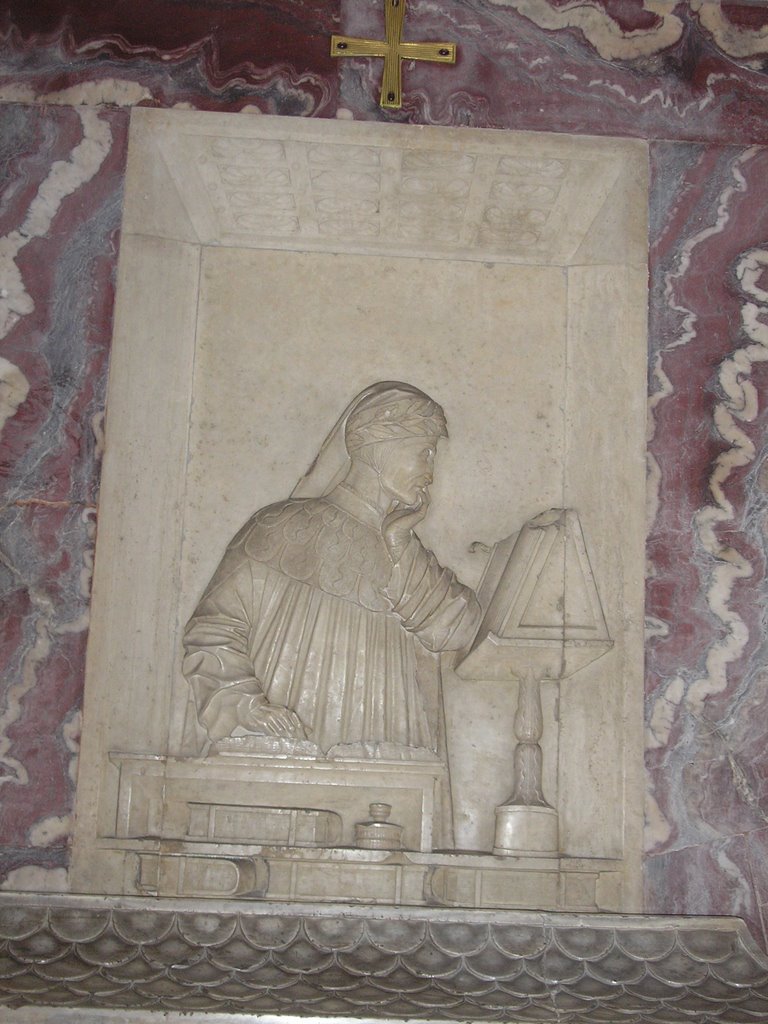
This isn't directly related to the ancient world, but I figured that as long as I was posting pictures from Ravenna, I might as well include some of the tomb of Dante, who eventually lived (and died) in Ravenna after having been exiled from Florence. I thought that since he took Vergil as a guide and since there's a fair amount of Latin in his tomb, we could slip him into the Campus.


Wherefore art thou Homer? And not say, Phantasia?

David Meadows quotes from an article on a book by a certain Andrew Dalby who argues that the Iliad and the Odyssey may have been written by a woman. David thinks this is weird, but I have another view: it's silly, and it's been done before by a better scholar.

Samuel Butler, perhaps best known for his novels The Way of All Flesh and Erewhon, also translated Homer and published a book in 1897 called The Authoress of the Odyssey: where and when she wrote, who she was, the use she made of the Iliad, & how the poem grew under her hands.

But Butler was not the first to hold that view. Butler himself was asked why he made no mention of the post-classical tradition that not only the Odyssey but also the Iliad were written by a woman (his critic is known only as 'The Librarian'). It turns out that Butler was 'entirely ignorant, though he had taken a very good degree in classics.'

[A] certain critic of Homer, Naucrates by name, asserts that Odyssey (and the Iliad!) were written by one Phantasia, daughter of Nicaritius, a professor of philosophy, and were preserved in the library of Memphis, where Homer found them.
Not perfect (she was the daughter of Nicarchus, not Nicaritius, perhaps a typesetter's error), but accurate enough. Note that Phantasia (fantasy) means imagination. This should send up a red flag, especially when we consider the fascination which Egypt held for the Greeks as a fairy land full of magic, mystery, and divine knowledge. It was very romantic, and in later periods virtually every Greek poet, philosopher, and statesman was said to have studied there under the priests and to have attained its secrets, regardless of anachronisms and wild inconsistencies in the tales.

While a difficult source to track, the story of Phantasia comes from the great Byzantine scholar Eustathius, archbishop of Thessalonica (12th c. A.D.), teacher of Michael Choniates, whom I've mentioned before (Michael, archbishop of Athens, delivered a eulogy at Eustathius' funeral). This is what Eustathius had to say in his commentary on Homer:
φασὶ γὰρ Ναυκράτην τινὰ ἱστορῆσαι, ὡς ἄρα Φαντασία γυνὴ Μεμφῆτις, σοφίας ὑποφῆτις, Νικάρχου θυγάτηρ, συντάξασα τόν τε ἐν Ἰλιάδι πόλεμον καὶ τὴν Ὀδυσσέως πλάνην, ἀπέδοτο τὰς βίβλους εἰς τὸ κατὰ Μέμφιν τοῦ Ἡφαίστου ἄδυτον. ἔνθα τὸν ποιητὴν ἐλθόντα, λαβεῖν παρά τινος τῶν ἱερογραμματέων ἀντίγραφα, κἀκεῖθεν συντάξαι τὴν Ἰλιάδα καὶ τὴν Ὀδύσσειαν. ὅτι δὲ ἢ Αἰγύπτιος ὁ ποιητὴς ἢ εἰς Αἴγυπτον φοιτήσας ἐμαθήτευσε τοῖς ἐκεῖ, ἱστοροῦσι τινές. καὶ ἐν τῷ περὶ τῶν πλαγκτῶν δὲ λόγῳ ἐν τοῖς ἑξῆς τοῦ βιβλίου τούτου τεθήσεταί τις ἱστορία τούτου δηλωτική.

They say that a certain Naucrates records that Phantasia, a woman from Memphis--a skilfull and inspired poetess and daughter of Nicarchus--, having composed works on the war in Ilias and the wandering of Odysseus, deposited the books in the sanctuary of Hephaestus in Memphis. Then (they say), after the poet (i.e. Homer) arrived, he took copies from a certain one of the sacred scribes, and at last composed the Iliad and the Odyssey. And some say either that he was an Egyptian poet, or that studying in (literally "frequenting") Egypt, he was their pupil.
Homer, like all the rest, was a student in Egypt ('frequenting' here is the usual idiom). The whole of Plato's philosophy was supposedly taken from sacred Egyptian scrolls, so this comes as no surprise. It's part of the strain of apocryphal stories mentioned above.

Unaware of this story, Dalby is at least as ignorant as Butler, though I suspect more (his talk page at Wikipedia suggests less familiarity with the Greek alphabet than with the Cyrillic, so I suspect that he does not read Greek). For example, how can he argue that the 'the idea that Homer was the author was first proposed in "one ill-informed post-classical text -- the anonymous Life of Homer, fraudulently ascribed to Herodotus"?' This argument can only be used to show that the Iliad and the Odyssey were not identified by those names in classical antiquity, but even then it would be just plain wrong.

Lines routinely ascribed to Homer by authors such as Plato are those of the Iliad and Odyssey, both directly and indirectly cited. Any good text with an index will bear this out. I'll point to just one of the (at least) dozens: Republic 393a (book 3), where Plato quotes Iliad 1.15-16 and says that 'the poet himself is the speaker' but that the poet then switches,
and tries as far as may be to make us feel that not Homer is the speaker, but the priest, an old man. And in this manner he has carried about the affairs in Ilium, all that happened in Ithaca, and the entire Odyssey. (translator Paul Shorey in Hamilton & Cairns, Collected Dialogues of Plato)
(Yes, I checked the Greek, and that's what it says.) One cannot deny that Homer was regarded in antiquity as the author of both the Iliad and the Odyssey. But let's return to Herodotus. Dalby suggests that Herodotus was credited with naming Homer as the author of the Iliad and the Odyssey only in a spurious Life of Homer, but this is incredibly misleading.
In Book II section 116 Herodotus not only names Homer explicitly as the author of the Iliad, but also quotes several line from both the Iliad (6.289) and the Odyssey (4.227 and 4.359). I'm not making this up. It's all easily checked. He cites Homer elsewhere, but I recommend you see for yourself using the most basic research tools at your disposal. It takes minutes -- far less time than researching, writing, and publishing a book.

But let's set all that aside. Can anyone take seriously the premise that a woman is better suited to write sensitively about human affairs than a man, because men are mere brutish pigs thirsting for blood? I guess reverse sexism sells.

This book smells of amateurish provocation and would-be-valiant lances at straw men such as misogyny in the modern academy. We have no shortage of critics who pretend to challenge doctrines that do not exist, constantly conjuring ghosts of the 19th century in place of the stodgy professors who are no longer there. They epitomize style over substance.

The fact is that this idea is not new, it is not challenging -- it is not even sound. Dalby will be able to pretend that misogyny or the power of received opinion is what fuels his critics, but he can not escape his own miserable failure.

Friday, June 30, 2006

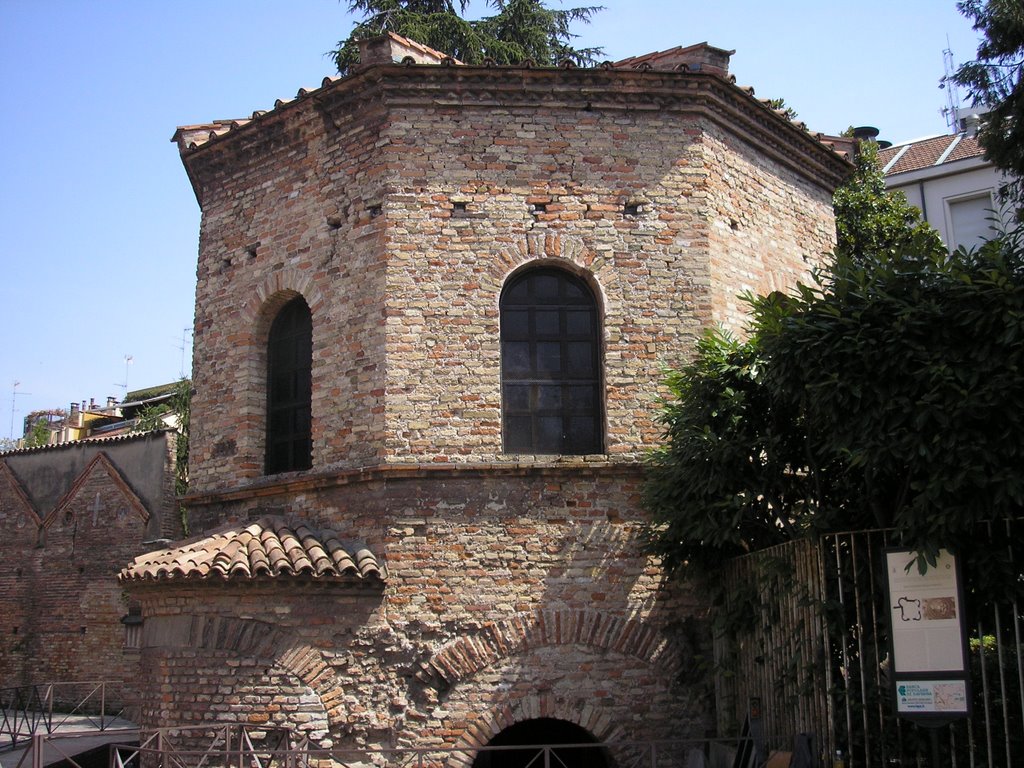
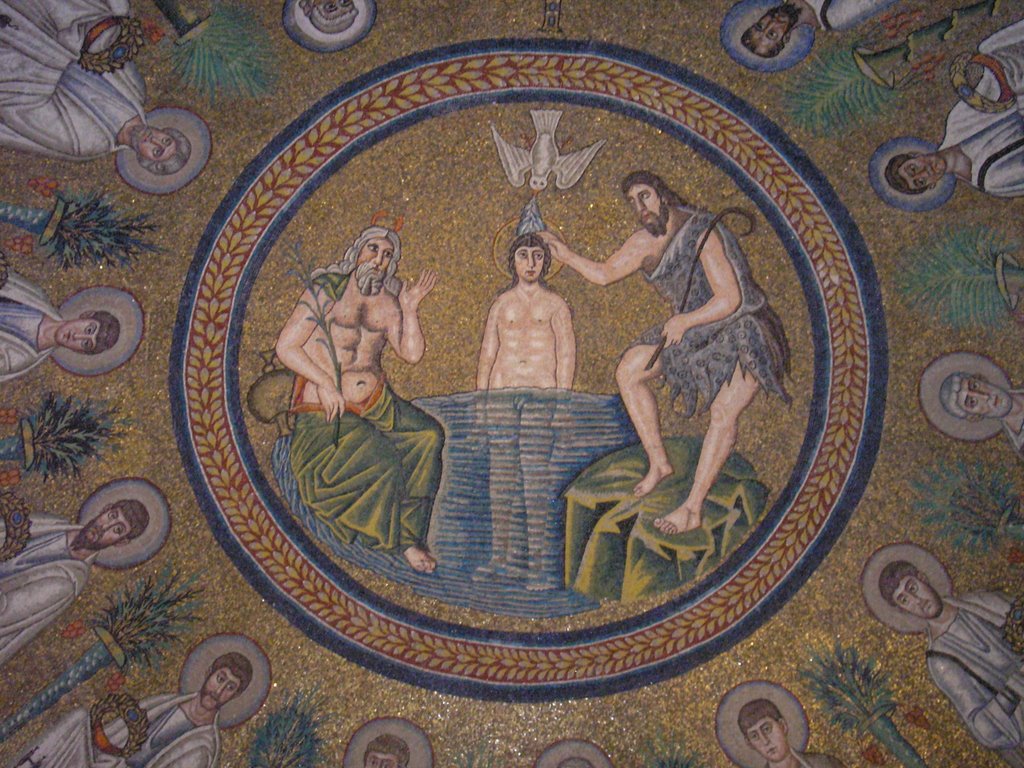
Ravenna/Arian Baptistery

Exterior of building, the base of which is now far below current ground level.

Dome mosaic of baptism of Christ. From left to right: personification of River Jordan; Christ of beardless type (with dove of Holy Spirit); John the Baptist. Ringed by procession of Apostles.

Same, but closer.

It is interesting to compare the scene on this dome with that on the dome of the Orthodox, or Neonian, Baptistery, which has many similiarities but is overall a much more complex composition. But for some reason I forgot to take pictures in there. Maybe I can find a few online at a later time to put up here for comparison.

Wednesday, June 28, 2006

Ravenna 1

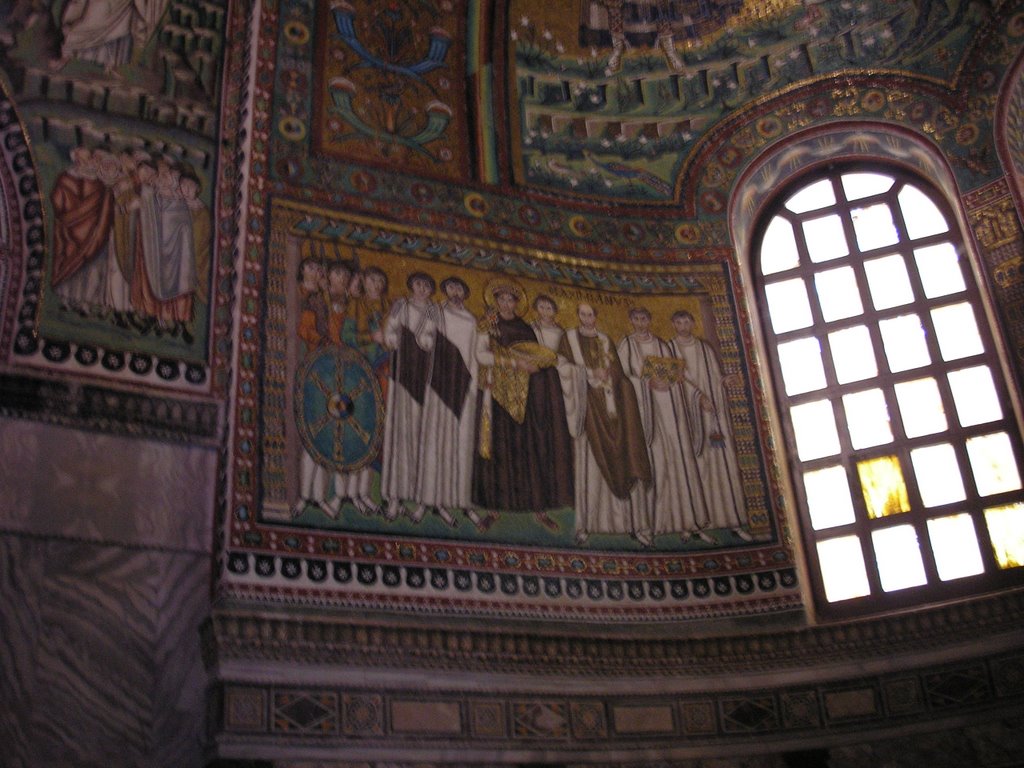
Ravenna is sort of like a Late Antique amusement park. It boasts several 5th and 6th century structures (especially religious buildings) and some of the most incredible mosaics I've ever seen. Here are a couple of photos from the 6th-century Basilica of San Vitale. The first is of a mosaic, made after Justinian's reconquest of Ravenna (which had been under Gothic control), of the emperor with attendants bringing a paten as an offering to the church. Opposite this in the church is one of his wife Theodora bringing a jeweled chalice.

The second is of the interior of the church, looking toward the apse and altar.

Wednesday, June 21, 2006

Moderns on Ancients

The Fall of Rome
by W. H. Auden

(for Cyril Connolly)

The piers are pummelled by the waves;
In a lonely field the rain
Lashes an abandoned train;
Outlaws fill the mountain caves.

Fantastic grow the evening gowns;
Agents of the Fisc pursue
Absconding tax-defaulters through
The sewers of provincial towns.

Private rites of magic send
The temple prostitutes to sleep;
All the literati keep
An imaginary friend.

Cerebrotonic Cato may
Extol the Ancient Disciplines,
But the muscle-bound Marines
Mutiny for food and pay.

Caesar's double-bed is warm
As an unimportant clerk
Writes I DO NOT LIKE MY WORK
On a pink official form.

Unendowed with wealth or pity,
Little birds with scarlet legs,
Sitting on their speckled eggs,
Eye each flu-infected city.

Altogether elsewhere, vast
Herds of reindeer move across
Miles and miles of golden moss,
Silently and very fast.


From Another Time by W. H. Auden, published by Random House. Copyright © 1940 W. H. Auden, renewed by The Estate of W. H. Auden. Used by permission of Curtis Brown, Ltd.

Thursday, June 15, 2006

Dentistical Archaeological Find

Some evidence for the work of ancients equivalent to our guys in white coats with inspiration posters all over the ceiling. This doesn't have anything to do with the Greco-Roman world, but it is old--and interesting.

WASHINGTON - Thousands of years before screen idols began beautifying themselves with cosmetic dentistry ancient Mexicans were getting ceremonial dentures.

Researchers report Wednesday that they found a 4,500-year-old burial in Mexico that had the oldest known example of dental work in the Americas.

The upper front teeth of the remains had been ground down so they could be mounted with animal teeth, possibly wolf or panther teeth, for ceremonial purposes, according to researchers led by Tricia Gabany-Guerrero of the University of Connecticut.

"It's like he was using the mouth of some other animal in his mouth," explained James Chatters, an archaeologist and paleontologist with AMEC Earth and Environmental Inc. in Seattle, Wash., and a member of the research team.

You can read the rest here.

Tuesday, June 13, 2006

Why study classical antiquity?

It's a question asked often, especially by classicists who despair for self-justification. Well, here's one humble response from 1964:

In the days when they formed the basis of a common culture for all educated Europeans, classical studies, together with the Bible, provided an outline of nearly all that was known or believed about world history and a background to the history of modern times and of the Middle Ages. Today, to speak of 'two cultures' is to understate: the Arts themselves are fragmented. Modern history, reaching back only a few generations, lacks depth; mediaeval history both begins and leaves off in the middle of the story; classical studies have become too narrowly philological.


     Our civilization needs classical scholars, as it needs sinologists, not only to train their successors but primarily for the sake of the wider public. There is a wide and spontaneous demand for knowledge about the origins and development of our civilization, manifested both in sales of books and in willingness to spend money on travel in the Near East. We could, and ought to, be satisfying this demand.


     At first sight the length of time — some 5,000 years since the first recorded dynasties — sounds overwhelming. But the appropriate measure of time is the human generation: the number of perhaps 200 since the beginning of recorded history and less than 100 since Homer is a modest one.


     We can here learn from American colleges, which have long taught world history or 'western civilization', not least that the study of Greek and Roman history can play a great part by bringing out the extraordinary resemblances between some of the great processes villain that history and the history of the Christian West. The re-growth of a culture, under stimulation from the East after the collapse of a previous civilization; the expansion to a more spacious world in the West and its effects on the old world's economy and society; the bold astronomical and geological speculations; the class-struggles and revolutions; the disastrous failure to transcend inter-state rivalries and wars — all these things have reminded scholars of the history of their own age. At the same time Greek thought and art have in some ways more resemblance to those of mediaeval Christendom than to modern trends.


     Even an outline knowledge of Greek and Roman history could be of immense value to specialists in modern fields. We should be devoting our best efforts to trying to convince our colleagues of this, and should be training our pupils to restore some unity to our culture, as well as training their successors.
The author was A.R. Burn (Proceedings of the Classical Association LXI, 1964, 27–28), most widely known by students as the author of The Penguin (formerly Pelican) History of Greece, first published under the title A Traveler's History of Greece a year after this talk was given. (I suppose this could be another's summary of his talk — it's given in a list of 'reports' from the General Meeting — but I suspect that it was his abstract.

Still sound sensible enough to me.

Monday, June 12, 2006

Speaking of Erasmus' Adages...

Here is a review by Richard Joines of a recent edition of Adages III.iv.1-IV.ii.100 by John N. Grant and Denis L. Drysdall.

Friday, June 09, 2006

Neologisms in Augustine's Sermon Super Verbis Apostoli Ad Galatas...

In his introduction to this sermon of Augustine, F. Dolbeau remarks that Augustine uses two words here not found in the TLL. (Sorry, I just noticed that when I pasted this citation in, all the French accents disappeared. I don't have time to fix it right now and don't know how to anyway, so I'm just going to replace them with unaccented letters. Hope that doesn't make it too unintelligible.)

Deux substantifs employes par Augustin sont absent du Thesaurus Linguae Latinae. Ce sont des noms d’agent en -tor, dont le sens ne fait pas difficulte. Le premier, obtestator (sec. 5), ne figure apparement dans aucun dictionnaire; le second, decretor (sec. 9), etait jusqu’ici atteste pour la premiere fois chez Raoul Glaber. Tous deux pourraient etre des creations deliberees d’Augustin, car ils fonctionnent en symetrie, repectivement avec praedicator et impletor.

Thursday, June 08, 2006

Julian the Apostate Quiz

Via Bread and Circuses, I learned about this fun online quiz on Julian the Apostate. Enjoy!

By the way, Dennis, love the cartoon!

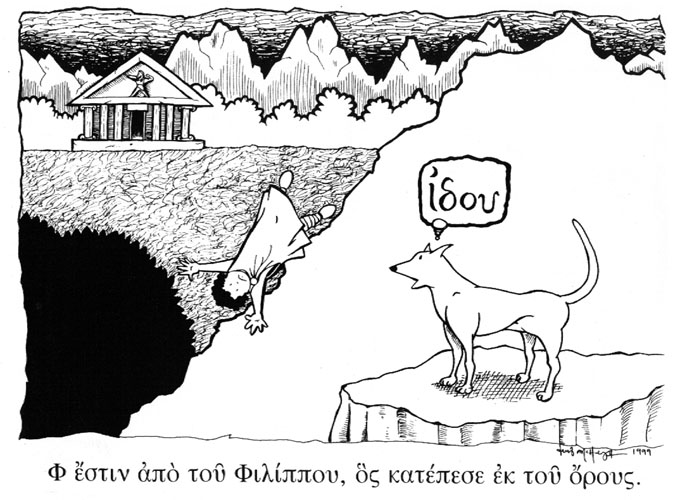
No, Philippos! Not again!


I drew this in my first year of baby Greek while at UMass: an homage to Athenaze's hapless young hero and his trusty dog, Argo. It was supposed to be in the style of Edward Gorey's Gashlycrumb Tinies, but I was lazy and hadn't drawn in a long time, so this was the result. Posted by Picasa

Ludi in AD 204

Today the Rogueclassicist asks for information on something called the ludi Latini et Graeci honorarii in AD 204, of which today is supposed to be the fifth day. I'm not sure if these are the same games, but Septimius Severus presided over a 10-day celebration of the ludi saeculares in 204 and, according to this report, he used Augustan calculations; Augustus had first celebrated the ludi saeculares in 17 BC and they took place in late May and early June. Now, I'm assuming that the ludi saeculares and the ludi Latini et Graeci honorarii must be the same games, since the Rogueclassicist also has a listing for the Latini et Graeci on this day in 17 BC, which roughly coincides with the timing for the saeculares in that year (though it is off by a few days).

Mr. Meadows--I'm not sure if any of this is the sort of information you're looking for. If it's all old news and you were inquiring about something different, please ignore!

Wednesday, June 07, 2006

The Remains of a Senarius in a Letter of Jerome?

In a letter written by Jerome to Augustine (Ep. 68 in editions of Augustine's letters; Ep. 102 in editions of Jerome), dated to 402 (see Fuerst's monograph on the correspondence), Jerome threatens Augustine via classical and proverbial metaphors:

nunc te currente et longa spatia transmittente nobis debetur otium simulque, ut cum venia et honore tuo dixerim, ne solus mihi de poetis aliquid proposuisse videaris, memento Daretis et Entelli et vulgaris proverbii, quod bos lassus fortius figat pedem.

In a brief but interesting note in Wiener Studien 19 (1897) 317, Karl Schenkl makes a case that the 'proverb' (italicized in the above citation) is not merely a proverb, but is a citation of a poet--the 'remains' or the 'left-overs' ('die Reste') of a senarius. For support, he offers four reasons: the balance of the phrase, its 'poetic coloring', the placing of the words, and the prominent (or 'pronounced') alliteration of fortius figat.

He says that he is not able to unravel whence it comes; Schenkl points out that Erasmus, in his Adagia, refers it to the Greek proverb Atremas bous (Diog. III.9, Arsen. VI.8, Apost. IV.24), but he states that this contributes nothing to its explanation. He theorizes that Jerome found the proverb in a Gnomologium, and that it was probably included in the fragmenta adespota of iambic poets.

Wednesday, May 31, 2006

J.P. Postgate's 'Flaws in Classical Research'

I'm reading J.P Postgate's classic essay 'Flaws in Classical Research' (Proceedings of the British Academy, 1908, 161-211), which, by the way, should be tempered with Paul Shorey's review (Classical Philology 5.2 225-228) which attempts to 'guard against the impression which it will make upon the student or the hostile layman.' Shorey notes Postgate's 'impatience of human frailty,' which puts one in mind of A.E. Housman. Incidentally, Housman (cited approvingly in the essay) beat out Postgate for the Latin chair at Cambridge.

Currently what's interesting me is Postgate's criticsm of modern 'lineal' thinking which is prone to misunderstand the 'circular' thought behind utterances in classical languages.

I was reminded of a recent article in the Guardian (linked by ALDaily) that dealt with the difficulties caused by syntax in the translation of humor from English to German. This difficulty has led some Brits to the conclusion that Germans are humorless, and in the same way the divide betwee 'lineal' and 'circular' habits of mind has led modern readers of the Classics to mistranslation, misleading commentary, and the attribution to the ancients of convoluted metaphorical expression alien to their native sensibility:

One main principle which it takes some trouble to grasp, and still more to apply with precision, is that, within certain wide limits, order in modern sentences is syntactically essential and in ancient sentences syntactically indifferent. The modern sentence, to put it roughly, is an arrangement in line, the ancient one within a circle. Now the lineal habit of mind, if I may call it so, is often at a loss when it has to understand the circular; it is devoid of the sense of grouping; it has not been trained to the necessary attention. If the groups are small, the trouble thus caused is small; but it is not absent altogether.
Now comes a great but simple example, the kind I've seen belabored by would-be critical theorists in their first semesters seeking out the foul stench of patriarchy and cultural imperialism at every turn:
In the second half of the pentameter Tibullus writes vir mulierque (ii. 2. 2), Ovid femina virque. The difference of order is absolutely without significance. But the lineal mind is apt to imagine that some subtle distinction between the places of man and woman is intended, as though Ovid were a sort of pro- and Tibullus an anti-suffragette.
Come to think of it, I've probably seen that in some of our leading journals.

From here he recalls the views of T.E. Page (note: Page's commentary on the Eclogues and Georgics of Vergil is still a classic -- go get it!) who 'called attention to the irrationality of current views of the figure called hysteron proteron':
To the lineal mind these 'inversions' are nonsense; to the circular but legitmate variations. ... The real character of such arrangements is seen in passages like Ter. Ad. 917 'tu illas abi et traduce; and Lucan, viii. 342 sq. 'quem captos ducere reges | vidit ab Hyrcanis Indoque a litore siluis', which almost shriek at us the warning respice finem.
There's more, and I recommend that you seek it out (taking Shorey's reservations into consideration). This kind of criticism, taken properly, keeps critics alert.

Tuesday, May 30, 2006

Concerning the Literacy of Augustine's Late 4th Century Congregation

We are often told that late antique sermons are geared toward an audience with a lower level of education (sermo humilis and all that) than the audience for written works of erudite theology and exegesis. And it is certainly true that one often finds an easier, simpler Latin in sermons. While reading one of Augustine's Dolbeau sermons (Sermo Beati Augustini Super Verbis Apostoli Ad Galatas, Ubi Paulus Reprehendit Petrum, Ubi Primo Docet Qaulis Esse Debeat Episcopus, preached in 397), however, I came across a couple of lines that imply at least some level of literacy in his congretation. At the point in the sermon in which we are interested, Augustine is discussing the decisions of the Council of Jerusalem in Acts 15, in which a solution was developed as to how Jewish Law should (and should not) be construed in relation to Gentile converts. Here are lines 183-4:

Hoc in Actibus apostolorum scriptum esse multi recolunt; legant qui non recolunt.

'Many recall that this was written in the Acts of the Apostles. Let those who do not recall it read it.'

More on the Concept of Philology

'An unrestricted concept of philology had to be established in order to get rid of all arbitrary distinctions and to discover its actual reality. But the more unrestricted the concept, the more necessary becomes limitation in developing it. It can accordingly be given an arbitrary limitation for the area in which any scholar works it out. The concept is absolute, the area relative. One can then set up limitations by disciplines, e.g., philology of language, of literature. One can also restrict the scope by time or space, as when one considers a specific period or some particular people. Thus we can have ancient and modern, oriental and occidental, Greek, Roman, Indian, Hebrew, and other philologies. Such division is quite in keeping with the nature of philology. Reichardt says justly with reference to ancient times: "Knowledge of antiquity is not the history of literature, of art, nor of religion--such histories exist without philology--but a history of the life of a people, which consists in the intermingling and cooperation of all these." Every special branch of knowledge historically presented proceeds in one line of development; philology collects all these into noe bundle, and from a focal point, the mind of a people, spreads them out as radii of a circle.'

--August Boeck, from On Interpretation and Criticism (tr. John Paul Pritchard)


Discuss.

Thursday, May 25, 2006

Georgics on my Mind: Merriam-Webster's Word of the Day

georgic \JOR-jik\ adjective

: of or relating to agriculture

Example sentence:
"Lanford Wilson has created yet another remarkable play... a fascinating tale of a georgic Midwestern community and the secrets lurking beneath the surface of its bucolic hum." (Adweek, March 25, 2004)

Did you know?
The adjective "georgic," which dates from the first half of the 18th century, derives by way of Latin "georgicus" and Greek "geōrgikos" from the Greek noun "geōrgos," meaning "farmer." That noun, in turn, was formed by a combination of the prefix "geō-" (meaning "earth") and "ergon" ("work"), the latter of which gave us words such as "allergy" and "ergonomics." The noun sense of "georgic," which dates from the early 16th century, refers to a poem that deals with the practical aspects of agriculture and rural affairs. The standard for such poems, Virgil's Georgics, is responsible for its name. The poem, written between 37 and 30 B.C., called for a restoration of agricultural life in Italy after its farms fell into neglect during civil war.

*Indicates the sense illustrated in the example sentence.

Tuesday, May 23, 2006

Life Imitates Art

Toward the beginning of Henry James' story 'The Last of the Valerii', we read this description from the story's narrator, who is a painter, of his American goddaughter's Roman husband-to-be:

'Strong the Conte Valerio certainly was; he had a head and throat like some of the busts in the Vatican. To my eye, which has looked at things now so long with the painter's purpose, it was a real perplexity to see such a throat rising out of the whit cravat of the period. It sustained a head as massively round as that of the familiar bust of the Emperor Caracalla and covered with the same dense sculptural crop of curls. The young man's hair grew superbly; it was such hair as the old Romans must have had when they walked bareheaded and bronzed about the world.'

Monday, May 22, 2006

On the Development of Philology

'Now that the defining of the philological activity has removed the one-sided ideas of it, the sole remaining task is to show how these ideas have arisen. They are easily accounted for through the division into separate elements of the definition just now established. Since the most usual vehicle of knowledge--rather, the pure reproduction of all knowledge--is speech, the first task of philology is to fathom the mystery of speech. The deepest and most illimitable human undertaking is the comprehension of speech in its freedom and necessity, and whoever has such knowledge has come to know all human knowledge.'

--August Boeckh, On Interpretation and Criticism, p. 10 (tr. John Paul Pritchard)

Discuss.

Thursday, May 18, 2006

Santa Giulia (4)

On the other itinerary at the museum, one finds an incredibly ornate jeweled cross, put together out of various pieces in the seventh century. One of those pieces, just over half-way down the lower arm of the cross, is a medallion from the Roman Empire (if you click on the photo to view it in a larger size in its own window, you might be able at least to make it out in general terms; my zoom-in shot is too blurry to see any details, though I’ve included it anyway).


Jas Elsner briefly discusses the object in the introduction to Imperial Rome and Christian Triumph: The Art of the Roman Empire AD 100-450 (Oxford, 1998). In his caption, he writes (p. 22), ‘Gold-glass medallion, perhaps from Alexandria, dated anywhere between the early third and the mid-fifth centuries AD. This family group of a mother, in a richly embroidered robe and jewels, with her son and daughter, bears the inscription BOUNNERI KERAMI. This may be an artist’s signature or the name of the family represented.’

In his remarks in the text, he states (p. 23):

...[T]here are...profound continuities between the visual productions of the pagan and Christian empires, as the following chapters will show. Take, for example, the beautiful gold-glass medallion from Brescia, which could have been made at any point in our period–its transfixing naturalism gestures towards the second century, while its technique is more typical of objects from the fourth. Perhaps from Alexandria, since its inscription is in the Alexandrian dialect of Greek, it probably found its way early to Italy–at any rate, it was incorporated there in the seventh century in a ceremonial, jewelled, cross. Whenever it was made, and for the duration of its use in antiquity, the imagery of this gem speaks of the continuity and values of family life, of the wealth and patronage of aristocratic elites, of the high value placed on exquisite workmanship from the second century to the fifth.

Tuesday, May 16, 2006

Santa Giulia (3)

One of the surprising things to me about the museum was their impressive and substantial collection of antique bronze sculptures and ornamention. By far their most famous bronze is this incredible Winged Victory from the Capitolium.


Why Not Keep Talking about Hercules and the Merchant of Venice?

In Act III, Scene II, another suitor-scene in front of the caskets (as was the previous scene recently discussed on the Campus), Hercules comes up twice. The first is in a speech of Portia:

...Now he goes
With no less presence, but with much more love
Than young Alcides, when he did redeem
The virgin tribute, paid by howling Troy
To the sea-monster: I stand for sacrifice,
The rest aloof are the Dardanian wives,
With bleared visages come forth to view
The issue of th' exploit: go Hercules!
Live thou, I live--with much much more dismay,
I view the fight, than thou that mak'st the fray.

(53-62)

Shortly thereafter, as Bassanio is deliberating his choice and commenting on the deceptive attraction of outward ornament, he states:
How many cowards whose hearts are all as false
As stairs of sand, wear yet upon their chings
The beards of Hercules and frowning Mars,
Who inward search'd, have livers white as milk?--
And these assume but valour's excrement
To render them redoubted.

(83-8)

Book Buys

There was another sale at the library here today. Not tons of stuff that I was interested in, but I did get a couple of Classics-related things--Oliver Strunk's Antiquity and the Middle Ages from the 'Source Readings in Music History' series and a book by Edward W. Spofford called The Social Poetry of the Georgics. But the grand prize of the day was the Alfred Rahlfs' 1935 edition of the Septuagint, voll. 1 and 2.

Monday, May 15, 2006

Is nothing sacred?

A reader has e-mailed to ask about the correct Latin translation of the phrase 'is nothing sacred?', made famous in Wes Anderson's classic Rushmore as 'nihilo sanctum estne?'

The problem with that translation was discussed here previously, but I thought I'd post my reply to this latest question, which may be inadequate so feel free to add your two cents on the issue in the comments.

It's almost a philosophical question. You have to think about the meaning behind the idiom rather than the literal translation.

Nihilo sanctum estne is close to a literal translation, but it's grammatically incorrect. A literal translation might be "nihilne sanctum est?" The interrogative particle (-ne) attaches to the first word (which is why "estne" would be a question unto itself in the Rushmore version). The verb "est" isn't technically necessary, so: nihilne sanctum?

This could work, but it's not said anywhere in Latin literature, though similar statements exist, e.g., "dictitat ... nihil esse tam sanctum quod non violari ... possit," i.e., "he asserts that ... nothing is so sacred that it can not be violated" (Cicero, In Verrem I. 2). This same thought is expressed elsewhere in nearly identical terms.

So it's possible to use "nihil sanctum (est)" to say "nothing's sacred." But still, the question "is nothing sacred" isn't asked.

It can be difficult to pinpoint the essential meaning of an idiom and then to translate it into the idiom of another language in a way that would be culturally relevant. In the same context that an English speaker says "is nothing sacred?", a Roman might have said, "mehercule!", an exclamation like our "my god!" which originally meant "by Hercules!" It expresses disbelief, maybe even disgust. But then again, there are probably better Latin idioms that I can't think of that would suit in different contexts.