Showing posts with label Livy. Show all posts

Thursday, June 28, 2007

A complete translation of Livy

I know I'm not the only one to hunt through Google Books to find useful editions and out of print classics.

But one thing I've had great difficulty locating is a complete text of Livy. Out of print editions on the used book market are few and expensive, and plain e-texts are unattractive. I'm not averse to printing PDFs (2-up, double-sided) and keeping them on the shelf in three ring binders.

So if you're like me and you're looking for Livy, then look no farther:


  1. Books 1 to 8
  2. Books 9 to 26
  3. Books 27 to 36
  4. Book 37 to the end

Friday, January 26, 2007

Images from Livy (9)


'Landscape with She-Wolf Suckling Romulus and Remus', by Annibale Carracci (1560-1609), c. 1590. Pen, brown ink and brown wash, retouched in black ink, on white paper. Paris, Louvre.

Thursday, January 25, 2007

Images from Livy (8)


'Romulus and Remus Given Shelter by Faustulus', by Pietro Berrettini, called Pierre de Cortone (1597-1669), around 1643 (Paris, Louvre)

Wednesday, January 24, 2007

Images from Livy (7)


'Les Sabines', by Jacques-Louis David (1748-1825), 1799 (Paris, Louvre)

Tuesday, January 23, 2007

Images from Livy (6)


'The Introduction of the Cult of Cybele at Rome', by Andrea Mantegna (about 1430/1-1506), 1505-6. Glue on Linen. Housed in National Gallery (London).

The National Gallery's page on this picture says the following:

Inscribed in the centre: S HOSPES NUMINIS IDAEI C [By decree of the Senate host to the Idaean deity]. Various other inscriptions on the tombs.

In 204 BC the Romans brought the cult of Cybele, the eastern goddess of victory, from Pessina, Asia Minor, to Rome. Mantegna has combined the accounts of Ovid, Livy and Appian. Cybele is represented by her sacred stone - 'she fell to earth as a meteor' - and as a bust with a mural crown (associating her with a city state). According to Juvenal, Cornelius Scipio (probably in profile gesturing with his right hand) was the most worthy Roman citizen to receive Cybele.

This is one of four pictures commissioned in 1505 by Francesco Cornaro a Venetian nobleman, who claimed descent from the ancient Cornelii family (prominent in the picture). Mantegna only completed one before his death and Bellini supplied another (Washington, National Gallery).

Monday, January 22, 2007

Images from Livy (5)


'Marcus Curtius', attributed to Bacchiacca (1495-1557), probably about 1520-30. Oil on wood. Housed in National Gallery (London).

Friday, January 19, 2007

Images from Livy (4)


'The Death of Camilla', by Jacques-Louis David (1748-1825), black chalk with brush and gray wash on cream-colored laid paper (New York, Metropolitan Museum of Art)

Some Essential Anglophone Resources on Livy

This list is not meant to be exhaustive and does not include commentaries. Suggestions for additional resources are welcome. This is a very basic list that has a number of good places to start.

Cantor, H.V. 'Livy the Orator'. Classical Journal 9 (1913) 24-34.

McDonald, A.H. 'The Style of Livy'. Journal of Roman Studies 47 (1957) 155-72.

Syme, R. 'Livy and Augustus'. Harvard Studies in Classical Philology 64 (1959) 27-87.

Walsh, P.G. Livy. Greece and Rome. New Surveys in the Classics 8 (Oxford: Clarendon Press, 1974).

----. Livy: His Historical Aims and Methods. Cambridge, UK: University Press, 1961.

----. 'Livy's Preface and the Distortion of History'. American Journal of Philology 76 (1955) 369-81.

Thursday, January 18, 2007

Images from Livy (3)


'The Oath of the Horatii', by Jacques-Louis David (1748-1825), 1786 (Toledo, Toledo Museum of Art)

Wednesday, January 17, 2007

Images from Livy (2)


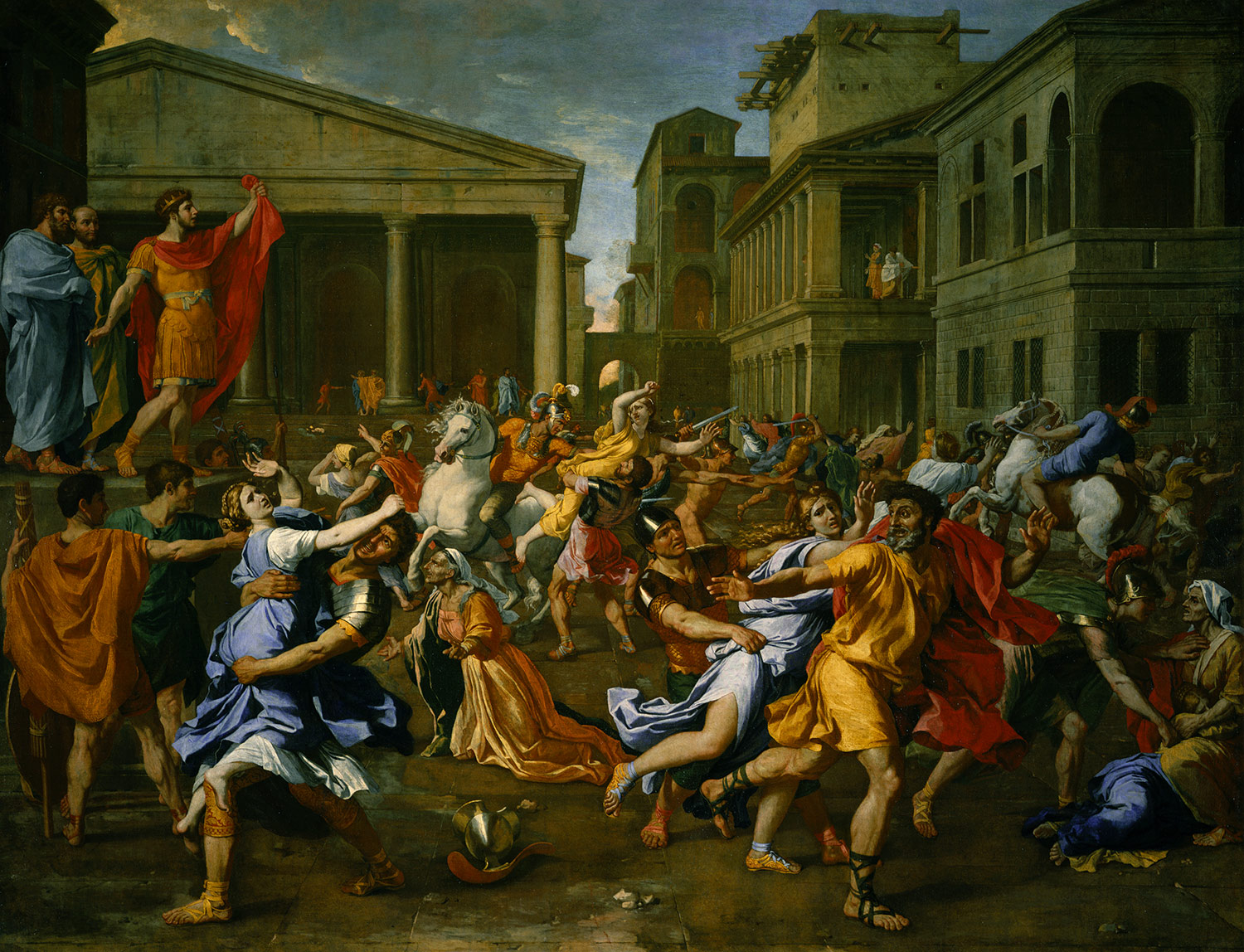
'The Rape of the Sabines', by Nicolas Poussin (1594-1665), ca. 1637-8 (Paris, Louvre)

Some Introductory Notes on Livy

The normal dates give for Livy's life are: born 59 BC, died AD 17 (Syme has challenged this dating and has made a case for 64 BC-AD 12; see his paper 'Livy and Augustus'). He was a native of Padua, hence Asinius Pollio's recriminations over his Patavinitas, though the meaning of this accusation remains in question.

His history, Ab urbe condita, consisted originally of 142 books. Of these, 35 books are extant: books 1-10 and 21-45. Summaries (epitomes or Periochae) of most of the remaining books have come down to us (with the exception of books 136 and 137), the value of which varies. The work spans Rome's legendary beginnings to, most likely, the death of Drusus in 9 BC, or perhaps the defeat of Varro in the Teutoberg Forest in AD 9.

For those interested in Late Antiquity, it is worth noting that 'Q. Aurelius Symmachus corrected a set of manuscripts containing the whole of Livy's work, as we know from a subscription; this was a large-scale cooperative venture of the Nicomachi and Symmachi families and is the ultimate source for all surviving manuscripts of the first decade' (Conte 374).

(For very brief introductions, see the Oxford Classical Dictionary and G.B. Conte's Latin Literature, pp. 367-76 (quoted above).)

Tuesday, January 16, 2007

Images from Livy (1)


'The Oath of the Horatii', by Armand Caraffe (1762-1822) (Moscow, Pushkin Museum)

Monday, January 15, 2007

Poetry and Livy's Preface

It is interesting to me that Livy's preface begins with the first four feet of a dactylic hexameter:

Facturusne operae pretium sim...

In other words, he inaugurates his prose history with the trappings of epic. This is only the first indication in the preface that Livy has poets on his mind.

He refers again to poetry when commenting on his refusal either to attempt to substantiate or refute the accounts of Rome's earliest days:
Quae ante conditam condendamve urbem poeticis magis decora fabulis quam incorruptis rerum gestarum monumentis traduntur, ea nec adfirmare nec refellere in animo est.

And, in a nice bit of ring-composition-cum-variatio, he ends the preface with a reference to 'the poets':
Cum bonis potius omnibus votisque et precationibus deorum dearumque, si, ut poetis, nobis quoque mos esset, libentius inciperemus, ut orsis tantum operis successus prosperos darent.

This is a present contrary-to-fact condition: 'If I were a poet, I would begin...'; in other words, he's not a poet, so he won't begin in such a way.

Or will he? By raising the issue in the first place, in a sort of praeteritio, he's already put such an invocation in the minds of his readers, his denials notwithstanding. And it's not as though he hasn't been thinking about the gods in the course of this preface:
Datur haec venia antiquitati, ut miscendo humana divinis primordia urbium augustiora faciat, et si cui populo licere oportet consecrare origines suas et ad deos referre auctores, ea belli gloria est populo Romano ut, cum suum conditorisque sui parentem Martem potissimum ferat, tam et hoc gentes humanae patiantur aequo animo quam imperium patiuntur.


Some questions to ponder: what, exactly, is the relationship of Livy's history to epic poetry? Was he attempting to write 'epic in prose'? How close are the parallels we can draw between his treatment and use of foundation myths and the treatment and use of them made by Vergil?

I realize that these are questions that have probably been addressed at length in the scholarship. Nevertheless, they're some questions that came up as I was reading the preface, and it's always good to try to take a fresh look. And it's better, perhaps, to try to come up with some ideas and theories before rushing to the answers that have already been given.

As always, any comments or feedback is welcome.