Tuesday, April 18, 2006

Late Antique Opus Sectile

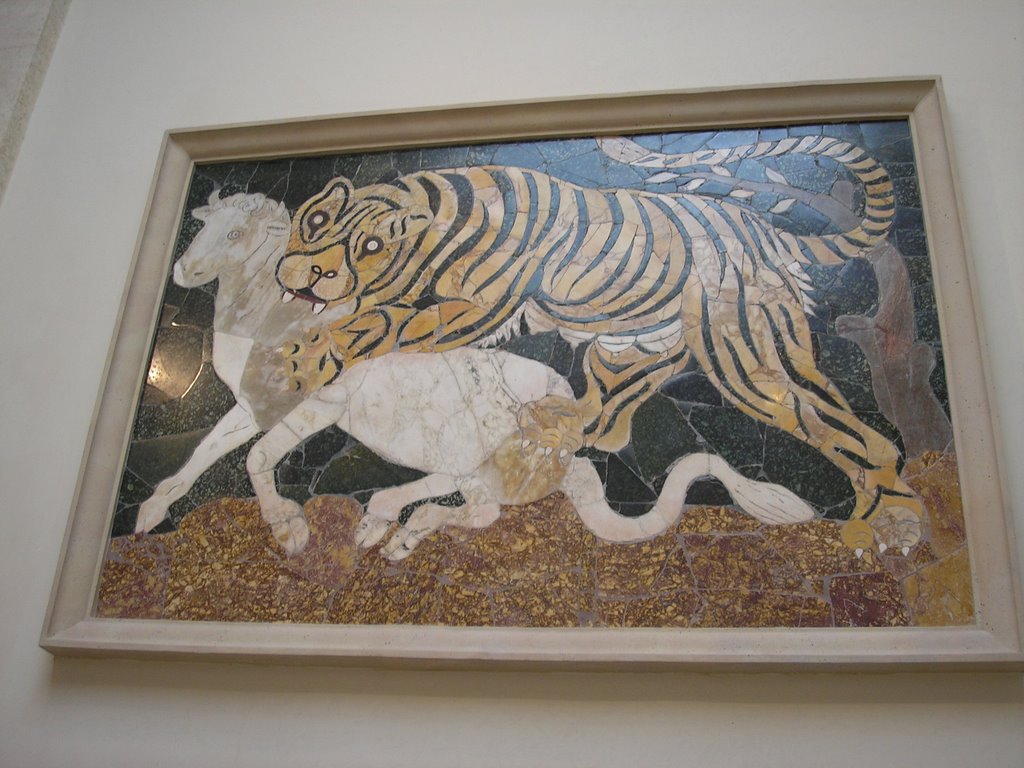
Not much survives from the decoration of the so-called Basilica of Junius Bassus on the Esquiline, but there are four panels located in two different museums in Rome: the Museo Nazionale Romano located in Palazzo Massimo alle Terme and the Palazzo dei Conservatori in the Capitoline Museums.


The Electa guide book for Palazzo Massimo gives us the following helpful information:

Two panels from the Basilica of Junius Bassus, consul in AD 331, show the extraordinary luxury that characterised the private residences of the artistocratic urban class of the 4th century AD. One panel represents the myth of Hylas abducted by the Nymphs and the other shows the beginning of a race at the circus. Along with two other panels which are now part of the collections at the Palazzo dei Conservatori, this panel belongs to the wall-decoration of a large hall which was a private baslica in a luxurious structure near the Esquiline. The existence of an inscription allows us to identify the hall as the property of the consul Junius Bassus, father of the Roman prefect of the same name. The latter, a Christian, died in AD 359.

After the hall was discovered in the 15th century it was destroyed, but all of the panels in opus sectile were seen and drawn by the well-known Renaissance artist Giuliano da Sangallo, who described them as a 'cosa meravigliosa' (thing of wonder).

Another Link

From Rogueclassicism I have gotten a link to a page of online dictionaries and language and paleography resources, which includes a Medieval Latin dictionary. Thanks to the Rogue for posting it. Enjoy!

Word of the Day for Dennis

I think Dennis should appreciate Merriam-Webster's 'Word of the Day' for 18 April, even though it doesn't actually mention Nicander:

theriac \THEER-ee-ak\ noun

1 : a mixture of many drugs and honey formerly held to be an antidote to poison
*2 : cure-all

Example sentence:
Garlic has been called the poor man's theriac.

Did you know?
There really is no such thing as a single remedy for all that ails us. But that hasn't kept English speakers from creating, not just a single word, but several words, that mean "cure-all" — "catholicon," "elixir," "nostrum," "panacea," and today's word, "theriac." When we first used "theriac," it meant "an antidote for poison" — for any and all poisons, that is. That's how our Roman and Greek forebears used their "theriaca" and "thēriakē," which derive ultimately from the Greek word for "wild animal." The first theriac was supposedly created by the first-century Greek physician Andromachus, whose concoction consisted of some 70 drugs pulverized with honey. Medieval physicians created even more elaborate theriacs to dose a plague-dreading populace, for whom the possibility of a cure-all didn't seem too wild a notion at all.

*Indicates the sense illustrated in the example sentence.

Monday, April 17, 2006

More Good Searches

Here is, in my opinion, the top recent search that brought someone to the Campus:

what's wrong with guys

Another interesting one is:
argosy grad school is bad

Two runners-up are:
"anyone owns a song"

And a personal favorite of mine:
"aaron kook"

And speaking of the Magister, where has he been lately, anyway?

Additionally, Dennis' post on 'bad movie latin' continues to attract a lot of hits.

Friday, April 14, 2006

A Christian Sarcophagus

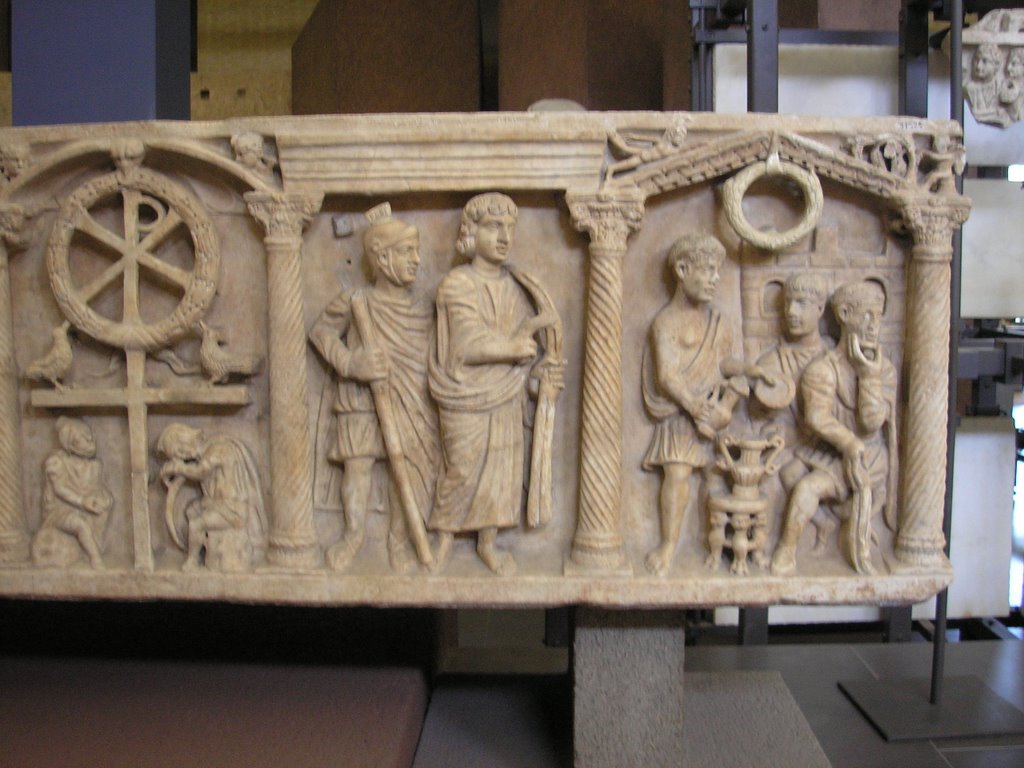
In honor of Good Friday/Easter, I thought I'd post a couple of photographs of a Christian sarcophagus currently on display in the Vatican Museums.


Regarding the type of symbolic centerpiece used in this sarcophagus, Andre Grabar writes the following:

'This first type of image of the Resurrection [i.e. the type he has been discussing in the foregoing paragraphs, not the type shown in the photographs here], which I call juridical and evangelical (because, like the Gospels, it evoked dogma by showing the story of the eyewitnesses of the Resurrection), was not the only one that the image-makers invented. It outweighed all the others, however, from about 400 until the eleventh century in the West and until modern times in the Byzantine world. But in the fourth century, probably in Rome, another image was invented, symbolic in its iconography, that had great success but was abandoned a hundred or a hundred and twenty years later, perhaps because its meaning had become obscure. It was a figuration inspired by the art of military triumphs of pagan Roman tradition, and as it became further removed from pagan times, it must have appeared less explicit. It is on Roman sarcophagi of the fourth century that we find almost all the examples. Here we see the military trophy, and in it the phoenix--symbol of the Resurrection--with seated or standing figures on either side. The origins of this iconography are recognizable in the reliefs of a pagan sarcophagus where the usual military trophy, displaying the arms of the vanquished, is represented, along with the barbarians beneath it who were conquered by the Romans. The Christian formula replaces the trophy by the Cross, on which is suspended a triumphal crown, and substitutes for the captured barbarians two armed but sleeping soldiers--in an allusion to the guardians of the tombe of Christ: their arms are as powerless to prevent the victorious Resurrection of Christ as the arms of the barbarians were powerless before those of the Imperial armies.'

--from Christian Iconography: A Study of its Origins (Princeton 1968), pp. 124-5

Thursday, April 13, 2006

Henry James and the Equestrian Marcus Aurelius

In the Michelangelo-designed piazza on the Capitoline hill is a giant bronze statue of Marcus Aurelius on horseback:

The above sculpture, however, is a copy. The real one has been moved inside the museum and is no longer exposed to the elements. It is now housed in the same room as the giant bronze of Constantine, a photo of which I posted the other day:

The sculpture, justifiably famous, has long provoked comment. Here are Henry James' thoughts, taken from his essay 'A Roman Holiday', which is collected in Italian Hours:

The legendary wolf of Rome has lately been accommodated with a little artificial grotto, among the cacti and the palms, in the fantastic triangular garden squeezed between the steps of the church and the ascent to the Capitol, where she holds a perpetual levee and "draws" apparently as powerfully as the Pope himself.
Above, in the piazzetta before the stuccoed palace which rises so jauntily on a basement of thrice its magnitude, are more loungers and knitters in the sun, seated round the massively inscribed base of the statue of Marcus Aurelius. Hawthorne has perfectly expressed the attitude of this admirable figure in saying that it
extends its arm with "a command which is in itself a benediction." I doubt if any statue of king or captain in the public places of the world has more to commend it to the general heart. Irrecoverable simplicity--residing so in irrecoverable
Style--has no sturdier representative. Here is an impression that the sculptors of the last three hundred years have been laboriously trying to reproduce; but contrasted with this mild old monarch their prancing horsemen suggest a succession of
riding-masters taking out young ladies' schools. The admirably human character of the figure survives the rusty decomposition of the bronze and the slight "debasement" of the art; and one may call it singular that in the capital of Christendom the portrait most suggestive of a Christian conscience is that of a pagan
emperor.

Wednesday, April 12, 2006

No 'Gold' and 'Silver' in the Middle Ages

'Instruction in grammar...comprised language and literature. The selection of authors studied in the medieval schools includes pagan and Christian writers. The Middle Ages makes no distinction between "gold" and "silver" Latinity. The concept "classical" is unknown to it. All authors are, as it were, authorities. Let us examine a number of medieval documents as to curriculum authors. When Walter of Speyer was in school about 975, he read Virgil, "Homer" (that is, the so-called Ilias Latina, a crude condensation of the Iliad in 1070 hexameters, of the first century A.D.), Martianus Capella, Horace, Persius, Juvenal, Boethius, Statius, Terence, Lucan. This is not a casual selection, it is a normative one. It recurs as the basis of later lists.'

--E.R. Curtius, from European Literature and the Latin Middle Ages, tr. Willard R. Trask, pp. 48-9

Two Useful Links Coming Your Way

The first (created, I believe, by Bryce Walker and Bret Mulligan) is the page for the Bi-College (i.e. Haverford College and Bryn Mawr College) 'ORALi-Tea', an event dedicated to the oral performance of ancient poetry. The page has some handy links to recordings of modern renditions of ancient lit by Stanley Lombardo and others and a nice bibliography on reading aloud and related topics.

The second will be especially useful if you live in the Philadelphia area or in relatively close proximity thereto. Bret Mulligan has put together a page listing all the Classics events going on in the area. From that page we learn that Carole Newlands will be speaking at Penn tomorrow (13 April). Her topic (as listed on Penn's page) appears to relate to a character mentioned just yesterday on the Campus: 'Problems of Violence in Ovid: Philomela and Marsyas'.

Kudos to the creators of these pages!

Truth and Virtue revisited

Recently I posted about the mystery of the Bryn Mawr College motto: is it VERITATEM DILEXI or VIRTVTEM DILEXI?

I showed that the inscription on Pembroke Arch, which is said to read 'veritatem,' actually reads 'virtutem.'

I'd heard from a faculty member that there were two explanations, described as apocryphal. One that a change occurred with the rise of feminism, what with virtus meaning 'manliness' and all (but would that have happened as early as 1908, when M. Carey Thomas quoted the motto in its modern form?). The other explanation wasn't mentioned, left off with a laugh that implied improbability or perhaps something unspeakable. I can't imagine what it might be, but it's probably more exciting to wonder.

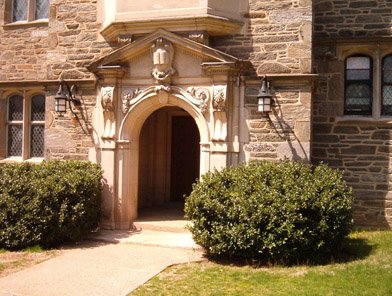
I happened by the entrance to the Quita Woodward wing of Thomas Hall the other day and found something interesting. Here's the entrance:


And here's the inscription above:


It looks like a much newer inscription to me (up close it looks as though the whole center section above the arch of the doorway is done in concrete newer than the rest -- if so, what might have been replaced?).

I reckon I ought to hunt up that second explanation.

Horace and Tyrtaeus

The other day, I posted one of Horace's Odes, and Dennis posted some Tyrtaeus of which he said my post had reminded him. While reading an article by Mario Citroni called 'Quintilian and the System of Poetic Genres' (from Flavian Poetry [Brill 2006], pp. 1-19), I came across a reference to Tyrtaeus and Horace's Ars Poetica in the context of a discussion regarding Quintilian's sources for his poetic canon. Here is Citroni:

'The other Greek poets mentioned by Quintilian, but not by Dionysius, are the epic poet Pisander, the authors of ancient comedy, and Tyrtaeus. As regards ancient comedy, Quintilian maintains the triad of Aristophanes, Eupolis and Cratinus, consecrated by Horace. As for Tyrtaeus, Quintilian quotes a verse from Horace's Ars Poetica as confirmation of his excellence. And it is certain that he was led by Horace, and not by a Greek source, to include Tyrtaeus in his survey, seeing that he does not place him among the elegiac poets, but among the epic writers, because, as he himself says, Horace had placed him beside Homer.' (p.8)

And here are Horace's words (Ars Poetica 400-7):
Sic honor et nomen diuinis uatibus atque 400
carminibus uenit. Post hos insignis Homerus
Tyrtaeusque mares animos in Martia bella
uersibus exacuit, dictae per carmina sortes,
et uitae monstrata uia est et gratia regum
Pieriis temptata modis ludusque repertus 405
et longorum operum finis: ne forte pudori
sit tibi Musa lyrae sollers et cantor Apollo.

Favorite Google Search Directing Someone to the Campus Today?

'i'm look the Angola basketball'.

Tuesday, April 11, 2006

A Post for Mr. Coke

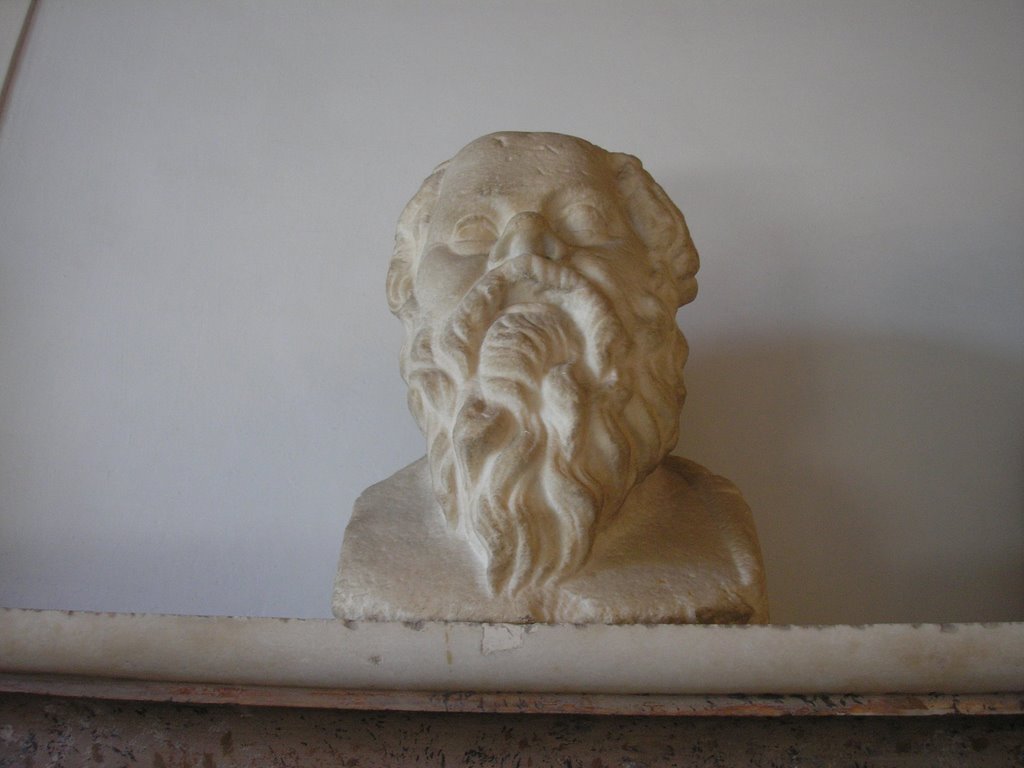
Our largely reticent co-blogger mentioned in the title to this post is a great enthusiast of Plato and his caprine leading man Socrates. In Symposium 215a and following, we find Alcibiades comparing Socrates to Marsyas:

“The way I shall take, gentlemen, in my praise of Socrates, is by similitudes. Probably he will think I do this for derision; but I choose my similitude for the sake of truth, not of ridicule. For I say [215b] he is likest to the Silenus-figures that sit in the statuaries' shops; those, I mean, which our craftsmen make with pipes or flutes in their hands: when their two halves are pulled open, they are found to contain images of gods. And I further suggest that he resembles the satyr Marsyas. Now, as to your likeness, Socrates, to these in figure, I do not suppose even you yourself will dispute it; but I have next to tell you that you are like them in every other respect. You are a fleering fellow, eh? If you will not confess it, I have witnesses at hand. Are you not a piper? [215c] Why, yes, and a far more marvellous one than the satyr. His lips indeed had power to entrance mankind by means of instruments; a thing still possible today for anyone who can pipe his tunes: for the music of Olympus' flute belonged, I may tell you, to Marsyas his teacher. So that if anyone, whether a fine flute-player or paltry flute-girl, can but flute his tunes, they have no equal for exciting a ravishment, and will indicate by the divinity that is in them who are apt recipients of the deities and their sanctifications. You differ from him in one point only--that you produce the same effect with simple prose unaided by instruments. For example, when we hear any other person--[215d] quite an excellent orator, perhaps--pronouncing one of the usual discourses, no one, I venture to say, cares a jot; but so soon as we hear you, or your discourses in the mouth of another,--though such person be ever so poor a speaker, and whether the hearer be a woman or a man or a youngster--we are all astounded and entranced. As for myself, gentlemen, were it not that I might appear to be absolutely tipsy, I would have affirmed on oath all the strange effects I personally have felt from his words, and still feel even now. For when I hear him [215e] I am worse than any wild fanatic; I find my heart leaping and my tears gushing forth at the sound of his speech, and I see great numbers of other people having the same experience. When I listened to Pericles and other skilled orators I thought them eloquent, but I never felt anything like this; my spirit was not left in a tumult and had not to complain of my being in the condition of a common slave: whereas the influence of our Marsyas here has often thrown me into such a state [216a] that I thought my life not worth living on these terms. In all this, Socrates, there is nothing that you can call untrue. Even now I am still conscious that if I consented to lend him my ear, I could not resist him, but would have the same feeling again. For he compels me to admit that, sorely deficient as I am, I neglect myself while I attend to the affairs of Athens. So I withhold my ears perforce as from the Sirens, and make off as fast as I can, for fear I should go on sitting beside him till old age was upon me."

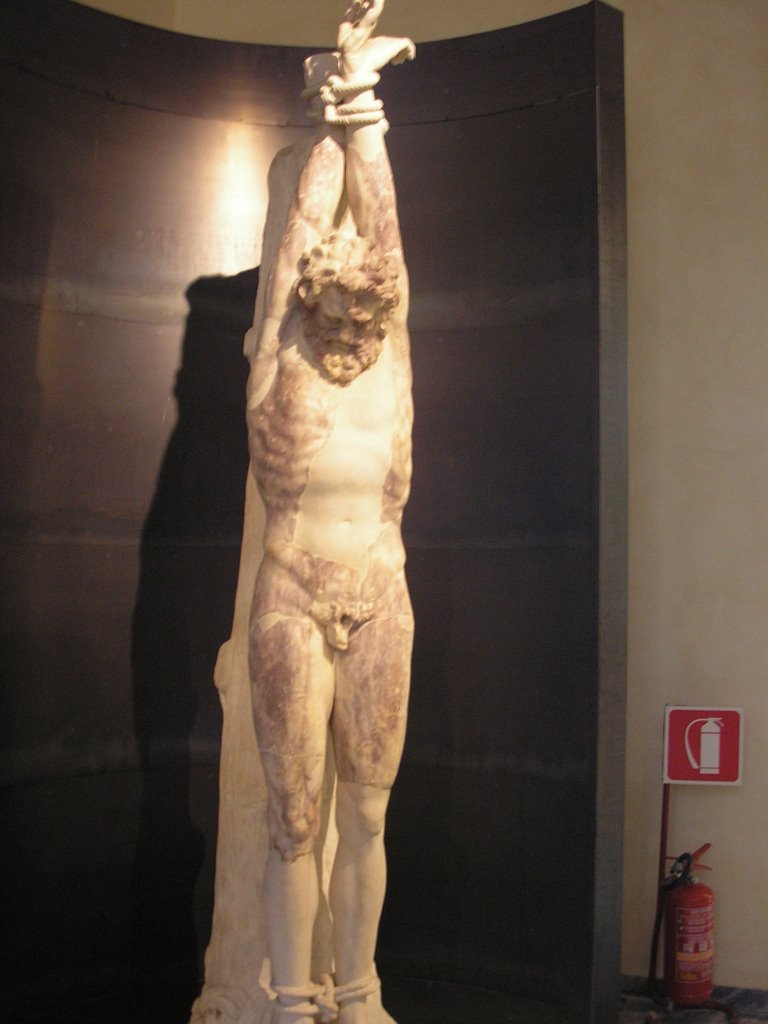
While at the Capitoline the other day, I got pictures of a sculpture of the flaying of Maryas and another of Socrates' head. Take a look at them and compare (sorry, I know the face of Marsyas is difficult to see at that angle). Is Alcibiades right? Does Socrates look like a satyr? Or is he telling a fib?

'So What Brings You to the Campus?'

Two recent (and blunt) answers to that question are, via Google search pages:

'cambridge latin course unit four cheat sheets' (triggered by remarks on the 'Cambridge Greek and Latin Classics Series' and the 'Grad School Cheat Sheet')

and
'catullus dirty poems' (triggered by Dennis' remarks on Catullus 50).

Monday, April 10, 2006

Constantinian Colossi

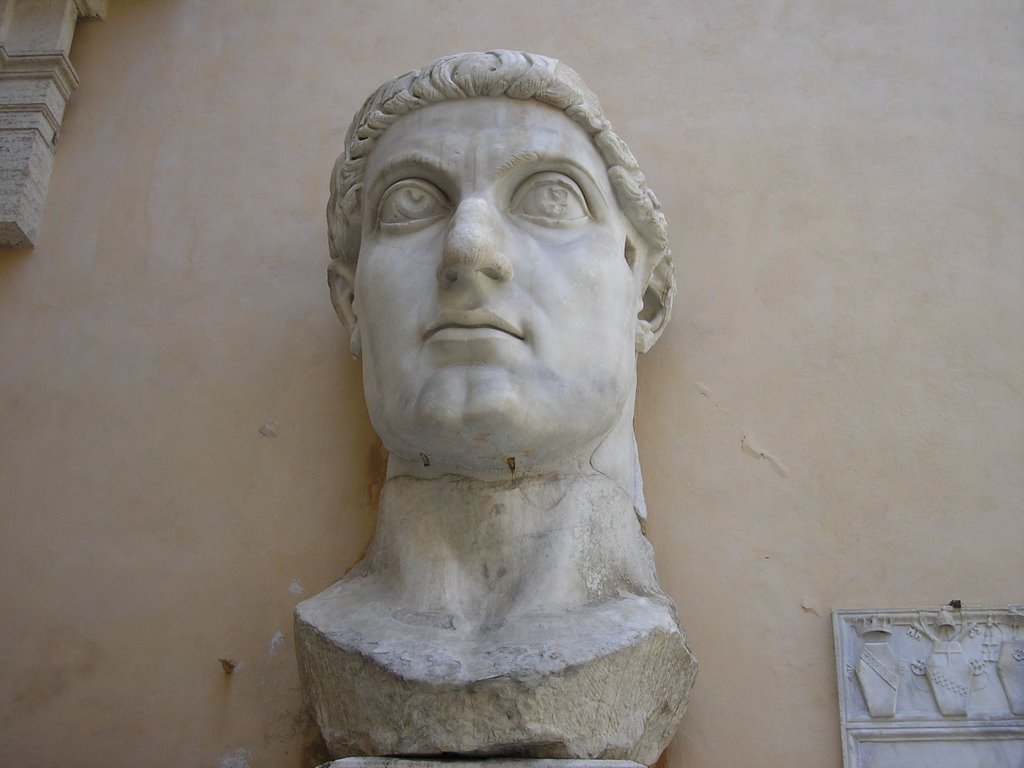
Last week was 'culture week' in Italy, so a lot of museums and sites were free. I tried to take advantage and save some euros and grabbed a bunch of photos along the way, and thought I'd post some that ancient enthusiasts might enjoy. Since Dennis remarked on the apparent popularity of Constantine, I decided to post a couple colossals of the big C from the Capitoline Museums. First, the head from the giant statue originally in the apse of the Basilica Nova:

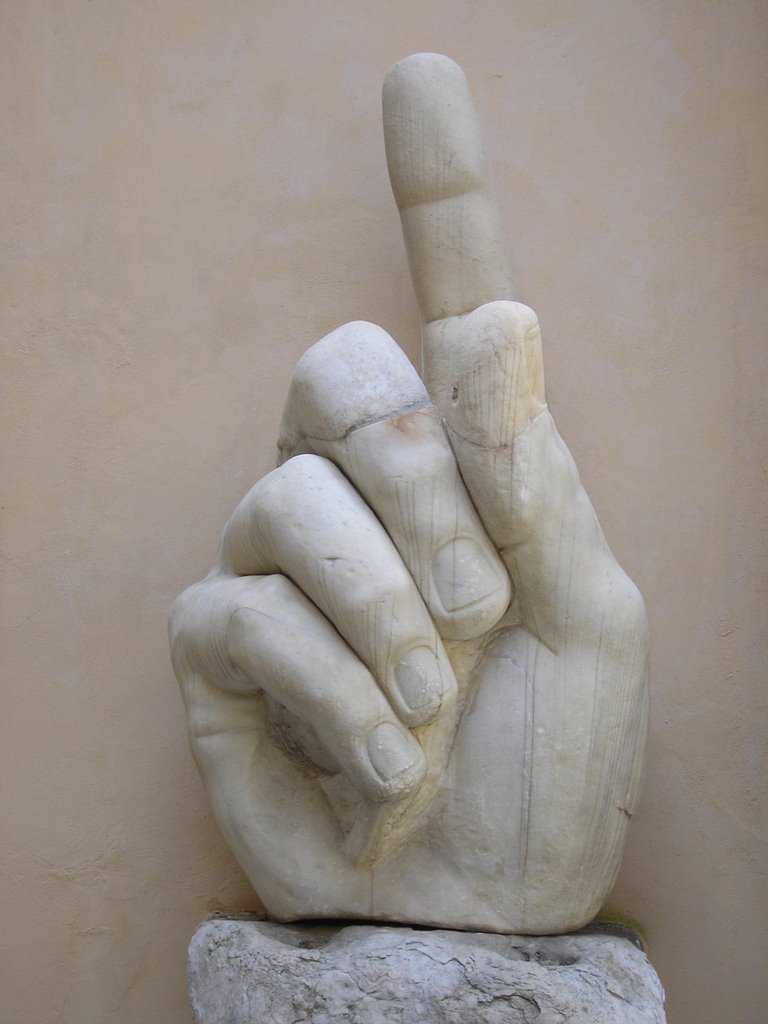
Next, possibly my favorite piece of ancient sculpture: the 'We're Number 1!' hand from the same statue.

Finally, an incredible bronze head, hand, and globe of Constantine. My museum guide says the following about it: 'Beginning in the mediaeval period, the precious remains of the sculpture depicting the first Christian emperor--the head, hand, and globe--were part of the patrimony of the patriarch's Lateran residence. In 1471, they went to the Capitoline Hill, as part of Sixtus IV's donation to the People of Rome. The large head, a masterpiece of antique bronze statuary, impressive both in the colossal scale and the intensity of the features, has been associated with portraits of Constantine during the last period of his life. The hand, intended to hold up a globe, symbol of the power over the world, is securely attributable to the statue.'

Boeckh's Use of the Term 'Encylopaedia'

'Boeckh's use of the term "encyclopaedia" also requires a gloss. He would have the student learn by careful study one or preferably several areas of learning before he is introduced to the survey of learning. He would, for example, introduce one to literature through intensive study of an author's work until he has attained to thorough knowledge of that body of writing. Only after repeated experiences of such a sort would he expose the student to the survey. Careful study in several fields provides a number of points from which the entire circle may be constructed. He who starts from a survey of the whole, which can be presented only in outlines, stands at the mercy of the surveyor and cannot attain to exact knowledge for himself. And yet the student cannot rest in minute knowledge of the several areas he has mastered. Such a one becomes arrogantly biased in his knowledge; and since no part of study is an island, study of single areas remains incomplete without their being fitted into the total ciruict of knowledge. By "encyclopaedia," Boeckh means the comprehensive view of all that is known. Obviously we have here another idea unattainable since probably the time of Dante. Boeckh envisages a scholar well acquainted with several areas whose experience in them enables him to fill out the less nearly complete areas presented in the encyclopaedic survey. He can thus contemplate competently the whole circle of knowledge much more inclusively than if he had not looked at the whole with a mind trained by previous intensive study.

'Methodology is not in Boeckh's view an actual part of philology itself, but is consideration of the means and tools for philological study. Its value for philology lies largely in the fact that it enables the instructed scholar to enter with equal detail as far as he may need to go into whatever area of knowledge the encyclopaedic study has presented to him.'

--John Paul Pritchard, from the preface to his abridged translation of August Boeckh's Encyclopaedie und Methodologie der philologischen Wissenschaften. The title of the translation is On Interpretation and Criticism (University of Oklahoma Press, 1968)

Back on Track (?)

Apologies for my lack of posts 'round here lately. I hope to start getting a few things up of perhaps at least marginal interest.

I thought Merriam-Webster's word-of-the-day for yesterday was intriguing. Here it is:

catchpole \KATCH-poal\ noun

: a sheriff's deputy; especially : one who makes arrests for failure to pay a debt

Example sentence:
David knew that it must be the catchpole knocking at his door, so he quickly threw on his shoes and coat and snuck out the back.

Did you know?
Imagine chasing a chicken around the barnyard. Catching it would be no mean feat. And chasing down someone who owes you money is pretty challenging too. It's no surprise then that these two taxing tasks come together in "catchpole," which derives from a word that literally means "chicken chaser" — Anglo-French "cachepole." Before it referred to the debt police, "catchpole" was used more generally for any tax collector. That's the sense demonstrated in a 12th-century homily about the apostle Matthew: "Matheus thet wes cachepol thene he iwende to god-spellere" ("Matthew who was a catchpole until he turned into a writer of the Gospel").

*Indicates the sense illustrated in the example sentence.

Friday, April 07, 2006

On Philology and Philosophy

'Philology and philosophy are treated as reciprocal. They exist on equal footing, and neither functions satisfactorily without the other. Their methods, as Boeckh views them, are opposite; philology attains to knowledge through induction, whereas philosophy starts from a concept. To formulate his concepts soundly, the philosopher needs an adequate fund of knowledge or data; too many philosophers, Boeckh charges, lack a basis in knowledge or tradition. The insights or intuitions of the well-based philosopher are more trustworthy than are those of the man not thus firmly based. On the other hand, the philologist who attempts to work without some order concept in his view gathers a mere aggregate of facts, cannot digest his data into a system. Philosophy is, as the etymology of the word indicates, the love of wisdom; philology, seeking Newman's "twofold logos," is the love of expression in words and of what that expression conveys. The followers of each strive after an unattainable idea. Boeckh would undoubtedly be exceedingly wary of the tendency apparent in some recent literary interpreters to treat philology as almost subservient to philosophy. In the study of literature, philology must be master and philosophy the servant.'

--John Paul Pritchard, from the preface to his abridged translation of August Boeckh's Encyclopaedie und Methodologie der philologischen Wissenschaften. The title of the translation is On Interpretation and Criticism (University of Oklahoma Press, 1968)

Thursday, April 06, 2006

Modern Hieroglyphics

Or should that be beeroglyphics?

Maybe this is the wrong place for this, but I'm stumped. Lionshead beer, a cheap but eminently drinkable Pennsylvania pilsner, has puzzles under the bottle cap. Maybe I'm just dense, but I can't solve this one:


I'm hoping that some of our vast and learned readership can help restore this bit of lost knowledge, exercising some of the skills they've acquired in the pursuit of Altertumswissenschaft.

UPDATE: I think the good professor solved the problem (see comment below): Count to 10.

And while I'm grateful, I feel a little like Ralphie in A Christmas Story, whose high hopes were dashed by the crass commercialism of the secret message he'd deciphered with the aid of his long-awaited and hard won Little Orphan Annie decoder ring: "Drink more Ovaltine."

Here the commercialism has been replaced by banality.

No, this will not do. We shall adopt the lectio difficilior, viz. bull ain't whistlin', evidently a colloquialism whose precise meaning is unrecoverable.

That's more like it.

Wednesday, April 05, 2006

Uncle Sam wants a piece of Nicander

I'm always interested to know how people find the campus, so I check the site meter pretty regularly. Our (mostly) silent partner, Magister Coke, brings in a lot of his students, but the big one has got to be Constantine's Vision.

Must be a hot topic these days.

I'm most puzzled, however, by this: it seems the IRS is auditing some very old books.

Someone found the Campus by googling Nicander's Alexipharmaca.

This isn't the first time someone's found us by searching for this most misunderstood and disliked Hellenistic poet. I should do him the honor of posting something more substantial than the post everyone stumbles upon.

In the meantime, go easy on the lad. His books don't sell well, and I doubt he's holding out on the feds.

Then again, maybe the IRS is concerned with incurring the wrath of those whom they audit. Antidotes might come in handy.

Monday, April 03, 2006

Stand your ground and bite your lip

I've never been much of a Latinist -- don't get me wrong. It's just that Greek poetry has always interested me more, even when it seems so straight forward and, by modern standards, jingoistic. Consequently I haven't read much Horace beyond the Sermones. I'm familiar with the famous 'dulce et decorum est,' but Eric's post which referred to it reminded of Tyrtaeus (7th c. BC). I would imagine that everyone who's written on either poem has noted the connection, but I thought it'd be nice to post the text for comparison:

τεθνάμεναι γὰρ καλὸν ἐνὶ προμάχοισι πεσόντα
ἄνδρ’ ἀγαθὸν περὶ ἧι πατρίδι μαρνάμενον·
τὴν δ’ αὐτοῦ προλιπόντα πόλιν καὶ πίονας ἀγροὺς
πτωχεύειν πάντων ἔστ’ ἀνιηρότατον,
πλαζόμενον σὺν μητρὶ φίληι καὶ πατρὶ γέροντι (5)
παισί τε σὺν μικροῖς κουριδίηι τ’ ἀλόχωι.
ἐχθρὸς μὲν γὰρ τοῖσι μετέσσεται οὕς κεν ἵκηται,
χρησμοσύνηι τ’ εἴκων καὶ στυγερῆι πενίηι,
αἰσχύνει τε γένος, κατὰ δ’ ἀγλαὸν εἶδος ἐλέγχει,
πᾶσα δ’ ἀτιμίη καὶ κακότης ἕπεται. (10)
†εἶθ’ οὕτως ἀνδρός τοι ἀλωμένου οὐδεμί’ ὤρη
γίνεται οὔτ’ αἰδὼς οὔτ’ ὀπίσω γένεος.
θυμῶι γῆς πέρι τῆσδε μαχώμεθα καὶ περὶ παίδων
θνήσκωμεν ψυχ<4έω>4ν μηκέτι φειδόμενοι.
ὦ νέοι, ἀλλὰ μάχεσθε παρ’ ἀλλήλοισι μένοντες, (15)
μηδὲ φυγῆς αἰσχρῆς ἄρχετε μηδὲ φόβου,
ἀλλὰ μέγαν ποιεῖτε καὶ ἄλκιμον ἐν φρεσὶ θυμόν,
μηδὲ φιλοψυχεῖτ’ ἀνδράσι μαρνάμενοι·
τοὺς δὲ παλαιοτέρους, ὧν οὐκέτι γούνατ’ ἐλαφρά,
μὴ καταλείποντες φεύγετε, τοὺς γεραιούς. (20)
αἰσχρὸν γὰρ δὴ τοῦτο, μετὰ προμάχοισι πεσόντα
κεῖσθαι πρόσθε νέων ἄνδρα παλαιότερον,
ἤδη λευκὸν ἔχοντα κάρη πολιόν τε γένειον,
θυμὸν ἀποπνείοντ’ ἄλκιμον ἐν κονίηι,
αἱματόεντ’ αἰδοῖα φίλαις ἐν χερσὶν ἔχοντα— (25)
αἰσχρὰ τά γ’ ὀφθαλμοῖς καὶ νεμεσητὸν ἰδεῖν,
καὶ χρόα γυμνωθέντα· νέοισι δὲ πάντ’ ἐπέοικεν,
ὄφρ’ ἐρατῆς ἥβης ἀγλαὸν ἄνθος ἔχηι,
ἀνδράσι μὲν θηητὸς ἰδεῖν, ἐρατὸς δὲ γυναιξὶ
ζωὸς ἐών, καλὸς δ’ ἐν προμάχοισι πεσών. (30)
ἀλλά τις εὖ διαβὰς μενέτω ποσὶν ἀμφοτέροισι
στηριχθεὶς ἐπὶ γῆς, χεῖλος ὀδοῦσι δακών.


Text: fr. 10 from M.L. West. Iambi et elegi Graeci, Oxford.